
Executive Overview
Deep in the hyper-arid coastal desert of Peru, far predating the grand expansion of the Inca Empire, a sophisticated society of the Wari civilization lived, breathed, and shared their spaces with a remarkably distinctive companion: the Peruvian hairless dog.
A groundbreaking study recently published in the Journal of Anthropological Archaeology has brought this deep-time relationship into sharp focus. Researchers working at Castillo de Huarmey—the only known Wari administrative and burial center on Peru’s northern coast—have uncovered the first physical evidence of Peruvian hairless dogs at the site. The findings include naturally mummified remains, rare skeletal anomalies, and chemical signatures embedded in teeth and bone that chronicle what these dogs ate, how they lived, and where they stood in the complex social hierarchies of a pre-Columbian empire.
Among the discoveries is a complete, naturally preserved male dog mummy dating back at least 1,200 years, making it the oldest radiocarbon-dated biological specimen recovered from the Castillo de Huarmey complex to date. Coupled with chemical analyses of bone and tooth collagen, this cache of archaeological data is upending long-held assumptions about how ancient Andean societies interacted with animals. Far from being uniform working beasts or mere scavengers, these hairless dogs occupied a nuanced, deeply stratified spectrum of roles—ranging from elite companions buried alongside master artisans to discarded trash or specialized offerings.
This comprehensive investigation, led by an international team of researchers from Dartmouth College and the University of Warsaw, offers a rare window into the multifaceted bonds tying humans and canines together over a millennium ago.
Detailed Chronology of the Castillo de Huarmey Excavations
To understand the weight of this canine discovery, one must trace the timeline of archaeological exploration at Castillo de Huarmey, a sprawling 110-acre complex located approximately 190 miles north of modern-day Lima.
Occupied between roughly 600 and 1050 CE, Castillo de Huarmey served as a vital administrative, religious, and burial hub for the Wari Empire, which flourished centuries before the rise of the Incas. However, the site’s timeline is marked by both extraordinary preservation and catastrophic destruction:
- 600–1050 CE: The Wari Empire actively occupies and utilizes Castillo de Huarmey, burying elite members of society, artisans, and sacrificial guardians alongside rich hoards of metallurgy, textiles, and ceramic artifacts.
- 1970 CE: A massive earthquake strikes Peru, causing structural collapses within parts of the Castillo de Huarmey complex. The seismic event inadvertently exposes internal burial chambers, rendering them vulnerable to extensive, unauthorized looting that damages upper archaeological strata.
- 2010–2025 CE: Systematic excavations spearheaded by international teams unearth extensive material culture, including South American camelids (llamas and alpacas), elite tombs, and scattered animal remains.
- 2012: Archaeologists uncover the first undisturbed elite Wari tomb at the site. The chamber yields the remains of 58 high-status noblewomen, six human sacrifices, and roughly 1,300 luxurious artifacts crafted from gold, silver, bronze, wood, and textiles.
- 2022: A subsequent discovery reveals the burials of elite craftspeople accompanied by specialized tools of gold, silver, and bronze, shedding light on the sophisticated industrial and artistic economy of the Wari state.
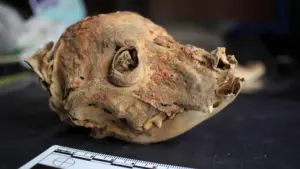
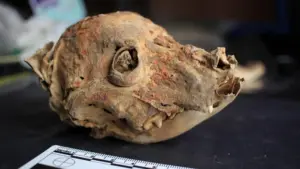
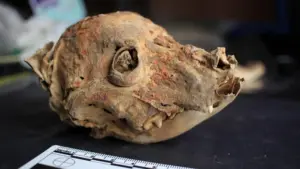
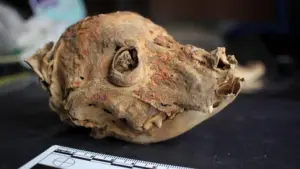
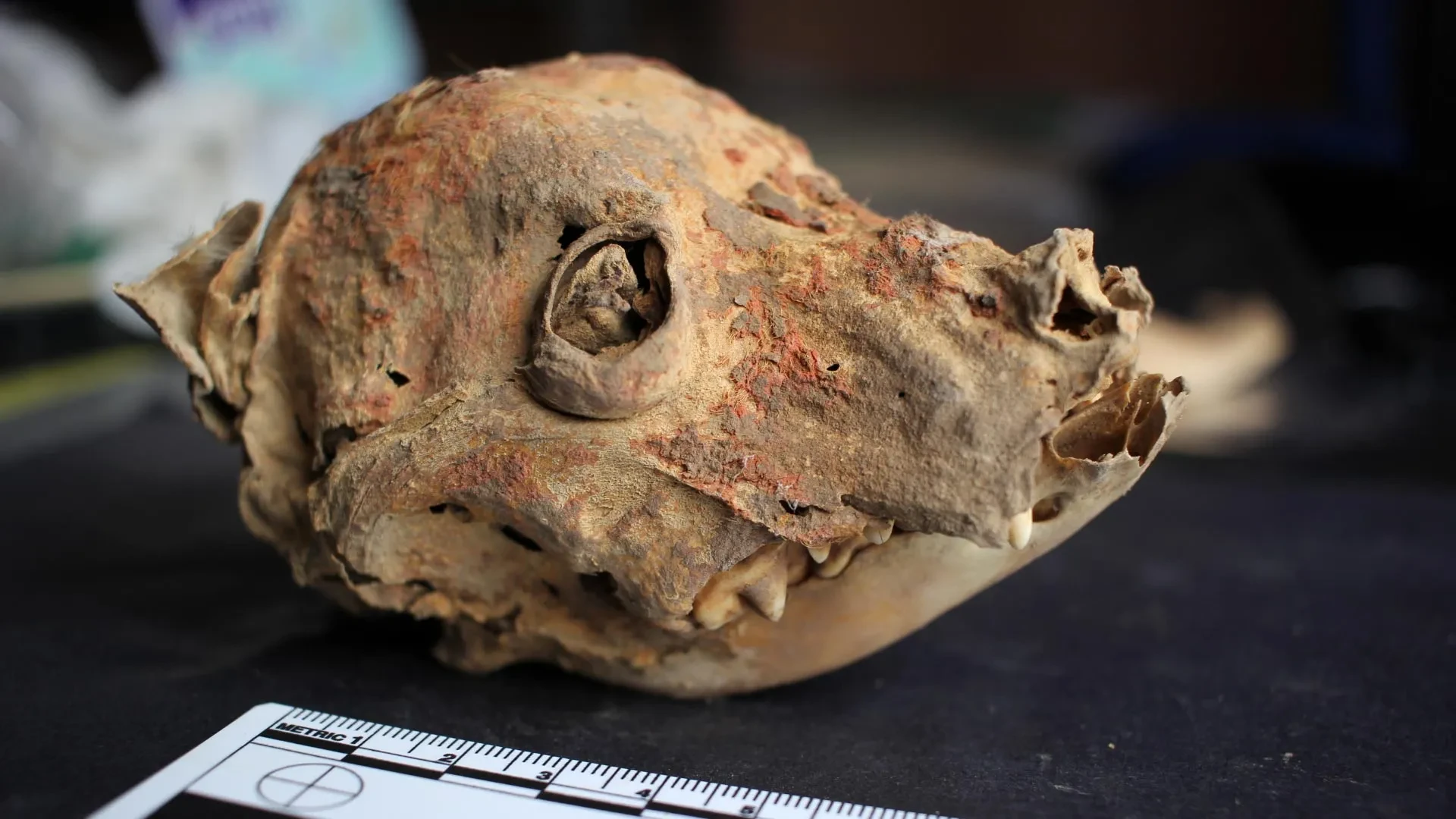
- Recent Years: Analysis of upper ceremonial layers and northern residential zones yields 341 dog bone specimens representing at least 19 individual canines. Among these are a naturally mummified skull stained with bright red cinnabar pigment, a male dog mummy missing its first premolars, and puppy remains interred directly beside high-status humans.
Supporting Context & Metrics: Unlocking the Genetics and Diets of Ancient Canines
The identification of these remains as Peruvian hairless dogs—a breed recognized today by the American Kennel Club as the Peruvian Inca Orchid and enshrined as an official part of Peru’s national cultural heritage in 2000—hinged on a clever biological sleuth hunt.
The Genetic Signature of Hairlessness
When the research team first unearthed the complete mummified male dog, its pristine preservation in the desert sand initially led some to suspect a much more recent burial, perhaps dating to the era of modern looting. However, biological anthropologist Weronika Tomczyk noticed two distinct morphological anomalies: the animal lacked fur entirely, and it was missing its first premolars.
In the biological world, these traits are intimately linked. The genetic mutation responsible for hairlessness in dogs is pleiotropic, meaning it simultaneously triggers a reduction in dentition—specifically the absence of first premolars and occasionally last molars. This biological marker confirmed that the remains were not modern interlopers or standard mutts, but true ancient Peruvian hairless dogs whose lineage stretches back well over a thousand years.
Isotopic Insights: Reconstructing Canine Diets
To look past the bones and into the lived experiences of these animals, the research team employed zooarchaeological analysis and multi-element isotopic testing. By examining isotopes of carbon, nitrogen, oxygen, and strontium preserved in tooth enamel and bone collagen, scientists reconstructed the diets and geographic origins of the Castillo de Huarmey canines.
- Childhood vs. Adulthood: Because dog teeth erupt rapidly, isotopic signatures extracted from teeth reflect the diet of a dog during its puppyhood. Bone collagen, by contrast, records the chemical inputs of roughly the last year of the animal’s life.
- The Maize Connection: Isotopic data revealed that most of the dogs consumed significant amounts of maize (corn), the staple agricultural crop of the pre-Hispanic Andes. Their diets closely mirrored those of the human population inhabiting the complex.
- The Hairless Puppy Phenomenon: A striking dietary pattern emerged among the hairless dogs specifically. As puppies, their isotopic signatures closely mirrored those of human children, suggesting they may have been fed specialized diets, table scraps, or controlled portions. As they matured into adulthood, their diets diversified, reflecting a shift in how they were managed or where they foraged.
Quantitative Overview of the Canine Assemblage
- Total Specimen Count: 341 individual dog bone fragments recovered.
- Minimum Number of Individuals (MNI): At least 19 distinct dogs identified across the excavation zones.
- Chronological Milestone: A radiocarbon-dated age of 1,200+ years for the primary male mummy, establishing it as the oldest verified biological canine specimen at Castillo de Huarmey.
- Burial Contexts: Ranging from a 6-to-8-week-old puppy buried next to an elite craftsperson (the "Master Basketmaker") to palace-floor burials and individuals interred alongside human sacrifice victims.
Official Perspectives and Expert Statements
The paradox of human-animal relationships in antiquity forms the core thesis of the research published in the Journal of Anthropological Archaeology. While modern pet owners often project sentimental, monolithic affection onto historical animals, the archaeological record paints a much messier, highly stratified picture.
"Our findings indicate that humans and dogs coexisted at this Wari site, but reconstructing their bond is challenging, as past emotions are difficult to capture through archaeological methods," explains lead author Weronika Tomczyk, a research associate in Dartmouth’s Department of Anthropology and a postdoctoral fellow in its Ecology, Evolution, Environment and Society Program.
Tomczyk emphasizes that the social standing of a dog in the ancient Andes was far from uniform, varying wildly from household to household or sector to sector within the same urban complex:
"The goal of our study was to not only present data on Castillo de Huarmey’s dog burials, but also emphasize that people in the past had often contradictory relationships with the animals, just as they do today: a pet for one group of people could at the same time be considered a pest by their closest neighbors."
Commenting on the unique dietary patterns observed in the hairless puppies—which hint at deliberate rearing or feeding practices—Tomczyk notes:
"We do not know if the dogs were intentionally fed maize or if perhaps, they were just eating leftovers or trash. Yet, the distinct dietary patterns of hairless puppies provide insights into what may have been organized breeding."
Concluding on the impossibility of projecting modern domestic sentiment onto ancient cultures, Tomczyk adds:
"While we will never know if any of the three dogs were pets or how people treated them, it is evident they received different treatment than other dogs."
The collaborative study brings together a multidisciplinary roster of scholars, including co-authors Miłosz Giersz, Wiesław Więckowski, and Roberto Pimentel Nita of the University of Warsaw, alongside Claire Ebert of the University of Pittsburgh. Together, their combined expertise in South American archaeology, zooarchaeology, and isotopic chemistry has transformed scattered desert bones into a rich narrative of ancient coexistence.
Future Outlook: Unveiling the Wider Andean Biocultural Network
The discovery of 1,200-year-old Peruvian hairless dog mummies at Castillo de Huarmey opens exciting new avenues for Andean archaeology and evolutionary biology. As researchers continue to process the vast array of materials recovered from the northern ceremonial sectors and elite burial chambers, several key areas of future investigation take shape:
- Expanded Ancient DNA (aDNA) Profiling: While morphological traits and dental anomalies strongly indicate the presence of Peruvian hairless dogs, future extraction of mitochondrial and nuclear DNA from the mummified tissues will allow geneticists to map the ancestral lineage of these dogs with microscopic precision, tracking genetic bottlenecks and population continuity down to the arrival of the Incas and Europeans.
- High-Resolution Isotopic Mapping: By broadening strontium and oxygen isotope baselines across the coastal valleys and highland territories controlled by the Wari Empire, researchers hope to determine whether these hairless dogs were bred locally at Castillo de Huarmey or transported across vast geographic distances as prized diplomatic gifts or economic commodities.
- Comparative Inter-Site Analysis: Archaeologists are eager to compare the Castillo de Huarmey canine assemblage with dog remains recovered from other Wari administrative centers, such as Huari (near modern-day Ayacucho) and Pikillacta. Such comparisons will reveal whether the specialized treatment of hairless dogs was a standardized imperial practice or a localized coastal tradition.
Ultimately, the sun-baked sands of Peru continue to yield astonishing secrets. By peering past the looted upper layers of Castillo de Huarmey and uncovering the preserved biological heritage of the Wari Empire, scientists are restoring a lost voice to history—proving that the deep bond between humans and their hairless canine companions has been a defining feature of Andean life for well over a millennium.