
Executive Overview
For pet owners, few realizations strike as much immediate dread as spotting a flea or tick crawling across an animal’s coat—or worse, finding one embedded in human skin. Beyond the immediate discomfort of itchy bites, these bloodsucking parasites act as notorious vectors for a frightening array of zoonotic diseases, posing health risks to both four-legged companions and their human families. Once a home infestation takes root, eradicating it requires an exhausting, multi-week campaign of rigorous cleaning, washing, and treating.
Because parasites remain a persistent threat, preventative veterinary care is non-negotiable. Administering flea, tick, and internal parasite treatments is an ongoing, lifelong commitment that requires consistency, financial investment, and vigilance. To help navigate the crowded market of pet medications, pet lifestyle experts and veterinary researchers evaluated 21 leading products, narrowing the field down to eight top-tier recommendations: four specifically formulated for dogs and four tailored to cats.
While no single treatment serves as a universal panacea, understanding the differences between oral chews, systemic topicals, and long-lasting collars can significantly simplify the selection process. Note: Always consult a licensed veterinarian before introducing any new medication or preventative regimen to your pet.

Detailed Chronology & Evolution of Parasite Control
The landscape of veterinary parasite control has undergone a dramatic transformation over the past three decades. Historically, pet owners relied on messy powders, hazardous indoor foggers, and outdoor chemical sprays—methods that often proved toxic, labor-intensive, and only marginally effective at breaking the flea life cycle.
The 1990s: The Topical Revolution
The paradigm shifted in the mid-1990s with the introduction of surface-active spot-on treatments containing insecticides like fipronil (popularized by brands like Frontline) and imidacloprid. These over-the-counter topicals revolutionized pest management by staying on the surface of the skin and hair coat, disrupting the flea life cycle and largely eliminating the need for hazardous indoor bug bombs. However, these surface treatments had a major limitation: they remained on the exterior, offering little to no systemic protection against fast-moving ticks or internal worms.
2014 to Present: The Era of Isoxazolines
A monumental leap forward occurred in 2014 with the introduction of a class of drugs known as isoxazolines. These systemic medications—delivered either as oral chews or advanced topicals absorbed directly into the bloodstream—marked a new golden age for pet safety and longevity. Isoxazolines provide long-lasting efficacy, capable of wiping out heavy tick burdens and eliminating home flea infestations within four to eight weeks.

Today, modern veterinary medicine emphasizes comprehensive multi-spectrum coverage. Parasitologists now stress that flea control alone is no longer sufficient; rising temperatures and expanding wildlife corridors mean that pets require robust, year-round defense against both fleas and a widening array of tick species.
Supporting Context & Metrics: Understanding the Risks
Parasite control is not merely a warm-weather seasonal chore. According to leading veterinary entomologists and parasitologists, abandoning preventative care during the autumn and winter months leaves pets dangerously exposed.
Year-Round Threats
- Ticks: Ticks can emerge whenever ambient temperatures hit 40 degrees Fahrenheit and above. However, in regions experiencing milder winters without prolonged deep freezes, ticks remain active year-round.
- Fleas: Indoor heating combined with short windows of winter humidity creates ideal microclimates for indoor flea outbreaks. As entomologist Michael Rust points out, letting your guard down during colder months is an invitation for a household infestation.
- Internal Parasites: Beyond external pests, pets face internal threats. Mosquitoes transmit fatal heartworms, while environmental contact with microscopic traces of animal feces can expose dogs and cats to debilitating intestinal worms like hookworms and roundworms.
Geographic Spread of Ticks
The Companion Animal Parasite Council (CAPC) and the Centers for Disease Control and Prevention (CDC) track the alarming geographic expansion of tick species across the United States. For instance, the Gulf Coast tick—once geographically localized—is steadily expanding its range up the East Coast and deep into the Midwest. Similarly, the Asian longhorned tick has established a prominent presence in numerous states. Because the U.S. is home to roughly 80 different tick species (with about half a dozen posing severe health risks), generalized protection is rarely enough; treatments must be chosen with local parasite pressures in mind.

Official Statements and Veterinary Insights
To establish an authoritative framework for pet care, leading veterinary experts emphasize the necessity of continuous, uninterrupted protection coupled with professional guidance.
- Dr. Aly Cohen (Cornell University’s Riney Canine Health Center): "To think of them as a seasonal concern is likely setting yourself or your pets up for exposure… No matter what you use, there’s a chance for breakthrough." Dr. Cohen underscores that routine, manual tick checks remain essential even when using the most advanced preventative medications.
- Dr. Susan Little (Oklahoma State University, Parasitologist): "The key thing with parasite control is it’s got to be there all the time. It’s got to be constantly on board. You can’t let your guard down." Dr. Little notes that while isoxazolines serve as an exceptional baseline defense, veterinarians in high-tick-burden areas often recommend layering treatments—such as adding a repellent collar—during peak seasons.
- Dr. Tierra Price (Emergency Veterinarian & BlackDVM Network Founder): Addressing minor adverse reactions, Dr. Price notes, "I do see topical site reactions, and it’s not common, but some animals just have more sensitive skin than others." She advises pet owners not to panic over minor skin irritation, but to monitor their pets closely and consult a professional if symptoms persist.
The Recommendations: Top Flea and Tick Treatments
Treatments for Dogs
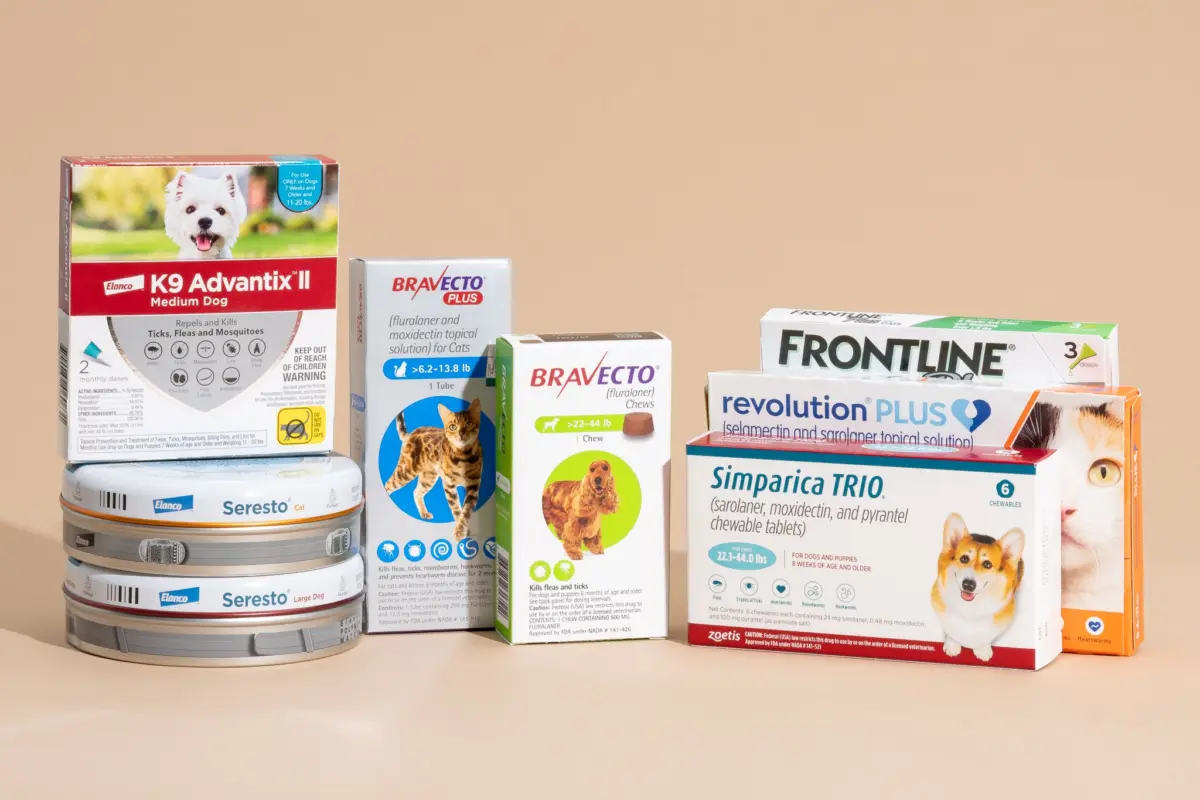
1. Top Pick: Simparica Trio Chewable Tablets for Dogs
- Type: Monthly oral chew (Prescription-only)
- Estimated Annual Cost: $390 – $450
- Coverage: Fleas, 6 tick species, heartworm prevention, hookworms, and roundworms.
- Why We Recommend It: Simparica Trio offers the broadest spectrum of protection for the lowest price point evaluated. Delivered via a single liver-flavored chewable tablet, it combines multiple active ingredients (including moxidectin and pyrantel) to eradicate external pests while preventing heartworm disease and treating intestinal worms. It is safe for puppies eight weeks and older weighing at least 2.8 pounds.
2. Best for Long-Lasting Coverage: Bravecto Chew for Dogs
- Type: 12-week oral chew (Prescription-only)
- Estimated Annual Cost: $345 – $370
- Coverage: Fleas and 5 tick species.
- Why We Recommend It: For owners who struggle with monthly medication schedules, Bravecto is a game-changer. A single chew provides robust protection against fleas and most ticks for a full 12 weeks. Note: It does not prevent heartworm or internal worms, meaning it must be paired with a separate internal parasite preventative.
3. Budget Pick (Repellent): Seresto Flea and Tick Collar for Dogs
- Type: 8-month collar (Over-the-counter)
- Estimated Annual Cost: $90
- Coverage: Fleas and ticks (kills and repels).
- Why We Recommend It: Unlike oral treatments that require a parasite to bite the animal before dying, the Seresto collar repels and neutralizes fleas and ticks on contact. This preventative action is vital for blocking rapid-transmitting tick-borne illnesses like ehrlichiosis and Rocky Mountain spotted fever. Lasting up to eight months, it is the most cost-effective option, though it requires a separate product for internal worm protection.
4. Budget Pick (Topical): K9 Advantix II Flea and Tick Spot Treatment
- Type: Monthly topical (Over-the-counter)
- Estimated Annual Cost: $160
- Coverage: Fleas, ticks, lice, biting flies, and mosquitoes.
- Why We Recommend It: Advantix II is an affordable, accessible monthly topical that repels and kills external pests without requiring a veterinary script. It fends off mosquitoes that carry heartworm and West Nile virus. Safety Warning: It contains permethrin, which is highly toxic to cats. Multi-pet households must strictly separate treated dogs from felines for 24 hours.
Treatments for Cats
1. Top Pick: Bravecto Plus Topical Solution for Cats
- Type: Bimonthly topical (Prescription-only)
- Estimated Annual Cost: $330
- Coverage: Fleas, 4 tick species, heartworm prevention, hookworms, and roundworms.
- Why We Recommend It: Administering medication to cats can be a battle. Bravecto Plus cuts the required applications down to just six times a year by offering robust, systemic protection that lasts for two full months. It absorbs into the bloodstream to tackle both external and internal parasites efficiently.
2. Runner-Up: Revolution Plus Topical Solution for Cats
- Type: Monthly topical (Prescription-only)
- Estimated Annual Cost: $290 – $340
- Coverage: Fleas, multiple tick species (including the lone star tick), heartworm prevention, hookworms, roundworms, and ear mites.
- Why We Recommend It: While it requires monthly application, Revolution Plus covers a slightly different profile of ticks (such as the lone star tick) and is the only product explicitly labeled to eliminate ear mites. It is also safe for young kittens starting at eight weeks of age.
3. Budget Pick (Collar): Seresto Flea and Tick Collar for Cats
- Type: 8-month collar (Over-the-counter)
- Estimated Annual Cost: $90
- Coverage: Fleas and ticks (kills and repels).
- Why We Recommend It: For cats that violently reject greasy liquid topicals, the Seresto collar offers stress-free, long-term defense lasting up to eight months. By repelling pests before they bite, it minimizes disease transmission risks. Like its canine counterpart, it does not treat internal worms, so dedicated heartworm prevention remains mandatory.
4. Budget Pick (Topical): Frontline Plus Flea and Tick Spot Treatment for Cats
- Type: Monthly topical (Over-the-counter)
- Estimated Annual Cost: $150
- Coverage: Fleas (adults, eggs, larvae), 4 tick species, and chewing lice.
- Why We Recommend It: Utilizing trusted fipronil, Frontline Plus breaks the flea life cycle reliably without breaking the bank. As an over-the-counter monthly option, it is ideal for owners without immediate veterinary access, though it lacks systemic protection against internal worms.
Future Outlook & Safety Regulations
Navigating regulatory oversight is crucial when purchasing pet medications. In the United States, prescription oral medications and systemic topicals that enter the bloodstream are strictly regulated by the Food and Drug Administration (FDA). Conversely, over-the-counter surface treatments and collars fall under the jurisdiction of the Environmental Protection Agency (EPA).
Critical Safety Guidelines
- Never DIY or Use Species-Substitute Drugs: Pet owners must strictly avoid using livestock or agricultural parasite control products (such as cattle pour-ons). The active ingredients and dosage concentrations are completely inappropriate for companion animals and can easily prove fatal.
- Understand Genetic Sensitivities: Certain dog breeds—such as collies—carry the MDR1 genetic mutation, making them hypersensitive to specific baseline compounds used in parasite medications. Always work with a veterinarian to screen for sensitivities.
- Beware of Counterfeits: The online marketplace is saturated with fraudulent or expired pet medications. Purchase treatments exclusively through licensed veterinarians or verified, authorized online pharmacies that guarantee product authenticity.
- Report Adverse Events: If your pet experiences unusual neurological symptoms, severe lethargy, or chemical burns from a product, report the incident immediately to the manufacturer, your veterinarian, and the regulating federal agency (FDA or EPA).
As veterinary pharmacology continues to advance, future treatments will likely offer even wider spectra of protection with extended dosing intervals. Until then, maintaining an active, informed partnership with a licensed veterinarian remains the single most effective strategy for keeping pets healthy, happy, and parasite-free.