
Executive Overview
In the modern consumer marketplace, the term "chicken" on a food package carries a legally binding promise of quality, safety, and government inspection—at least when purchased for human consumption. Under United States Department of Agriculture (USDA) regulations, chicken designated for human diets must be thoroughly inspected, passed, and explicitly labeled according to specific anatomical cuts, such as wings or breast meat. However, step into the pet food aisle, and that exact same word—"chicken"—operates under a drastically different regulatory reality.
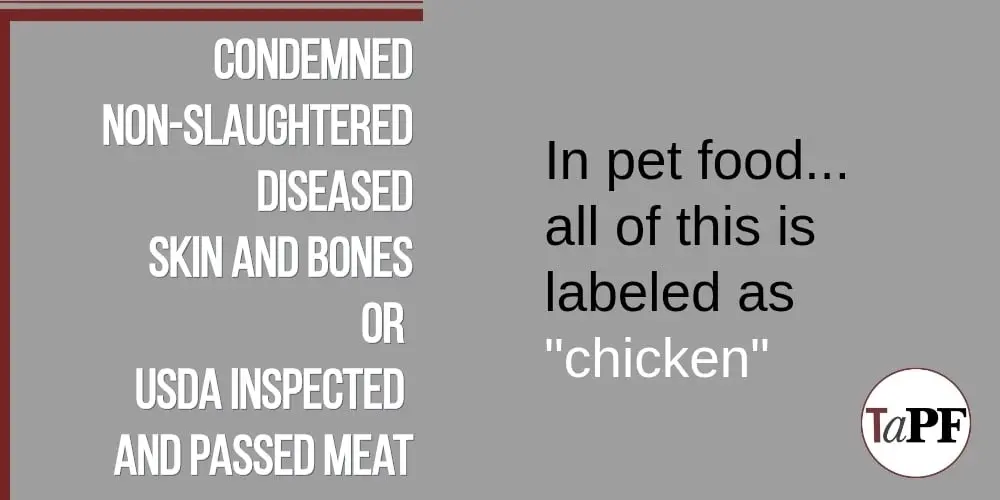
Due to a long-standing absence of legally enforceable "Standards of Identity" (SOIs) for pet food ingredients, a single term on a pet food label can legally denote anything from wholesome, USDA-inspected meat to condemned, diseased poultry carcasses, bones, skin, or animals that died from causes other than slaughter. To the consumer, all these vastly different quality grades are legally conflated under the single word "chicken."
This regulatory disparity is the outcome of decades of administrative decisions, statutory revisions, and policy rollbacks by the U.S. Food and Drug Administration (FDA). While Standards of Identity have protected human food consumers from "economically motivated adulteration" (EMA)—the intentional substitution or dilution of valuable ingredients with inferior ones—for nearly a century, animal food lacks these fundamental consumer protections. Consequently, millions of pounds of condemned meat are funneled into animal food manufacturing each quarter without public disclosure.
This investigative report details the history, statutory evolutions, statistical scope, and regulatory dynamics that permit economic adulteration to persist within the commercial pet food market.
The Regulatory Paradox: Understanding Standards of Identity and Economic Adulteration
To understand why pet food labeling remains fundamentally opaque, one must examine the legal mechanisms that govern human food labeling. The foundation of modern food labeling integrity rests on two core legal concepts enforced by federal regulatory bodies: Standards of Identity and the prevention of Economically Motivated Adulteration.
       HUMAN FOOD REGULATION vs. PET FOOD REGULATION
       _____________________________________________

   [ Human Food: USDA Inspected ]      [ Pet Food: Unstandardized ]
                 |                                  |
   +-------------+-------------+      +-------------+-------------+
   |                           |      |                           |
[Breast Meat]            [Wings Meat] [USDA Pass]   [Condemned]  [4-D Meat]
   |                           |      |               |             |
   +-------------+-------------+      +---------------+-------------+
                 |                                  |
       Explicit Cut Disclosures           Single Label Term: "Chicken"
The Role of Standards of Identity (SOIs)
First established by the FDA in 1939 under the Federal Food, Drug, and Cosmetic Act (FD&C Act), Standards of Identity were created to combat widespread food fraud and economic deception in the consumer market. According to the FDA, SOIs were enacted:
"To help address economic adulteration that was occurring in the marketplace… SOIs were developed to help protect consumers and promote honesty and fair dealing. SOIs have been established to ensure that the characteristics, ingredients and production processes of specific foods are consistent with what consumers expect."
In human food, an SOI dictates the precise minimum composition required for a product to bear a specific name. For instance, fruit preserves and jams are legally mandated to contain a precise ratio of fruit-to-sugar. Without an SOI, a manufacturer could formulate a jar consisting primarily of flavored corn syrup with negligible fruit content while selling it as "jam"—a classic form of consumer deception.
Defining Economically Motivated Adulteration (EMA)
The FDA formally defines Economically Motivated Adulteration (EMA)—commonly referred to as food fraud—as occurring when an entity intentionally leaves out, removes, or substitutes a valuable ingredient or component of a food item to reduce production costs or inflate perceived value.
In human food, labeling rendered lard or poultry waste as "muscle meat" constitutes severe economic adulteration and triggers swift federal enforcement. In pet food, however, the complete absence of SOIs creates a framework where substituting premium animal protein with diseased or condemned animal tissue does not violate standard labeling laws. As a result, feed-grade pet food manufacturers can market products containing low-grade or condemned rendered parts using identical ingredient nomenclature to premium, human-edible alternatives.
Detailed Chronology: Decades of Deregulation and Broken Promises
The legal framework surrounding pet food ingredients has evolved through key regulatory milestones, shifting legislative policies, and administrative rollbacks over the past several decades.
1939 --------> 1980 --------> 1999 --------> 2004 --------> 2007 --------> 2018
FDA creates    Compliance    FDA deletes   First Human-   Melamine    Sen. Paul
Human Food     Policy permits animal food  Grade Pet      Recall &    Amendment
SOIs           4-D meats     SOI rules     Food enters    FDAAA Sec   deletes pet
               in feed       as "unneeded" market         1002 pass   food SOIs
1939: Establishment of Human Food Standards
The FDA introduces Standards of Identity for human food to suppress consumer fraud and standardize mandatory composition guidelines across retail markets. Animal food is excluded from these initial detailed definitions, though general adulteration provisions apply.
1980: The Formal Acceptance of "4-D" Meats
The FDA issues an explicit Compliance Policy Guidance manual addressing the use of inferior animal tissues in animal feed. The agency clarifies its legal position regarding diseased animals and non-slaughtered carcasses (often referred to in the industry as "4-D" meat: Dead, Diseased, Dying, or Disabled):
"Pet food consisting of material from diseased animals or animals which have died otherwise than by slaughter, which is in violation of 402(a)(5) will not ordinarily be actionable, if it is not otherwise in violation of the law. It will be considered fit for animal consumption."
This guidance formally acknowledged that animal material deemed illegal and adulterated for human consumption under Section 402(a)(5) of the FD&C Act would be routinely tolerated in pet food manufacturing without requiring explicit disclosure on product packaging.
January 1999: Administrative Elimination of Regulatory Authority
Prior to 1999, federal procedural regulations existed to allow the FDA to establish binding Standards of Identity for animal food. However, in January 1999, the FDA officially submitted these regulations for deletion, claiming that formal rule-making procedures for animal food standards were "unnecessary."
Addressing potential public and congressional concerns regarding this regulatory rollback, the FDA asserted that if a clear necessity ever arose, the agency maintained administrative flexibility to respond:
"Should FDA ever receive a request to develop an animal food standard regulation, the agency could determine whether procedural regulations are necessary and issue such procedures through the notice and comment rulemaking process."
2004: The Emergence of "Human Grade" Pet Food
The commercial introduction of the first officially labeled "Human Grade" pet food in 2004 created a clear market distinction. To legally use the "Human Grade" designation, the FDA and state feed regulators required manufacturers to source exclusively USDA-inspected and passed ingredients, processed in full compliance with human food manufacturing standards.
This development highlighted an underlying regulatory double standard: while "Human Grade" pet foods were held to rigorous sourcing standards, traditional feed-grade pet food manufacturers remained permitted to utilize condemned or diseased meats while using identical core ingredient terms—such as "chicken"—on their package labels.
2007: The Melamine Recall Crisis and Congressional Action
In 2007, the pet food industry experienced one of the most devastating safety crises in modern history. Foreign ingredient suppliers intentionally adulterated vegetable proteins—such as wheat gluten and rice protein concentrate—with industrial chemicals, including melamine and cyanuric acid. These compounds artificially inflated nitrogen levels during analytical testing, making low-quality or diluted ingredients appear to have a significantly higher protein content.
       2007 MELAMINE CONTAMINATION MECHANISM
       ______________________________________

 [ Raw Vegetable Protein ] + [ Melamine / Cyanuric Acid ]
            |                             |
            +--------------+--------------+
                           |
            [ High Nitrogen Reading on Test ]
                           |
         [ Falsified High-Protein Quality Rating ]
                           |
   [ Widespread Renal Failure & Fatalities in Pets ]
The resulting widespread kidney failure in pets caused thousands of animal deaths and injuries. The crisis was a direct consequence of the lack of mandatory ingredient standards and verified quality metrics.

In response to public outrage, Congress passed the Food and Drug Administration Amendments Act (FDAAA) of 2007. Specifically, Section 1002 ("Ensuring the Safety of Pet Food") legally mandated that the FDA establish:
- Ingredient standards and definitions with respect to pet food;
- Updated processing standards for pet food facilities; and
- Explicit labeling requirements for pet food ingredients.
Congress established a statutory deadline requiring the FDA to complete these binding pet food ingredient standards by September 2009.
2009–2018: Statutory Non-Compliance and Legislative Erasure
Despite the explicit congressional mandate and the 2009 deadline, the FDA failed to promulgate final regulations establishing animal food Standards of Identity. Year after year, the mandate remained unfulfilled.
In 2018, Senator Rand Paul of Kentucky attached an addendum to an unrelated federal legislative bill. This amendment formally repealed the statutory mandate established under Section 1002 of the 2007 FDAAA. The legislative deletion eliminated the FDA’s legal obligation to establish binding ingredient Standards of Identity for pet food, returning the industry to an unstandardized regulatory status quo.
Supporting Context & Metrics: The Scale of Unvetted Ingredients
The financial incentive to utilize lower-grade animal proteins in feed-grade pet food is substantial. Without mandatory Standards of Identity, the volume of condemned material entering the animal feed supply chain remains high.
Statistical Scope of Condemned Poultry
Data released by the USDA Food Safety and Inspection Service (FSIS) illustrates the massive volume of poultry meat rejected for human consumption that subsequently becomes available for rendering into animal feed.
    QUARTERLY USDA POULTRY CONDEMNATION METRICS (Q3 FY2025)
    ________________________________________________________

    Carcasses Condemned:  > 1,000,000 units
    Avg. Weight / Unit:   ~ 6.0 lbs
    --------------------------------------------------------
    Total Disposed Volume: > 6,000,000 lbs in 90 days
During a single three-month period (Q3 FY2025, covering April through June 2025), official USDA inspection metrics report:
- Total Poultry Carcasses Condemned: Exceeding 1,000,000 units.
- Estimated Mass per Carcass: Approximately 6 pounds.
- Aggregate Rejected Meat Volume: Over 6,000,000 pounds in a single 90-day window.
Under federal meat inspection laws, poultry condemned due to disease, contamination, or systemic infection cannot enter the human food supply. However, because no animal food Standard of Identity restricts these materials from being labeled simply as "chicken" once rendered or processed into animal feed, millions of pounds of condemned tissue can be absorbed into commercial pet food formulations quarterly without disclosure to end consumers.
Economic Impact of Labeling Ambiguitiy
The operational cost differential between sourcing USDA-inspected, human-edible chicken meat and sourcing rendered, feed-grade condemned poultry material is significant.
| Ingredient Grade | USDA Inspection Required | Processing Facility Standard | Legal Label Term on Pet Food |
|---|---|---|---|
| Human Grade / Edible | Yes (Inspected & Passed) | Human Food Processing Facility | "Chicken" |
| Feed Grade (Standard) | No (Condemned/Rejected Allowed) | Animal Rendering / Feed Facility | "Chicken" |
Because both categories are sold under identical ingredient titles on consumer packaging, feed-grade manufacturers can capture significantly higher profit margins while marketing products using imagery and language that imply premium, farm-fresh ingredients.
Official Statements & Regulatory Silence
Throughout the historical evolution of pet food safety policy, consumer advocacy groups have drawn attention to the gap between federal regulatory statements and enforcement reality.

FDA Regulatory Stance
While the FDA asserts authority over animal food safety under the general provisions of the FD&C Act—which prohibits food from containing harmful pathogens or poisonous substances—it maintains a permissive policy regarding the quality and origin of animal tissues used in feed.
The agency’s historical position remains anchored in its Compliance Policy statements, which view materials derived from diseased or non-slaughtered animals as acceptable for pet food, provided the finished product does not present an immediate, demonstrable health hazard.
However, the FDA has notably refrained from issuing clear public disclosures regarding the quality spectrum of ingredients permitted in commercial pet foods. Packaging labels are not required to indicate whether animal proteins were derived from USDA-passed meats or rejected feed-grade offal.
Advocacy Perspective
Susan Thixton, a prominent pet food consumer advocate and founder of TruthaboutPetFood.com and the Association for Truth in Pet Food (ATPF), has publicly criticized the systemic lack of transparency in animal food labeling:
"The FDA has NEVER informed the public to what quality of ingredients the agency allows in pet food… The FDA knows diseased animals and condemned animal material goes into pet food, but they have NEVER told the pet-owning public. The agency’s lack of action continues to keep pet owners in the dark… and provides feed-grade pet food manufacturers the opportunity to profit from misleading consumers."
Advocates argue that the regulatory framework creates an unlevel playing field that penalizes transparent manufacturers while shielding companies that leverage raw material loopholes.
Future Outlook & Strategic Consumer Action
As federal statutory mandates for pet food ingredient standards remain absent, the market reliance on voluntary certifications and consumer education has intensified.
                      CONSUMER ACTION PATHWAYS
                      ________________________

               +----------------------------------+
               | Strategic Navigational Options   |
               +----------------------------------+
                                |
        +-----------------------+-----------------------+
        |                                               |
[ Sourcing Verification ]                     [ Public & Legislative ]
        |                                               |
  - Select "100% Human Grade"                     - Direct emails to FDA CVM
  - Verify USDA Edible Sourcing                     - Contact Federal/State reps
  - Review Third-Party Testing                    - Participate in AAFCO public
                                                    comment processes
Market Trends: The Rise of Certified Human Grade
In the absence of FDA-enforced Standards of Identity for general pet foods, the "Human Grade" market segment has emerged as the primary alternative for consumers seeking verified ingredient sourcing.
Pet foods explicitly labeled as "Human Grade" must comply with strict regulatory criteria established by state feed control officials and the Association of American Feed Control Officials (AAFCO). These criteria mandate that 100% of the ingredients utilized in the product are human-edible and processed in registered human-food-grade facilities, satisfying traditional standards of identity by default.
Actionable Advocacy Pathways
Consumer advocacy organizations suggest several avenues for pet owners seeking structural regulatory reforms and clearer labeling requirements:
- Direct Regulatory Filings: Pet owners can submit formal inquiries to the FDA Center for Veterinary Medicine (CVM) via email (
[email protected]), requesting the administrative establishment of explicit Standards of Identity for all commercial pet food ingredients to eliminate packaging ambiguities. - Legislative Outreach: Engagement with state and federal legislators can bring renewed attention to pet food labeling loopholes, advocating for the reintroduction of federal mandates similar to Section 1002 of the 2007 FDAAA.
- Stakeholder Representation: Participation in regulatory advisory groups—such as the Association for Truth in Pet Food—allows pet owners to maintain formal representation during standard-setting meetings held by AAFCO and the FDA.
Without comprehensive legislative reform or reinstated FDA rule-making, the pet food industry will continue to operate under a dual reality: one where the single word "chicken" remains a standard of high quality in human food, but a mark of regulatory ambiguity in the pet food aisle.