
Executive Overview
The intersection of artificial intelligence and agriculture is no longer limited to autonomous tractors or drone-mapped crop health. Today, it is entering the multi-billion-dollar financial safety net that underpins global food security: crop insurance.
At the forefront of this transformation is SAGE (Soil Analytics Geospatial Engine), an agricultural risk intelligence venture founded by Silicon Valley veteran Bill Veghte and former USDA official Robert Bonnie, alongside co-founder Deon Blaauw. SAGE is leveraging advanced AI models to bridge a historical data divide, translating complex agronomic dynamics into hyper-local, field-level risk profiles.
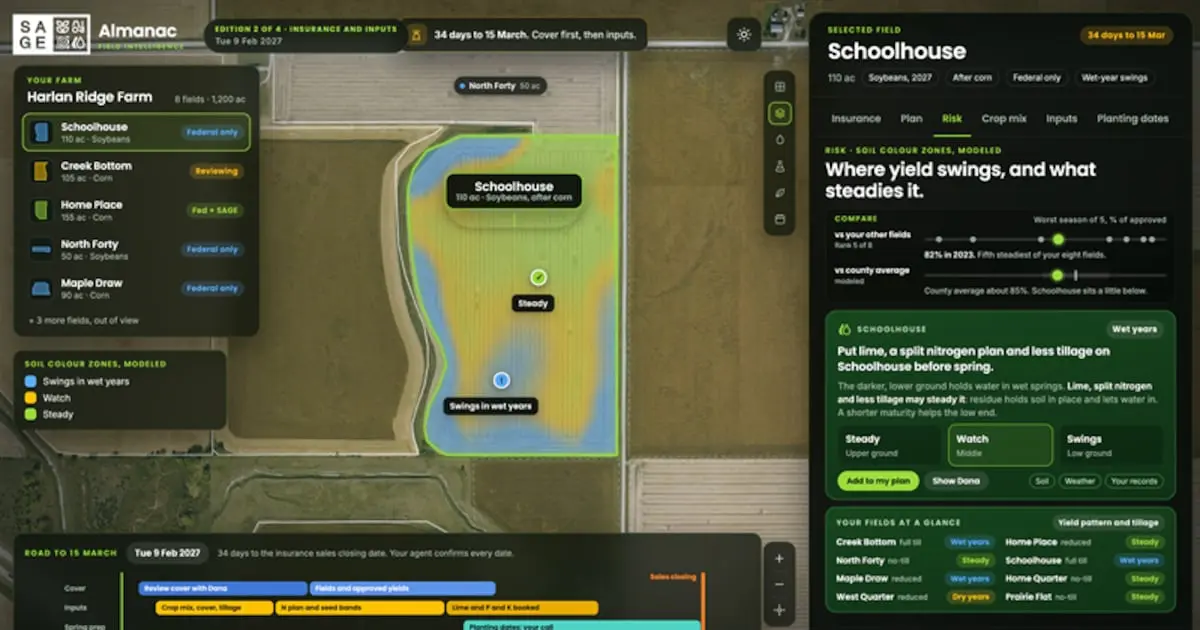
For decades, crop insurance has operated on broad, countywide averages. This blunt instrument often penalized sustainable farmers who employed resilient practices, while oversubsidizing risk elsewhere. By ingesting massive arrays of public and private data—ranging from real-time satellite telemetry and soil metrics to historical academic research—SAGE evaluates risk down to the individual acre.
The launch of SAGE arrives alongside high-profile partnerships with professional services giant Aon and specialty agricultural insurer AgriCap, aiming to roll out "precision crop insurance" for corn and soybean growers across 15 states by 2027. Backed by pilot programs spanning over a million acres in Michigan, the venture represents a monumental shift: making on-farm resilience visible, un-derwritable, and capable of unlocking private capital to fund the future of regenerative agriculture.
Detailed Chronology: From Northern Hampshire Roots to Silicon Valley and AgTech Innovation
The Roots of an AgTech Vision
While Bill Veghte’s professional resume reads like a who’s who of Big Tech—featuring executive leadership tenures at Microsoft, Hewlett-Packard (HP), and SurveyMonkey—his worldview was forged much earlier. Growing up on a working farm in Northern New Hampshire instilled in Veghte a lifelong reverence for the land, the unpredictability of weather, and the thin margins defining a farmer’s livelihood.
Years later, as artificial intelligence matured past the constraints of structured relational databases, Veghte recognized an opportunity to apply enterprise-grade data intelligence to the world’s oldest industry. Traditional agriculture technology had long struggled to ingest unstructured, real-time natural phenomena into clean spreadsheets. Veghte realized that modern AI foundation models possessed the contextual awareness necessary to decode the complex interdependencies of soil chemistry, hydrological cycles, meteorological shifts, and human agronomic interventions.
The Inception of SAGE
Pooling his technological acumen with deep agricultural expertise, Veghte co-founded SAGE alongside Deon Blaauw and Robert Bonnie, whose extensive public sector background includes more than a decade at the United States Department of Agriculture (USDA) across the Obama and Biden administrations.
The company’s namesake—the Soil Analytics Geospatial Engine—was designed from the ground up to solve a fundamental inefficiency in agricultural financing: the inability to accurately price risk at the micro-level. By unifying disparate datasets into deeply contextualized AI models, SAGE bypassed the limitations of legacy agricultural software, creating a platform capable of predicting specific agricultural outcomes and their associated financial risks with unprecedented precision.
Strategic Partnerships and the Michigan Pilot
SAGE’s transition from conceptual engine to market-ready infrastructure materialized through strategic alignment with major financial and insurance heavyweights. In late 2024, the company announced foundational partnerships with professional services firm Aon and specialty agricultural insurance provider AgriCap.
To prove the model at scale, SAGE initiated a rigorous four-county pilot project in Michigan. Developed in conjunction with the Resilience in Agricultural Lending and Insurance Coalition (RALIC) and backed by funding from the Michigan Department of Agriculture and Rural Development, the pilot encompasses more than one million acres of farmland—roughly 12% of the state’s total agricultural production. This pilot serves as the proving ground for commercial rollout, paving the way for a 15-state precision crop insurance offering targeted at corn and soybean growers by 2027.
Supporting Context & Metrics: The Mechanics of Modern Agricultural Risk
The Flaw of Averages in Legacy Crop Insurance
To understand the disruptive potential of SAGE, one must examine the structural limitations of contemporary agricultural insurance. Historically, crop insurance rates, coverage parameters, and payouts have been calculated using broad, countywide averages.
This macro-level approach introduces profound distortions:
- The Cross-Subsidization Penalty: Farmers who invest in advanced soil health, irrigation efficiency, and risk-mitigating practices often find themselves pooled into the same risk bracket as neighbors who farm conventionally or on degraded soils. Consequently, resilient growers routinely pay higher insurance premiums than their operational risk warrants.
- Delayed Data Processing: Legacy assessment methods rely on lagging economic indicators and manual reporting, making it difficult for insurers to adjust dynamically to sudden ecological or macroeconomic shocks.
- The Regeneration Roadblock: As Robert Bonnie noted from his tenure at the USDA, federal and private entities have long wanted to incentivize sustainable practices—such as no-till farming and cover cropping—that are scientifically proven to reduce yield volatility and build long-term climate resilience. However, policymakers could not legally or practically tie insurance incentives to these practices without verifiable, field-by-field risk data.
Transforming Data into Underwritable Resilience
SAGE eliminates these systemic blind spots by synthesizing vast layers of disparate information:
$$textSAGE Risk Index = f(textSatellite Telemetry + textSoil Chemistry + textHydrology + textWeather Modeling + textAgronomic Practices)$$
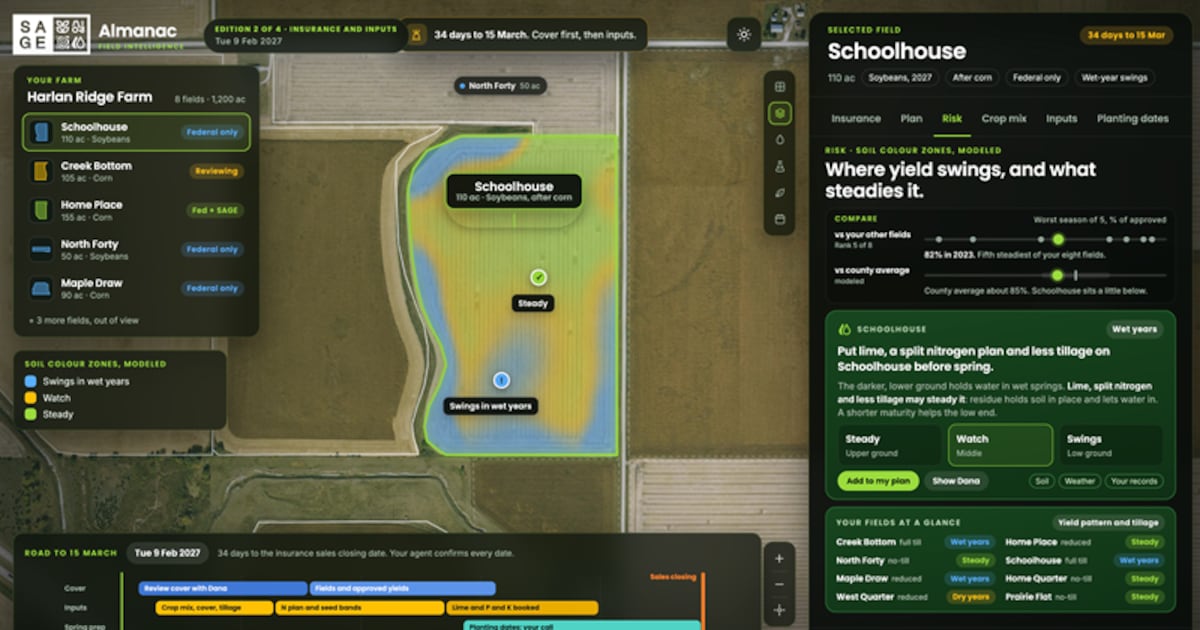
By processing these inputs through contextualized AI architectures, SAGE bridges the gap between ecological stewardship and financial markets. As Jonathan Sherrill of Aon’s Agriculture Resilience Center articulated, the platform translates physical land use into clear risk signals. Once resilience is made visible, it becomes underwritable; once underwritable, global capital can be syndicated behind it.
The Macroeconomic Pressures of the 2020s
The timing of SAGE’s market entry coincides with mounting systemic stress across global supply chains. According to Veghte, the agricultural industry faces an unprecedented convergence of headwinds:
- Climatic Volatility: The recurrent intensification of El Niño patterns, shifting precipitation zones, and prolonged droughts necessitate a complete recalculation of what crops can sustainably grow in specific regions.
- Soil Degradation: Decades of intensive monoculture have eroded organic matter in arable soils worldwide, heightening vulnerability to weather extremes.
- Input Cost Volatility: Fluctuating prices for synthetic fertilizers, fuel, and machinery have squeezed farm gate margins, leaving little room for error.
These compounding factors point toward an inevitable global repricing of agricultural risk. This financial recalibration will ripple outward, affecting every stakeholder in the food value chain—from individual primary producers and global agribusiness conglomerates to sovereign governments and everyday consumers.
Official Statements and Industry Perspectives
The paradigm shift heralded by SAGE’s technology has drawn widespread commentary from leaders spanning technology, risk management, and public policy:
"In previous generations, we had to put something in a very structured database. We spent enormous amounts of effort taking all these different types of data and trying to put it into something that we could query—a relational database, a spreadsheet. AI changed that. SAGE has built a deeply contextualized set of AI models that combine the observation and understanding of soil, water, weather, and human interaction to drive specific outcomes and the resulting risks."
— Bill Veghte, Co-Founder of SAGE"We’re going to have to re-answer what we grow where, given shifting weather patterns, degrading soils, rising input costs, and more volatile markets. And this repricing, in my opinion, will impact every stakeholder from farmers to governments to food companies to consumers, not just in the U.S. but internationally."
— Bill Veghte, Co-Founder of SAGE"The opportunity is to translate what is happening on the land into risk signals that the insurance market can understand and act on. When we make resilience visible, it becomes underwritable. And if we can make it underwritable, we can syndicate capital behind it."
— Jonathan Sherrill, Senior Vice President, Aon’s Agriculture Resilience Center"One of the things we tried to do during the Biden administration was actually create incentives within crop insurance to reward growers that used practices like no-till cover crops that are known to reduce the yield volatility of crops. That is, they increase the resilience of those croplands. There’s a lot of interest in that—has been for a long time. The reason we weren’t able to do it was because, in order to do it, we needed to be able to look at risk on a field-by-field basis."
— Robert Bonnie, SAGE Co-Founder and former USDA Official"In the last 15 years, crop insurance has really become the dominant safety net tool of the farm bill, so significant resources annually, anywhere from $14–20 billion annually that the U.S. taxpayer is providing to subsidize crop insurance. It’s very popular. It’s worked really well."
— Robert Bonnie, SAGE Co-Founder and former USDA Official
Future Outlook: The Next Frontier in Agricultural Finance
The Evolution of the Farm Safety Net
Crop insurance is far from a niche financial product; it is the cornerstone of modern agricultural economics. In the United States, roughly 90% of all corn and soybean acreage is protected by crop insurance. Furthermore, institutional lenders universally require proof of crop insurance before extending operating loans to producers.
With the federal government currently subsidizing crop insurance to the tune of $14 billion to $20 billion annually through the Farm Bill, the stakes for optimizing this safety net are exceptionally high. As public budgets face scrutiny and climate risks multiply, transitioning from blanket subsidization to performance- and resilience-based underwriting offers a sustainable fiscal pathway forward.
Scaling Precision Insurance Globally
Looking ahead to the 2027 commercial rollout across 15 states, SAGE’s framework points toward a broader transformation in global agro-finance. By rewarding regenerative practices—such as cover cropping, rotational grazing, and reduced tillage—through lower insurance premiums, technology platforms can harness market forces to accelerate environmental stewardship.
Rather than relying purely on regulatory mandates or government grants, the marriage of AI-driven risk analytics and commercial insurance creates a self-reinforcing economic incentive: farmers who protect their soil are rewarded with lower capital costs, insurers secure lower loss ratios, and global supply chains gain long-term stability.
In an era defined by climate uncertainty and ecological transition, ventures like SAGE demonstrate that the path forward relies not on abandoning tradition, but on infusing it with the clarity, speed, and precision of modern artificial intelligence.