
Executive Overview
For decades, the agricultural supply chain has operated under the shadow of an invisible, highly destructive thief: potato bruising. Because potatoes are exceptionally vulnerable to physical damage during harvest and transit, farmers worldwide hemorrhage millions of dollars in lost revenues annually. Damaged crops are routinely rejected by processors, downgraded in value, or left to rot, creating a cascade of food waste and financial strain that ripples from the field all the way to consumer packaged goods (CPG) conglomerates.
While agricultural engineering has traditionally attempted to solve this issue through heavier steel, automated sensors, and gentler mechanical redesigns, a profound oversight has persisted across the industry: the human element. Even the most advanced harvesting machinery can tear, bruise, or crush crops if operated incorrectly. Addressing this persistent skills gap, CPG giant PepsiCo and agricultural machinery manufacturer Grimme have forged a groundbreaking cross-industry partnership. Teaming up with immersive learning technology provider Altoura, the companies have developed hyper-realistic digital replicas—commonly known as digital twins—of Grimme’s flagship EVO and SE series potato harvesters.
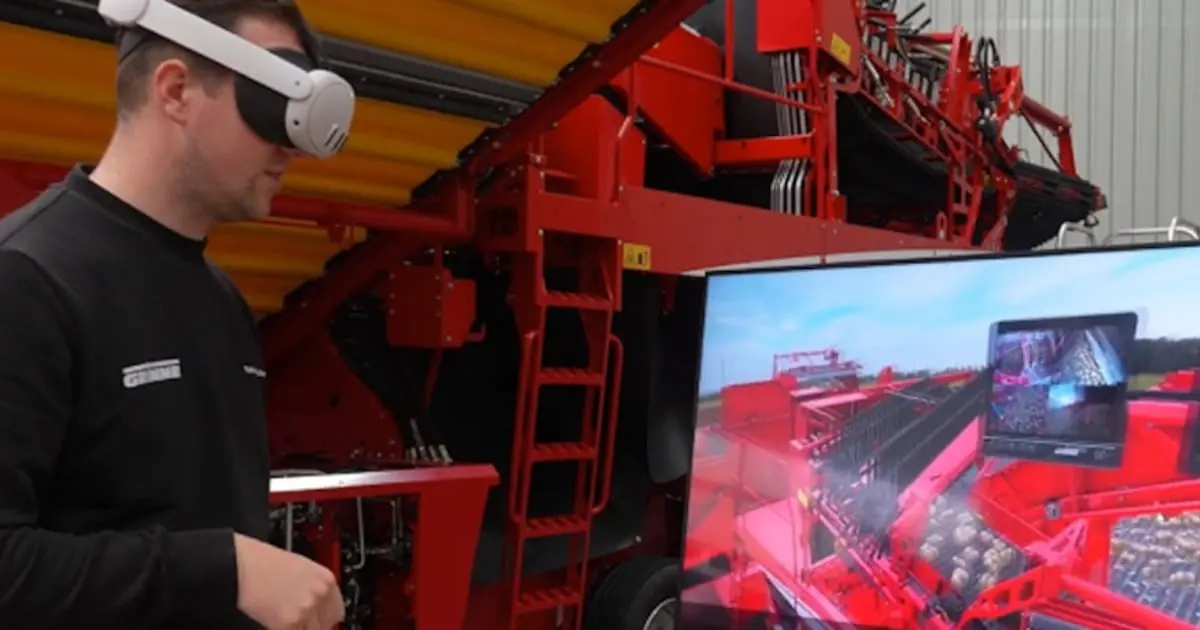
This immersive training initiative allows operators to step inside a virtual environment to inspect complex machinery, remove mechanical panels, simulate harvesting scenarios, and master optimal machine settings long before stepping foot onto a tractor. Built with versatility in mind, the platform is optimized for virtual reality (VR) headsets yet remains fully accessible via desktop computers, tablets, and smartphones. Crucially, once the training application is downloaded, it operates entirely offline, eliminating the connectivity barriers that frequently plague remote agricultural regions.
Early pilot programs across Brazil, Mexico, Poland, and Romania have yielded staggering results. According to metrics released by PepsiCo, participating farms experienced an 87-percentage-point increase in bruise-free potato yields, alongside a remarkable 1.7-fold reduction in severe crop bruising. By shifting the paradigm of agricultural upskilling, PepsiCo and Grimme are demonstrating that the future of farming is not merely about smarter iron, but smarter operators. This in-depth report explores the technological mechanics, global rollout, economic implications, and broader industry trajectory of this virtual reality revolution in modern agriculture.
Detailed Chronology: From Industrial Manufacturing to the Potato Field
The genesis of this agricultural VR initiative did not emerge in a vacuum; rather, it represents the cross-pollination of industrial automation strategies adapted for primary agricultural production. To understand how PepsiCo arrived at virtual reality potato harvester training, one must examine the chronological progression of the company’s internal technology adoption.
The Industrial Blueprint
Earlier in the year, PepsiCo made headlines by announcing an industry-first artificial intelligence and digital twin collaboration with tech titans Siemens and NVIDIA. This enterprise-wide initiative utilized advanced simulation, digital twins, and AI to optimize industrial manufacturing plants, streamline assembly lines, and train factory floor operators through immersive virtual environments.
Rob Meyers, Vice President of Global Agriculture at PepsiCo, closely monitored these manufacturing trials. Recognizing the profound efficacy of digital twins in industrial environments, Meyers and his agricultural strategy team began exploring whether these immersive training methodologies could bridge the persistent skills gap found in primary agriculture.
"We had seen some of the work that our wider PepsiCo business was doing around using digital twins to improve operator training in the manufacturing space and felt there was a lot of applicability that could help us on the farming side," Meyers explained in interviews with agricultural technology analysts.
Forging the Alliance with Grimme and Altoura
With the conceptual framework established, PepsiCo partnered with Grimme—a globally renowned German manufacturer of potato harvesting, planting, and tillage technology—and Altoura, a leader in immersive learning solutions. The objective was clear: construct high-fidelity digital replicas of Grimme’s complex EVO and SE series potato harvesters.
Unlike simple 3D video tutorials, these digital twins function as dynamic, interactive simulations. Operators can virtually walk around the multi-ton harvesting machinery, unbolt and remove inspection panels, peer into internal web chains and separation units, and observe how adjustments to web speeds and roller angles directly impact crop integrity.
Global Pilot Testing and Regional Customization
The partnership moved quickly from concept to field-testing. Last year, PepsiCo and Grimme launched their initial pilot programs in Latin America, specifically targeting agricultural hubs in Brazil and Mexico. These regions presented diverse operating conditions, varied machinery familiarity, and distinct linguistic needs, making them ideal proving grounds for scalable technology.
Following the initial success in Latin America, the program expanded across the Atlantic into Central and Eastern Europe, with targeted pilot deployments in Poland and Romania. Furthermore, the companies showcased the technology on a global stage at PepsiCo’s prestigious Global Agro University in Germany, exposing international agronomists and farm managers to the immersive platform.
However, the rollout was intentionally measured. Recognizing that agricultural practices, machinery configurations, and operator demographics vary wildly across international borders, PepsiCo and Grimme prioritized localization.
"Adapting to local realities is often more important to driving adoption at scale," Meyers emphasized. "As we expand into new markets, we’re continuing to refine the experience, including language support and training content. The goal isn’t to introduce complexity. It’s to make proven expertise available to more operators, in more places, before they enter the field."
Supporting Context & Metrics: Quantifying the Impact of Virtual Training
In agriculture, technological investments are routinely scrutinized through a strict economic lens. Farmers operate on tight margins, where the cost of new equipment, software licenses, or training downtime must be decisively justified by tangible return on investment (ROI). The PepsiCo-Grimme digital twin initiative addresses this reality by directly targeting the immense financial losses associated with crop damage.
The Anatomy of Potato Bruising
Potatoes are delicate commodities. Despite their rugged appearance in the grocery store aisle, tubers are highly susceptible to mechanical shock. When harvested by massive industrial machinery—which must rapidly unearth, clean, and separate potatoes from soil, stones, and vines—improperly adjusted webs, excessive drop heights, or overly aggressive agitation rollers can cause internal and external bruising.
External bruising manifests as skin scuffs, cuts, or pressure marks, while internal bruising (often invisible until the potato is cut or processed) causes enzymatic discoloration. Both forms of damage render the crop unsuitable for high-value consumer products like potato chips (crisps) and french fries. Consequently, bruised potatoes are routinely downgraded to lower-value uses, sold at a heavy discount as livestock feed, or discarded entirely. Annually, this results in tens of millions of dollars in collective revenue loss for growers within major supply chains.
Staggering Pilot Metrics
The implementation of the Altoura-powered digital twin training platform transformed how operators interacted with their harvesting equipment, yielding quantifiable improvements in crop quality. According to empirical performance data released by PepsiCo from their initial pilot markets:
- 87% Increase in Bruise-Free Potatoes: Farms utilizing the VR training program witnessed a dramatic surge in pristine, undamaged harvests.
- 1.7x Reduction in Severe Bruising: Catastrophic crop damage—instances where tubers suffered deep structural fractures or crushing—was nearly halved.
These metrics highlight a fundamental shift in operational awareness. By understanding the mechanical mechanics of the Grimme EVO and SE harvesters in a risk-free virtual environment, operators learned how to fine-tune machine parameters (such as conveyor speeds, share depths, and separator aggressiveness) in real-world conditions to minimize physical trauma to the crop.
Economic Viability and Accessibility
Cost remains the single greatest barrier to technology adoption in agriculture. While advanced machinery and VR hardware represent upfront expenditures, Meyers notes that the financial risk of inaction vastly outweighs the investment.
"The loss of revenue for a farmer due to bruising can be very high, and the VR technology costs are only a fraction of this risk," Meyers noted.
Moreover, the technical architecture of the training platform was specifically engineered for economic and logistical practicality. While the digital twin is optimized for state-of-the-art virtual reality headsets—offering an unparalleled spatial understanding of the machinery—it is hardware-agnostic. Operators who do not possess VR headsets can seamlessly access the exact same training modules via standard desktop computers, tablets, or smartphones.
Even more critically, the software overcomes rural infrastructure deficits. Once the training application is downloaded via the Altoura platform onto a device, users do not require active Wi-Fi or mobile cellular service to run the simulations. This offline functionality ensures that operators stationed in remote rural fields with zero internet connectivity can still complete comprehensive upskilling modules.
Official Statements and Industry Insights
The convergence of CPG giants, heavy agricultural machinery manufacturers, and immersive tech developers signals a broader evolution in modern agribusiness. Leadership from the collaborating entities has been vocal about the strategic necessity of this project.
Rob Meyers, whose role as PepsiCo’s VP of Global Agriculture places him at the intersection of supply chain sustainability and raw material sourcing, views workforce empowerment as the ultimate catalyst for agricultural efficiency.
"One of agriculture’s biggest challenges is delivering consistent, high-quality training to operators who may be seasonal, geographically dispersed or working in different languages and markets. The opportunity with digital tools is their ability to make expert training more accessible and scalable," Meyers stated.
This sentiment underscores a chronic vulnerability in global farming: the labor shortage. Agriculture increasingly struggles to attract, retain, and train skilled machine operators. Farming operations rely heavily on seasonal migrant labor or shifting local workforces, making standardized, high-retention training programs notoriously difficult to execute. Traditional instruction manuals are frequently dense, language-restricted, and easily misunderstood, while on-the-machine training risks expensive equipment damage and ruined harvests while novices learn through trial and error.
By moving the learning curve into a virtual metaverse, PepsiCo and Grimme have decoupled skill acquisition from physical risk. Trainees can repeatedly practice complex maintenance procedures—such as clearing jammed webs, adjusting roller clearances, and replacing worn-out components—until muscle memory and cognitive understanding are fully established.
Industry analysts note that this partnership establishes a new benchmark for corporate stewardship in agricultural supply chains. Rather than simply penalizing growers for substandard crop quality or high rejection rates, forward-thinking CPG corporations are actively investing in the operational capabilities of their farming partners. By providing the tools, technology, and insights necessary to elevate farming practices, companies like PepsiCo ensure long-term supply chain resilience, food security, and mutual profitability.
Future Outlook: Can Virtual Reality Be the Catalyst for Agrisight Upskilling?
As the pilot programs transition into permanent, scaled deployments across PepsiCo’s global agricultural footprint, the implications of this initiative extend far beyond potato farming. The success of the Grimme-Altoura collaboration raises a pivotal question for the broader agricultural sector: Can virtual reality and digital twins become the universal standard for upskilling the global agricultural workforce?
Scaling Across Commodities
While potatoes represent an ideal proving ground due to their extreme susceptibility to bruising, the foundational methodology is infinitely scalable. Similar digital twin and VR training frameworks could be readily adapted for a vast array of specialized harvesting equipment, including:
- Combine Harvesters for cereal grains and corn, minimizing grain cracking and header loss.
- Grape and Berry Harvesters, optimizing delicate shake frequencies to prevent fruit pulp damage.
- Orchard Fruit Pickers and Sorting Platforms, training operators on delicate vacuum suction and mechanical arm handling.
As precision agriculture continues to integrate artificial intelligence, autonomous machinery, and advanced telemetry, the complexity of farm equipment is skyrocketing. Modern tractors and harvesters resemble mobile supercomputers more than traditional mechanical tractors. Consequently, the cognitive load placed on human operators has never been higher. Traditional onboarding methods are fundamentally incapable of keeping pace with this technological velocity. Immersive learning technologies provide the high-bandwidth cognitive transfer necessary to master complex machinery safely and efficiently.
Overcoming Remaining Adoption Hurdles
Despite the undeniable success of the PepsiCo-Grimme pilot, widespread industry adoption of immersive learning across independent farming communities will not happen overnight. Several challenges remain on the horizon:
- Cultural Resistance: Traditional farming communities can occasionally exhibit skepticism toward high-tech, abstract digital tools. Demonstrating immediate, tangible economic ROI—such as the 87% reduction in bruising—will be essential to winning over traditionalist growers.
- Hardware Standardization: While the PepsiCo-Grimme platform supports tablets and desktops, fully realizing the spatial benefits of digital twins requires VR headsets. Subsidizing or facilitating access to affordable headset hardware for smaller, independent farming co-ops will dictate the democratization of the technology.
- Continuous Content Updates: As agricultural machinery manufacturers release annual equipment updates, digital twins must be continuously patched and updated to reflect new mechanical layouts, software interfaces, and engineering specifications. Establishing seamless collaboration pipelines between equipment manufacturers and software developers will be vital.
Conclusion
The collaboration between PepsiCo, Grimme, and Altoura marks a watershed moment in agricultural technology. By recognizing that multi-million-dollar supply chain losses often originate from simple human training deficits, these industry leaders have bypassed conventional band-aid solutions and engineered a transformative educational ecosystem.
By fusing the precision of digital twins with the accessibility of multi-platform VR training, the initiative has proven that empowering operators directly translates to superior crop quality, minimized food waste, and enhanced financial viability for growers. As this technology matures and expands into new global markets and commodity sectors, it is poised to redefine what it means to be a skilled machine operator in the 21st-century agricultural landscape—proving that the most effective way to protect the future of farming is to invest in the minds of the people who work the land.