
In the high-stakes, emotionally charged world of small animal medicine, the boundary between clinical science and human psychology is often razor-thin. For Dr. Greg Bishop, a veterinarian in his second year of clinical practice in Portland, Oregon, a routine case involving a 14-year-old black Labrador named Tom evolved into a masterclass in veterinary communications, vulnerability, and the hidden psychological toll of chronic disease management.
What began as a straightforward presentation of a decubital ulcer on a canine’s left hock spiraled into a grueling months-long ordeal that tested not only the limits of veterinary therapeutics and antimicrobial stewardship, but also the practitioner’s capacity for empathy. More importantly, the case inadvertently exposed a foundational pillar of modern veterinary practice: client trust is not merely a byproduct of perceived medical competence, but a direct reflection of communication pacing, presence, and emotional attunement.
This retrospective journalistic account examines the intricate dynamics of the case—tracing it from an initial optimistic prognosis through weeks of frustrating therapeutic failures, surgical setbacks, and eventual healing—while contextualizing the narrative within the broader scope of veterinary communication science and client relationship management.
Detailed Chronology: The Decubital Ulcer From Hell
Presentation and Initial Assessment
The case commenced on an ordinary morning when Tom, an aging, neutered male black Labrador retriever, was presented to the clinic. Tom’s joints moved with the stiffness of "frozen hydraulic fluid," a hallmark of advanced canine osteoarthritis. However, the primary complaint was a localized decubital ulcer—a pressure sore—situated on his left hock.
Dr. Bishop, early in his career and unjaded by the administrative and emotional burnout common to veterinary medicine, formulated a standard, text-book treatment plan: basic wound management, supportive bandaging, targeted systemic antibiotics, and a recheck appointment scheduled for two days later.
Communication with Tom’s owner—a warm, articulate woman in her early seventies—was exemplary. It embodied relationship-centered care: objectives were aligned, cost projections were mutually agreed upon, and next steps were mapped out clearly. However, this initial competency was immediately tested when the client requested that the explanation be repeated for her husband, who was waiting in the lobby. The husband, diagnosed with Parkinson’s disease, found the building’s slight architectural incline and cramped examination rooms prohibitive to navigate.
Stepping into the lobby, Dr. Bishop was confronted by an imposing, 6-foot-8-inch man with broad shoulders, sharp gray eyes, and a completely inscrutable, blank expression. Overwhelmed by the physical presence of the client and fighting a rising wave of internal panic, the young veterinarian resorted to rapid-fire, breathless medical exposition—a verbal delivery that would later be recognized as the antithesis of effective client communication.
The Escalation and Therapeutic Stall
Two days later, Tom returned for his scheduled bandage change, and the clinical picture had darkened. The decubital ulcer was larger, deeper, and wider—progressing in direct opposition to the therapeutic goals. While veterinary technicians managed the wound care, Dr. Bishop delivered a measured, calm update to the wife, who remained unfailingly supportive and underscored how deeply her husband cherished the dog, noting that Tom was the anchor holding her husband’s spirit intact amidst the ravages of Parkinson’s.
When the husband attended the subsequent visit, Dr. Bishop lapsed into defensive over-explanation. Fearing the judgment of the towering man’s piercing gaze, the veterinarian delivered another barrage of jargon-heavy veterinary discourse: resistance, susceptibility, bacterial isolates. The husband remained motionless, offering only a slow, deliberate "Okay, Doc" before retreating into stoic silence.
Over the ensuing weeks, the case devolved into a therapeutic quagmire. The wound refused to granulate. The clinical team exhausted every intervention in the modern playbook:
- Advanced moisture-retention and antimicrobial wound dressings
- Low-level laser therapy (LLLT) to stimulate cellular repair
- Specialist consultations and aggressive adjustments to systemic antimicrobial protocols based on mixed-isolate culture and sensitivity panels
- An unauthorized surgical excision performed by a covering colleague during Dr. Bishop’s absence, which rapidly dehisced within days.
Despite mounting veterinary bills, climbing financial costs, and visibly worsening tissue pathology, the owners maintained unwavering faith in the clinical team, waiting patiently in the lobby while their aging companion underwent painful treatments "in the back."
The Turning Point and Surrender
Months into the battle against the unhealing wound, Dr. Bishop reached an absolute clinical and psychological breaking point. Recognizing the futility of projecting false omniscience, the veterinarian dropped the armor of professional authority during a consultation with Tom’s wife.
In a moment of radical transparency, Dr. Bishop admitted complete defeat: he simply did not know how to fix the unfixable wound, nor could he shoulder the existential weight of reversing the patient’s biological entropy and the husband’s neurological decline.
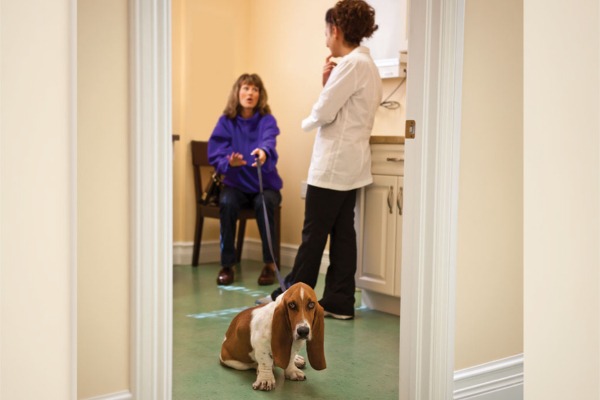
The wife received this admission with grace. Displaying remarkable resilience, she reaffirmed her trust in the veterinary team, leaving the next strategic pivot entirely in their hands. Stripped of pretense, Dr. Bishop devised a radically simplified protocol: managing the fragile tissue strictly as an open wound, introducing an oral fluoroquinolone (ciprofloxacin) despite its complex bioavailability profile, and resigning the outcome to the mercy of clinical pragmatism.
Because the husband was too frail to enter the lobby and remained seated in the car, Dr. Bishop walked out to the parking lot for the final consultation. Abandoning the rushed, jargon-laden lectures of the past, the veterinarian simply stood by the passenger window, spoke at a deliberate pace, and acknowledged the limits of their remaining options without sugarcoating the prognosis.
Upon hearing this honest, unhurried assessment, the husband’s gray eyes glistened, his lips trembled slightly, and he offered a slow, imperceptible nod of deep acknowledgment.
Resolution and Clinical Recovery
In an outcome that defied standard physiological expectations, the chronic wound began to turn a corner within forty-eight hours. Granulation tissue emerged along the margins, steadily bridging the gap until, roughly a week later, the decubital ulcer was completely healed.
During Tom’s final presentation at the clinic, the husband managed to walk into the lobby alongside his wife. Abandoning the frantic communication styles of the past, Dr. Bishop permitted the interaction to unfold at the client’s own measured pace. The husband extended his hand, his voice catching slightly as he offered a profound, simple acknowledgment: "Thank you."
Supporting Context & Metrics: The Science of Veterinary Communication
While Dr. Bishop processed this grueling clinical trial purely as an exercise in trial-and-error medicine, the underlying dynamics of the case mirror extensive findings in contemporary veterinary communication research.
The Psychology of Client Trust
Decades of empirical studies in human-animal interaction and veterinary sociology demonstrate that client compliance and satisfaction are rarely tied exclusively to perceived clinical competence. Instead, they are heavily mediated by interpersonal dynamics:
- The Perceived Time Constraint: Research consistently indicates that clients who perceive their veterinarian as hurried, rushed, or dismissive report significantly lower levels of trust and satisfaction, even when the objective quality of medical care is identical to that of unhurried practitioners.
- Jargon as a Barrier: The use of complex medical terminology ("verbal diarrhea" involving terms like fibroblast physiology and antimicrobial resistance patterns) often serves as an anxiety-driven defense mechanism for the clinician rather than an educational tool for the client. When clients are overwhelmed by illness or external stressors—such as managing a partner’s neurodegenerative disease—dense explanations induce cognitive overload.
- Presence Over Perfection: Dr. Bishop’s breakthrough occurred not when he finally selected the correct antibiotic, but when he surrendered the need to appear infallible. By slowing his physical cadence, lowering his gaze, and matching the emotional gravity of the moment, he established genuine relational presence.
Official Statements and Industry Perspectives
Reflecting on the broader implications of relationship-centered care in veterinary medicine, clinical educators and veterinary communications experts emphasize that emotional resilience and communication training are just as critical as surgical proficiency.
"The veterinary profession has historically prioritized biological sciences, pharmacology, and surgical techniques while underfunding interpersonal communications training," notes a senior veterinary clinical instructor. "Cases like Dr. Bishop’s illustrate that chronic disease management is an emotional marathon for clients. When we rush our communication, we alienate the very people we need as collaborative partners in patient care."
Furthermore, specialists in palliative and geriatric veterinary care point out that chronic wounds in geriatric patients—particularly those complicated by systemic co-morbidities like canine osteoarthritis and recumbency—require a holistic approach that accounts for the human-animal bond as much as the integrity of the dermal layers.
Future Outlook
As veterinary medicine continues to evolve into a high-tech, specialized field characterized by advanced diagnostics, laser therapies, and complex pharmacotherapy, the risk of clinical dehumanization grows proportionally. Cases like Tom’s serve as a vital reminder that the core of veterinary practice remains rooted in human relationships.
Moving forward, veterinary academic institutions are increasingly integrating communication modules—such as the Calgary-Cambridge Guide for medical communication—into core curricula. These frameworks train practitioners to recognize personal anxiety triggers, manage time constraints transparently, and adapt their communication styles to accommodate vulnerable clients.
Ultimately, Dr. Bishop’s journey from a frantic, insecure novice to a grounded, reflective clinician highlights an enduring truth of the healing arts: while science provides the tools to mend the flesh, it is empathy, presence, and honest human connection that ultimately heal the client.