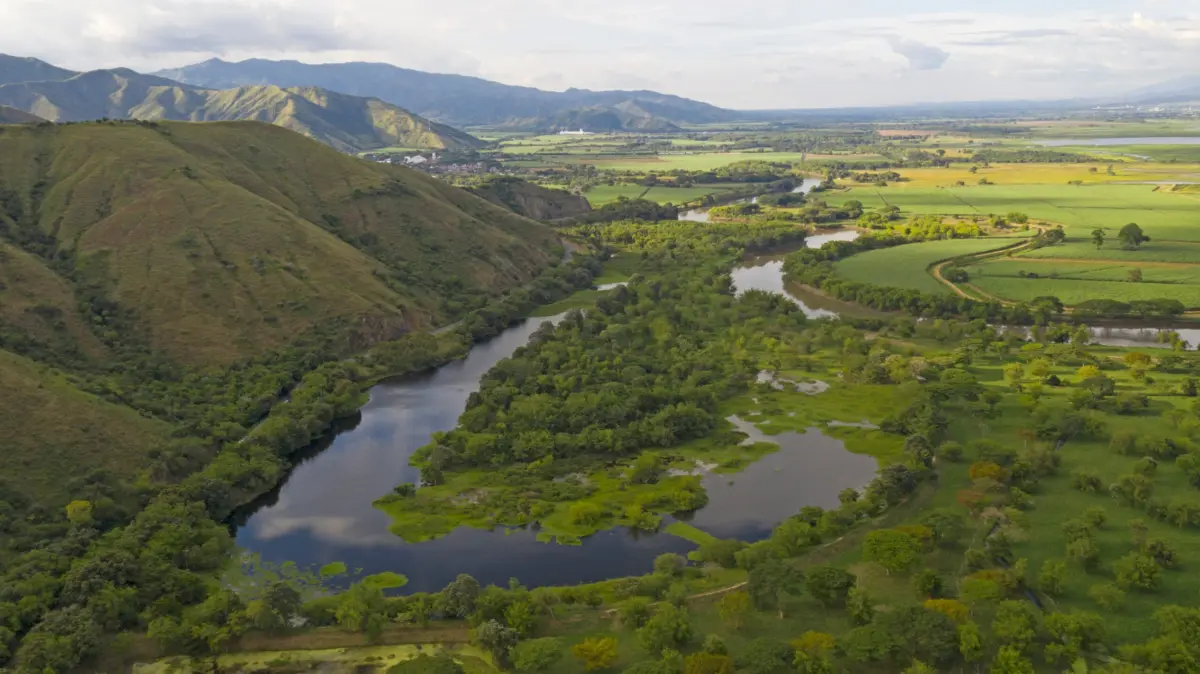

Colombia’s Cauca Valley—a rich geographical tapestry framed by the towering peaks of the Western and Central Andes—has long been celebrated as one of the planet’s premier biodiversity hotspots. Home to more than 900 resident and migratory bird species, this high-altitude valley serves as a critical biological crossroads. Here, colorful Andean endemics mingle with shorebirds that traverse thousands of miles annually between South America and the North American boreal forests.
Yet, for decades, conservation in the region suffered from a fractured approach. Protected areas were treated as isolated islands, separated by intensive agriculture, sprawling cattle ranches, and rapidly developing urban centers.
Over the past five years, however, a coalition spearheaded by the National Audubon Society and a vast network of local, national, and international partners has fundamentally shifted this paradigm. By designating the Cauca Valley as a flagship "Blueprint Landscape," Audubon and its allies have tested a bold, interconnected theory of change: conservation succeeds not when it walls nature off from human enterprise, but when science, protected areas, productive agricultural lands, local communities, financial mechanisms, and public policy all move in the same direction, guided by birds.
Today, this vision is materializing at scale. The region is transforming into a functioning, continuous ecological network where birds move freely across mountains, forests, farms, wetlands, and rivers—and where the people who live and work within these landscapes are empowered as their primary stewards. From AI-driven acoustic monitoring and bird-friendly sugarcane cultivation to community-led eco-tourism and national policy shifts, the Cauca Valley is proving that conservation is not a linear path with a single solution, but a mosaic of interconnected strategies. This is the story of how a bold blueprint is rewriting the future of conservation in the Americas.
Detailed Chronology: Five Years of Transformation in the Valley
The transformation of the Cauca Valley did not happen overnight; it was built through a meticulous, multi-phased approach that bridged grassroots community engagement with high-level scientific and political coordination.
Phase One: Laying the Groundwork and Establishing Protected Areas (Years 1–2)
The journey began with the identification of the Cauca Valley as a critical stronghold for avian biodiversity. Recognizing that land acquisition and formal protection form the bedrock of any conservation strategy, Audubon—alongside global heavyweights such as BirdLife International, the American Bird Conservancy, Birds Canada, and RedLAC—helped champion Conserva Aves. Launched as one of the most ambitious bird conservation initiatives in Latin America and the Caribbean, the program sought to accelerate the creation, expansion, and long-term management of local protected areas.
Supported by funding from the Bezos Earth Fund, the Government of Canada, and other philanthropic entities, Conserva Aves catalyzed nearly 180 locally led conservation projects across nine countries, safeguarding over three million hectares of critical habitat. Within the Cauca Valley specifically, the initiative targeted 17 local protected areas, resulting in the rapid formal establishment of two cornerstone reserves: the Regional Integrated Management District (RIMD) Alto Calima and the RIMD Atuncela, collectively spanning 19,435 hectares. Crucially, each site was anchored by local organizations and long-term commitments to community stewardship.
Phase Two: Technological Innovation and Agricultural Integration (Years 2–3)
With core sanctuaries established, the initiative confronted the reality that protecting land in isolation is insufficient. Attention turned to the vast agricultural matrix occupying the valley floor, particularly the sugarcane sector, which accounts for over 70 percent of regional water use and blankets nearly 240,000 hectares.
Through a landmark partnership with Asocaña (the National Association of Sugar Cane Mills and Growers of Colombia), Audubon helped develop the nation’s first Bird-Friendly Best Management Practices Manual for sugarcane. Simultaneously, the launch of Corredor 890—an ambitious landscape-reconnection effort—began utilizing Audubon’s science-based Bird Friendliness Index (BFI) in collaboration with ICESI University. This metric allowed producers to measure whether their operational lands were actively functioning as healthy secondary habitats for wildlife.
Concurrently, the region embraced cutting-edge conservation technology. Through the Escucha Aves program, local communities deployed autonomous acoustic recorders into forest canopies. Backed by artificial intelligence, these devices process thousands of hours of audio to identify bird species with remarkable precision. This technological leap democratized science, dramatically lowered monitoring costs, and provided rural communities with real-time data to manage their local ecosystems.
Phase Three: Economic Diversification and Watershed Resilience (Years 3–4)
As ecological corridors began to knit the landscape together, the initiative focused heavily on human livelihoods and watershed health. In the rugged mountains surrounding the valley, Audubon partnered with Fondo Agua por la Vida y la Sostenibilidad, CIPAV, Fedegán, and The Nature Conservancy to transition traditional cattle ranching into sustainable silvopastoral systems. Backed by a major grant from the UK’s Global Centre on Biodiversity for Climate (GCBC), this transition improved water regulation, restored avian habitats, boosted farm productivity, and secured long-term family incomes.
Concurrently, the human dimension of conservation expanded into the service economy. More than 200 local residents were trained as specialized birding guides, transforming passive residents into active economic beneficiaries of ecotourism. School curricula across five districts were overhauled to integrate avian ecology, complemented by cross-cultural student exchanges with schools in Connecticut and Ohio. Furthermore, Audubon deepened its support for the Colombia BirdFair—organized alongside Asociación Río Cali—helping position it as Latin America’s premier avian festival.
Phase Four: Institutionalization and Policy Scaling (Year 5 to Present)
In its most recent phase, the Cauca Valley blueprint transcended local boundaries to influence national governance. Synthesizing data and grassroots lessons from the valley, Audubon collaborated with the Colombian National Ornithological Network (RNOA), the Humboldt Institute, and the Ministry of Environment to finance and draft Colombia’s National Bird Strategy 2030 (ENCA 2030). This unprecedented policy framework engaged over 2,000 stakeholders to integrate bird conservation into regional and national development planning. Locally, the departmental government of Valle del Cauca followed suit, passing a regional ordinance that legally designates birdwatching tourism as a strategic pillar of economic development.
Supporting Context & Metrics: Data Behind the Blueprint
To understand the tangible impact of the Cauca Valley initiative, one must examine the metrics that quantify its ecological, economic, and social achievements:
- Avian Richness: The Cauca Valley hosts over 900 bird species, representing roughly 10% of the world’s total avian biodiversity within a remarkably concentrated geographic area.
- Habitat Protection via Conserva Aves: Across nine Latin American and Caribbean nations, the initiative has advanced nearly 180 projects, protecting over 3 million hectares of critical habitat for more than 1,600 bird species.
- Local Reserves in the Cauca Valley: Out of 17 targeted local protected areas, two major reserves—RIMD Alto Calima and RIMD Atuncela—have been officially established, covering 19,435 hectares.
- Agricultural Footprint: The Bird-Friendly Best Management Practices for sugarcane now influence management across nearly 240,000 hectares of productive agricultural land.
- Capacity Building: More than 200 local residents have been professionally trained as certified birding guides. Educational integration has impacted schools across five districts, fostering international exchanges with U.S. students.
- National Policy Reach: The development of ENCA 2030 mobilized over 2,000 participants from government, civil society, Indigenous groups, and the private sector to codify avian conservation at the national level.
Official Statements & Expert Perspectives
The philosophy underpinning the Cauca Valley initiative emphasizes that conservation is fundamentally a human endeavor. Leaders from partnering institutions have continually underscored the importance of cross-sector collaboration:
"The biggest result isn’t any single conservation success. It’s the landscape itself, starting to function as one connected system. Birds move across mountains, forests, farms, wetlands, and rivers. People live and work within that same mosaic of connected landscapes."
— Field Assessment Report, Audubon Conservation Team
The integration of private sector actors has been equally vital to bridging the historic divide between agricultural production and environmental protection. Industry leaders note that economic viability and ecological health are mutually reinforcing:
"Demonstrating that productive agriculture and biodiversity conservation can move forward together is no longer an idealistic goal; it is an operational necessity. By working hand-in-hand with scientists and conservationists, our growers are actively redefining the footprint of Colombian sugarcane."
— Representative, Asocaña (National Association of Sugar Cane Mills and Growers of Colombia)
The human-centric approach is perhaps best embodied by the migratory birds that serve as living threads connecting distant ecosystems. The tracking of Cholao, a Lesser Yellowlegs monitored via satellite telemetry across rice fields and sugarcane plantations on its epic journey to the North American boreal forest, has captured public imagination. As researchers note, Cholao and other tracked migrants serve as ambassadors for hemispheric cooperation:
"Conserving migratory birds means protecting an ecological network that spans an entire hemisphere. When local communities see a tagged bird return year after year to the exact same field, they realize they are custodians of a global heritage."
— Collaborative Research Team, Universidad Icesi and Audubon
Future Outlook: A Blueprint for the Americas
As the Cauca Valley initiative looks toward the horizon, its architects are focused on scaling these integrated models across the hemisphere. The roadmap established over the past five years demonstrates that resilient conservation does not rely on a single linear path; rather, it thrives on redundancy, community empowerment, and institutional permanence.
Future efforts will see the expansion of acoustic AI monitoring through Escucha Aves into new watersheds, alongside the deepening of sustainable ranching practices supported by international climate finance. Furthermore, the upcoming staging of the Colombia BirdFair—which will uniquely host the II World BirdFair and the South American BirdFair—will place the Cauca Valley on the absolute center stage of global ecotourism and ornithological science.
Perhaps the most enduring symbol of this future is found not in academic journals or government legislative halls, but on the walls of the valley’s towns and cities. Colorful bird murals—depicting everything from vibrant Andean endemics to the soon-to-be-painted Lesser Yellowlegs—now brighten schools, public buildings, and community spaces. These murals represent a profound cultural shift: birds are no longer viewed merely as wild animals inhabiting remote forests, but as central pillars of local identity and community pride.
Ultimately, the Cauca Valley Blueprint has proven that when protected areas safeguard biodiversity, farms connect habitats, sustainable ranching regulates water, communities take up stewardship, tourism creates livelihoods, and public policy locks in endurance, conservation ceases to be a restriction. It becomes woven into the everyday fabric of human life—taking flight across the Americas and pointing the way toward a sustainable future.