
Originally featured in the Alley Cat Action® 2026 Summer Newsletter. Read the full newsletter edition here.
Executive Overview
When nature unleashes its most destructive forces, human communities are not the only ones left reeling in the aftermath. Domestic pets, free-roaming community cats, and bonded street animals often bear the silent brunt of extreme weather events. On the island of Oahu, Hawaiʻi, the consequences of the worst flooding in two decades threatened the lives of countless vulnerable animals, leaving them stranded, injured, and without access to basic necessities.
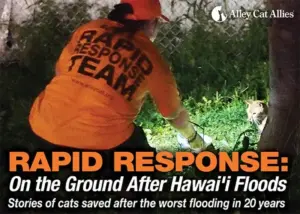
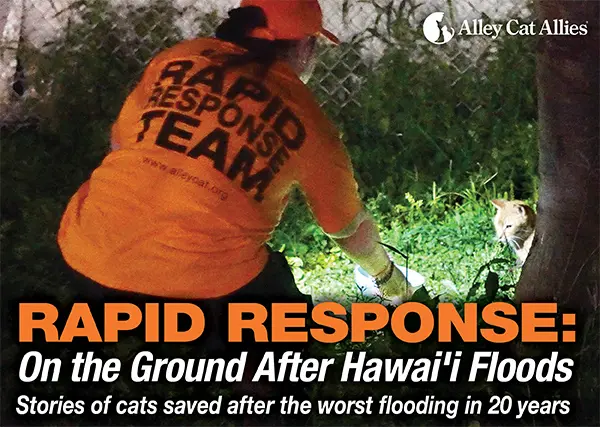
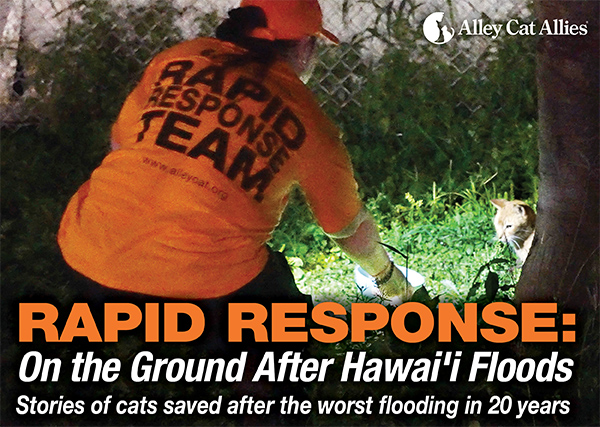
Amid the chaos, the Alley Cat Allies Rapid Response Team deployed immediately to the hardest-hit regions, transforming crisis management into targeted, compassionate lifesaving operations. Working tirelessly around the clock, the team converged on Oahu’s perilous North Shore, establishing vital supply lines for emergency food and fresh water. Beyond basic sustenance, Alley Cat Allies bridged the gap between disaster zones and emergency veterinary medicine, underwriting the complete cost of medical treatment for injured cats pulled from the wreckage.
This comprehensive report details the mobilization efforts on the ground, profiles individual survivors such as Lieutenant Dan and Pumpkin, examines the broader logistical hurdles of disaster animal rescue, and highlights the imperative role of community preparedness in mitigating future animal welfare crises.
Detailed Chronology: The Oahu Emergency Response
Days 1–3: The Deluge and the Initial Assessment
When unrelenting rains triggered historic flash floods across Oahu, transforming roadways into churning rivers and inundating low-lying neighborhoods, the immediate priority for human emergency services was rescue and evacuation. However, as the floodwaters began to recede, local residents and animal advocates faced a grim landscape of displaced wildlife and imperiled companion animals.
Alley Cat Allies’ Rapid Response Team hit the ground running, arriving on the scene to assess the catastrophic impact on the island’s cat populations. The North Shore bore the heaviest burden, with heavy debris, mudslides, and contaminated standing water posing severe health risks to both outdoor cats and their human caregivers.
Recognizing that many caregivers had also suffered property damage or displacement, the Rapid Response Team established emergency distribution points. For days, specialists worked at all hours, navigating treacherous terrain to deliver critical supplies of high-calorie food and potable water directly to impacted colonies and residential hubs.
Bridging the Gap to Veterinary Care
Providing sustenance was only the first step. In the wake of fast-moving floodwaters, many cats suffered traumatic injuries—ranging from lacerations caused by hidden debris to severe infections brought on by prolonged exposure to stagnant water and chemical runoff.
Understanding that financial barriers often prevent residents from seeking immediate medical attention for community or low-income pets during a crisis, Alley Cat Allies instituted an emergency funding protocol. The organization worked hand-in-hand with local veterinary clinics, guaranteeing that all medical costs for rescued cats would be fully covered. This financial safety net empowered local residents to rush injured animals to clinics without hesitation, ensuring timely interventions that ultimately saved lives.
Individual Profiles of Resilience
Disaster statistics often obscure the individual suffering and remarkable resilience of the animals caught in the path of destruction. Two distinct rescue cases from the Oahu deployment underscore the vital importance of the Rapid Response Team’s intervention.
Lieutenant Dan: A Neighborhood Symbol of Survival
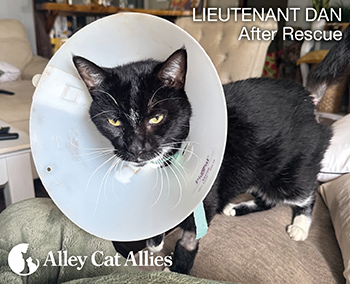
Seven-year-old Lieutenant Dan is far from an ordinary stray; he is a well-known, deeply cherished fixture in his Oahu neighborhood. When the historic flooding struck, Lieutenant Dan managed to survive the initial deluge, but he did not escape unscathed. He sustained a painful, deep laceration injury wrapped around his tail—a wound vulnerable to rapid infection in a tropical, post-flood environment.
The moment a local caregiver spotted the injured tuxedo cat, they immediately recognized the urgency of his condition and rushed him to a nearby veterinary clinic. Upon arrival, medical professionals evaluated the wound, but the looming obstacle for the caregiver was the cost of comprehensive surgical and post-operative care.
Alley Cat Allies stepped in, footing the bill for Lieutenant Dan’s complete medical treatment, including wound cleaning, surgical stitching, and pain management. The medical team reported a smooth recovery process. Better yet, because Lieutenant Dan was already embedded in a loving network of human advocates, his community was eagerly waiting to welcome him home the moment he was cleared, pain-free, and ready to resume his reign as the neighborhood favorite.
+-----------------------------------------------------------------+
|                    PATIENT PROFILE: LIEUTENANT DAN               |
+-----------------------------------------------------------------+
| Age: 7 Years Old                                                |
| Breed/Type: Tuxedo Cat                                          |
| Injury: Severe tail laceration caused by flood debris           |
| Intervention: Emergency veterinary surgery, wound care, and     |
|               pain management funded entirely by Alley Cat Allies |
| Outcome: Successfully treated, fully recovered, and returned    |
|          to his eager, loving neighborhood community.           |
+-----------------------------------------------------------------+
Pumpkin: Finding Hope After the Waters Receded
Just as the Rapid Response Team prepared to depart the veterinary clinic after checking on Lieutenant Dan’s progress, another emergency materialized through the doors. An Oahu resident rushed inside carrying an orange tabby cat named Pumpkin, desperately seeking medical attention.
As Pumpkin cautiously peeked her head out from her carrier, the source of her distress was immediately apparent: a raw, agonizing wound on her ear. Pumpkin had been discovered wandering in a previously flooded zone, visibly traumatized. When rescuers offered her a bowl of fresh food, she turned away, refusing to eat. Given the overwhelming psychological trauma of surviving a flash flood alongside a painful, untreated physical injury, her lack of appetite was hardly surprising—it was a textbook physiological response to acute stress.
With Alley Cat Allies providing continuous support alongside the veterinary care team, Pumpkin received the specialized medical attention required to clean and heal her ear. Recognizing that she lacked a stable home environment to return to in the wake of the disaster, the support network extended to foster care. Pumpkin was placed in a safe, nurturing temporary home where her appetite returned, her wounds healed, and she was prepared for the next chapter of her life: adoption into a permanent, loving forever home.
Supporting Context & Metrics: The Reality of Disaster Animal Rescue
Cat populations in tropical and coastal regions like Oahu are uniquely vulnerable to climate-induced catastrophes. According to environmental and animal welfare researchers, the increasing frequency of extreme weather events—driven by shifting global climate patterns—demands a permanent paradigm shift in how animal welfare organizations approach disaster management.
The Hidden Dangers of Floodwaters for Cats
- Pathogen Exposure: Floodwaters frequently mix with agricultural runoff, sewage, and urban debris, carrying leptospirosis, parasites, and severe bacterial agents that can easily enter open wounds or be ingested by grooming cats.
- Displacement and Disorientation: Rapidly rising waters destroy familiar scents and landmarks, leaving outdoor and community cats disoriented, trapped in trees or attics, or swept miles away from their established feeding stations.
- Secondary Starvation: Even after waters recede, local food sources are decimated, and stressed animals frequently experience temporary anorexia, complicating their chances of survival without human intervention.
The intervention mounted by Alley Cat Allies on Oahu demonstrates the efficacy of a decentralized, rapid-deployment model. By injecting immediate capital, material supplies, and medical underwriting directly into the local infrastructure, the Rapid Response Team prevented what could have been a localized mass-mortality event for the island’s outdoor feline population.
Official Statements and Strategic Insights
The success of the Oahu deployment highlights the critical synergy between national advocacy organizations and grassroots local networks.
"Disasters do not discriminate between humans and animals," notes field operations data from disaster response specialists. "When an island community experiences its worst flooding in two decades, the collateral damage sustained by outdoor and community cats is immense. Our mandate is to ensure that these animals are never treated as an afterthought."
Animal welfare advocates emphasize that financial relief is often the single greatest bottleneck during local emergencies. Veterinary clinics, already overwhelmed with displaced domestic pets, frequently lack the pro-bono capacity to absorb the medical costs of injured strays and community cats. By covering 100% of the treatment costs for cats like Lieutenant Dan and Pumpkin, Alley Cat Allies effectively removed the economic friction that too often results in deferred care or euthanasia.
Furthermore, the integration of foster networks—as seen in Pumpkin’s journey—illustrates that emergency response must seamlessly transition into long-term welfare solutions. Emergency triage cannot stop at first aid; it requires a commitment to rehabilitation, sheltering, and permanent placement.
Future Outlook: The Imperative of Disaster Preparation
While the emergency intervention in Oahu successfully saved lives, animal welfare leaders stress that the ultimate goal of disaster management must be proactive preparation rather than reactive rescue.
Natural disasters will continue to test vulnerable ecosystems, making proactive education an urgent necessity for cat caregivers, community leaders, and municipal shelters alike. Proactive planning significantly reduces the mortality rate of companion animals and minimizes the psychological trauma inflicted upon both pets and their human families.
Key Elements of Feline Disaster Preparedness
To safeguard cats against the next inevitable crisis, Alley Cat Allies urges caregivers and community groups to implement the following foundational measures:
- Establish Evacuation Kits: Maintain a dedicated grab-and-go kit for every cat, containing a minimum of a two-week supply of food, bottled water, necessary medications, secure carriers, and clear identification (microchip documentation and physical photos of the cat).
- Identify Safe Havens: Research pet-friendly emergency shelters, boarding facilities, or veterinary hospitals outside of flood-prone or high-risk zones well in advance of a weather event.
- Secure Community Feeding Protocols: For community cat colony managers, establish a communications network with neighbors to ensure multiple individuals know the locations of feeding stations and can safely secure or relocate feeding supplies prior to a storm.
- Microchipping and Identification: Ensure all cats—whether indoor pets or managed outdoor community cats—are microchipped with up-to-date contact information to facilitate rapid reunification if displaced by rising waters.
For comprehensive, step-by-step disaster preparedness guides tailored specifically to cats and feline caregivers, stakeholders are encouraged to visit the official Alley Cat Allies resource portal at alleycat.org/Disaster.
As climate anomalies continue to challenge coastal and island communities worldwide, the heroism witnessed on the North Shore of Oahu serves as both a testament to what is possible through compassionate intervention and a stark reminder of the work that lies ahead. Through preparedness, immediate response, and unwavering financial and medical support, organizations like Alley Cat Allies continue to light the path forward for our most vulnerable animal populations.