
Executive Overview
For decades, evolutionary biologists and paleontologists have wrestled with a profound temporal mismatch known colloquially as the "Cambrian explosion paradox." While the geological record shows a relatively sudden proliferation of complex animal fossils during the Cambrian Period—stretching from 539 to 487 million years ago—genetic and molecular data have long hinted that the animal lineage (Metazoa) began much earlier.
However, scientists trying to reconcile these conflicting timelines relied on a critical foundational assumption: the absence of evidence was, indeed, evidence of absence. Specifically, researchers used exceptionally preserved, ancient fossil deposits—such as the 590-million-year-old Weng’an Biota in China—to draw a hard line in the sand. The logic was straightforward: if delicate, microscopic structures like soft-bodied organisms and embryo-like cells could be preserved in pristine detail at sites like Weng’an without a single trace of animal life, then animals simply could not have existed yet.
That foundational assumption has now been thoroughly dismantled.
In a landmark study published on October 2 in Science Advances, an international team of researchers led by the University of Oxford—with contributions from the University of California, Berkeley, ETH Zürich, and Yale University—revealed that exceptional fossil preservation does not guarantee the capture of animal remains, even when it is historically proven that animals were already alive. By examining exceptionally preserved microfossils from the Kheseen Biota in Mongolia, the research team demonstrated that a lack of animal fossils in ancient deposits can no longer be used to cap the maximum age of the animal kingdom.
When the researchers adjusted their mathematical models—known as molecular clocks—to account for this realization and incorporated much older geological constraints (dating from 850 to 730 million years ago), the calculated origin of animal life plummeted backward by an astonishing 200 million years. The new models place the potential dawn of the animal kingdom between 800 and 700 million years ago.
This profound shift suggests that the first primitive animals may have roamed the Earth before some of the most catastrophic global climate upheavals in planetary history, including the extreme glaciations of the Cryogenian "Snowball Earth" era. While the elusive body fossils of these Precambrian pioneers still await discovery, this study fundamentally reshapes how science views the deep-time heritage of complex life.
Detailed Chronology: Unraveling the Evolutionary Timeline
To understand the magnitude of the new Oxford-led study, it is necessary to retrace the timeline of how scientists have historically estimated the birth of the animal kingdom.
The Traditional Paradigm: The Ediacaran Barrier
For generations, the conventional consensus pegged the appearance of the first animals close to the Ediacaran Period (spanning roughly 635 to 539 million years ago). The reasoning was anchored by extraordinary windows into the ancient past known as Lagerstätten—sedimentary deposits that preserve soft tissues and microscopic structures with breathtaking clarity.
Chief among these sites was the Weng’an Biota of South China. Dating back approximately 590 million years, the Weng’an phosphatic rocks contain microscopic organisms, algae, and proto-organisms preserved down to the cellular level. Because microscopists could examine these ancient micro-ecosystems in granular detail without finding a single undisputed animal fossil, science drew a firm conclusion: animals had not yet evolved. If they had, the pristine conditions of the Weng’an deposit surely would have captured them.
This negative evidence was subsequently used as a calibration point—a maximum age constraint—for molecular clock analyses, effectively locking the upper limit of animal evolution to the late Neoproterozoic.
The Kheseen Biota: Breaking the Rule
The turning point for the new research team came in the remote rock formations of the Kheseen Biota in Mongolia. The international research collective set out to analyze microfossils from this site, which is roughly 40 million years younger than the Weng’an Biota (placing it deeper into the Ediacaran).
Crucially, the paleontological record elsewhere on Earth already firmly establishes that animals did exist by the time the Kheseen Biota was deposited. Confirmed fossil evidence of early animal ecosystems from locations such as Namibia and South China clearly demonstrates that metazoans were swimming and creeping across the globe during this window.
Using advanced analytical methodologies—including high-resolution scanning electron microscopy (SEM)—the team examined more than 140 distinct rock samples, including materials recovered from previously undocumented field locations. Their harvest was rich: they uncovered exquisitely preserved new microfossil species, including acritarchs (enigmatic, tiny spherical micro-organisms adorned with intricate spines and branching projections) and delicate, embryo-like fossils containing distinct internal cell structures.
Yet, despite the phenomenal fidelity of the preservation, not a single specimen could be confidently classified as an animal.
This single realization shattered the core premise of Neoproterozoic paleontology. As senior author Associate Professor Ross Anderson pointed out, if the Kheseen microfossils can be just as well-preserved as those at Weng’an while still completely lacking animal remains—despite the indisputable fact that animals were alive at that time—then the absence of animals at Weng’an proves nothing. It merely indicates that animals lived elsewhere, preferred different environmental niches, or possessed body chemistries and compositions unsuited to the specific fossilization processes active in those localities.
Recalibrating the Molecular Clock
With the Weng’an constraint invalidated as a hard upper limit, the research team was forced to look much further back into the geological record to establish realistic maximum ages for the origin of animal life.
They turned their attention to ancient, highly productive fossil deposits dating from 850 to 730 million years ago. These included:
- The Svanbergfjellet Formation (Norway)
- The Bitter Springs Group (Australia)
- The Chuar Group (Arizona, USA)
These formations are known for preserving rich microfossil assemblages and possess the chemical and geological characteristics capable of hosting organic remains, even though definitive animal body fossils have not yet been discovered within them.
Feeding these older geological constraints into sophisticated molecular clock models, the research team ran rigorous simulations. Molecular clocks utilize the rate of genetic mutations accumulated over time by living species, combined with fossil calibration dates, to mathematically infer when lineages diverged from common ancestors.
When anchored to these older 850–730 million-year-old formations rather than the younger Weng’an deposit, the mathematical output shifted dramatically. The estimated emergence of the animal kingdom was pushed backward by approximately 200 million years, landing firmly in a window between 800 and 700 million years ago.
Supporting Context & Metrics
The implications of pushing the origin of animals back to 800–700 million years ago ripple across multiple scientific disciplines, intersecting with geochemistry, paleoclimatology, and molecular biology.
[Traditional Timeline]
Present ---> Cambrian (539Mya) ---> Ediacaran / Weng'an (590Mya) [MAXIMUM AGE CAP] ---> Animal Origins assumed here.

[New Oxford-Led Timeline]
Present ---> Cambrian (539Mya) ---> Ediacaran (Kheseen / Weng'an Proven Inadequate) ---> Older Constraints (850-730Mya) ---> ANIMAL ORIGINS PUSHED BACK TO 800-700Mya.
Supporting Chemical Evidence: Biomarkers
While physical body fossils from this deep-time interval remain elusive, the new evolutionary timeline aligns surprisingly well with independent biochemical lines of evidence.
For years, organic geochemists have studied ancient rock strata for chemical fossils, or biomarkers. These are stable molecular hydrocarbons that survive the breakdown of biological tissues and serve as molecular fingerprints of specific organisms.
Lipid biomarker research has consistently detected compounds known as 24-isopropylcholestanes in rocks dating back at least 650 million years. These specific molecules are heavily associated with demosponges—simple, filter-feeding aquatic animals. The presence of these chemical signatures tens of millions of years before the first widespread macroscopic animal fossils has long puzzled scientists. Under the new Oxford chronology, this biomarker evidence slots neatly into place, serving as an expected echo of a nascent, soft-bodied animal radiation that was already quietly populating ancient shallow seas.
The Anatomy of the First Animals
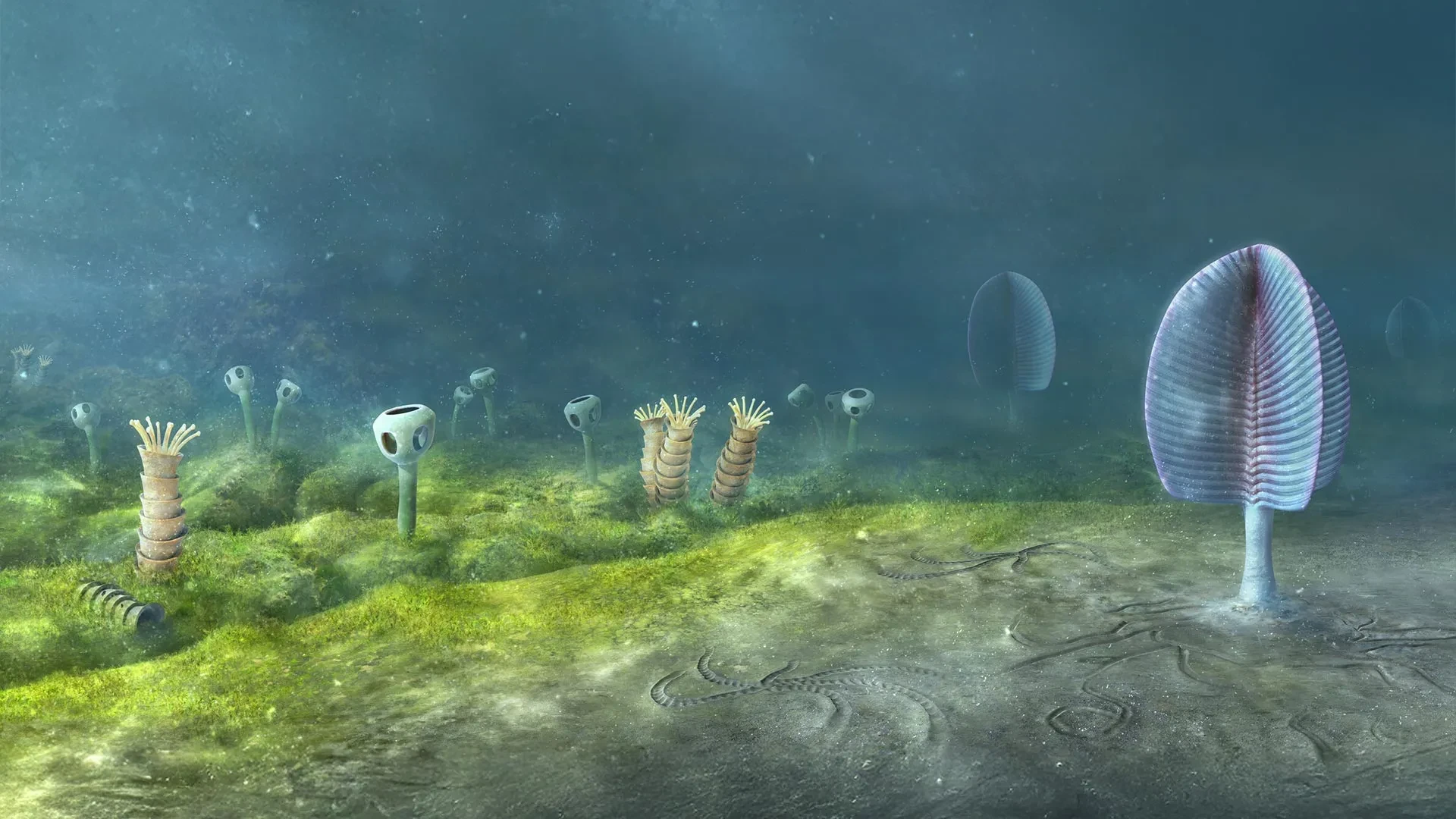
Why are these early animals so hard to find in the fossil record? The answer lies in their basic architecture.
- Lack of Hard Parts: The earliest metazoans were tiny, delicate, and entirely soft-bodied. They possessed no mineralized shells, rigid carapaces, or internal bony skeletons.
- Taphonomic Bias: Soft tissues decompose rapidly after death through bacterial decay and oxidation. For a soft-bodied organism to fossilize, an exceptionally rare sequence of geochemical events must occur—such as rapid entombment in fine-grained sediments, early mineralization by phosphate or silica, or development in anoxic (oxygen-depleted) bottom waters that shut down scavengers.
- Environmental Segregation: Early animals likely inhabited micro-environments (such as deep-water settings, cryptic crevices, or specific planktonic layers) that were chemically distinct from the depositional environments captured by famous fossil beds like Weng’an or Kheseen.
The "Snowball Earth" Conundrum
Perhaps the most staggering implication of an 800-to-700-million-year-old animal origin is its synchronization with the Cryogenian Period.
Beginning approximately 720 million years ago, Earth experienced some of the most severe, planet-wide glaciation events in its 4.5-billion-year history. During these episodes—collectively termed "Snowball Earth"—ice sheets advanced from the poles all the way to the tropics, locking the global ocean beneath massive, thick mantles of glacial ice.
If animals originated between 800 and 700 million years ago, it means the animal kingdom not only predated these global deep-freeze events, but may have actually lived through them, or perhaps even originated in the environmental pressures generated during the onset of these global crises. This forces paleoclimatologists and evolutionary biologists to reconsider how primitive ecosystems adapted, survived, or evolved in refugia—such as open equatorial patches of water, hydrothermal vent systems, or beneath translucent sea-ice shelves—during Earth’s most severe climatic test.
Official Statements from Leading Researchers
The study has drawn widespread attention across the global academic community for its methodological rigor and paradigm-shifting conclusions.
Associate Professor Ross Anderson, senior author of the study from the Oxford University Museum of Natural History, emphasized how the Mongolian discoveries upend decades of textbook assumptions:
"The Kheseen Biota breaks the argument that the exceptional microfossils of Weng’an mean we would have seen animal fossils in the assemblage had they existed at the time. The Kheseen microfossils are just as well-preserved, yet animals continue to be absent—despite the fact we know at that point they existed."
Anderson noted that researchers must now abandon simplistic assumptions about fossil absence and look deeper:
"Until that evidence becomes available, the precise birth date of the animal kingdom remains uncertain."
Orin Lole Durbin, the study’s first author—who began the research as an undergraduate at the University of Oxford and is now a doctoral student at Virginia Tech—discussed the nuanced reality of the findings:
"Pre-Ediacaran animal body fossils still elude us, and this analysis does not prove that animals existed 800 million years ago. However, our new fossil evidence from Mongolia undermines one of the main arguments for restricting animal origins to the Ediacaran interval. Meanwhile, our molecular-clock analyses show how much further back their evolutionary history could extend."
Future Outlook: The Next Frontier in Paleontology
As the dust settles on this publication in Science Advances, the paleontological community is charting a new course for how to hunt for the elusive dawn of complex life. The methodologies that relied on a tidy, restrictive reading of ancient fossil deposits are officially obsolete.
To definitively locate the first animals, researchers agree that future investigations must pivot toward three major strategic pillars:
1. Diversifying Geochemical and Environmental Sampling
Paleontologists must cast a wider net, exploring sedimentary basins from a much broader array of ancient environments, lithofacies, and global tectonic settings. Assuming that one or two exceptionally preserved fossil deposits represent global biological reality is a trap that science can no longer afford to fall into. Exploring older Neoproterozoic strata in less-studied geographic regions will be critical.
2. Multi-Proxy Integration
The search for early animal life can no longer rely on a single line of evidence. Future scientific breakthroughs will depend on synthesizing every available data stream:
- Body Fossils: Continuing the painstaking microscopic and macroscopic search for soft-bodied preservation.
- Trace Fossils: Looking for subtle bioturbation—burrows, tracks, or crawling traces left in ancient microbial mats that indicate active movement by multicellular organisms.
- Biomarkers: Expanding lipid and isotopic analyses to trace organic molecules linked to animal cellular metabolism across older rock sequences.
3. Refining Molecular Clock Models
As genetic databases of living organisms grow exponentially and computational power increases, molecular clock frameworks will continue to improve. By tightening the error margins on mutation rates and incorporating more robust geological calibration points derived from multi-basin analysis, geneticists will be able to narrow down the divergence windows with greater statistical confidence.
Conclusion
The journey to uncover the exact moment complex animal life sparked into existence on Earth has taken a dramatic turn. By proving that the absence of animal fossils in prime preservation sites is a false negative, the Oxford-led research team has reopened a 200-million-year window into Earth’s deep history. Whether the true progenitors of the animal kingdom swam in the warm, pre-glacial seas of a pristine Neoproterozoic world or weathered the unimaginable chill of Snowball Earth, the hunt for our most ancient ancestors has only just begun.