
Executive Overview
Long before a puppy ever learns to sit, walks in a disciplined heel on a leash, or assumes the profound responsibility of guiding an individual through a complex world, an intricate web of biological and neurological development is already underway behind the scenes. In the specialized realm of guide and service dog training, the margin for error is razor-thin. The ultimate success of a working dog relies heavily on resilience, environmental adaptability, emotional regulation, and unshakable focus.
Organizations dedicated to breeding and training elite service dogs recognize that these vital traits do not materialize overnight; nor are they forged exclusively during formal training in adolescence. Instead, they require a deliberate, science-based foundation built during the earliest, most vulnerable moments of an animal’s life. At Dogs Inc, preparing future guide dogs and service dogs begins long before formal training ever commences—reaching back into the silent, critical hours of the neonatal stage.
At the core of this early developmental strategy is a specialized, scientifically grounded protocol known as Early Neurological Stimulation (ENS). Designed to introduce mild, controlled physical challenges during a puppy’s first two weeks of life, ENS acts as a catalyst for neurological development, cardiovascular performance, and stress tolerance. While ENS is only one chapter in a much larger, comprehensive developmental story, it illustrates the meticulous, forward-thinking approach required to nurture healthy growth from birth. This report investigates the science, methodologies, chronological milestones, and overarching philosophies that govern early puppy development at organizations like Dogs Inc, exploring how early-life interventions shape the life-changing partners of tomorrow.
Detailed Chronology: From Neonatal Beginnings to Adolescent Milestones
A puppy’s journey from a blind, deaf newborn to a confident, highly skilled service dog is a masterclass in developmental biology. Understanding this evolution requires a careful examination of each distinct stage of early life, tracking how physiological milestones intersect with targeted human intervention.

[Birth - 2 Weeks] Neonatal Stage (ENS & Gentle Handling)
       │
       ▼
[2 - 4 Weeks] Transitional Stage (Eyes/Ears Open, First Steps)
       │
       ▼
[3 - 12 Weeks] Socialization Period (Environmental Exposure)
       │
       ▼
[6+ Months] Adolescent Stage & Fear Periods (Boundary Testing)
1. The Neonatal Stage (Birth to 2 Weeks)
During the first week of life and beyond, newborn puppies exist in a state of absolute dependency. Completely reliant on their mother and littermates for warmth, nutrition, and survival, these tiny animals spend the vast majority of their time sleeping and nursing. At this juncture, their eyes and ears remain firmly sealed, and they are physiologically incapable of regulating their own body temperature.
Despite their apparent fragility, monumental changes are occurring beneath the surface. The brain and central nervous systems are undergoing explosive growth, making this a critical window for foundational neurological imprinting. It is precisely within this delicate 14-day window that Early Neurological Stimulation is introduced. Because puppies at this stage are exceptionally vulnerable, ENS protocols are not designed to be rigorous training sessions. Rather, they consist of a series of brief, highly controlled, gentle tactile exercises administered by trained professionals following strict protocols. These mild stimuli challenge the neurological system just enough to encourage positive physiological adaptations without triggering chronic distress or overwhelming the puppy.
2. The Transitional Stage (2 to 4 Weeks)
As puppies cross the threshold from the neonatal phase into the transitional stage, the world rapidly opens up to them. Around the two-week mark, their eyes and ears begin to open, forever altering how they perceive their environment. By four weeks of age, puppies achieve significant motor milestones: they begin to stand, wobble on their legs, explore their immediate surroundings, and even experiment with playful barking.
Simultaneously, their deciduous baby teeth begin to erupt, signaling a nutritional shift away from exclusive nursing toward soft gruels and eventually solid foods. This stage introduces newfound sensory inputs—sight, sound, and varied textures underfoot—setting the stage for more complex social learning.

3. The Socialization Period (3 to 12 Weeks)
While ENS lays the biological bedrock during the neonatal period, the socialization window is where emotional and social architecture is constructed. Spanning from roughly three to twelve weeks of age, this period is arguably the most critical juncture in a dog’s behavioral development. As young puppies begin interacting actively with humans, novel sounds, varied surfaces, and other dogs, their brains rapidly form associations with the world around them.
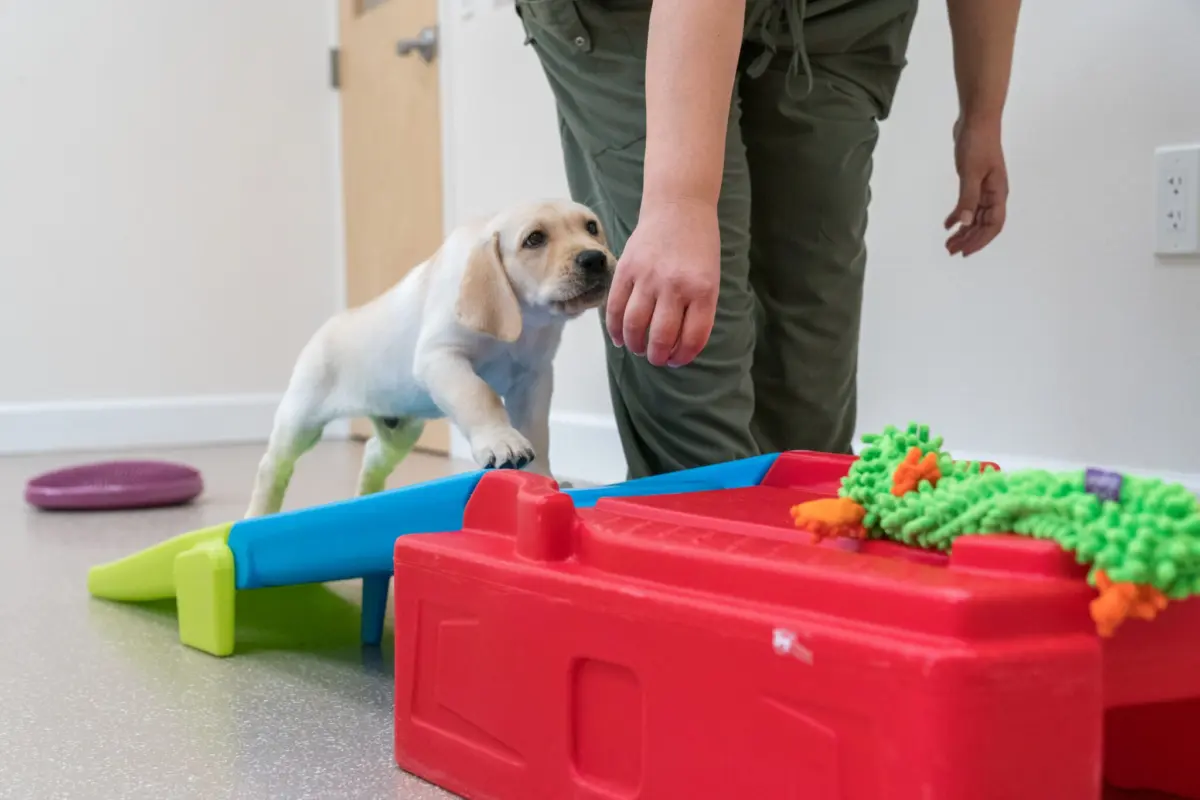
By the time a puppy reaches twelve weeks of age, structured exposure to diverse stimuli is paramount. Meeting individuals of different ages and appearances, exploring unfamiliar environments, navigating urban or rural settings, and experiencing novel sounds help cultivate baseline confidence. This deliberate exposure is essential for preventing fear-based behaviors, anxiety, and aggression in adult dogs. By eight weeks, many of these foundational experiences cement the behavioral traits required to become friendly, well-adjusted companions.
4. The Adolescent Stage and Fear Periods (6 Months and Beyond)
Development does not conclude with puppyhood. As dogs mature, they enter the adolescent stage—often beginning around six months of age—where they may test boundaries, much like human teenagers. Concurrently, most puppies experience reproductive maturity between six and 12 months. For female dogs, this includes navigating their first heat cycle and the broader hormonal shifts associated with it, while male dogs may display new hormone-driven behaviors.
Furthermore, canine behavioral science identifies an average of four distinct "fear periods" that most puppies traverse as they grow. During these sensitive phases, negative experiences can leave a disproportionately lasting psychological impact. Consequently, introducing new experiences during adolescence requires profound thoughtfulness, patience, and positive reinforcement methods to help puppies navigate their evolving hormonal and cognitive landscapes safely.

Supporting Context & Metrics: The Science and Mechanics of ENS
To fully appreciate the value of Early Neurological Stimulation, one must examine the specific mechanics of the practice and the physiological rationale behind it. Originally developed as part of the U.S. military’s canine breeding program (popularized as the "Bio Sensor" or "Super Dog" program), ENS was designed to improve the adaptability and performance of working dogs.
The Five Core Exercises of ENS
During the neonatal stage (days 3 through 16), puppies are subjected to a daily routine consisting of five specific, gentle exercises. Each movement lasts for approximately three to five seconds. The routine includes:
- Tactile Stimulation: Holding the puppy in one hand and gently tickling the pad of one foot using a Q-tip or finger. This stimulates sensory pathways in the paws, which are critical for future footing and environmental awareness.
- Head Erect: Holding the puppy perpendicularly (straight up) so that its head is directly above its tail. This challenges the vestibular system, encouraging balance and spatial orientation.
- Head Down: Holding the puppy firmly with its head pointed downward toward the ground at a controlled angle. This inverted position stimulates a minor stress response that activates the cardiovascular and neurological systems.
- Supine Position: Holding the puppy comfortably on its back, resting in the palm of the handler’s hand, allowing it to relax for a few seconds. This reduces defensiveness to handling in future veterinary and grooming contexts.
- Thermal Stimulation: Placing the puppy on a damp, cool towel for a brief moment. The mild drop in temperature introduces a safe, low-level thermal stressor that fires up metabolic and neurological pathways.
Quantifying the Physiological Benefits
Clinical observations and working dog data indicate that these brief, daily stressors yield remarkable physiological improvements. Potential benefits of ENS include:
- Improved Cardiovascular Performance: Enhanced heart rate efficiency and vascular tone.
- Stronger Heart Beats: Increased cardiac reserve capacity.
- Greater Tolerance to Stress: A heightened capacity to bounce back from novel or unexpected environmental pressures.
- Enhanced Immune System: Improved baseline resilience against minor physical stressors.
However, experts emphasize that ENS is only one piece of a complex puzzle. A puppy’s ultimate temperament, trainability, and success as a working dog are determined by a confluence of variables, including rigorous genetic selection, overall health, comprehensive socialization, environmental enrichment, and consistent, positive reinforcement training. ENS is designed to complement—never replace—these broader rearing practices.

Future Outlook: Preparing Elite Service Dogs for Complex Roles
Guide dogs and service dogs operate in environments that would overwhelm the average pet. They must navigate bustling city streets, crowded public transit systems, hospital corridors, and unpredictable social settings—all while maintaining absolute composure and a laser-like focus on their handler.
These elite operational qualities cannot be improvised during adulthood; they must be engineered through a lifelong continuum of care, beginning in the whelping box. The robust neurological foundation established by ENS and early neonatal handling prepares puppies for subsequent phases of life, including intensive puppy raising, public access training, and specialized task acquisition. Every developmental stage builds systematically upon the last.
Organizations like Dogs Inc invest profound resources into tracking and nurturing every phase of a puppy’s journey. By honoring the biological imperatives of the neonatal stage, navigating the critical windows of socialization, and supporting dogs through the turbulence of adolescence, these organizations ensure that future service dogs are fully equipped for the vital work they perform.
Ultimately, a puppy’s earliest weeks pass in the blink of an eye, yet they cast a long shadow over the rest of the animal’s life. Through a harmonious blend of cutting-edge canine science, compassionate handling, and lifelong education, the journey from a tiny, blind newborn to a life-changing service partner is successfully achieved—proving once again that true excellence truly does begin on day one.