
Executive Overview
Keeping a freshwater aquarium is a time-honored hobby that dates back approximately 4,500 years. Yet, despite centuries of tradition, modern advancements in equipment, filtration chemistry, and biological understanding have transformed the practice from a delicate guessing game into a reliable science. For beginners and intermediate enthusiasts alike, establishing a thriving aquatic ecosystem requires navigating an overwhelming array of tanks, filters, heaters, lights, and chemical conditioners.
To demystify this hobby, we consulted top-tier industry professionals, including Chi Cho, co-owner of New York’s Pacific Aquarium; Keith Seyffarth, creator of The First Tank Guide and a 35-year veteran of the hobby; and Jesse Trushenski, fish pathologist supervisor at the Idaho Department of Fish and Game. Combined with extensive hands-on testing of leading aquarium kits, standalone tanks, lighting arrays, and accessories, this guide provides the authoritative blueprint for setting up, stocking, and maintaining a successful 20-gallon freshwater community aquarium.
Detailed Chronology: Setting Up Your First Aquatic Ecosystem
Transitioning from an aquarium novice to a confident fish keeper requires a methodical, step-by-step approach. Because an aquarium is a closed biological system—unlike a flowing river or vast lake—every component must be chosen and installed with precision.
Phase 1: Planning and Equipment Procurement
Before purchasing a single fish, you must assemble the core infrastructure. A comprehensive starter checklist includes:
- A 20-gallon (or larger) glass tank
- A robust power or canister filter
- A reliable, adjustable submersible heater
- A high-efficiency LED light fixture
- A secure lid or canopy
- Quality gravel or soil substrate
- Water conditioner (dechlorinator)
- A comprehensive liquid water test kit
- A manual gravel vacuum/siphon
- Premium fish food
- An aquarium-safe algae scraper
Phase 2: Sourcing Livestock and Hardware
While dry goods can easily be ordered online, your fish should never be purchased via express delivery. Experts strongly recommend visiting a reputable Local Fish Store (LFS) rather than a commercial pet superchain. LFS establishments typically feature healthier livestock, more knowledgeable staff, and superior hardware. When evaluating any fish store, inspect the display tanks: cloudy water, dead fish, or medicated blue water in betta cups are immediate red flags.
Phase 3: The Nitrogen Cycle and Tank Maturation
Once your tank is assembled, filled, and treated with water conditioner, you face the most critical step in fish keeping: the nitrogen cycle. Because fish produce waste (ammonia), and uneaten food decays into toxic compounds, your tank must cultivate beneficial bacteria colonies to process these toxins into nitrites, then nitrates, and ultimately maintain a safe environment.
You can cycle your tank using two primary methods:
- Fish-In Cycling: Introducing two or three hardy fish immediately and managing toxic spikes through frequent 30% water changes over an eight-week period.
- Fishless Cycling: Adding a small dose of pure, concentrated ammonia to an empty tank to jump-start bacterial colonies before introducing any livestock. This prevents unnecessary stress on animals and establishes a resilient biological filter in roughly four weeks.
Supporting Context & Metrics: Testing the Best Equipment
To determine the gold standard in aquarium hardware, our testing panel evaluated dozens of products across major categories. Here is how the top picks shook out under rigorous scrutiny.
1. The Best Tank Kit: Marina 20G LED Aquarium Kit
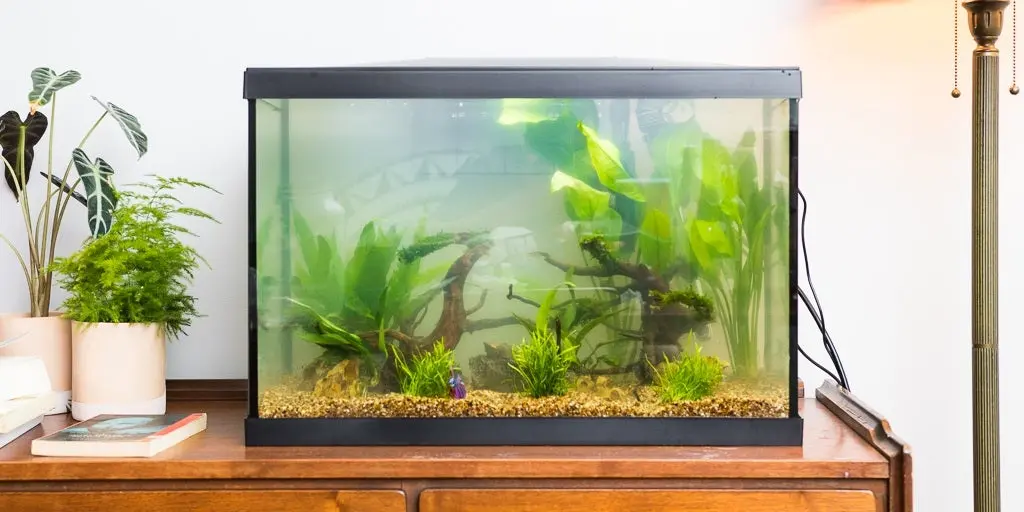
After testing five glass 20-gallon kits, the Marina 20G LED Aquarium Kit emerged as the top pick for beginners. While it lacks a heater, it outperforms competitors by featuring the brightest, most even LED lighting strip and a uniquely designed, customizable power filter. Unlike single-cartridge systems (such as Aqueon or Tetra) that wipe out your entire bacterial colony during routine media changes, the Marina’s four-cartridge system allows you to swap filters incrementally, preserving vital biological filtration.
2. The Best Heater: Eheim Jäger Thermostatic Aquarium Heater (100-Watt)
Temperature stability is paramount; fluctuating water can compromise a fish’s immune system and trigger outbreaks of Ichthyophthirius multifiliis (Ich). The Eheim Jäger offers an impressive temperature range (65°F to 93°F) with half-degree calibration precision. Its stiff adjustment dial prevents accidental bumps during tank maintenance, and its robust glass construction makes it the industry standard. For an indestructible alternative, the Aqueon Pro Heater offers a shatterproof aluminum core and a lifetime warranty, though with slightly less precise temperature markings.
3. The Best Lighting: Current USA Satellite Freshwater LED
Lighting dictates both visual aesthetics and plant health. The Current USA Satellite is exceptionally slim (under half an inch tall) yet casts an even, brilliant glow across all four corners of a 20-gallon tank. It includes a wireless remote with seven customizable presets mimicking natural phenomena like thunderstorms, dusk, and moonlight. For budget-conscious buyers, the Nicrew White and Blue LED offers incredible brightness at half the price, while the Finnex Planted+ 24/7 serves as the ultimate upgrade pick for high-tech, heavily planted underwater jungles.
4. The Best Filter: AquaClear Power Filter
For standalone filtration, the AquaClear Power Filter remains peerless. Endorsed by professional aquurists, it utilizes a three-stage filtration process: mechanical foam for debris, activated carbon for chemical adsorption, and porous ceramic rings (BioMax) that maximize surface area for beneficial bacteria. Its modular design allows you to clean or replace individual components without crashing your tank’s biological cycle.
Official Statements & Expert Insights
Industry leaders emphasize that patience and preventative maintenance form the cornerstone of successful fish keeping.
- On Tank Size: "I always recommend starting with a 20-gallon tank or larger," notes Keith Seyffarth of The First Tank Guide. "Small tanks have a tiny margin for error. A minor ammonia spike that is easily diluted in 30 gallons can prove lethal in a 2-gallon bowl."
- On Diet and Nutrition: Jesse Trushenski, fish pathologist supervisor at the Idaho Department of Fish and Game, highlights the systemic impact of nutrition: "There is very little that happens to a fish that can’t be directly or indirectly influenced by their diet, including pigmentation, growth rates, and overall immune health." Choosing high-protein staples like TetraMin Tropical Flakes (47% protein) ensures optimal development, particularly for younger fish.
- On Water Chemistry: Chi Cho of Pacific Aquarium stresses the importance of heavy-duty dechlorinators: "Seachem Prime is simply one level above the rest. It binds toxic ammonia, nitrite, and nitrate, making it an indispensable tool during new tank setups and routine water changes."
Future Outlook: Trends and Sustainability in Modern Aquaria
As the freshwater aquarium hobby continues to evolve into the 2020s and beyond, several key trends are shaping the market:
- Smart Technology Integration: Automated programmable lighting timers, digital temperature controllers with Wi-Fi alerts, and auto-top-off (ATO) systems are shifting from salt-water reef tanks into mainstream freshwater setups, reducing human error.
- The Planted Tank ("Aquascaping") Renaissance: Driven by social media platforms like YouTube and Instagram, natural planted aquariums utilizing high-grade nutrient soils (such as CaribSea Eco-Complete) and CO2 injection systems are surging in popularity over artificial, neon-colored plastic decorations.
- Sustainable Breeding Practices: More hobbyists and commercial suppliers are prioritizing captive-bred fish over wild-caught specimens, reducing ecological pressures on tropical river ecosystems in South America and Southeast Asia.
By investing in quality foundational equipment—such as a 20-gallon glass tank, a multi-stage filter like the AquaClear, a precise Eheim heater, and a reliable test kit—newcomers can bypass common pitfalls and enjoy a vibrant, low-stress aquatic hobby for years to come.