
Executive Overview
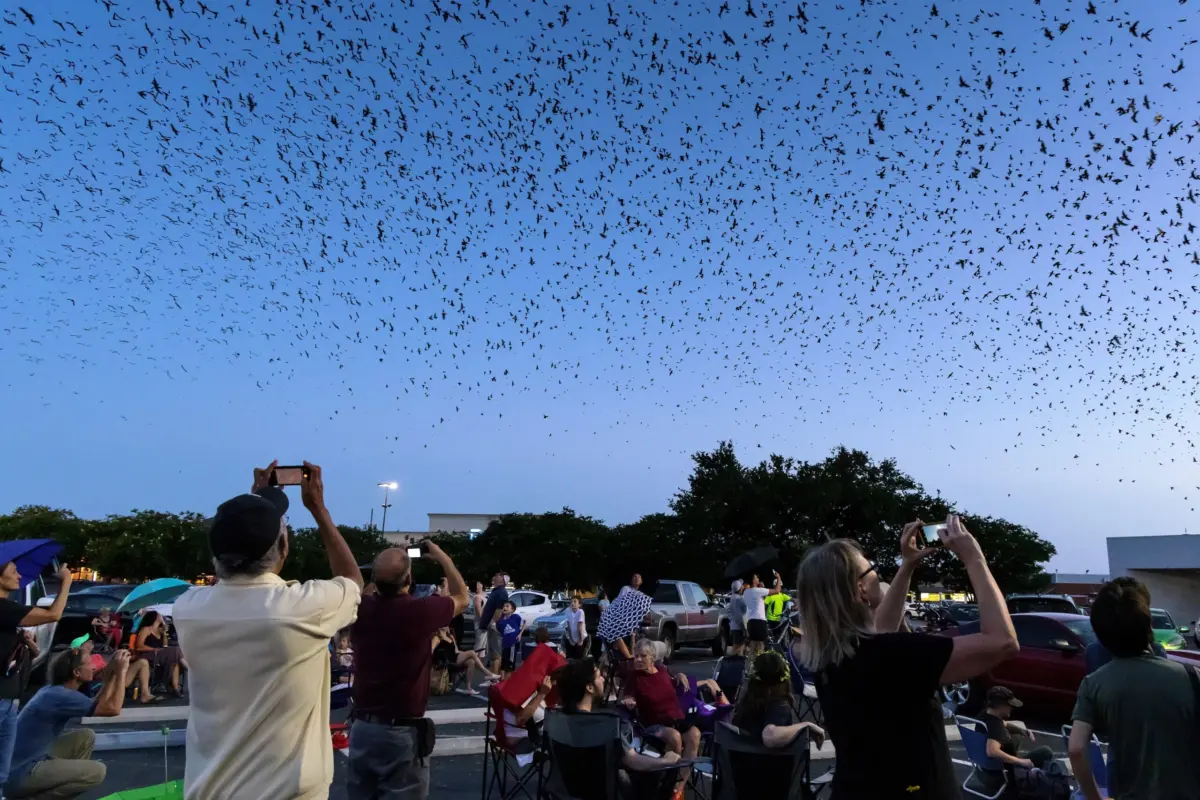
Every summer, as the golden afternoon light of the Texas dusk fades into a humid twilight, an unusual scene unfolds across the asphalt expanses of urban strip malls and downtown plazas. Beneath the buzzing fluorescent glow of commercial signage, hundreds of people—armed with lawn chairs, picnic blankets, and, crucially, protective hats and umbrellas—gather on the warm concrete. As day turns to dark, the air fills with a cascading chorus of high-pitched chirps. Suddenly, a swirling vortex of ultramarine feathers descends from the sky, blanketing the urban canopy in a fluttering, living cloud of hundreds of thousands of Purple Martins.
This phenomenon, now famously celebrated as the "Purple Martin party," has transformed mundane commercial real estate into epicenters of wildlife tourism and community engagement. For decades, birders and curious onlookers alike have congregated in these unlikely venues to witness one of nature’s most dazzling aerial spectacles. Organized primarily by conservation groups like the Travis Audubon Society in Austin and the Friends of Warner Parks in Nashville, these gatherings bring together everyday citizens, seasoned ornithologists, and local business owners.
However, beneath the festive atmosphere of lawn games, food trucks, and shared awe lies a complex ecological narrative. Purple Martins (Progne subis)—the largest swallows in North America—rely on these massive pre-migratory roosts as a vital stage in their annual life cycle. As these aerial insectivores prepare for their arduous, thousands-of-mile journey back to the Brazilian Amazon, they congregate in dense flocks for protection against predators and to help fledglings learn critical foraging skills.
Yet, as urban sprawl encroaches upon natural habitats and commercial pressures mount, securing these staging grounds has become an increasingly high-stakes endeavor. Conservationists must navigate logistical nightmares, from tracking elusive roosts via weather radar to convincing reluctant property managers that hosting a "tornado of birds" is an ecological privilege rather than a public nuisance. Amid widespread population declines driven by habitat loss, invasive species, and shifting climatic conditions, these urban roosting parties have evolved far beyond mere public entertainment. They serve as critical tools for grassroots advocacy, community science, and a burgeoning movement toward human-wildlife coexistence in the concrete jungles of the twenty-first century.
Detailed Chronology: From Elusive Flocks to Organized Phenomenon
To understand the modern Purple Martin party, one must first retrace the meticulous detective work required to bring these events to life. The journey from a hidden natural phenomenon to a celebrated public festival involves weeks of scouting, data analysis, and delicate public relations.
The Search for the Elusive Roost
Despite their immense numbers—often swelling into the tens or hundreds of thousands at a single site—Purple Martin roosts can be remarkably difficult to pinpoint. Unlike stationary nesting colonies, these pre-migratory gatherings are transient and notoriously fickle. The birds do not necessarily return to the exact same cluster of trees year after year, and their activity windows are hyper-restricted to the fleeting moments of sunrise and sunset.
For organizers like Susanne Harm, a long-time volunteer for the Travis Audubon Society in Austin, the process of securing a venue begins weeks before the first party flyer is printed. Harm and her fellow volunteers spend mornings and evenings driving north of Austin, scanning the horizon for the telltale silhouette of swooping martins.
When visual scouting fails from the ground, volunteers turn to modern technology: meteorology. Because these swirling flocks of birds are so dense and massive, they routinely register on Doppler weather radar. As millions of wings beat in unison at dawn and dusk, the flocks bloom into distinct, airborne "donuts" on radar screens, allowing conservationists to track their departure paths and pinpoint their general coordinates from miles away.
Courting the Commercial Sector
Once a viable roost is located—often in the parking lot of a strip mall, a corporate office park, or a massive stadium—organizers face their next major hurdle: winning over local property managers and business owners.
The arrival of 150,000 birds brings undeniable challenges, primarily in the form of massive quantities of guano and the sheer acoustic volume of thousands of chirping martins. In 2020, when a massive roost blanketed a downtown Nashville symphony center with droppings, the initial corporate response was immediate recourse to pest control to drive the birds away. Conservationists had to scramble to intervene, convincing facility managers to halt extermination efforts and instead lean into the ecological spectacle.
This outreach requires delicate diplomacy. "The first thing I do is educate them about this massive tornado of birds that will soon be descending," Harm explains. This educational push is not always met with open arms; as recently as 2023, Travis Audubon faced the daunting prospect of canceling its signature parties due to a sudden lack of buy-in from skittish property managers worried about liability and property cleanliness.
Yet, when education succeeds, the partnership can be transformative. Following intensive advocacy efforts in Nashville, volunteers stationed themselves at summer roosts to demystify the birds for the public. By 2024, when the martins adopted Nissan Stadium as their staging ground, a series of co-hosted Purple Martin parties drew massive crowds of dazzled spectators, proving that commercial spaces and massive wildlife congregations can, with careful management, successfully coexist.
Supporting Context & Metrics: The Biology and Ecology of Progne subis
To fully appreciate the drama unfolding in asphalt parking lots, one must examine the life history and ecological imperatives driving the Purple Martin.
+-------------------------------------------------------------------------------+
|                        THE PURPLE MARTIN ANNUAL CYCLE                         |
+-------------------------------------------------------------------------------+
|  EARLY SPRING      -->  NESTING & BREEDING  -->  MIDSUMMER ROOSTS  --> FALL   |
|  Migrate from           East of the Rockies,     Massive urban parking   Return |
|  Brazilian Amazon       nest almost exclusively  lot gatherings for      to     |
|  to North America       in human-made gourds     protection & learning   South  |
+-------------------------------------------------------------------------------+
Anatomy of an Aerial Insectivore
The Purple Martin is an extraordinary athlete of the skies. Known for their striking, ultra-marine iridescent plumage (in mature males) and cheery, bubbling calls, these birds spend the vast majority of their lives airborne. They capture all their food—primarily flying insects such as dragonflies, beetles, butterflies, and flies—on the wing.
In early spring, the martins embark on a grueling transcontinental migration from their wintering grounds in South America, specifically the Brazilian Amazon. They fan out across eastern North America, as well as select pockets of the Southwest and the Pacific Coast, to breed and raise their young.
Why the Parking Lot?
As summer draws to a close and the breeding season concludes, the birds undergo a profound behavioral shift. Rather than remaining in isolated family units, they begin to congregate in colossal communal roosts. According to Joe Siegrist, president of the nonprofit Purple Martin Conservation Association, this staging behavior is a non-negotiable component of their survival strategy.
Gathering in massive numbers provides safety in numbers against nocturnal predators such as owls and hawks. Furthermore, these pre-migratory roosts act as vital educational academies. Fledglings, having recently left their nests, learn critical foraging techniques and navigational cues by observing older, more experienced birds.
The choice of urban parking lots as roosting sites is not as bizarre as it initially appears. To a martin descending from the stratosphere, vast expanses of dark, heat-absorbing asphalt and concrete visually mimic natural aquatic bodies. "A patch of trees in the middle of a parking lot mimics a patch of trees in the middle of water," Siegrist notes, explaining why these human-made landscapes so effectively substitute for ancestral wetlands and river basins.
The Role of the "Landlord"
The relationship between Purple Martins and humans is uniquely intimate, stretching back centuries. Indigenous peoples across North America historically hung hollowed-out gourds from poles to encourage martins to nest near their villages, valuing the birds for their aggressive insect control.
Today, this tradition continues in a modernized form. In eastern North America, Purple Martins now breed almost exclusively in human-made structures. As natural tree cavities have vanished due to deforestation and land development, a dedicated subculture of citizen conservationists—affectionately known as "landlords"—has stepped in. These individuals construct and maintain multistory aluminum housing complexes or clusters of specialized gourds in their backyards, public parks, and community gardens.
These landlords do more than just provide housing; they serve as the backbone of North American martin research. By logging data on when parents arrive, how many eggs are laid, and how many chicks successfully fledge, these volunteers provide invaluable datasets to academic researchers studying avian ecology and climate impacts.
Official Statements & Expert Perspectives
The intersection of urban planning, wildlife conservation, and public education has elicited powerful reflections from leaders in the field:
"A lot of people who would not consider themselves to be birders—or maybe even nature lovers—come out to our parties. They see this massive cloud of birds, they feel the breeze of thousands of wings, and something shifts inside them."
— Shelia Hargis, Board President, Travis Audubon Society"It’s pretty amazing that they have this association with humans. They share our cities, they adapt to our parking lots, and they bring people together who might never otherwise set foot in a nature reserve. They truly are the people’s bird."
— Laura Cook, Bird Research Coordinator, Friends of Warner Parks"The data our citizen scientists and volunteer landlords collect are hugely valuable to what we’re doing as scientists. From tracking climate change impacts to identifying unknown roost sites via radar, we simply could not monitor this species at scale without public participation."
— Dr. Maria Stager, Biologist, University of Massachusetts Amherst
Future Outlook: Challenges and Conservation Imperatives
Despite the festive atmosphere and the growing popularity of urban bird-watching parties, the long-term outlook for the Purple Martin requires urgent vigilance.
Population Pressures
Across their North American range, Purple Martin populations are facing widespread, concerning declines. These downward trends are primarily driven by compounding environmental stressors:
- Habitat Loss: The continuous clearing of mature forests reduces natural nesting cavities, making the species nearly entirely dependent on human-provided housing east of the Rockies.
- Invasive Species: Aggressive non-native birds, particularly European Starlings and House Sparrows, frequently usurp martin nesting boxes, destroying eggs and killing nestlings.
- Climate Disruption: Increasingly erratic weather patterns, severe droughts, and unseasonal storms during migration periods can decimate insect populations and impair migratory success.
The Power of Coexistence
Conservationists emphasize that saving the Purple Martin cannot be achieved through strict isolation or protected wilderness areas alone. Because these birds have forged such a close, dependent relationship with human infrastructure—nesting in our yards and roosting in our parking lots—their future is inextricably linked to our willingness to share our living spaces.
By demystifying the birds, addressing public concerns over guano and noise, and turning potential conflicts into celebratory community events, organizations like Travis Audubon and Friends of Warner Parks are pioneering a new paradigm of urban conservation. The sprawling parking lot parties prove that human-dominated landscapes do not have to be sterile zones devoid of wildlife. Instead, under the right conditions, they can become vibrant classrooms for empathy, scientific discovery, and profound ecological wonder.
As the thousands of martins wheel into the dusk sky above Austin, Nashville, and cities across the continent, they leave behind more than just a fleeting spectacle. They leave a challenge to urbanites everywhere: to look up from the concrete, embrace the wildness thriving right outside our doors, and ensure that the skies remain filled with the spirited chatter of the people’s bird for generations to come.