
By Caleb Frankel, VMD
Executive Overview
For years, the veterinary profession has grappled with an enduring paradox: while medical science and pharmacological options advance at a breathtaking pace, the operational infrastructure supporting frontline practitioners has frequently lagged behind. Veterinary teams have long fought to close the gap between the meaningful, high-impact clinical work they were trained to do and the administrative burdens of the tools they were given to execute it.
The industry has successfully navigated two distinct technological revolutions over the past decade. The first wave introduced cloud-based practice management software (PMS) designed around actual clinical workflows, bringing connectivity and speed to hospitals. The second wave delivered AI scribing platforms, which revolutionized documentation by drastically cutting down after-hours record-keeping and allowing clinicians to be fully present with their patients and clients.
Yet, these monumental wins are merely precursors to a much larger evolution. As we look toward the horizon of veterinary medicine, the core mission of the clinician remains steadfast: to diagnose, treat, and communicate. While documentation supports that mission, it is not the work itself.
We stand now at the threshold of the third wave: the integration of Artificial Intelligence as a mechanism for clinical decision support. This next frontier is not merely about helping veterinary teams move faster or write notes more efficiently; it is about empowering them to practice better, more confident medicine at the point of care. By intelligently converging practice management software, AI scribes, and deeply trusted clinical references, the profession is poised to transform how medical knowledge is retrieved and applied during live patient examinations.
Detailed Chronology: The Evolution of Veterinary Tech
To understand where veterinary technology is heading, it is instructive to examine the path it has traveled over the past ten years. This evolution can be broken down chronologically into distinct generational leaps.
Phase 1: The Foundation of Modern Connectivity (Early-to-Mid 2010s)
Historically, veterinary clinics relied on fragmented, legacy software systems that operated in silos. Patient records, laboratory results, billing, and scheduling often lived on local servers or disjointed databases that required cumbersome data entry.
- The Shift: The first wave of modern practice technology introduced cloud-native platforms. Designed specifically around the chaotic, multi-tasking realities of veterinary hospitals, these systems prioritized speed, safety, and cross-departmental connectivity.
- The Impact: Medical teams were finally placed at the center of the software architecture, rather than serving as mere data-entry clerks for archaic financial ledgers.
Phase 2: The Eradication of Documentation Fatigue (Late 2010s–Early 2020s)
Even with modern PMS platforms, veterinarians faced an invisible epidemic: documentation fatigue. Clinicians spent hours after their shifts typing SOAP (Subjective, Objective, Assessment, Plan) notes, reviewing dictated logs, and catching up on medical records well into the evening.
- The Shift: The emergence of AI-powered ambient scribes and voice-to-text documentation tools changed the landscape. By listening to patient-client-veterinarian conversations and automatically structuring them into clinical notes, these tools relieved one of the most universal burnouts in practice.
- The Impact: Clinicians regained precious personal time, reducing compassion fatigue and allowing for deeper human connections in the exam room.
Phase 3: The Dawn of Clinical Decision Support (The Present & Beyond)
With documentation largely streamlined, the industry is shifting its focus back to the primary intellectual challenge of veterinary medicine: making complex, multi-variable medical decisions under pressure.
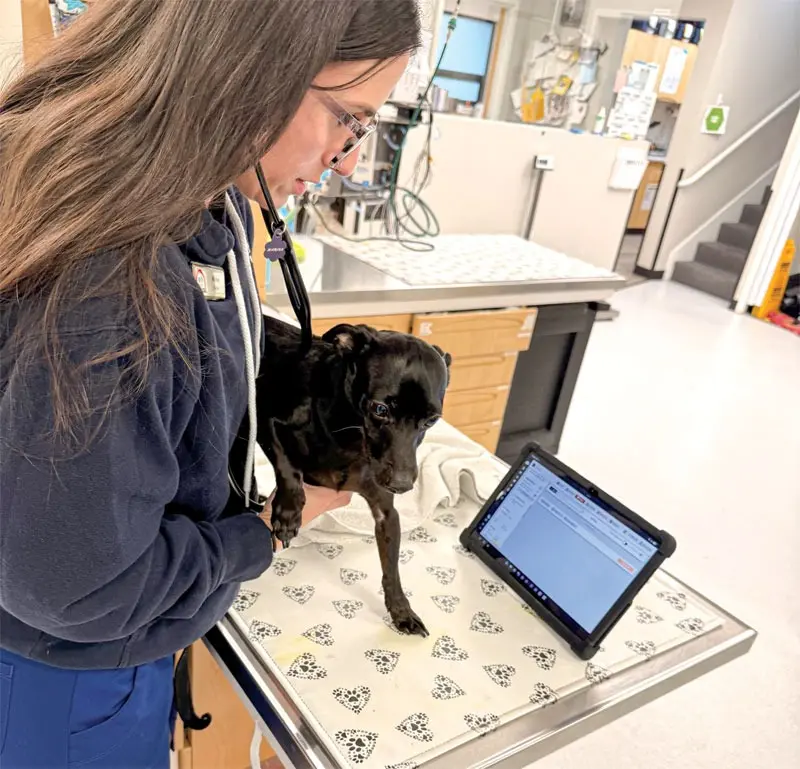
- The Shift: The convergence of AI with peer-reviewed clinical references and practice management software. Rather than forcing a clinician to leave an active medical record, open a new browser tab, and manually search through textbooks or digital compendiums, next-generation tools bring synthesized, evidence-based guidance directly into the active workspace.
- The Impact: Practitioners can verify drug dosages, cross-reference adverse reactions, check interactions, and pull client handouts instantly, ensuring that institutional knowledge and published data are always within arm’s reach during an exam.
Supporting Context & Metrics: The Reality of Information Retrieval in Practice
The necessity for real-time clinical decision support is rooted in the sheer volume of modern veterinary pharmacology, toxicology, and internal medicine. To appreciate why AI-enabled clinical retrieval is critical, one must look at the cognitive load currently placed on practitioners.
The Information Overload Challenge
In a typical busy general practice or emergency room, a clinician may manage dozens of patients daily across multiple species—primarily dogs and cats, but frequently exotic pets, pocket pets, and avian species. Each species brings its own distinct metabolic pathways, pharmacokinetic profiles, and therapeutic safety margins.
- The Plurality of Resources: Veterinary professionals have access to world-class point-of-care references, including specialized drug formularies (Plumb’s Veterinary Drugs), evidence-based consensus statements, peer-reviewed journals, and internal hospital protocols.
- The Friction of Access: Despite the wealth of available data, the friction of retrieval remains high. When a veterinarian is standing in front of a critical patient, balancing a worried client’s questions, and managing a tight schedule, stopping to thoroughly research a rare drug interaction or double-check a specialized dosing calculation creates a difficult dilemma. Clinicians are frequently forced to choose between performing exhaustive literature searches—thereby falling behind schedule—or relying solely on memory under time constraints.
The "Garbage In, Garbage Out" Dilemma in Veterinary AI
As artificial intelligence permeates healthcare, a foundational rule of technology becomes profoundly relevant: garbage in, garbage out.
General-purpose, consumer-grade AI models are trained on vast internet scrapes. While they can generate polished, confident-sounding prose in a matter of seconds, confidence in medicine is not synonymous with reliability. If an AI tool draws from unvetted, outdated, or human-medicine-centric datasets, the output can introduce catastrophic risks into veterinary workflows.
Veterinary medicine is uniquely complex due to inter-species variations. A drug that is safe and standard in human medicine or canine practice can be lethal in felines or specific breeds. Therefore, the architecture of clinical AI must rely on rigorous, specialized safeguards:
- Peer-Reviewed Foundation: Content must be strictly evidence-based and drawn from recognized veterinary authorities.
- Dynamic Updating: Formularies and guidelines must reflect the most current pharmacological data.
- Transparent Citations: Tools must clearly cite their sources, allowing veterinarians to verify the origin of any recommendation rather than blindly trusting an opaque algorithmic output.
- Species-Specific Nuance: Algorithms must account for the multi-species complexities inherent to veterinary practice.
Official Perspectives: The Role of AI as an Assistant, Not an Arbiter
Industry leaders and practicing clinicians emphasize a vital distinction: clinical decision support is not clinical decision-making.
Dr. Caleb Frankel, founder and CEO of Instinct Science, an internship-trained emergency veterinarian, and a prominent voice at the intersection of veterinary medicine and technology, articulates this boundary clearly.
"AI-enabled clinical tools should support decision-making, not replace it," Frankel notes. "Clinical decision support can surface relevant information faster. It can retrieve published data, summarize key considerations, highlight potential interactions, and direct veterinarians back to the original source. However, it has limits when it comes to context."
The Nuance of Patient Context
No two patients are identical. A clinical algorithm can evaluate raw parameters, but it cannot fully account for the intricate, living matrix of veterinary practice:
- Comorbidities and Concurrent Medications: Subtle organ system declines or complex drug regimens change the calculus of treatment.
- Economic Realities: Financial limitations frequently dictate the spectrum of care a client can pursue, requiring veterinarians to pivot skillfully while maintaining high ethical standards.
- Client Circumstances and Patient Temperament: Home administration challenges, aggressive patient disposition, and client lifestyle factors heavily influence therapeutic success.
Because these variables fluctuate wildly from case to case, AI must remain an intelligent assistant—handling the heavy lifting of information retrieval, drafting, summarizing, and citation—while the attending veterinarian retains ultimate responsibility for synthesizing data, applying clinical judgment, and standing behind the final medical plan.
Future Outlook: Parallels with Human Medicine and the Path Forward
Veterinary medicine often looks to human healthcare as a bellwether for technological adoption. In human medicine, physicians are already utilizing AI-powered clinical decision support systems embedded directly into electronic health record (EHR) workflows to instantly surface the latest evidence at the bedside.
As veterinary medicine reaches this pivotal inflection point, the roadmap ahead is clear. The goal is not to automate the clinician out of the loop, nor is it to turn veterinary practice into a sterile, algorithmic exercise. Rather, the future of veterinary AI is designed to foster a stronger foundation of clinical confidence.
What the Third Wave Promises for the Profession:
- Workflow Harmony: Seamless integration where practice management software, AI scribes, and clinical references operate as a unified ecosystem. Information surfaces precisely when a case demands it, eliminating the need to toggle between multiple windows and tabs.
- Preservation of the Human Element: By offloading administrative searches and cognitive friction, clinicians gain more mental bandwidth for clear thinking, empathetic communication, and meaningful client engagement.
- Elevated Standards of Care: Easy access to trusted, peer-reviewed references ensures that practitioners across all environments—from rural general practices and high-volume shelters to multi-specialty referral hospitals—can practice top-tier medicine with institutional backing.
Ultimately, the true promise of artificial intelligence in veterinary medicine is not about doing more work in less time. It is about creating room for the parts of the profession that matter most: thinking clearly, communicating compassionately, and making the best possible decisions for the animal patients entrusted to our care. That is the version of AI worth building, refining, and championing for the veterinary community.