
EXECUTIVE OVERVIEW
Deep within the hyper-arid coastal desert of Peru, roughly 190 miles north of Lima, archaeologists have unearthed extraordinary physical evidence that rewrites our understanding of human-animal relationships in the ancient Americas. Recent excavations at Castillo de Huarmey—the sole confirmed northern coastal administrative and ceremonial center of the sprawling pre-Inca Wari Empire—have yielded naturally mummified remains, unique skeletal anomalies, and chemical clues detailing the lives of Peruvian hairless dogs that walked the Andean landscape more than 1,200 years ago.
Long before the rise of the Inca Empire, the Wari civilization integrated these slender, distinctive canines into their complex society. Published in the Journal of Anthropological Archaeology, this groundbreaking study offers the first physical verification of the Peruvian hairless dog breed at a Wari site. Far from being uniform working animals or mere village scavengers, these dogs occupied a nuanced, sometimes contradictory social standing. Some were buried with elite craftspeople and human sacrifices in sacred chambers, while others shared the fate of standard refuse. Through advanced zooarchaeological techniques, radiocarbon dating, and stable isotope analysis, an international team of researchers has decoded a millennium-old biological and cultural legacy, demonstrating that humanity’s complicated, multifaceted bond with dogs is as old as civilization itself.
DETAILED CHRONOLOGY: UNCOVERING THE SECRETS OF CASTILLO DE HUARMEY
The historical narrative of Castillo de Huarmey is one of imperial ambition, catastrophic natural disaster, illicit looting, and painstaking scientific redemption. Built and occupied between 600 and 1050 CE, the 110-acre complex served as a vital provincial hub for the Wari Empire, predating the famous Inca civilization by roughly four centuries.
A History of Monumental Archaeological Discoveries
For decades, the true significance of Castillo de Huarmey remained partially masked by time and human disturbance. However, a series of monumental discoveries over the last two decades transformed the site into one of the most critical archaeological zones in South America:
- 2012 Breakthrough: Archaeologists announced the discovery of the first completely undisturbed elite Wari tomb. Tucked safely beneath floors, the burial chamber contained the breathtaking remains of 58 high-status women, six human sacrificial victims, and approximately 1,300 luxury artifacts crafted from gold, silver, bronze, and precious stones.
- 2022 Revelations: Researchers uncovered adjacent burials dedicated to elite craftspeople. These individuals were interred alongside specialized tools of gold, silver, and bronze, illustrating how the Wari orchestrated specialized industrial production and provincial governance.
- 2010–2025 Animal Remains Excavations: Ongoing work across the ceremonial and domestic sectors of the site yielded vast quantities of South American camelid remains (domesticated llamas and alpacas), alongside extensive dog bones. However, interpreting these faunal assemblages was heavily complicated by historical damage.
Surviving Earthquakes and Looters
The archaeological integrity of Castillo de Huarmey has faced severe trials. In 1970, a massive earthquake rocked the Peruvian coast, causing structural sections of the ancient complex to collapse. This tectonic violence exposed upper-level burial chambers, inadvertently inviting widespread looting.
As looters ransacked the upper strata, valuable artifacts and faunal remains became heavily mixed and displaced. Fortunately, the deepest archaeological layers remained entirely sealed and untouched, preserving their pristine Wari context. It was within these complex upper-and-middle transition zones—particularly in the northern section of the main ceremonial area—that researchers stumbled upon the definitive biological markers of ancient Peruvian hairless dogs.
SUPPORTING CONTEXT & METRICS: GENETICS, ISOTOPES, AND DIETARY RECONSTRUCTION
The identification of the ancient canines relied on a fascinating convergence of rare anatomical preservation, modern genetics, zooarchaeology, and chemical analysis.
The Genetic Signature: Missing Teeth and Hairlessness
During excavations, three specific sets of dog remains instantly captured the research team’s attention:
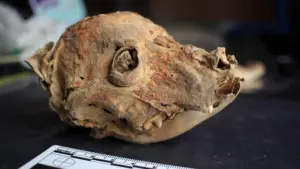
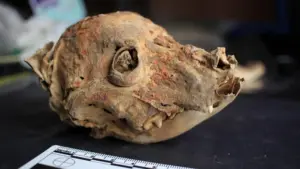
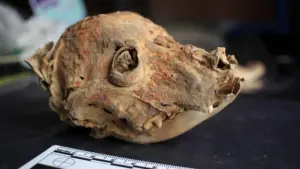
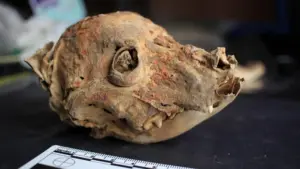
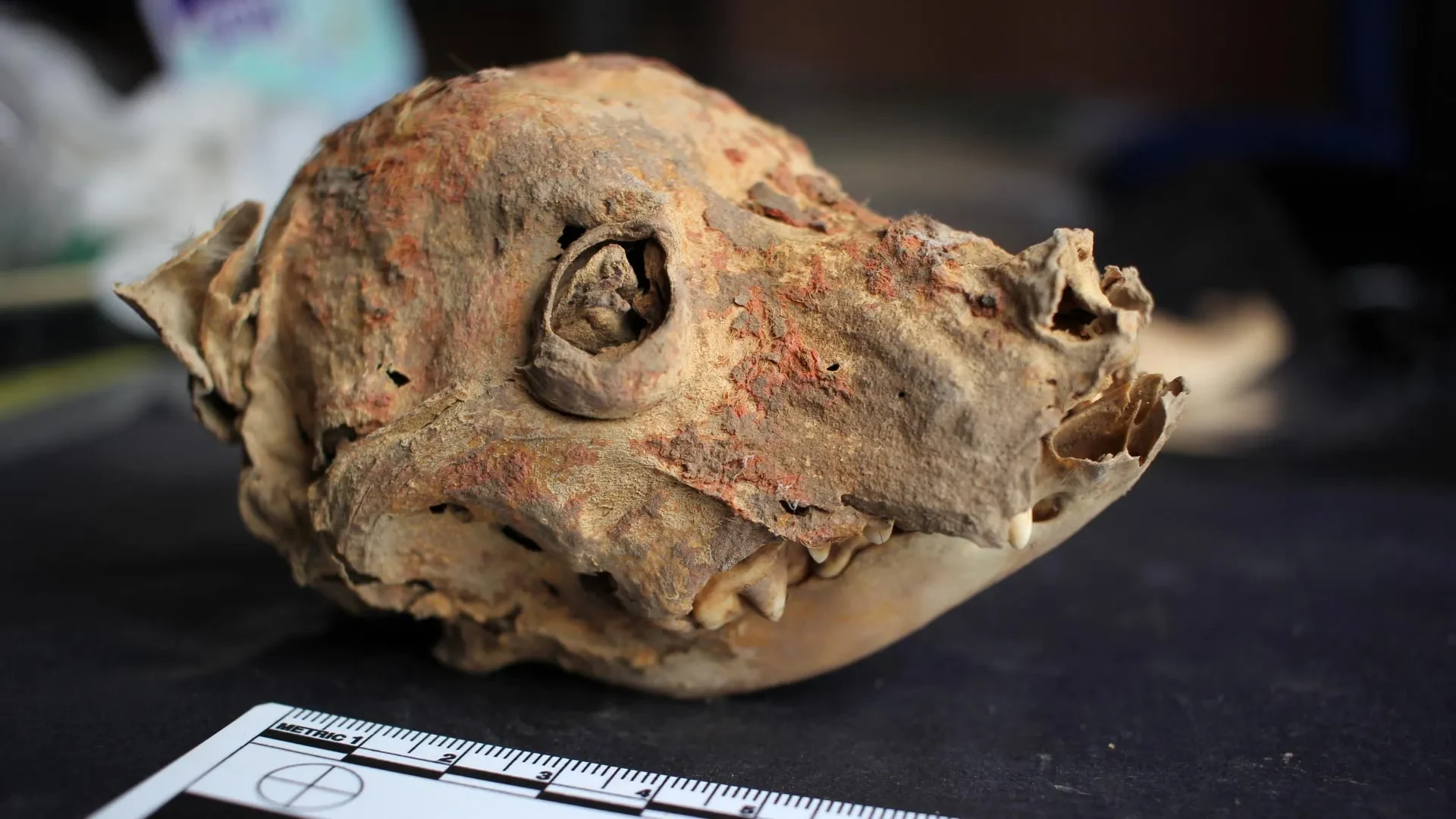
- A naturally mummified skull retaining visible hairless skin and attached ears, dramatically stained with cinnabar—a toxic, bright red mineral pigment heavily favored in Andean funerary rites.
- A second, larger dog skull recovered from nearby deposits.
- A naturally mummified, nearly complete male skeleton discovered in a shallow pit, missing only the lower portions of its front limbs.
Initially, field researchers wondered if these remarkably preserved remains might be recent intrusions, perhaps dating back to periods of mid-20th-century looting. However, lead author Weronika Tomczyk identified two unmistakable indicators of antiquity and breed: the animals were entirely hairless, and all three specimens lacked their first premolars.
Crucially, these teeth were not lost due to trauma, periodontal disease, or old age. They had simply never erupted. Medical and biological literature confirms that the precise genetic mutation responsible for hairlessness in dogs is pleiotropic, meaning it simultaneously suppresses the development of specific teeth, such as the first premolars and last molars. This biological fingerprint confirmed the remains belonged directly to the ancestral lineage of the modern Peruvian hairless dog (recognized today by the American Kennel Club as the Peruvian Inca Orchid, and designated as official Peruvian cultural heritage in the year 2000).
Osteological and Isotopic Analysis
To extract further historical data from the find, the team gathered a total of 341 dog bone specimens representing a minimum of 19 individual dogs, alongside the complete mummified male. Using standard zooarchaeological protocols, they estimated the ages, health statuses, and life histories of the animals.
Radiocarbon dating performed on the complete mummified male dog established that it lived at least 1,200 years ago, anchoring it as the oldest radiocarbon-dated canine specimen retrieved from Castillo de Huarmey to date.
Furthermore, scientists utilized stable isotope analysis—measuring isotopes of carbon, nitrogen, oxygen, and strontium preserved in the dogs’ bones and teeth.
- Bone Collagen vs. Tooth Enamel: Tooth enamel forms rapidly during puppyhood, capturing a localized chemical signature of early life. Conversely, bone tissue continuously remodels, reflecting the animal’s diet and environment over the final year of its life.
- Strontium Isotopes: Strontium varies depending on local geological bedrock, allowing scientists to track whether an animal was raised locally or brought from distant geographic regions.
- Dietary Insights: The isotopic results demonstrated that most Wari dogs consumed diets heavy in maize (corn), closely mirroring the primary carbohydrate staple of the human population. Interestingly, hairless puppies exhibited isotopic signatures during their early weeks that closely mirrored those of human children, suggesting they may have been provisioned directly or fed domestic table scraps under controlled domestic conditions. As they matured, their diets diversified, pointing toward semi-controlled breeding and care practices.
OFFICIAL STATEMENTS & EXPERT PERSPECTIVES
The complexity of interpreting these archaeological finds has drawn commentary from the study’s lead researchers, who emphasize that ancient human-animal dynamics defy simplistic categorization.
"Our findings indicate that humans and dogs coexisted at this Wari site, but reconstructing their bond is challenging, as past emotions are difficult to capture through archaeological methods," explains Weronika Tomczyk, first author of the study, a research associate in Dartmouth’s Department of Anthropology, and a postdoctoral fellow in its Ecology, Evolution, Environment and Society Program.
Tomczyk highlights the multifaceted nature of human psychology across different social groups, noting that what constitutes a treasured companion to one household might simultaneously be viewed as a nuisance by neighbors:
"The goal of our study was to not only present data on Castillo de Huarmey’s dog burials, but also emphasize that people in the past had often contradictory relationships with the animals, just as they do today: a pet for one group of people could at the same time be considered a pest by their closest neighbors."
Discussing the surprising anatomical link that unlocked the mystery of the breed, Tomczyk remarks:
"What I noticed is that some of the dog skeletons were missing teeth, and not that they lost them during their lifespan; some teeth, especially first premolars and sometimes last molars, had just never erupted. And then I found in the literature that the same gene which is responsible for hairlessness in dogs is responsible for a reduced number of teeth, indicating that these were Peruvian hairless dogs."
Regarding the varied social treatment of the animals—ranging from elite burials alongside master craftspeople and sacrificial tomb guardians to discarded debris—Tomczyk concludes:
"While we will never know if any of the three dogs were pets or how people treated them, it is evident they received different treatment than other dogs."
The collaborative research effort features an interdisciplinary team of international experts, including co-authors Miłosz Giersz, Wiesław Więckowski, and Roberto Pimentel Nita of the University of Warsaw, alongside Claire Ebert of the University of Pittsburgh.
FUTURE OUTLOOK: EXPANDING HORIZONS IN ANDEAN ARAEOLOGY
The confirmation of 1,200-year-old Peruvian hairless dogs at Castillo de Huarmey opens exciting new pathways for Andean archaeology and paleo-zoology. As research moves forward, several key areas of inquiry are set to shape future academic expeditions:
- Broader Genetic Mapping: Future studies aim to extract ancient DNA (aDNA) from the mummified hairless dog tissues. Sequencing the genome will help scientists trace the evolutionary divergence of hairless dog lineages across pre-Columbian South America and measure genetic continuity with modern descendants.
- Refining Isotopic Geographies: By expanding strontium baseline databases across various ecological zones of the Peruvian coast and highlands, researchers hope to track exact trade routes or movement patterns of prized animals exchanged between Wari administrative centers.
- Comparative Imperial Faunal Studies: Archaeologists plan to compare the Huarmey faunal assemblage with canine remains recovered from other contemporary Wari and Moche sites. This comparative framework will clarify whether hairless dogs served specialized ritual functions exclusive to elite coastal enclaves or if their distribution was widespread throughout the empire.
Ultimately, the discovery at Castillo de Huarmey bridges the immense chasm of time between modern Andean culture and its ancient pre-Inca roots. By revealing how ancient civilizations cared for, bred, and interacted with specialized animals like the Peruvian hairless dog, contemporary science continues to demonstrate that the emotional and practical bonds linking humanity with our canine companions have remained deeply resilient across millennia.