
Executive Overview
In a decisive move underscoring its long-term strategic commitment to Latin America’s agricultural powerhouse, multinational original equipment manufacturer (OEM) Yanmar has broken ground on a transformative R$280 million manufacturing facility in Indaiatuba, São Paulo. The expansive 140,000-square-meter campus represents a massive leap forward for the company’s regional footprint, nearly tripling its existing manufacturing capacity in the municipality.
Designed to cater specifically to the distinct operational realities of Brazil’s small- and medium-sized farmers—particularly those managing operations between 200 and 600 hectares—the new industrial site will substantially scale Yanmar’s production capabilities. Once fully operational, the plant will allow the OEM to increase its annual tractor output from 5,000 units to a robust 7,000 units, while simultaneously establishing a future-proof foundation for subsequent expansions.
The project breaks ground at a fascinating juncture for the global and domestic agricultural machinery sector. While broader macroeconomic headwinds and domestic political cycles have temporarily cooled high-horsepower equipment sales in Brazil, the market for low-to-medium horsepower tractors is experiencing resilient growth. By heavily investing in localized advanced manufacturing, automated production frameworks, and sustainable technological innovation—including telematics, autopilot systems, artificial intelligence (AI), and alternative energy solutions like biodiesel—Yanmar is strategically positioning itself to capture the rising tide of demand from independent producers.
The initiative is not merely an operational expansion; it is a holistic consolidation of Yanmar’s Brazilian footprint. By bringing manufacturing, engine and generator assembly, spare parts distribution, administrative offices, and advanced training facilities together under one campus roof, Yanmar is signaling a generational investment in Brazilian agricultural infrastructure.
Detailed Chronology & Phased Implementation
The ambitious timeline for the Indaiatuba campus reflects a carefully calculated, phased rollout designed to ensure minimal disruption to current supply chains while methodically scaling up capacity over the next half-decade.
Phase I: Operational Relocation and Core Assembly (Target: 2027)
The initial phase of the project, slated to come online in 2027, focuses on core manufacturing migration. Yanmar will systematically transfer its existing tractor, engine, and generator manufacturing operations to the new site. This initial transition is engineered to secure uninterrupted product availability for regional dealers and end-users, ensuring that the current baseline output of 5,000 units annually is safely maintained and primed for immediate growth.
Phase II: Scaling Production and Logistics Infrastructure (Target: Post-2027)
Following the successful migration of core assembly lines, the second phase will focus heavily on scaling manufacturing volume up toward the targeted 7,000-unit ceiling. Crucially, this phase involves the expansion and modernization of Yanmar’s spare parts distribution center. By centralizing and upgrading logistics management, the company aims to drastically reduce equipment downtime for farmers across South America, ensuring rapid parts fulfillment during critical planting and harvesting windows.
Phase III: Corporate Consolidation and Training Campus (Target: 2030)
The final chapter of the Indaiatuba development plan, scheduled for completion by 2030, will see the physical integration of Yanmar South America’s corporate administrative offices and its specialized training facility directly onto the campus. This consolidation will foster a high-synergy environment where engineers, administrative leadership, and technical support teams work hand-in-hand with the manufacturing floor. Furthermore, the advanced training facility will serve as a regional hub for educating dealers, technicians, and end-users on emerging machinery diagnostics, precision farming tools, and sustainable maintenance practices.
The Groundbreaking Milestone
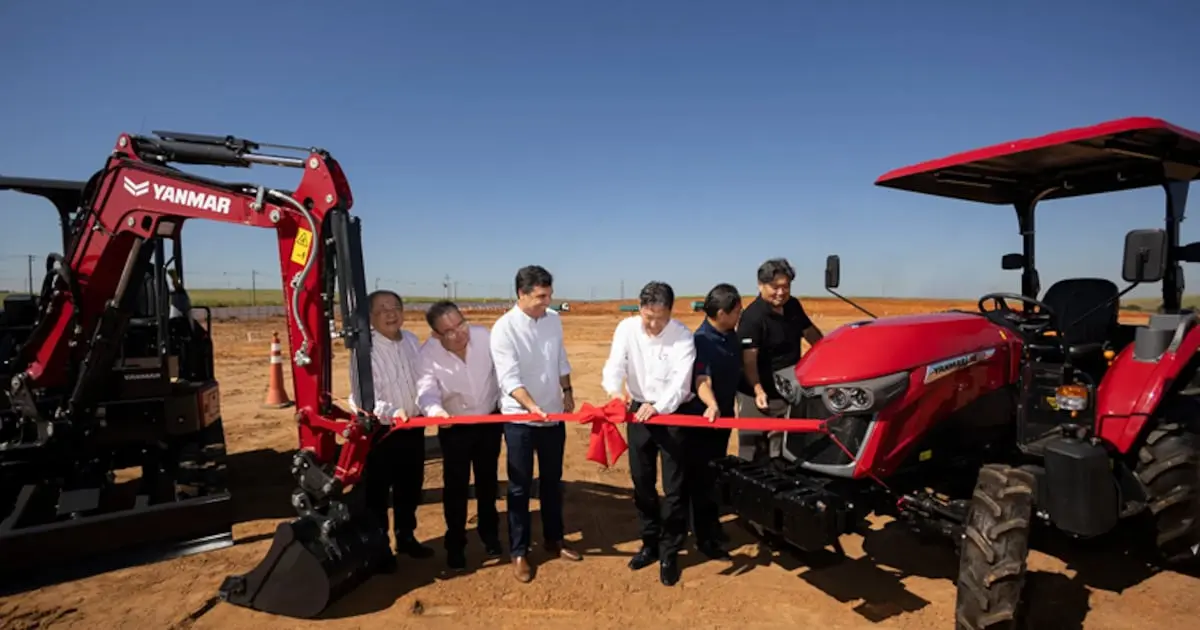
The official genesis of this industrial leap forward occurred on July 28, during a high-profile groundbreaking ceremony at the Indaiatuba site. The event brought together a distinguished delegation of Yanmar South America executives, local and regional government officials, and key business partners. The ceremony served not only as a ceremonial turning of the earth but as a public affirmation of Yanmar’s enduring partnership with the Brazilian agricultural sector—a relationship that stretches back nearly seven decades.
Supporting Context & Metrics: Navigating the Brazilian Machinery Market
To fully grasp the strategic brilliance of Yanmar’s timing, one must examine the complex macroeconomic and agricultural data governing Brazil’s machinery sector.
Historical Roots and Target Demographics
Yanmar’s history in Brazil dates back to 1958. Over nearly 70 years of operations, the company has deeply understood the structural fabric of Brazilian farming. While massive corporate agribusinesses dominating thousands of hectares in the Center-West often command headlines, the backbone of Brazilian food security relies heavily on small and medium-sized enterprises (SMEs).
Yanmar has consciously targeted the 24-to-105 horsepower (HP) bracket. These tractors are engineered to serve farmers managing land plots ranging from 200 to 600 hectares. Through its proprietary solutions—such as the advanced Yanmar YM Series—and strategic partnerships yielding machinery like the Solis 26, 60, and 75/80 models, Yanmar has cemented its reputation as a dependable lifeline for independent producers requiring rugged, fuel-efficient, and technologically adaptable equipment.
Current Market Headwinds and the Electoral Cycle
The agricultural machinery market is currently navigating a complex global environment. Domestically, Brazilian farmers have adopted a cautious holding pattern regarding equipment acquisitions. According to Wagner Santaniello, Innovation and Marketing Manager for Yanmar South America, this temporary procurement freeze is primarily tied to the upcoming 2026 Brazilian Presidential election.
Electoral cycles in Brazil carry significant policy and tax implications for the agricultural sector, prompting producers to exercise fiscal prudence until political clarity is achieved. "From August until after the election, they stop buying… but it’s normal," Santaniello noted, contextualizing the temporary market stagnation as a predictable cyclical behavior rather than a fundamental collapse in agricultural confidence.
Statistical Analysis: The Rise of Lower-HP Tractors
Data compiled by Anfavea (Brazil’s National Association of Motor Vehicle Manufacturers) illustrates the nuance of the current market. Overall wheeled tractor sales in Brazil experienced a modest contraction, dropping 2.1% year-over-year to 46,500 units in 2025.
However, a granular examination of the data reveals a stark divergence between heavy machinery and low-to-medium horsepower units. While high-horsepower sales softened, Brazil’s agricultural market absorbed 31,400 tractors rated at 100 HP or less, representing a healthy 6.3% year-over-year growth rate. This statistical reality validates Yanmar’s strategic focus: the small-to-medium farming segment is not only surviving macroeconomic headwinds—it is actively driving localized volume growth, making the R$280 million investment in Indaiatuba an exceptionally well-timed maneuver.
Official Statements & Industry Perspectives
The weight of the Indaiatuba project is best captured through the voices driving Yanmar’s strategic vision in South America.
Addressing the significance of the multi-million-real investment, Wagner Santaniello emphasized the deep-rooted alignment between the company’s corporate ethos and Brazil’s agricultural future:
"This project represents an important step in Yanmar’s long-term commitment to Brazil. By investing in advanced manufacturing capabilities and creating a more integrated production environment, this investment strengthens our ability to support customers, partners, and local communities while contributing to the long-term development of Brazilian industry."
Santaniello’s remarks highlight a core philosophy of the Japanese OEM: operational localization coupled with advanced manufacturing systems. Rather than viewing the Brazilian subsidiary as a mere assembly outpost, Yanmar is actively transplanting its globally renowned production systems—encompassing advanced automation, precision material handling, and lean logistics practices refined in its Japanese facilities—directly onto the São Paulo soil.
This technological transfer ensures that equipment rolling off the Indaiatuba assembly lines meets the rigorous global quality standards that Yanmar has maintained for over a century, while remaining meticulously tailored to the punishing terrain and demanding duty cycles of South American agriculture.
Future Outlook: Technological Innovation and Sustainable Farming
Looking beyond the completion of the Indaiatuba campus in 2030, Yanmar’s trajectory in Brazil is inextricably linked to the rapid evolution of smart farming and environmental sustainability.
Precision Agriculture and AI Integration
Modern farming demands unprecedented levels of efficiency, and Yanmar is proactively embedding digital intelligence into its equipment ecosystem. Santaniello outlined the company’s active development of precision technologies tailored for the Brazilian market. This includes the integration of robust telematics systems for remote fleet monitoring and predictive maintenance, advanced autopilot solutions to minimize overlap and fuel consumption during long hours in the field, and emerging artificial intelligence (AI) capabilities designed to optimize implement control and crop yield management.
Decarbonization and Alternative Energy
As global regulatory frameworks and corporate sustainability targets push the agricultural sector toward decarbonization, Yanmar is leading the charge in alternative propulsion. While Yanmar Japan has already successfully introduced commercial electric machinery solutions to international markets, the South American division is adopting a transitional yet forward-looking approach suited to regional infrastructure realities.
Notably, Yanmar is exploring the development and implementation of advanced biodiesel engines. Given Brazil’s position as a global leader in biofuel production and consumption, a localized biodiesel engine platform represents a natural, highly synergistic technological frontier. It empowers farmers to utilize renewable fuels generated within their own supply chains, drastically reducing carbon footprints while insulating agricultural operations from the volatility of fossil fuel markets.
Conclusion
Yanmar’s R$280 million investment in Indaiatuba is much more than a brick-and-mortar expansion; it is a masterclass in strategic industrial foresight. By tripling its manufacturing footprint, embracing cutting-edge automation, doubling down on the booming low-to-medium horsepower tractor market, and pioneering sustainable technologies like telematics, AI, and biodiesel engines, Yanmar is fortifying its position as an indomitable pillar of Brazilian agriculture. As the facility phases in its operations between now and 2030, it will undoubtedly serve as a sophisticated engine of economic growth, technological advancement, and agricultural resilience for generations of South American farmers to come.