
Executive Overview
Fromm Family Foods, a long-established pet food manufacturer based in Mequon, Wisconsin, has initiated a voluntary recall involving select batches of its canned wet dog food products due to potential foreign matter contamination. The recall specifically targets 3,852 cases of Fromm Turkey Pâté Wet Dog Food and 1,973 cases of Fromm Diner Classics Milo’s Meatloaf Pâté Wet Dog Food. The decision was made following reports indicating the presence of metal fragments within the affected product lines, posing potential health and safety hazards to canine consumers.
Distributed widely across independent neighborhood pet specialty stores and various e-commerce platforms throughout the United States and Canada, the recalled items present a risk of mechanical tissue trauma and gastrointestinal complications if ingested. Ingested metal debris—ranging from microscopic shavings to larger or sharp-edged fragments—can inflict severe physical injuries, including oral cavity lacerations, esophageal lesions, gastric irritation, or life-threatening gastrointestinal obstructions and perforations.
To date, Fromm Family Foods and regulatory authorities report that no illnesses, injuries, or adverse health events have been officially documented in connection with the recalled products. Nevertheless, out of an abundance of caution and in coordination with the U.S. Food and Drug Administration (FDA), the company has urged consumers to immediately discontinue feeding these specific lots to their pets. Fromm has identified the operational failure responsible for the breach and implemented corrective actions within its manufacturing infrastructure to prevent recurrence.
Detailed Chronology of the Recall
[Production & Packaging Phase]
  │  Lots produced with "Best By 032029" date codes
  ▼
[Distribution Network]
  │  Products shipped across US & Canadian retail & e-commerce channels
  ▼
[Consumer Detection & Reporting]
  │  Pet owners discover metal fragments; complaints lodged with manufacturer
  ▼
[Internal Investigation & Root-Cause Analysis]
  │  Fromm QA team isolates batch runs & identifies mechanical failure point
  ▼
[Voluntary Recall Action & FDA Notification]
  │  Public announcement issued; product safety advisories broadcast to retailers
Production and Initial Distribution
The affected production runs originated at Fromm Family Foods’ processing facility in Wisconsin. Utilizing automated canning lines, the batches were processed, sealed, and stamped with expiration dates extending to March 2029 ("Best By 032029"). Following standard post-production hold and quality sampling routines, thousands of cases were released into commercial distribution channels.
The distribution network spanned nationwide independent pet stores and prominent online pet product vendors across both the United States and Canada. Because Fromm focuses heavily on the specialty pet retail market, the products reached a broad segment of pet owners seeking premium dietary options.
Discovery Through Consumer Escalation
The contamination came to light through direct consumer feedback. Pet owners preparing meals for their dogs detected foreign metallic material embedded within the wet pâté formulas. The consumers reported these findings directly to Fromm’s customer support team, prompting an immediate escalation to the company’s quality assurance (QA) and regulatory compliance departments.
Corporate Mobilization and Regulatory Notification
Upon receiving the consumer complaints, Fromm initiated an internal investigation to determine the scope and origin of the foreign matter. Quality control managers audited recent production records, equipment logs, and lot samples associated with the reported codes.
After verifying that metal fragments were present in specific manufacturing runs, Fromm alerted the U.S. Food and Drug Administration (FDA) to formally initiate a voluntary market withdrawal. The formal press announcement was published shortly thereafter, providing lot details, risk assessments, and instructions for consumer returns.
Supporting Context, Product Identification, and Medical Metrics
Affected Product Matrix and Identification Criteria
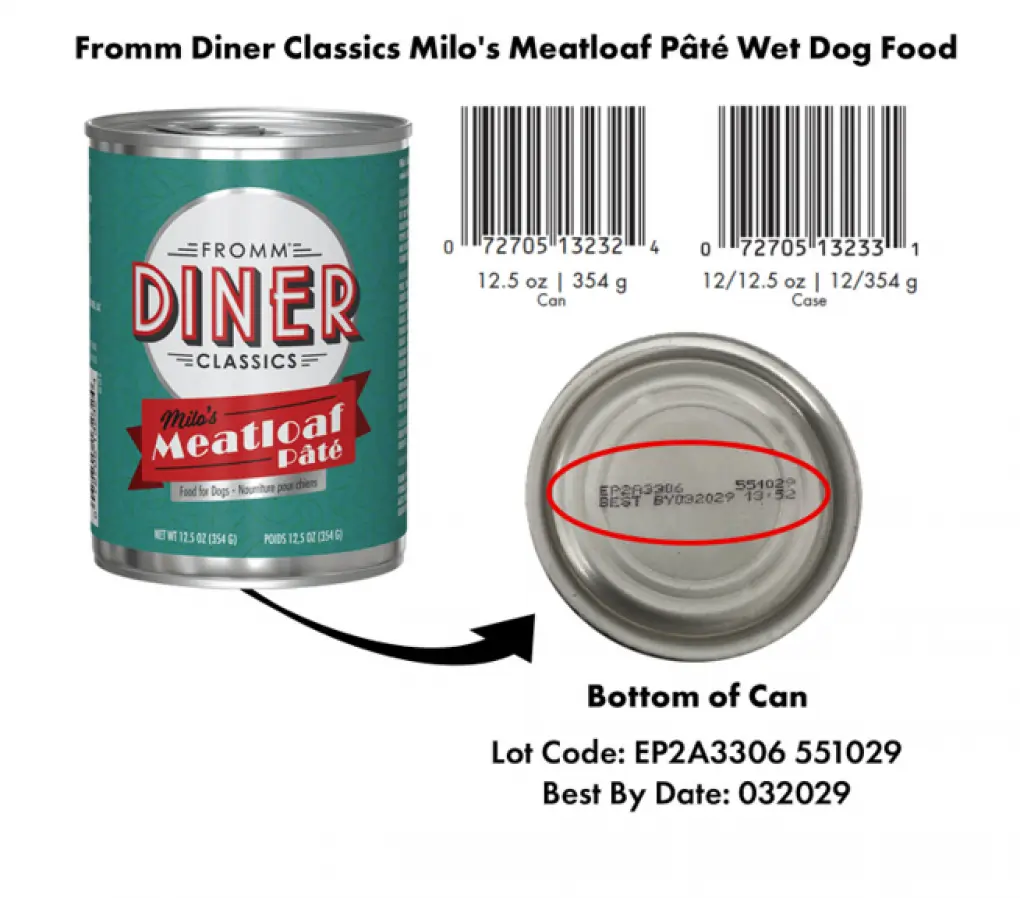
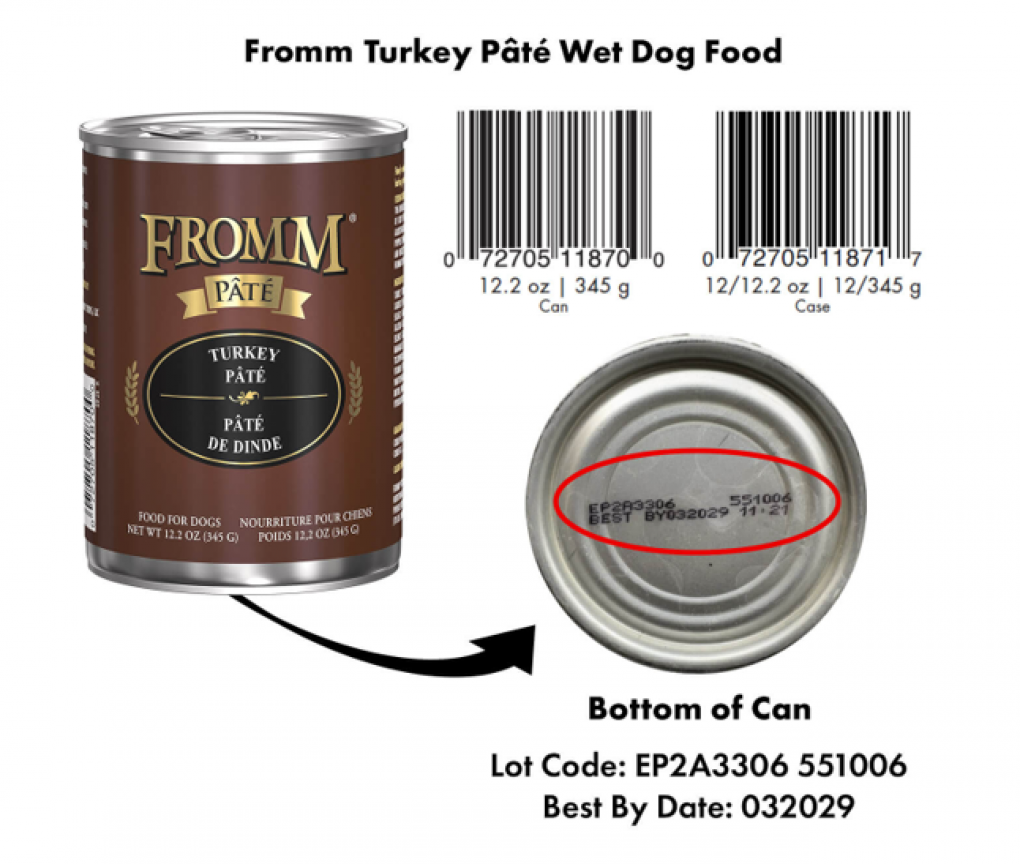
Pet owners and retail inventory managers are advised to inspect their supply of wet canned dog food. The voluntary recall is strictly limited to two specific product formulations carrying designated Lot Codes and Universal Product Codes (UPCs). No other Fromm canned products, dry kibble, or treats are impacted by this recall.
| Product Name | Net Weight | UPC | Lot Code | Expiration / Best By Date | Affected Volume |
|---|---|---|---|---|---|
| Fromm Turkey Pâté Wet Dog Food | 12.2 oz. per can | 072705118700 |
EP2A3306 551006 |
Best By 032029 |
3,852 Cases |
| Fromm Diner Classics Milo’s Meatloaf Pâté Wet Dog Food | 12.5 oz. per can | 072705132324 |
EP2A3306 551029 |
Best By 032029 |
1,973 Cases |
Consumers can verify their products by looking at the bottom of the can where the ink-stamped Lot Code and Best By dates are printed, and checking the barcode label for the matching 12-digit UPC number.

+-----------------------------------------------------------------------+
|                         PRODUCT CAN LABEL                             |
+-----------------------------------------------------------------------+
|  Brand: FROMM FAMILY FOODS                                            |
|  Item:  Turkey Pâté / Milo's Meatloaf Pâté                            |
|                                                                       |
|  [ BARCODE ]  --->  Check UPC Code:                                   |
|                     - Turkey Pâté: 072705118700                       |
|                     - Milo's Meatloaf: 072705132324                  |
+-----------------------------------------------------------------------+
|                        BOTTOM OF CAN STAMP                            |
+-----------------------------------------------------------------------+
|  Lot Code:  EP2A3306 551006  (or EP2A3306 551029)                     |
|  Best By:   032029                                                    |
+-----------------------------------------------------------------------+
Medical and Pathophysiological Hazards of Metal Ingestion
Ingestion of foreign physical contaminants—particularly metal—presents direct risks to canine health. The severity of clinical pathology depends on the size, sharpness, quantity, and physical composition of the metal fragments. Veterinary toxicologists and emergency clinicians divide the hazards into three primary clinical categories:
                  ┌─────────────────────────────────────────┐
                  │    Ingestion of Metallic Contaminants   │
                  └────────────────────┬────────────────────┘
                                       │
         ┌─────────────────────────────┼─────────────────────────────┐
         ▼                             ▼                             ▼
┌─────────────────┐           ┌─────────────────┐           ┌─────────────────┐
│ Mechanical      │           │ Gastrointestinal│           │ Systemic /      │
│ Laceration      │           │ Obstruction     │           │ Toxicological   │
├─────────────────┤           ├─────────────────┤           ├─────────────────┤
│ • Oral lesions  │           │ • Partial/full  │           │ • Inflammatory  │
│ • Esophageal    │           │   blockages     │           │   responses     │
│   tears         │           │ • Gastric       │           │ • Potential     │
│ • Gastric mucosal│          │   impaction     │           │   heavy metal   │
│   punctures     │           │ • Perforation   │           │   toxicity      │
└─────────────────┘ └─────────────────┘ └─────────────────┘-
Mechanical Tissue Trauma and Lacerations:
Sharp metal shards pose an immediate risk of mechanical injury upon mastication and deglutition (swallowing). Lesions can occur in the oral cavity, tongue, gums, pharynx, and esophagus. Once inside the gastrointestinal tract, sharp fragments can score or puncture the delicate mucosal lining of the stomach and intestines, leading to internal bleeding, localized inflammation, and potential infection. -
Gastrointestinal Obstruction and Impaction:
Even if metal fragments lack sharp edges, larger pieces or accumulated debris can fail to pass through the narrow sphincters of the digestive tract, such as the pylorus or ileocecal valve. This can trigger partial or complete intestinal obstructions, preventing the normal movement of food and fluid. Clinical signs of gastrointestinal distress include:- Acute Emesis (Vomiting): Often persistent, caused by gastric irritation or blockage.
- Anorexia and Loss of Appetite: Refusal to accept food due to nausea and pain.
- Lethargy and Depression: Signs of pain, systemic distress, or fluid imbalance.
- Abdominal Discomfort: Guarding of the abdomen, whining, or unnatural posturing (e.g., the "prayer position").
- Choking or Dysphagia: Coughing, gagging, or excessive drooling during or immediately after eating.
-
Perforation and Peritonitis:
If a metallic fragment penetrates the intestinal wall, intestinal contents can leak into the peritoneal cavity. This condition—septic peritonitis—is a medical emergency requiring swift surgical intervention and intensive care.
Mechanics of Contamination in Wet Pet Food Processing
In industrial canned pet food production, raw meat products, grains, and liquid ingredients undergo grinding, mixing, thermal processing, and high-speed filling. Heavy machinery operating under intense pressure and rotational force can occasionally suffer mechanical degradation.
Possible points of origin for metal contamination in wet canning lines include:
- Grinding and Emulsifying Blades: High-shear pumps and grinders processing meat can experience blade chipping or friction-induced wearing.
- Conveyor and Mixing System Components: Loose fasteners, worn agitator vanes, or failing metal bearings can detach and enter the product stream.
- Canning Line Shearing: Mechanical contact between filler nozzles and tin cans during high-speed filling operations can generate tiny metallic flakes or shavings.
While modern pet food facilities employ inline metal detectors, magnet traps, and X-ray inspection devices, equipment miscalibrations or localized sensor failures can allow isolated batches of contaminated product to bypass detection screens.
Official Corporate and Regulatory Statements
Response from Fromm Family Foods
In its official recall notification, Fromm Family Foods detailed the root cause analysis and corrective measures undertaken to isolate the defect:
"The recall was initiated after receiving complaints of metal contamination. We have identified the error, and in addition to our existing safety processes, we have put corrective actions in place to prevent this from happening again."
The company reiterated that no other products within the Fromm Family Foods portfolio—including its dry dog and cat kibble lines, wet cat foods, or other canned dog formulas—are subject to this action. Fromm stressed that no injuries or adverse health events have been documented to date, framing the move as a preventive safety action.
Federal Regulatory Framework and Oversight
The recall is conducted under the administrative oversight of the U.S. Food and Drug Administration (FDA) pursuant to federal regulations governing animal food safety under the Food Safety Modernization Act (FSMA). Under FSMA regulations, animal food manufacturers are legally obligated to maintain Hazard Analysis and Risk-Based Preventive Controls (HARPC). These standards mandate that processing facilities identify physical hazards—such as foreign object debris—and maintain verified preventive controls to mitigate those risks.
The FDA has published the recall notification on its enforcement advisory portal and continues to monitor Fromm’s distribution tracing and product destruction protocols.
Consumer Action and Contact Protocols
Fromm Family Foods instructs pet owners who have purchased the affected products to discontinue feeding them immediately. Consumers should handle the cans with care, take note of the lot codes, and follow these steps:
- Retail Return and Refund: Affected cans may be returned to the neighborhood pet retailer where they were purchased for a full refund or exchange.
- Proper Disposal: If returning the product is not feasible, consumers should secure the cans in a sealed trash bag prior to disposal to prevent wildlife or scavengers from accessing the contaminated contents.
- Veterinary Consultation: If a dog has consumed food from either of the recalled batches and exhibits clinical symptoms—such as vomiting, lethargy, refusal to eat, or signs of pain—owners should seek immediate veterinary evaluation.
                      CONSUMER ACTION FLOWCHART

        Has your dog consumed product from Lot EP2A3306?
                               │
               ┌───────────────┴───────────────┐
               YES                             NO
               │                               │
    Exhibiting symptoms?               No action needed.
 (Vomiting, Lethargy, Pain)             Product is safe.
        │             │
       YES            NO
        │             │
  Contact Vet     Stop feeding immediately.
  Immediately.    Return to store for refund.
For further inquiries, product verification, or direct support, Fromm has established dedicated communication channels:
- Customer Support Phone: 1-800-325-6331 (Mon–Fri, 8:00 AM – 4:30 PM Central Time)
- Direct Email Contact:
[email protected]
Future Outlook and Industry Preventive Protocols
Operational Corrective Actions and Technological Upgrades
To prevent similar occurrences, pet food manufacturing facilities routinely update their preventative maintenance routines and real-time detection technologies following a market recall. Industry experts note that addressing mechanical foreign object risks requires a multi-layered approach:
                       REDUNDANT QUALITY CONTROL STACK

  Level 1: Magnetic Separators  ──► Traps ferrous metals early in raw flow
  Level 2: Inline X-Ray Systems ──► Scans sealed cans for dense foreign matter
  Level 3: Inductive Detectors  ──► Detects non-ferrous/stainless steel pieces
Level 4: Vibration Protocols ──► Audits mechanical wear on processing lines- Advanced In-Line X-Ray Inspection: Unlike basic inductive metal detectors that identify ferrous metals, high-resolution X-ray systems can detect non-ferrous metals, stainless steel fragments, glass, and dense materials even within sealed metallic cans.
- Enhanced Magnetic Separators: Installing high-intensity rare-earth inline magnets at multiple transfer points captures ferrous particles prior to thermal processing and canning.
- Routine Preventive Maintenance Audits: Increasing the frequency of scheduled inspections on high-shear mixers, pump impellers, and filling nozzles minimizes wear-and-tear failures.
Strategic Guidance for Pet Owners and Retail Partners
This incident underscores the importance of ongoing vigilance among pet owners and retail operators in the specialty pet care market. Retailers are advised to audit their physical stock room shelves and e-commerce inventory databases immediately, removing any cans bearing Lot Code EP2A3306 with the 032029 Best By date.
Pet owners are encouraged to build a habit of inspecting canned food during meal preparation. Checking the consistency of wet food before feeding can help identify rare physical defects or foreign material before consumption occurs.
As Fromm Family Foods completes its voluntary recall in cooperation with retail partners and federal regulators, the incident serves as a clear reminder of the importance of strict quality controls and rapid public notification systems in maintaining the safety of the commercial pet food supply chain.