
Executive Overview
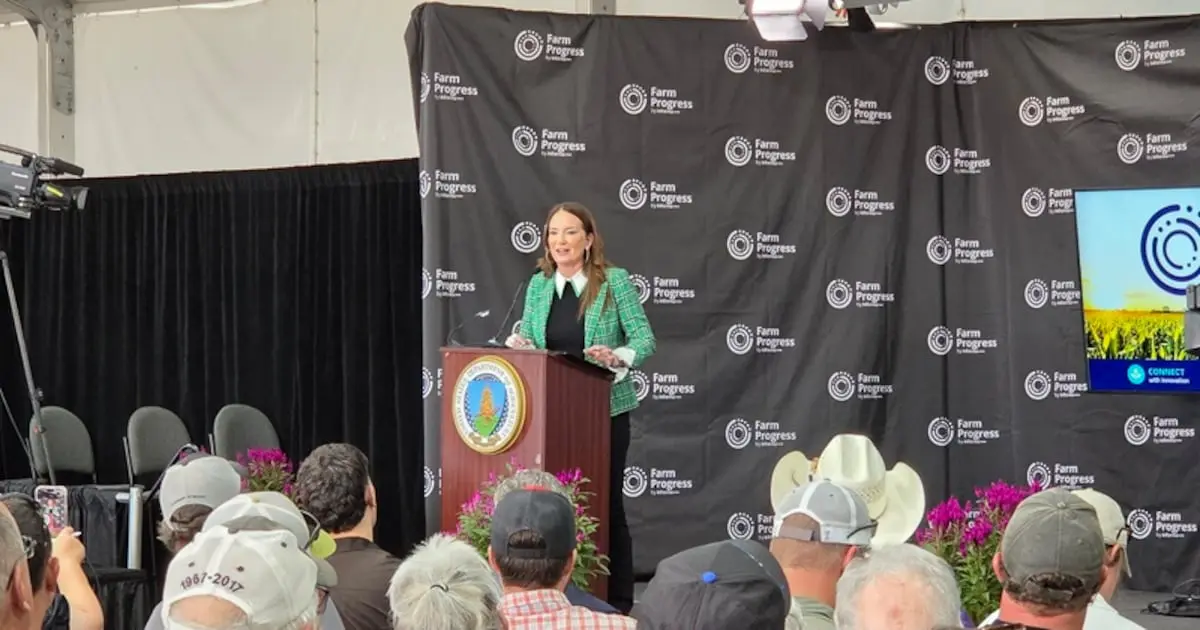
Opening day at the annual Farm Progress Show (FPS) brought a dense crowd of agricultural stakeholders, producers, and industry leaders into the auditorium to hear from U.S. Secretary of Agriculture Brooke Rollins. Delivering a roughly 45-minute keynote address on September 1, Rollins staked out the policy priorities of the Department of Agriculture under the current administration, pivoting sharply toward digital modernization, aggressive administrative cost-cutting, and a back-to-basics philosophy designed to put traditional producers first.
At the center of Rollins’ address was the department’s flagship bureaucratic reform: the "One Farmer, One File" initiative. First introduced in February 2026, the program is designed to collapse the labyrinth of agency-specific record-keeping into a single digital file for every agricultural producer, drastically reducing administrative friction and paperwork redundancy. To demonstrate the system’s early success, Rollins pointed to skyrocketing engagement metrics under the platform, notably a dramatic fiftyfold increase in participation for the one-time bridge assistance program compared to historical enrollment figures seen in prior emergency initiatives.
Beyond administrative streamlining, the Secretary’s address highlighted technological tools aimed at farm-gate economics and environmental compliance. Rollins showcased the Feedstock Carbon Intensity Calculator (FD-CIC), a digital application developed as part of the USDA’s regenerative biofuels feedstock rule. Demonstrated live at the USDA exhibition booth alongside Iowa farmer Tom Cowser, the tool evaluates the carbon intensity of field corn, soybeans, sorghum, and spring canola on a per-bushel basis. According to Rollins, these technological bridges do more than satisfy environmental reporting; they unlock premium pricing structures, reduce overhead input costs, and improve long-term soil health.
Yet, the core of the Secretary’s message also featured a stark defense of sweeping federal spending cuts. Detailing the elimination of hundreds of programs and trainings—specifically targeting diversity, equity, and inclusion (DEI) initiatives and unconventional grant distributions—Rollins argued that past USDA leadership had lost sight of the American farmer’s core economic realities. Even as the administration navigates ongoing public scrutiny regarding food safety protocols and animal health management, such as the containment of the New World Screwworm in Texas, the USDA’s leadership remains firm on its trajectory: modernizing core services, cutting administrative bloat, and centering federal agriculture policy strictly on operational profitability.
Detailed Chronology
The Road to the Farm Progress Show: Prelude to Modernization
The lead-up to the September 1 address at the Farm Progress Show was marked by a series of aggressive digital rollouts and operational shifts within the United States Department of Agriculture. Throughout late 2025 and early 2026, the department faced mounting pressure from farm country to address systemic bottlenecks in federal aid distribution, loan applications, and disaster relief programs. Producers had long complained about navigating disconnected silos across the Farm Service Agency (FSA), the Natural Resources Conservation Service (NRCS), and the Risk Management Agency (RMA), where identical farm data often had to be submitted multiple times across different portals.
In response to these persistent complaints, President Trump issued an executive order directing every federal agency to completely redesign public-facing services, modernizing digital infrastructure to prioritize security, simplicity, and human-centric design. Seizing upon this directive, the USDA announced the "One Farmer, One File" initiative in February 2026. Designed to unify producer profiles into a single, comprehensive digital record, the program signaled a technological turning point for an agency historically bogged down by paper-heavy bureaucracy.
September 1: Keynote Address and Live Demonstrations
Stepping up to the podium on the first day of the Farm Progress Show, Secretary Rollins framed the administration’s actions as a structural liberation for agricultural producers.
"Last year, we were directed by President Trump under an executive order to have every federal agency rethink the entire design of public-facing services and to build tools that are simple, that are modern, that are secure, and that are centered on our human needs, specifically with us, our farmers’ needs," Rollins told the packed auditorium.
Following the keynote, the focus shifted from policy rhetoric to practical demonstration. At the USDA exhibition booth, Rollins, alongside Iowa producer Tom Cowser, walked attendees through the newly deployed Feedstock Carbon Intensity Calculator (FD-CIC). The live walkthrough illustrated how producers can input field-level agronomic data—ranging from tillage methods to fertilizer applications—to calculate the exact carbon footprint of their harvest in grams of carbon dioxide equivalents per bushel.
As the afternoon progressed, the conversation turned toward fiscal accountability. Rollins detailed the removal of thousands of administrative roadblocks and the defunding of peripheral research grants, signaling a clean break from prior federal funding priorities. By evening, the address had sparked intense debate across the exhibition grounds, drawing praise from producers eager for less paperwork and prompting scrutiny from critics concerned about the scope of federal funding rollbacks.
Supporting Context & Metrics
The "One Farmer, One File" Triumph
The quantifiable impact of the USDA’s digital overhaul became a primary talking point during the Secretary’s address. For decades, the fragmented nature of USDA agency databases meant that a farmer applying for disaster relief through the FSA might have to re-enter basic farm boundaries, crop histories, and ownership structures already on file with the NRCS.
The implementation of "One Farmer, One File" was built to eliminate this redundancy. The architecture consolidates land data, compliance records, and program histories into a secure cloud-based dashboard accessible to the producer and authorized agency personnel alike.
The practical outcome of this modernization was underscored by participation metrics in the one-time bridge assistance program. According to data cited by Rollins, the platform yielded 50 times the number of farmer sign-ups compared to the Emergency Commodity Assistance program administered during previous months under legacy systems. This exponential leap in adoption underscores a critical reality: when bureaucratic hurdles are removed, agricultural producers engage readily with federal support structures.
Navigating the Feedstock Carbon Intensity Calculator (FD-CIC)
The integration of environmental metrics into daily farm management has increasingly defined modern agronomy, driven largely by consumer demand for sustainable biofuels and corporate supply chain tracking. The FD-CIC was engineered specifically to address the regulatory and commercial demands established by the USDA’s regenerative biofuels feedstock rule.
The calculator measures the carbon intensity of four primary commodity crops:
- Field Corn
- Soybeans
- Sorghum
- Spring Canola
By quantifying carbon performance down to the bushel, the tool provides a standardized metric that ethanol refineries, grain merchandisers, and food processors can use to verify low-carbon grain sourcing.
"Farmers who choose to implement regenerative practices have new opportunities to earn premium prices, lower their input costs, improve soil health, and strengthen the long-term profitability of your operations," Rollins emphasized. By connecting carbon metrics directly to input reduction—such as minimized synthetic nitrogen applications and reduced tillage passes—the USDA is positioning environmental stewardship not as a regulatory burden, but as a direct driver of farm-gate revenue.
Budgetary Scrutiny and Program Reductions
The administration’s fiscal tightening at the USDA has involved extensive audits of discretionary grant programs, research allocations, and administrative overhead. Rollins highlighted the elimination of nearly 900 diversity, equity, and inclusion (DEI) programs and staff trainings, characterizing them as misallocated taxpayer resources that distracted from the department’s core mission.
Among the specific structural cuts was a $324,671 grant directed toward a program titled "Increasing DEIA Programming for Integrated Pest Management." While this specific allocation was formally cancelled, Rollins also pointed to broader historical spending anomalies that caught the attention of department auditors, including past research funding directed toward fertilizer applications derived from kombucha and mushrooms, as well as pest control initiatives framed through social equity lenses.
Critics of the administration have raised concerns regarding the depth and breadth of these funding cuts, particularly regarding public health, food safety inspections, and agricultural research diversity. Questions have similarly swirled around the USDA’s handling of emerging biological threats, such as the New World Screwworm. However, departmental officials have maintained that current quarantine protocols are succeeding. As of September 1, Rollins confirmed that active cases in Texas had dropped to just two, with federal quarantine zones actively being lifted as the livestock industry stabilizes.
Official Statements
The tone of the Farm Progress Show was deeply shaped by the direct quotes delivered by leadership and the subsequent reactions from agricultural stakeholders.
"Last year, we were directed by President Trump under an executive order to have every federal agency rethink the entire design of public-facing services and to build tools that are simple, that are modern, that are secure, and that are centered on our human needs, specifically with us, our farmers’ needs."
— U.S. Secretary of Agriculture Brooke Rollins
Highlighting the economic and agronomic rationale behind the administration’s push for regenerative tools, Rollins connected environmental metrics directly to operational balance sheets:
"Farmers who choose to implement regenerative practices have new opportunities to earn premium prices, lower their input costs, improve soil health, and strengthen the long-term profitability of your operations."
— U.S. Secretary of Agriculture Brooke Rollins
Addressing the shift in departmental spending priorities away from specialized or ideological research grants toward foundational agricultural production, Rollins remarked:
"When we walked in the door, there were taxpayer dollars that was being spent on fertilizer research on kombucha and mushrooms. When we walked in the door, there were taxpayer dollars being spent on how we support getting rid of racism in the pest control industry. Y’all, it was something, and I’ll tell you what it wasn’t. It was not farmers first."
— U.S. Secretary of Agriculture Brooke Rollins
Future Outlook
As the agricultural sector looks ahead toward the 2027 crop year and beyond, the policies articulated by Secretary Rollins at the Farm Progress Show indicate a permanent shift in how the USDA interacts with American producers.
The rapid adoption of the "One Farmer, One File" architecture establishes a new baseline for federal digital infrastructure. Industry analysts expect that the success of this platform will pressure other federal agencies—such as the Environmental Protection Agency (EPA) and the Department of the Interior—to streamline their own reporting requirements for agricultural landowners. Furthermore, as the Feedstock Carbon Intensity Calculator gains widespread utilization among grain buyers and biofuel refineries, verified regenerative farming practices will likely transition from a niche marketing strategy to a standard prerequisite for accessing premium commodity markets.
At the same time, the aggressive pruning of administrative programs and DEI-focused grants signals that federal agricultural funding will face rigorous cost-benefit scrutiny for the foreseeable future. While the administration’s supporters praise these measures as essential fiscal discipline that refocuses the USDA on crop production, food security, and rural infrastructure, critics will continue to monitor the long-term impacts on specialized agricultural research and public health monitoring systems.
Ultimately, the message delivered in the exhibition halls of the Farm Progress Show was clear: the USDA is betting its future on a leaner, digitally unified, and market-driven framework. Whether these tools can consistently deliver higher profit margins and lower operational friction for producers across the country will be the ultimate metric by which this administration’s agricultural legacy is measured.