
Executive Overview
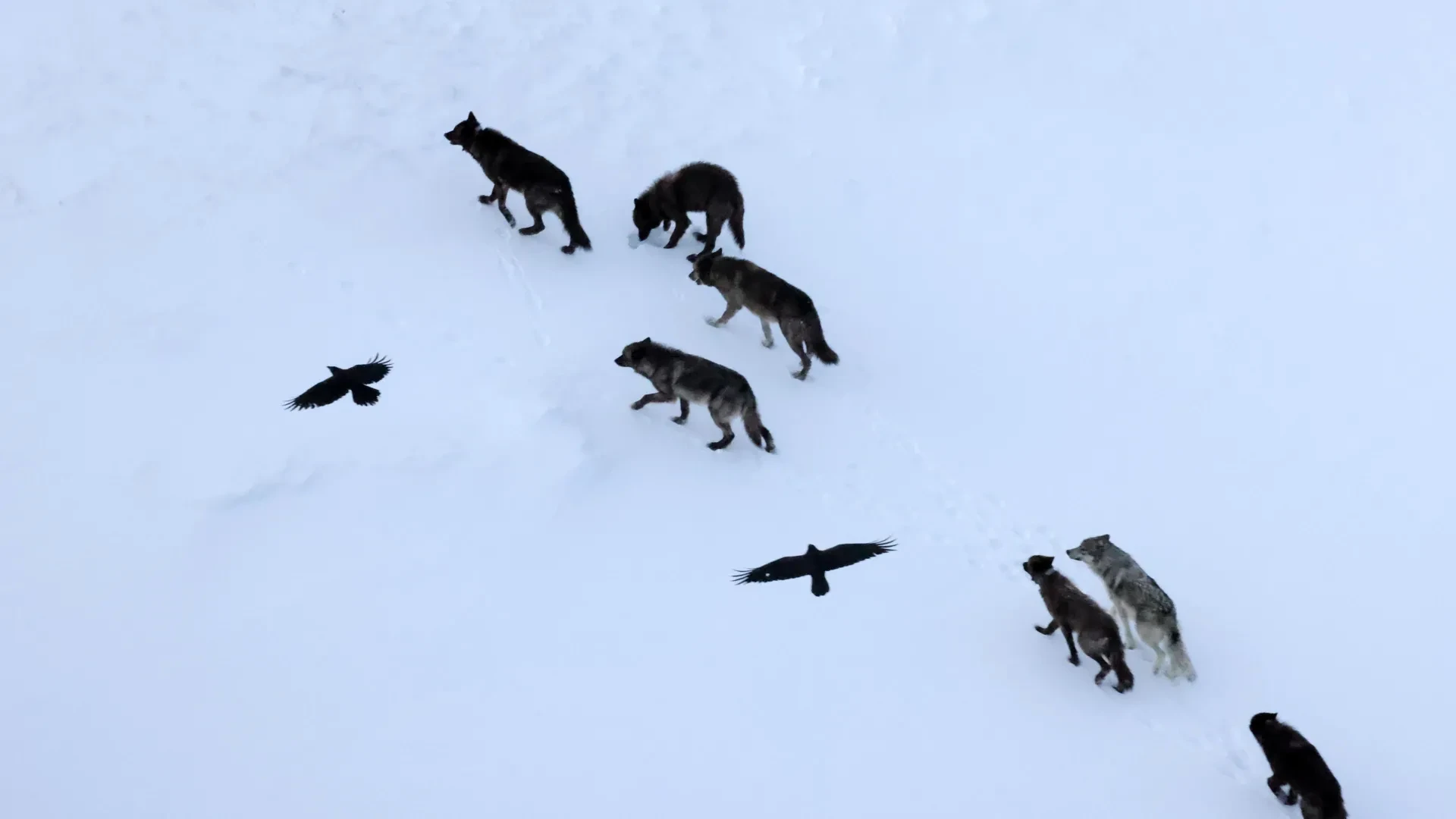
For centuries, the dynamic between the gray wolf (Canis lupus) and the common raven (Corvus corax) has been a staple of wilderness lore. Observers in the snow-draped valleys of the American West long held a simple, almost romanticized view of this relationship: the formidable wolf hunts, fells, and opens the carcass, while the opportunistic raven plays the role of the shadow, trailing the pack day in and day out, waiting patiently for the scraps of an elk or bison feast. It was an ecological partnership defined by spatial proximity—a classic predator-follower dynamic etched into the collective imagination of naturalists and wildlife enthusiasts alike.
However, a comprehensive, multi-year scientific investigation conducted within the sprawling wilderness of Yellowstone National Park has completely upended this long-standing assumption. Published in the prestigious journal Science, a landmark study tracking dozens of ravens and wolves simultaneously over two and a half years reveals that the relationship is far more sophisticated than previously imagined. Rather than acting as perpetual shadows tethered to wandering wolf packs, ravens deploy an advanced cognitive strategy anchored in exceptional spatial memory, long-range navigation, and geographical pattern recognition.
Armed with high-resolution GPS telemetry data, an international team of researchers discovered that ravens rarely trail wolves over long distances. Instead, these corvids mentally map the Yellowstone ecosystem, remembering historical kill sites, recognizing high-yield landscape features, and launching awe-inspiring flights—sometimes covering up to 155 kilometers in a single day or flying six hours non-stop—straight to a fresh carcass. This paradigm-shifting discovery not only redefines our understanding of avian intelligence and memory capacity, but it also alters how wildlife biologists view scavenger ecology, proving that some avian minds operate on a scale of spatial awareness and strategic foresight previously unrecognized in the wild.
Detailed Chronology: Unraveling the Yellowstone Raven Mystery
To fully appreciate the gravity of the recent findings in Science, one must look back at the historical framework of Yellowstone National Park and trace the methodical, often painstaking steps researchers took to challenge decades of ecological assumptions.
The Return of the Apex Predator
The ecological stage for this study was set in the mid-1990s, when gray wolves were triumphantly reintroduced to Yellowstone National Park after a 70-year absence. Their eradication earlier in the 20th century had triggered cascading negative effects throughout the park’s ecosystem, altering vegetation patterns, stream morphology, and the populations of numerous native species.
With the return of the wolves, the landscape came alive with predatory pressure once more. Almost immediately, naturalists noticed a familiar ecological shadow returning alongside them: ravens. As wolf packs re-established their territories, swelling to populations numbering in the hundreds, ravens materialized in high numbers. Biologists working in the park watched as the glossy black birds circled above moving wolf packs, perched quietly in the snow-laden pines as wolves stalked their prey, or hopped aggressively close to the action during a takedown.
For decades, this close association reinforced the prevailing hypothesis: ravens find food by tracking wolves. It was a neat, logical, and superficially undeniable narrative. Yet, as Dr. Dan Stahler, a veteran Yellowstone biologist who has studied the park’s wolves since their return, candidly admitted, this foundational premise had never actually been tested under rigorous scientific scrutiny. Nobody had ever placed the scavenger at the center of the investigative lens.
Designing a Masterclass in Field Ecology
To answer questions that had lingered for generations, a coalition of elite scientific institutions joined forces. The project was spearheaded by the Research Institute of Wildlife Ecology at the University of Veterinary Medicine Vienna and the Max Planck Institute of Animal Behavior in Germany. They were joined by an impressive roster of international partners, including the Senckenberg Biodiversity and Climate Research Centre in Germany, the School of Environmental and Forest Sciences at the University of Washington, and the tireless field operations teams of Yellowstone National Park.
The primary hurdle facing the research team was capturing and tagging a sufficient sample size of ravens. Anyone familiar with corvids knows they possess legendary wariness and intelligence. "Ravens are so observant of the landscape that they don’t step into traps easily," explains Dr. Matthias Loretto, the study’s first author.
To overcome this formidable avian intellect, the field team had to outsmart the birds at their own game. Traps deployed near backcountry campsites were meticulously disguised using everyday human refuse and fast-food packaging. "Or else the ravens would suspect that something was off and wouldn’t come near it," Loretto notes. Through patience and ingenuity, the researchers successfully fitted 69 wild ravens with miniaturized, high-precision GPS telemetry trackers—an unprecedented sample size for a behavioral study of this scale and species.
The Winter Data Collection Phase
Simultaneously, the research team tapped into Yellowstone’s extensive long-term wolf-monitoring infrastructure. Approximately 25 percent of the park’s wolf population carries active GPS tracking collars at any given time. By synchronizing the telemetry data, the researchers focused intensely on the harsh winter months—the period when raven-wolf interactions peak due to heightened energetic demands and deep snowpacks that facilitate wolf predation on elk, bison, and deer.
The tracking matrix was remarkably fine-grained:
- Raven Locations: Logged via GPS every 30 minutes, capturing micro-movements, resting periods, and marathon cross-country flights.
- Wolf Locations: Logged every hour, providing a comprehensive map of pack movements, territorial boundaries, and resting areas.
- Carcass Documentation: Field biologists meticulously mapped the exact geographical coordinates, timing, and species makeup of every successful wolf kill across the rugged terrain.
The Shocking Discovery in the Data
When the telemetry data was finally compiled and analyzed after two and a half years of continuous monitoring, the research team encountered a stunning paradox.
Expected to find countless hours of ravens tailing wolf packs across the snow, the researchers found the exact opposite. Over the entire duration of the study, only a single clear instance was recorded of a raven following a wolf for more than one kilometer or for more than an hour.
"At first, we were puzzled," confesses Loretto. "Once we realized that ravens are not following wolves over long distances, we couldn’t explain why the birds still arrive so quickly at wolf kills."
The long-held myth of the constant avian shadow was shattered. The ravens were not shadowing the wolves. So how, then, were they managing to materialize at a fresh kill site deep in the backcountry within minutes or hours of the event?
Supporting Context & Metrics: The Architecture of Avian Memory
The resolution of the Yellowstone mystery lay not in real-time surveillance of predators, but in the extraordinary cognitive mapping capabilities of the scavengers. The data revealed that ravens operate using an internalized, highly accurate "resource landscape"—a mental GIS database built upon spatial memory, geographical pattern recognition, and historical environmental feedback.
Quantitative Metrics of the Study
To understand the sheer scale of raven mobility and spatial awareness revealed by the Science publication, consider the following metrics gathered during the tracking phase:
- Study Duration: 2.5 years of continuous, synchronized GPS tracking.
- Tagged Ravens: 69 individuals fitted with specialized, lightweight backpack GPS trackers.
- Collared Wolves: 20 individuals representing multiple Yellowstone packs, tracked hourly.
- Maximum Daily Travel Distance: Up to 155 kilometers flown by a single raven in a 24-hour period.
- Non-stop Flight Endurance: Up to 6 hours of continuous flight executed straight to a historical or high-probability kill site.
- Data Granularity: Raven positions recorded every 30 minutes; wolf positions recorded hourly.
Decoding the Resource Landscape
If ravens are not following wolves, how do they beat the odds and find carcasses scattered unpredictably across thousands of square kilometers of mountainous terrain? The answer lies in their acute understanding of geography and prey behavior.
Wolf predation is not distributed evenly across the Yellowstone ecosystem. Wolves hunt efficiently by targeting environments where prey densities are high and physical conditions favor the pack. Consequently, wolf kills heavily cluster in specific ecological niches, most notably flat valley bottoms, low-elevation riparian zones, and historical migration bottlenecks where elk and bison herds congregate during harsh winter months.
While an individual kill remains an unpredictable stochastic event—a wolf pack cannot be counted on to bring down an elk at a specific hour on a specific Tuesday—the geographical probability of a kill occurring in certain sectors is exceptionally high over time.
The researchers discovered that ravens recognize and exploit these statistical probabilities. Instead of wasting energy trailing a wolf pack that might travel for days without making a successful kill, ravens commit these high-yield areas to long-term memory. When energetic needs arise, or when seasonal weather shifts prompt movement, ravens launch into direct, linear flights toward these productive sectors.
"We already knew that ravens can remember stable food sources, like landfills," Dr. Loretto explains. "What surprised us is that they also seem to learn in which areas wolf kills are more common. A single kill is unpredictable, but over time some parts of the landscape are more productive than others—and ravens appear to use that pattern to their advantage."
The Multi-Tiered Foraging Strategy
This discovery does not mean ravens completely ignore wolves; rather, it highlights a multi-tiered foraging strategy that shifts scales depending on proximity:
- Macro-Scale (Spatial Memory & Navigation): Over distances spanning tens or hundreds of kilometers, ravens rely entirely on spatial memory and environmental navigation. They bypass wandering wolves and fly directly to historically productive valleys or zones where carcasses are statistically likely to manifest.
- Micro-Scale (Local Cues & Monitoring): Once a raven arrives within a localized area, it switches tactics. If wolves are operating nearby, ravens will use short-range sensory cues—such as observing the distinct behavioral shifts of a traveling wolf pack, listening for auditory signals like wolf howling, or spotting ravens already congregated at a fresh site.
This dual-layered approach maximizes energetic efficiency. Flying long distances while chasing wolves incurs massive metabolic costs with low immediate return. Flying directly to a remembered high-probability hunting ground optimizes energy expenditure, allowing the bird to survey vast territories with calculated precision.
Official Statements: Perspectives from the Scientific Vanguard
The publication of this study in Science has sent ripples through the global ornithological and ecological communities, challenging deep-seated dogmas regarding cognitive ecology. Here, the leading minds behind the research articulate the profound implications of their findings.
Dr. Matthias Loretto (First Author, University of Veterinary Medicine Vienna & Max Planck Institute of Animal Behavior):
"They can fly six hours non-stop, straight to a kill site… Ravens can cover large distances by flying, and they seem to have a good memory, so they don’t need to constantly follow wolves in order to profit from the predators. Once we realized that ravens are not following wolves over long distances, we couldn’t explain why the birds still arrive so quickly at wolf kills… A single kill is unpredictable, but over time some parts of the landscape are more productive than others—and ravens appear to use that pattern to their advantage."
Dr. Dan Stahler (Yellowstone National Park Wildlife Biologist):
"You see them [ravens] flying directly above traveling packs or hopping close behind wolves as they take down prey. We all assumed that the birds had a very simple rule; just stick close to the wolves. But we didn’t know what ravens were capable of because nobody had ever put them at the center; nobody had taken the scavenger’s point of view."
Prof. John M. Marzluff (Senior Author, University of Washington School of Environmental and Forest Sciences):
"What our study clearly shows is that ravens are flexible in where they decide to feed. They don’t stay tied to a particular wolf pack. With their sharp senses and memory of past feeding locations, they can choose among many foraging opportunities far and wide. This changes how we think about how scavengers find food—and suggests we may have underestimated some species for a long time."
Future Outlook: Reimagining Avian Cognition and Scavenger Ecology
The revelation that Yellowstone’s ravens navigate their world through sophisticated spatial memory and ecological mapping opens up exciting new frontiers in behavioral ecology, conservation science, and the study of animal cognition.
Rewriting Textbook Ecology
For decades, ecological textbooks have used the wolf-raven dynamic as a textbook example of obligate or semi-obligate following behavior. The empirical data captured by Loretto, Stahler, Marzluff, and their international colleagues demands an immediate rewrite of these educational frameworks. Scavenger ecology must now account for the cognitive maps of the scavengers themselves. Rather than viewing secondary species as passive dependents of apex predators, scientists must recognize them as active, highly intellectual landscape managers who integrate historical spatial data, meteorological shifts, and topographical features into their daily survival strategies.
Broader Implications for Avian Intelligence
Corvids—a family that includes ravens, crows, jays, and magpies—have long held a reputation as the "primates of the avian world." Known for their ability to manufacture tools, solve complex puzzles, recognize human faces, and engage in intricate social politics, ravens continue to push the boundaries of what scientists believe is possible for a creature with a brain the size of a walnut.
This study elevates avian spatial cognition to new heights. The capacity to mentally reconstruct a 155-kilometer landscape, remember historical feeding success rates across hundreds of square kilometers, and navigate directly to target zones without visual cues of active predation demonstrates a level of cognitive abstraction comparable to that of large mammals. Future research will undoubtedly investigate whether other scavenger species—such as bald eagles, coyotes, or vultures—employ similar mental mapping strategies, or if this advanced cognitive resource tracking is a specialized hallmark of corvid brilliance.
Conservation and Management in Changing Landscapes
As human activities increasingly fragment natural habitats across the globe, understanding how intelligent wildlife species navigate and utilize landscapes is critical for effective conservation. Human-induced environmental changes, such as the construction of highways, energy development, and residential expansion, alter the "resource landscapes" that animals rely upon.
By proving that ravens depend heavily on internal spatial memory rather than immediate, localized predator cues, this research suggests that disruptions to broader landscape connectivity could severely impact scavenger populations. If traditional high-yield zones are degraded or blocked, avian mental maps may lead them into ecological traps, disrupting natural nutrient recycling processes that depend on scavengers to clean and distribute energy across ecosystems.
Ultimately, the Yellowstone raven study serves as a humbling reminder of how much remains unknown about the complex mental lives of animals inhabiting our wild places. Beneath the glossy black feathers and raspy calls of the common raven lies a brilliant, calculating mind—one that does not need to follow the wolf, because it has already mapped the world the wolf runs through.