
Executive Overview
In the realm of municipal emergency services, standard operating procedures are designed to mitigate risk, establish secure perimeters, and execute tactical objectives with clinical precision. However, a routine dispatch in Spokane County, Washington, recently demonstrated that even the most structured public safety operations can be delightfully disrupted by unexpected local variables.
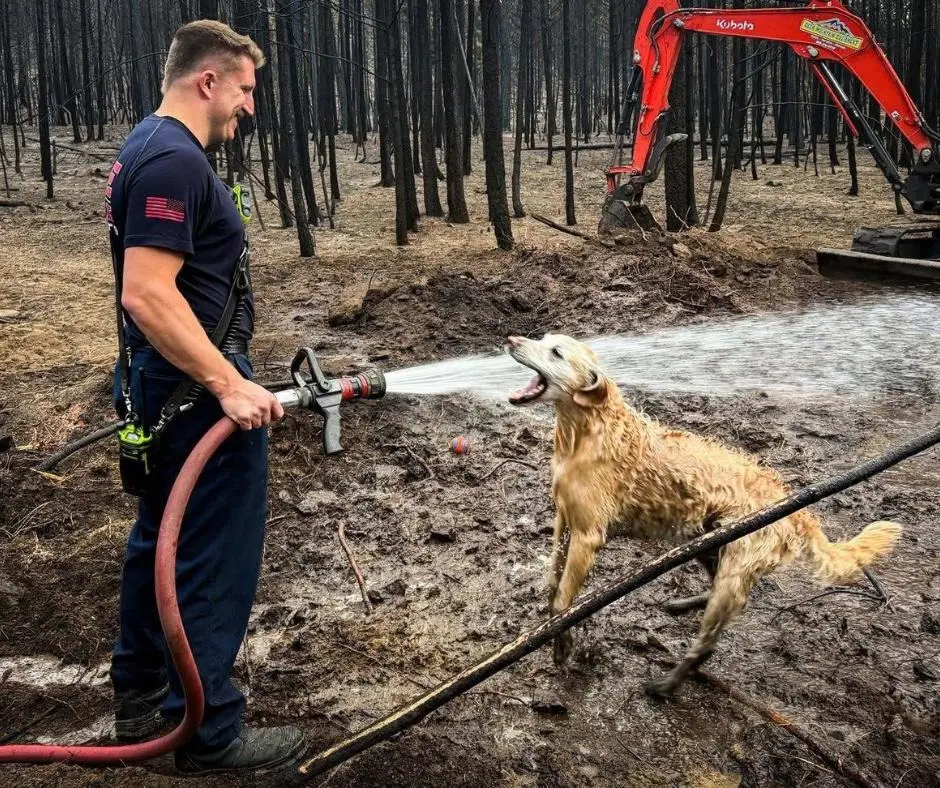
When the crew of Engine 93 from Spokane County Fire District 9 (SCFD9) responded to a minor, localized fire hazard on a wooded residential property, their primary objective was straightforward: suppress and extinguish a smoldering tree stump. What they did not anticipate was a highly enthusiastic, four-legged civilian force-multiplying—or rather, distracting—the operation.
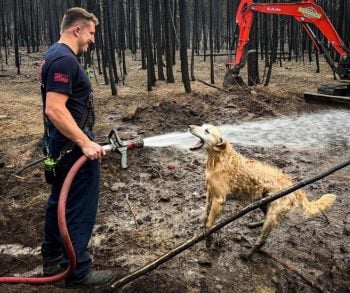
An energetic resident canine, fascinated by the sudden deployment of high-pressure hydraulic equipment, successfully commandeered the scene, transforming a standard Class A fire suppression task into an impromptu interactive water park. The incident, later documented and shared by the department, highlights not only the lighthearted realities of rural first response but also the profound, stress-relieving impact of spontaneous animal-human interactions on first responders.
Detailed Chronology
[Dispatch: Smoldering Tree Stump Reported]
                    │
                    ▼
[Engine 93 Arrives on Wooded Property]
                    │
                    ▼
[Hose Deployment & Initial Suppression]
                    │
                    ▼
[Canine Intercepts Hydraulic Stream]
                    │
                    ▼
[Tactical Adjustment: Pressure Lowered for Safety]
                    │
                    ▼
[Dual Objective Met: Stump Extinguished & Dog Satiated]
                    │
                    ▼
[Demobilization & Post-Incident Cleanup (Home Dog Wash)]
The Dispatch and Arrival of Engine 93
The incident began on an otherwise unremarkable shift for the crew of Spokane County Fire District 9’s Engine 93. Dispatched to a wooded private property within their jurisdiction, the firefighters were tasked with investigating and extinguishing a smoldering tree stump. While tree stump fires may seem minor, they present persistent underground hazards; root systems can burn undetected for days, potentially spreading fire through subterranean organic pathways or igniting dry brush nearby.
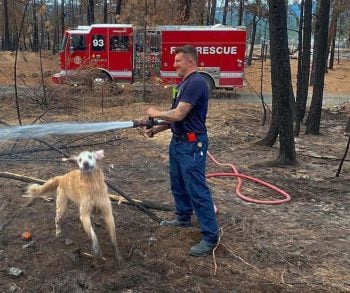
Upon arriving at the scene, the crew assessed the situation, established a water supply, and prepared to deploy a standard attack line to douse the smoldering timber. The environment was quiet, typical of Spokane County’s wooded rural-urban interface, until the homeowner’s dog caught sight of the responding apparatus and personnel.
Tactical Pivot: From Fire Suppression to Canine Play
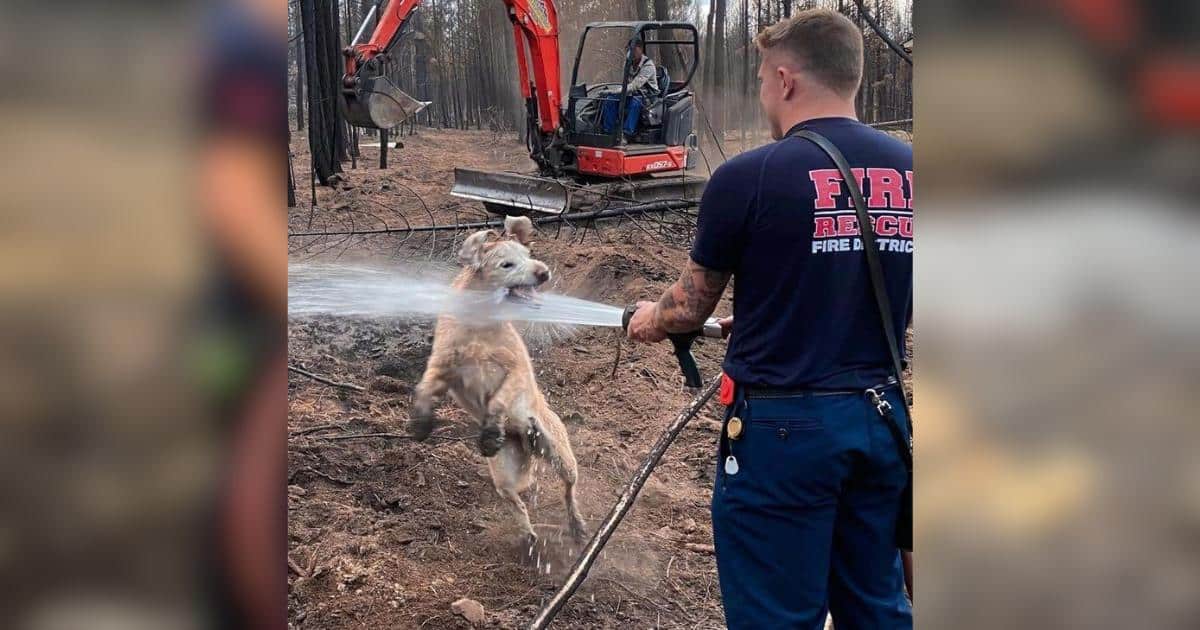
As the crew charged the hose line and began directing a stream of water toward the hot spot, the homeowner’s dog bypassed the typical perimeter boundaries. Rather than exhibiting fear or territorial aggression toward the loud machinery and uniformed personnel, the canine identified the high-velocity water stream as the ultimate recreational apparatus.
+------------------------------------------------------------+
|                  TACTICAL ADJUSTMENT LOG                   |
+------------------------------------------------------------+
| Standard Operating Psi: ~100-150 psi (Engine Output)       |
| Adjusted Play-Safe Psi: Reduced to safe contact pressure   |
| Primary Target: Smoldering Stump                           |
| Secondary Target: Playful Canine Interceptor               |
+------------------------------------------------------------+
The dog immediately charged the spray, attempting to bite, catch, and wrestle the pressurized water. Recognizing the animal’s intense drive and harmless intent, the nozzle operator executed a rapid tactical pivot. To ensure the safety of the animal while still accomplishing the suppression objective, the firefighter lowered the discharge pressure, softening the stream into a safe, manageable arc.
For several minutes, the scene existed in a dual state: serious environmental mitigation on one end, and pure, chaotic canine joy on the other. The dog bounded through the mud, leaping into the air to intercept the water droplets, completely unfazed by the smoke or the formal nature of the responding crew.
Post-Operation Demobilization and Cleanup
With the smoldering stump successfully saturated and declared safe from rekindling, the crew began the process of demobilization. By this point, the canine "assistant" was thoroughly soaked, covered in soot-tinged mud, and visibly exhausted from his high-intensity workout.
Fortunately, the property was uniquely equipped for such an aftermath. The homeowner possessed a dedicated dog-washing station at the residence, mitigating what would have otherwise been a logistical nightmare for the pet owner. The soggy, muddy pup was escorted to his clean-up station, and Engine 93 returned to service, their gear slightly muddier but their spirits significantly lifted.
Supporting Context & Operational Safety Metrics
Fire Scene Safety and Pet Management Protocols
While this incident concluded without injury or operational delay, public safety agencies emphasize that emergency scenes are generally high-risk environments for domestic pets. Under standard conditions, incident commanders enforce strict safety perimeters to protect both personnel and civilian animals.
| Hazard Category | Risk Factor for Pets | Standard Mitigation Protocol |
|---|---|---|
| Hydraulic Hazards | High-pressure hose lines can cause blunt force trauma. | Maintain safe distance; reduce pressure if animals enter hot zone. |
| Toxic Exposure | Smoke, ash, and runoff contain carcinogens and toxins. | Keep animals upwind of active suppression activities. |
| Physical Obstacles | Heavy tools, moving apparatus, and unstable terrain. | Secure pets inside the residence or on a leash prior to arrival. |
In this specific scenario, the low-hazard nature of a smoldering stump—lacking active structure collapse risks, toxic synthetic smoke, or rapid fire spread—allowed the crew the operational latitude to safely accommodate the dog’s playful intrusion.
Canine Hydro-Affinity and Behavioral Drivers
The behavior exhibited by the Spokane County dog is a recognized phenomenon among veterinary behaviorists. Many dog breeds, particularly those with high prey drives or working backgrounds (such as Retrievers, Spaniels, and Shepherds), view fast-moving water as an active target.
- Visual Stimulation: The rapid movement and light refraction of water droplets mimic the movement of small prey.
- Tactile Enrichment: Pressurized water provides sensory stimulation that many high-energy dogs find inherently rewarding.
- Play Deprivation Relief: The sudden appearance of novel stimuli (firefighters and large hoses) triggers a strong investigative and play response.
Official Statements and Public Reception
The incident gained widespread traction after Spokane County Fire District 9 shared photos of the encounter on their official social media platforms. The public response was overwhelmingly positive, offering a moments-of-joy reprieve from the typically solemn news cycles associated with emergency services.
The Digital Echo: Social Media Engagement
In their official post, the department showcased the muddy, water-logged pup alongside the crew of Engine 93. They utilized the opportunity to highlight the human element of their staff while joking about their recruitment policies.
"This is probably why we don’t have a station dog… but honestly, now we want one even more."
— Spokane County Fire District 9 Spokesperson
The post generated significant community engagement, with local residents praising the crew’s patience, adaptability, and kindness. Such interactions serve as vital public relations touchpoints, building trust and community rapport during non-crisis events.
Future Outlook: The Evolving Role of Therapy and Station Dogs
The lighthearted suggestion by SCFD9 regarding a "station dog" reflects a growing structural trend within the North American fire service. Over the past decade, fire departments have increasingly integrated facility and therapy dogs into their ranks to address a critical internal issue: first responder mental health.
                      BENEFITS OF STATION DOGS
                                 │
         ┌───────────────────────┼───────────────────────┐
         ▼                       ▼                       ▼
   [PTSD Reduction]     [Physiological Calming]   [Community Liaison]
Lowering cortisol levels   Lowering blood pressure    Bridging the gap between
  and occupational stress    during post-incident     the public and first
     among personnel.          demobilization.            responders.
Addressing the Mental Health Crisis in First Response
First responders are routinely exposed to acute trauma, chronic stress, and sleep deprivation, leading to disproportionately high rates of Post-Traumatic Stress Injury (PTSI) and burnout.
- Physiological Impact: Interacting with a therapy or station dog has been clinically proven to lower cortisol levels, decrease blood pressure, and stimulate the release of oxytocin.
- De-escalation: After returning from a high-stress call (such as a medical emergency or a structural fire), firefighters can utilize the presence of a calm, non-judgmental animal to transition back to a baseline emotional state.
- Peer Support Facilitation: Dogs often act as social icebreakers, making it easier for personnel to open up and discuss difficult calls with peer support teams.
While the playful pup in Spokane County was far too chaotic to serve as a certified therapy animal, his brief tenure as Engine 93’s "assistant" provided the crew with the exact same therapeutic benefits—a brief, joyful escape from the high-stress realities of the job. As public safety agencies continue to navigate the challenges of modern first response, encounters like this serve as a poignant reminder of the invaluable, healing connection between humans and animals.