Long before a puppy takes its first deliberate step, learns to walk on a loose leash, or shoulders the profound responsibility of guiding an individual through a complex world, an intricate biological orchestration is already underway. In the quiet, dimly lit hours of the neonatal nursery, fundamental neural pathways are forming. While a newborn puppy is still blind, deaf, and entirely dependent on its mother and littermates, its brain and central nervous system are hard at work, absorbing and processing early physiological inputs that will dictate its lifetime resilience, adaptability, and cognitive capacity.
At organizations like Dogs Inc, the preparation of elite guide dogs and service dogs does not begin with formal obedience commands or harness training in bustling public spaces. It begins at birth—and sometimes even earlier—through meticulously curated, science-based protocols designed to optimize a puppy’s neurodevelopmental trajectory.
Chief among these foundational methodologies is Early Neurological Stimulation (ENS). Though ENS is only one piece of a much larger, highly sophisticated puzzle, it exemplifies the rigorous, intentional approach required to breed and rear animals destined for life-changing roles. This article examines the physiological science of early canine development, the mechanics and benefits of ENS, the vital distinctions between stimulation and socialization, and how these foundational weeks culminate in the poise, focus, and emotional stability demanded of modern service animals.
Detailed Chronology: From the Neonatal Nursery to the Working Life
The development of a service dog candidate is a continuous, highly sensitive continuum. Understanding how early interventions shape adult temperament requires mapping out the distinct developmental windows through which every puppy passes.
During this initial phase, puppies spend the vast majority of their time nursing and sleeping. They cannot see, hear, or regulate their own body temperatures. Despite appearing entirely vulnerable, their nervous systems are undergoing rapid, foundational growth.
Key Interventions: This is the exact window for Early Neurological Stimulation (ENS). Because puppies cannot yet process complex sights or sounds, ENS relies on tactile and thermal stimuli to gently stress and adapt the cardiovascular and neurological systems.
Maternal Influence: The mother provides crucial physiological warmth, nutrition, and early comfort, while littermates offer the first tactile feedback through huddling and competing for resources.
2. The Transitional Stage (2 to 4 Weeks)
As puppies cross into the transitional period, their eyes and ears open, permanently altering their perception of the environment. By approximately four weeks of age, puppies begin to walk, vocalize, and erupt their first baby teeth.
Nutritional Shift: Their diet begins a gradual transition from maternal milk to soft foods, marking the beginning of independent physical consumption.
Sensory Awakening: They transition from reacting purely to touch and temperature to responding to sharp noises and visual movement, opening the door to broader environmental awareness.
3. The Socialization Period (3 to 12 Weeks)
Often considered the most critical psychological window in a dog’s life, the socialization period overlaps with the latter half of transitional development and extends deep into puppyhood.
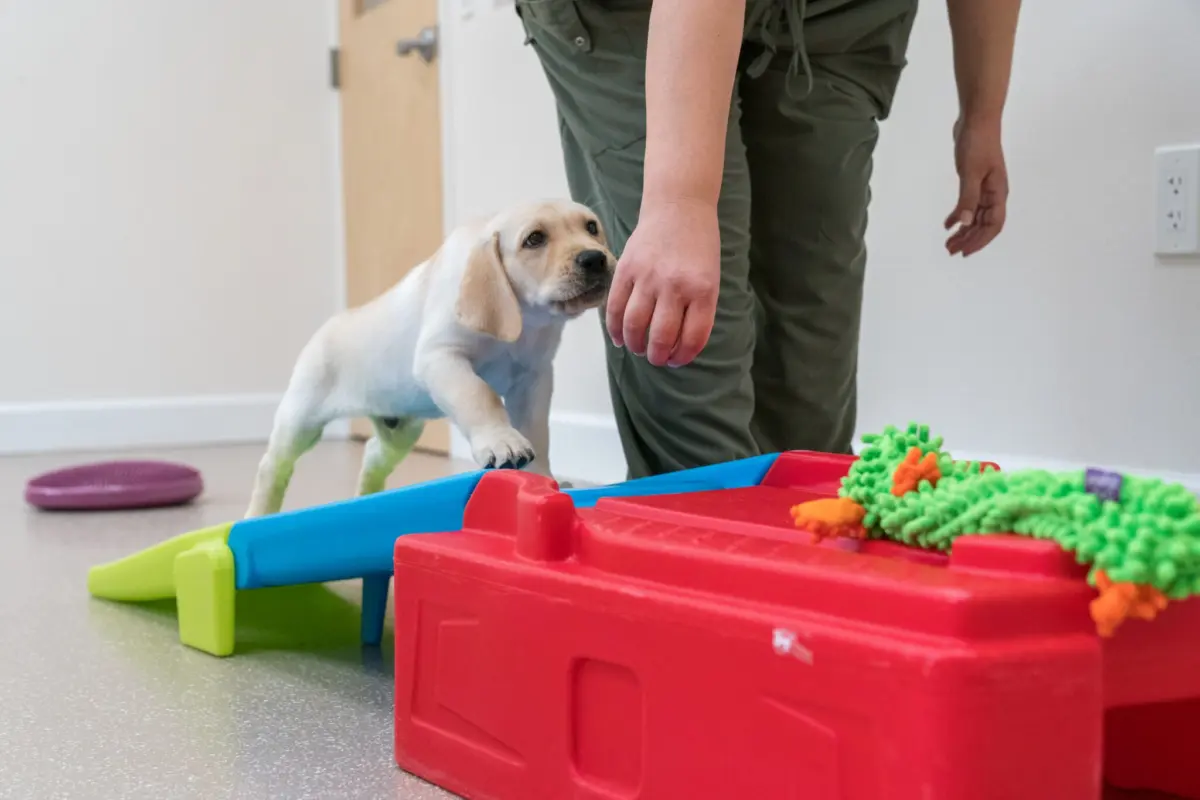
Active Exploration: Young puppies begin interacting dynamically with human handlers, novel sounds, varied textures, and other dogs.
Building Associations: By 8 to 12 weeks of age, positive exposures to diverse stimuli help build permanent neural pathways associated with confidence, emotional stability, and resilience against future phobias or reactive behaviors.
Inhibitory Learning: Time spent with the dam and littermates teaches essential lessons in bite inhibition and canine social signaling.
4. Adolescent Milestones and Fear Periods (6 to 12+ Months)
As puppies mature into adolescence, they frequently test boundaries—much like human teenagers—and undergo significant hormonal shifts. Female dogs experience their first heat cycles, while males exhibit hormone-driven behaviors.
Fear Periods: Most dogs experience an average of four distinct "fear periods" as they grow, during which frightening experiences can leave lasting psychological scars. Thoughtful, positive reinforcement training is essential here to prevent the onset of long-term reactivity or fear-based aggression.
Structured Learning: Training shifts toward basic obedience cues, short structural sessions, and environmental generalization, often supplemented by puppy kindergarten classes around 16 weeks of age.
Supporting Context & Metrics: The Science of Early Neurological Stimulation
Originally developed as part of the "Bio Sensor" program (popularized by the military canine breeding programs), Early Neurological Stimulation was designed to improve the operational and health performance of working dogs. The underlying premise is rooted in the fact that neonatal animals have immature nervous systems that can be positively stimulated through mild, non-harmful stressors.
The Mechanics of ENS Protocols
The exercises are remarkably brief—typically lasting only a few seconds per step—and are performed daily between days three and sixteen of a puppy’s life. These exercises are strictly regulated to avoid exhausting or overwhelming the animal’s delicate system. Common tactile manipulations include:
Tactile Stimulation: Holding the puppy in one hand and gently tickling the pad of one foot using a Q-tip or finger for 3–5 seconds.
Head Erect: Holding the puppy perpendicular to the ground, so its head is directly above its tail, for 3–5 seconds.
Head Pointed Down: Holding the puppy firmly in both hands with its head pointed downward toward the floor for 3–5 seconds.
Supine Position: Placing the puppy flat on its back, resting in the palm of the handler’s hand, allowing it to relax for 3–5 seconds.
Thermal Stimulation: Placing the puppy feet-down on a damp, cool towel for 3–5 seconds.
Physiological Impacts on the Canine Body
Controlled research and decades of anecdotal evidence from elite working dog organizations indicate that these brief, controlled stressors trigger significant biological responses. Potential physiological benefits include:
Improved Cardiovascular Performance: Enhanced heart rate efficiency and stronger heartbeats.
Stress Tolerance: Greater adaptability to environmental stress and sudden changes later in life.
Adrenal Gland Optimization: Improved endocrine system function, allowing the body to manage cortisol and adrenaline spikes more effectively.
Immune System Strengthening: Enhanced resistance to various common illnesses and environmental pathogens.
ENS vs. Socialization: Clarifying the Timeline
A common point of confusion among prospective puppy raisers and pet owners is conflating ENS with socialization. While both are vital, they operate in completely different developmental epochs:
ENS is strictly a neonatal intervention (days 3–16) focused on neurological and cardiovascular conditioning prior to the opening of the eyes and ears.
Socialization is a post-neonatal process (weeks 3–12 and beyond) focused on psychological exposures, environmental confidence, and interpersonal bonding once sensory organs are fully functional.
ENS does not replace socialization; rather, it provides the robust neurological hardware upon which proper socialization can build its software.
Official Perspectives: The Institutional Philosophy at Dogs Inc
Preparing a dog to serve as an independent mobility partner, a medical alert companion, or a sighted guide for an individual with visual impairments requires an uncompromising commitment to quality control from the very moment of birth.
Organizations operating at the highest tier of the service dog industry view puppy development through a holistic lens. According to canine development specialists at Dogs Inc, early interventions must never be viewed in isolation.
"Early Neurological Stimulation is a foundational chapter, but it is not the entire story," notes a senior canine program director at Dogs Inc. "Genetics, maternal care, veterinary health, targeted socialization, and structured environmental enrichment must all work in concert. Our goal is not to manufacture a ‘perfect’ animal in a laboratory sense, but to supply our puppies with the physiological resilience and emotional equilibrium required to navigate an unpredictable human world."
Institutional protocols emphasize that while science provides the tools—such as ENS and positive reinforcement schedules—the human element remains irreplaceable. Puppy parents, staff trainers, and specialized neonatal handlers must execute these protocols with clinical precision and deep emotional attunement. By acknowledging that a puppy’s behavioral outcome is a complex matrix of heredity, early neurological shaping, and ongoing environmental education, organizations like Dogs Inc maximize the graduation rate and working longevity of their elite service animals.
Future Outlook: The Evolution of Canine Breeding and Service Readiness
As veterinary science, epigenetics, and canine behavioral studies continue to advance, the landscape of service dog breeding is undergoing a quiet revolution. The future of organizations like Dogs Inc lies in the data-driven refinement of early-life protocols.
1. Precision Phenotyping and Behavioral Tracking
Modern breeding programs are increasingly utilizing advanced tracking metrics to evaluate how neonatal interventions correlate with long-term success in harness. By logging behavioral responses across each developmental milestone—from the neonatal stage through the turbulent adolescent fear periods—researchers can continuously refine which stimulation techniques yield the highest adaptability scores.
2. Expanding Access to Elite Working Lines
The insights gained from neonatal neurological conditioning are not just restricted to elite guide dog schools; they are increasingly informing best practices across the broader canine community. As techniques like ENS become more widely understood, responsible breeders everywhere are adopting structured neonatal protocols to give all puppies—whether destined for pet homes, therapy work, or specialized service—the best possible start at life.
3. Lifelong Learning and Advanced Partnership
Ultimately, the meticulous care invested during a puppy’s first two weeks pays dividends years down the road when a fully trained service dog stands calmly beside its handler in a crowded subway station, navigates a chaotic airport terminal, or provides life-saving medical alerts. Development does not stop at puppyhood; it is a lifelong continuum.
By prioritizing scientific rigor, compassionate handling, and intentional environmental exposure from day one, institutions like Dogs Inc ensure that the future of service work rests upon the strongest, most resilient foundation possible. For those who rely on these remarkable animals, that journey from a tiny, blind newborn to a confident, life-changing partner is nothing short of miraculous—and it all begins in the nursery.