
Executive Overview
As intensifying heatwaves and persistent droughts rewrite the playbook for global agriculture, the intersection of climate resilience and agricultural technology has transitioned from a niche sector into the absolute frontline of food security. Modern farming faces an unprecedented existential challenge: feeding a growing global population on a finite amount of arable land while water resources dwindle at alarming rates. In this high-stakes environment, the demand for cutting-edge biosolutions that enable crops to thrive under severe water stress has surged.
At the center of this agricultural revolution is Elicit Plant, an innovative French agtech pioneer making waves across international markets. Speaking at the prestigious World Agri-Tech Innovation Summit in London, Jean-François Duchamp, co-founder and CEO of the company, laid out a compelling vision for the future of farming. According to Duchamp, mounting climate pressures are no longer distant projections; they are immediate financial and operational crises for growers worldwide.
Elicit Plant has positioned itself at the vanguard of this movement by harnessing a proprietary technology rooted in phytosterols—naturally occurring plant compounds designed to optimize water management in broadacre crops like corn, soybeans, sunflowers, and wheat. By functioning as a preventative spray treatment, these biosolutions allow farmers to bridge the gap between sustainability and profitability. Backed by robust field data, substantial venture backing, and strategic partnerships with multinational agricultural giants, Elicit Plant’s trajectory underscores a broader industry pivot: the commercial imperative for climate-adaptive technologies is driving agtech firmly back to pragmatic, fundamentals-driven innovation.
Detailed Chronology: From French Innovation to Global AgTech Powerhouse
The journey of Elicit Plant offers a masterclass in how targeted scientific research can rapidly scale to meet macro-environmental challenges. The company’s evolution is marked by deliberate milestones of scientific validation, financial backing, and international market penetration.
Foundations and Early Development
Founded in France, Elicit Plant was built on the premise that nature holds the answers to modern agricultural challenges. The founding team recognized that while conventional breeding programs and chemical fertilizers had successfully driven yields for decades, they were largely ill-equipped to handle the erratic, high-stress weather patterns characteristic of the 21st century. By focusing on phytosterols—molecules naturally produced by plants to regulate various biological processes, including stress response—the company engineered a proprietary technology designed to trick crops into managing water reserves more efficiently.
Scaling Trials and Scientific Validation
Over the past five years, Elicit Plant has quietly built one of the most comprehensive datasets in the agtech sector. Eschewing flashy marketing in favor of rigorous scientific backing, the company has executed more than 1,000 field trials across diverse climatic zones. This exhaustive testing phase culminated in breakthrough results during the recent agricultural season across France and Central Europe, where the company’s treatments demonstrated a unique ability to simultaneously boost yields and drastically lower water consumption.
Capital Infusion and Commercial Acceleration
The market took notice of these proven results. In November 2024, Elicit Plant secured a massive €45 million ($48 million) funding round. This vital capital injection was explicitly earmarked to accelerate the company’s international growth strategy, expand its manufacturing and R&D footprints, and scale the delivery of its crop-resilience biosolutions to new territories.
Industry Accolades and Global Recognition
The momentum continued through 2026. In August, Elicit Plant’s groundbreaking approach was validated on the global stage when it was named Climate Adaptation Solution of the Year at the prestigious 2026 AgTech Breakthrough Awards. This honor was quickly followed by another major milestone: selection as one of the 10 exclusive winners of the Blue Earth Summit’s 2026 BE100 cohort, recognizing enterprises driving transformative environmental and social impact.
Global Footprint and Strategic Partnerships
Today, Elicit Plant’s commercial footprint spans 16 countries across Europe, Brazil, and North America. Rather than building a massive standalone distribution network from scratch, the company has wisely chosen to partner with established global agricultural titans.
- Certis Belchim: A strategic collaboration aimed at developing specialized biosolution products for potato crops.
- The Mosaic Company: A major partnership in North America focused on delivering climate-resilient solutions for canola growers.
- Bayer: An ongoing alliance covering corn production across several vital European markets.
Through these high-level integrations, Elicit Plant has transformed from a promising French startup into a globally trusted ally for some of the largest agribusinesses on earth.
Supporting Context & Metrics: The Hard Economics of Water Stress
The business case for agricultural biosolutions rests on a simple, immutable equation: farmers must do more with less. As Jean-François Duchamp articulated during his keynote discussions in London, modern growers face a dual mandate that was once considered mutually exclusive: drastically improving resource efficiency while protecting or even enhancing overall crop yield.
Quantifying the Impact: Field Data and Efficiency Gains
Elicit Plant’s extensive trial data from the most recent agricultural season provides concrete proof that this dual mandate is achievable. In controlled and commercial field trials conducted throughout France and Central Europe, the company’s phytosterol-based treatments delivered remarkable metrics:
- Yield Increases: Growers recorded yield gains exceeding one tonne per hectare in treated broadacre crops.
- Water-Use Efficiency: Efficiency improvements ranged between 17% and 30%.
To understand the real-world implications of these numbers, one must look at day-to-day farm management. In practical terms, these efficiency gains allow a farmer to reduce irrigation from roughly 300 millimeters down to approximately 220 millimeters. Crucially, this reduction in water usage is achieved without sacrificing crop performance or final harvest volume. In regions grappling with strict water quotas, skyrocketing irrigation energy costs, and dwindling aquifer levels, saving 80 millimeters of water per hectare represents the difference between a profitable season and financial ruin.
The Macroeconomic Reality of Climate Instability
These operational savings are occurring against a backdrop of severe global climate disruption. Traditional weather predictability has completely broken down. According to meteorological data cited by agricultural analysts, weather systems are increasingly prone to "blocking patterns"—atmospheric conditions that cause weather systems to stall over specific geographic regions for weeks or even months at a time.
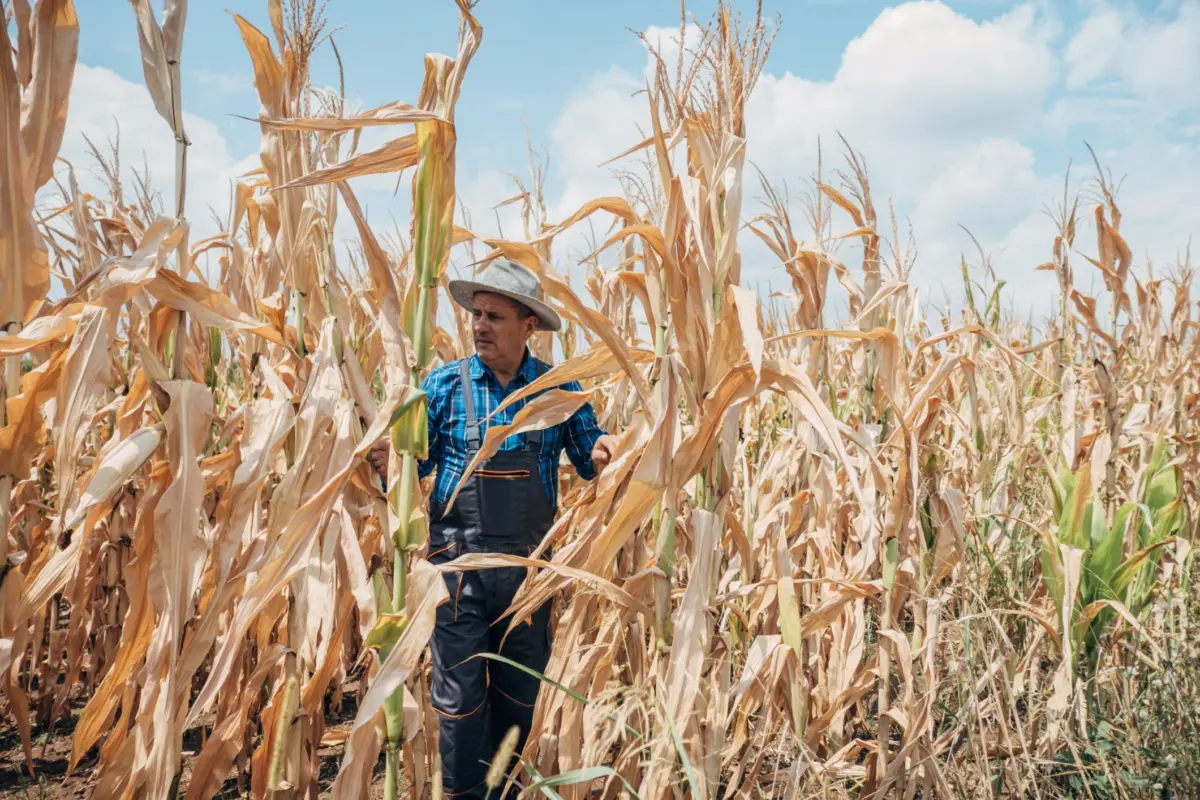
This atmospheric stagnation is directly responsible for the polarized weather extremes currently plaguing the agricultural sector: excessively long, intensely wet periods followed immediately by prolonged, searing heatwaves and multi-month droughts. For broadacre crops—which are entirely dependent on natural precipitation or calculated irrigation during critical growth windows—these volatile shifts can devastate a harvest overnight.
Elicit Plant’s preventative spray treatments act as an internal insurance policy for the plant, altering its physiological response to drought at the cellular level so it can endure prolonged dry spells without shutting down metabolic processes.
Official Statements and Industry Insights
The dialogue at the World Agri-Tech Innovation Summit in London made one thing abundantly clear: the agtech sector has officially entered a post-hype era. Investors, founders, and enterprise buyers are no longer dazzled by speculative concepts; they are demanding proven technologies that solve immediate, bottom-line operational problems.
Jean-François Duchamp’s commentary during the summit cut straight to the heart of this philosophical shift. Speaking candidly about the lived experiences of modern farmers, Duchamp emphasized the pragmatic nature of Elicit Plant’s value proposition:
"Heat waves and drought events are clearly having a significant impact on growers in many countries. In these conditions, we’ve been able to demonstrate strong results with our products."
When discussing the core motivation driving adoption among growers, Duchamp framed the technology not merely as an environmental safeguard, but as an essential economic strategy:
"For farmers, it’s really a case of addressing two challenges at once. First, better use of water resources. Second, higher yields, which translate directly into economic benefits."
Duchamp also offered a sobering perspective on what the future holds for regions traditionally considered immune to severe water scarcity, such as the United Kingdom and Northern Europe. As atmospheric temperatures continue to climb, the historical safety nets provided by temperate climates are eroding.
"We’re moving toward greater weather instability," Duchamp warned attendees. "Wet periods may become longer and more intense, while periods of heat and drought may also become longer and more severe. As temperatures rise, weather patterns can remain in place for weeks or even months at a time. That’s why we’re seeing longer periods of persistent rainfall followed by extended dry spells."
This shifting paradigm ensures that the market for climate adaptation technologies will experience sustained, secular growth for decades to come, moving from a luxury add-on to standard operating procedure across all major agricultural belts.
Future Outlook: The Next Frontier for Agricultural Resilience
As Elicit Plant looks toward the horizon, the roadmap ahead is defined by aggressive international scaling, deeper scientific discovery, and an expanded product portfolio.
Expanding Beyond Traditional Geographies
While the company has successfully anchored its presence across 16 countries in Europe, Brazil, and North America, vast agricultural regions remain largely untapped. North America’s immense corn and soybean belts, combined with South America’s expanding agricultural frontier, present massive opportunities for biological water-stress management. Furthermore, as Western Europe and the UK experience more frequent meteorological anomalies, local adoption rates are projected to accelerate dramatically.
Deepening Industry Collaborations
The modern agtech ecosystem relies heavily on synergy. Elicit Plant’s strategy of partnering with established giants like Bayer, Mosaic, and Certis Belchim serves as a blueprint for sustainable growth. By embedding its phytosterol technology into the distribution and R&D pipelines of these multinational powerhouses, Elicit Plant ensures rapid market penetration and regulatory navigation across diverse global jurisdictions. Future partnerships will likely target specialized specialty crops, expanding far beyond foundational broadacre staples.
The Road Ahead for AgTech Fundamentals
The broader implications of Elicit Plant’s success signal a maturation of the entire agtech sector. Following years of speculative venture capital deployment into unproven concepts, the industry has pivoted decisively toward solutions that offer measurable, verifiable return on investment for growers. Biosolutions that protect against climate volatility while preserving natural resources are no longer a utopian ideal—they are the commercial bedrock of modern farming.
As climate change continues to test the limits of human ingenuity, companies like Elicit Plant are proving that science and nature can work in tandem to secure the global food supply. Through rigorous field trials, strategic global partnerships, and a relentless focus on practical economic and environmental results, the company is not merely adapting to a changing world—it is actively cultivating a more resilient agricultural future.
Editor’s Note: This interview and market analysis were conducted in conjunction with the World Agri-Tech Innovation Summit in London. To dive deeper into these insights and watch comprehensive interviews with other industry experts, tune in to AgNavigator’s upcoming "World Agri-Tech Unwrapped" webinar on November 4, available live and on-demand.