
EXECUTIVE OVERVIEW
Archaeological excavations at the remote desert citadel of Castillo de Huarmey in Peru have yielded extraordinary physical evidence of Peruvian hairless dogs dating back more than 1,200 years. Long predating the rise of the Inca Empire, these ancient remains—including naturally mummified specimens, preserved skin, and rare skeletal anomalies—provide an unprecedented window into the complex, multifaceted relationships between humans and animals in pre-Columbian South America.
Published in the Journal of Anthropological Archaeology, the groundbreaking study not only confirms the presence of the iconic hairless breed at the only known northern coastal site of the Wari Empire, but it also challenges historical assumptions about how ancient civilizations integrated, valued, and managed domesticated animals. Through a combination of osteological analysis, isotopic chemistry, and radiocarbon dating, an international team of researchers has uncovered how these distinctive canines lived, what they ate, and how their existence intertwined with the elite echelons of Wari society centuries before European contact.
DETAILED CHRONOLOGY: UNLOCKING THE SECRETS OF CASTILLO DE HUARMEY
Situated approximately 190 miles north of Lima, the Castillo de Huarmey complex spans 110 acres of punishingly arid terrain along Peru’s Pacific coast. Operating as a major administrative, religious, and burial hub for the Wari Empire between 600 and 1050 CE, the site predates the expansion of the Inca Empire by roughly 400 years.
A History of Monumental Discoveries
For decades, the desert sanctuary has rewarded archaeological perseverance with world-class historical insights, though it has faced severe environmental and human threats:
- 1970: A catastrophic earthquake struck the region, causing structural collapses within Castillo de Huarmey that exposed ancient burial chambers containing precious metals and ceramics, which subsequently invited illicit looting.
- 2012: Excavation teams achieved a monumental breakthrough by uncovering the first completely undisturbed elite Wari tomb. The vault contained the remains of 58 high-status women, six sacrificial human victims, and approximately 1,300 luxury artifacts.
- 2022: Archaeologists identified nearby burials of elite craftspeople interred alongside sophisticated tools crafted from gold, silver, and bronze.
- 2010–2025: Ongoing systematic excavations in the northern sectors of the ceremonial complex recovered extensive biological remains, including South American camelids (llamas and alpacas), alongside scattered canine bones.
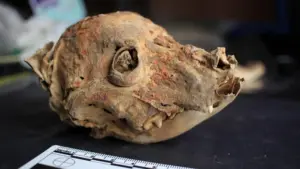
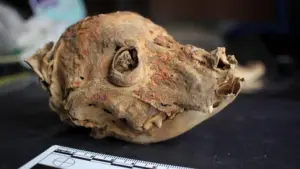
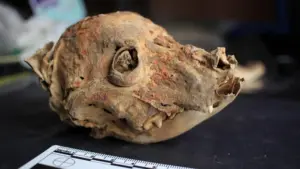
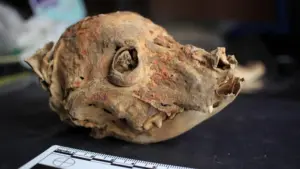
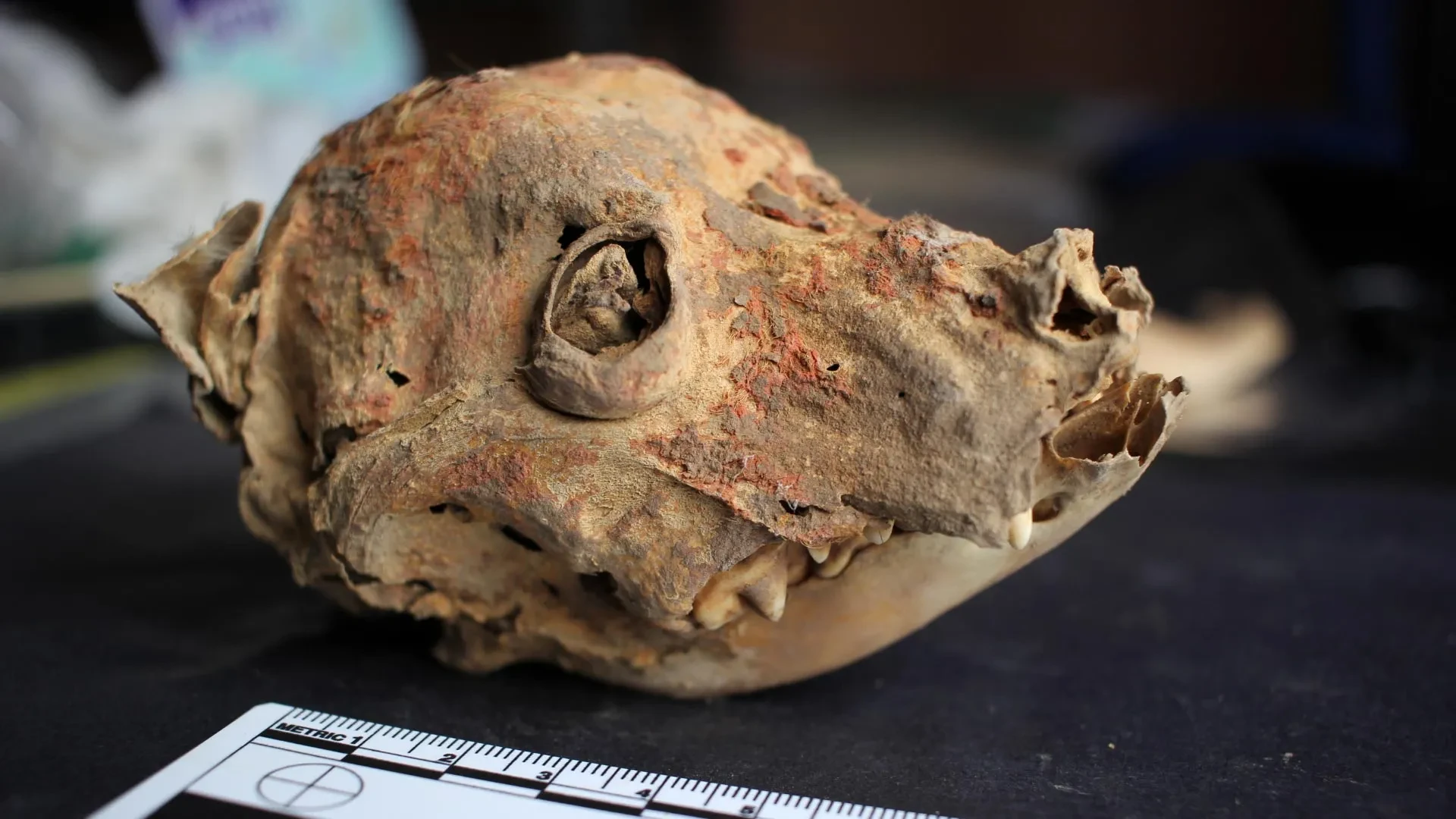
- Recent Breakthroughs: Deep within the stratigraphically intact layers untouched by looters, researchers isolated 341 dog bone specimens representing at least 19 individual animals, culminating in the identification of naturally mummified Peruvian hairless dogs.
The Genetic Marker of Identity: Missing Teeth
Initially, the upper-layer animal remains presented analytical challenges due to mixing caused by past looting and seismic activity. However, distinct biological markers quickly shifted the research trajectory.
Lead author Weronika Tomczyk, a research associate in Dartmouth’s Department of Anthropology and a postdoctoral fellow in its Ecology, Evolution, Environment and Society Program, noticed an unusual dental pattern among the recovered skulls: the animals were systematically missing their first premolars and, in some cases, their final molars. Crucially, these teeth had never erupted during the animals’ lifespans, rather than being lost due to disease, trauma, or old age.
Further cross-referencing with biological literature confirmed a direct genetic correlation: the identical genetic mutation responsible for hairlessness in dogs also triggers oligodontia (a reduced number of teeth). This vital deduction confirmed that the remains belonged to the ancestral lineage of the modern Peruvian hairless dog—recognized today by the American Kennel Club as the Peruvian Inca Orchid and designated a national cultural heritage asset by the Peruvian government in 2000.
SUPPORTING CONTEXT & METRICS: DIET, STATUS, AND BURIAL RITUALS
The investigation utilized an array of advanced scientific techniques to construct comprehensive life histories for the Castillo de Huarmey canines. By evaluating zooarchaeological metrics, isotopic signatures, and radiocarbon timelines, researchers mapped out the animals’ origins, environments, and nutritional habits.
Isotopic Analysis: Reconstructing Ancient Diets
To understand what the dogs consumed and how their environments changed over time, the research team analyzed stable isotopes of carbon, nitrogen, oxygen, and strontium extracted from the animals’ bones and teeth.
- Teeth vs. Bones: Isotopic signatures retrieved from dental enamel captured the chemical composition of the animals’ puppyhoods, as canine teeth erupt rapidly. In contrast, bone collagen provided integrated dietary data representing the final year of life.
- Maize Consumption: The data revealed significant dietary overlap between the dogs and the human population at Castillo de Huarmey. Most of the canines consumed diets rich in maize (corn), a cornerstone agricultural product of the pre-Hispanic Andes.
- The Hairless Puppy Paradox: Isotopic profiles of hairless puppies closely mirrored the diets of human children during early development, diverging into more varied food sources only as the animals matured. This striking parallel suggests that hairless puppies may have received specialized human care, targeted feeding, or controlled rearing within domestic environments.
Quantitative Overview of the Findings
- 1,200+ Years: Radiocarbon dating confirmed that the complete mummified male dog is at least 1,200 years old, making it the oldest radiocarbon-dated biological specimen recovered from Castillo de Huarmey to date.
- 341 Specimens: The total collection of recovered canine skeletal remains.
- 19 Individuals: The minimum number of distinct dogs represented by the bone assemblage.
- Elite Accompaniments:
- The skeletal remains of a 6-to-8-week-old puppy interred alongside an elite artisan known as the "Master Basketmaker."
- An adult dog buried within the complex’s central palace structure.
- Partially recovered puppy remains buried alongside a male individual designated as "XY," interpreted as a sacrificial tomb guardian.
Despite these intimate burial contexts, the researchers noted a stark duality in how dogs were treated across the community. While a select few received deliberate, individualized interments near elite figures, others were discarded alongside general waste materials. Notably, very few bones exhibited butchery marks, indicating that these animals were rarely, if ever, consumed as a primary food source.
OFFICIAL STATEMENTS AND SCHOLARLY PERSPECTIVES
The complex nature of human-canine interactions in antiquity requires cautious interpretation, as researchers stress the impossibility of directly measuring ancient emotional bonds.
"Our findings indicate that humans and dogs coexisted at this Wari site, but reconstructing their bond is challenging, as past emotions are difficult to capture through archaeological methods," stated Weronika Tomczyk, lead author of the study and postdoctoral researcher at Dartmouth College.
Addressing the broader sociological implications of the discovery, Tomczyk emphasized the duality of animal status within early urban centers:
"The goal of our study was to not only present data on Castillo de Huarmey’s dog burials, but also emphasize that people in the past had often contradictory relationships with the animals, just as they do today: a pet for one group of people could at the same time be considered a pest by their closest neighbors."
Commenting on the dental anomalies that unlocked the identity of the mummies, Tomczyk explained:
"What I noticed is that some of the dog skeletons were missing teeth, and not that they lost them during their lifespan; some teeth, especially first premolars and sometimes last molars, had just never erupted. And then I found in the literature that the same gene which is responsible for hairlessness in dogs is responsible for a reduced number of teeth, indicating that these were Peruvian hairless dogs."
Reflecting on the controlled dietary habits inferred from isotopic sampling, Tomczyk noted:
"We do not know if the dogs were intentionally fed maize or if perhaps, they were just eating leftovers or trash. Yet, the distinct dietary patterns of hairless puppies provide insights into what may have been organized breeding."
Concluding on the ambiguous social standing of the animals, Tomczyk added:
"While we will never know if any of the three dogs were pets or how people treated them, it is evident they received different treatment than other dogs."
The collaborative international research team behind the study features prominent scholars including Miłosz Giersz, Wiesław Więckowski, and Roberto Pimentel Nita from the University of Warsaw, alongside Claire Ebert from the University of Pittsburgh.
FUTURE OUTLOOK: EXPANDING THE HORIZONS OF ANDEAN ZOOARCHAEOLOGY
The identification of 1,200-year-old Peruvian hairless dog mummies at Castillo de Huarmey opens new avenues for archaeological investigation across South America. As researchers continue to process the vast array of organic materials preserved by the hyper-arid Peruvian desert, several key areas of future study are emerging:
- Ancient DNA (aDNA) Sequencing: Future research phases will likely attempt to extract mitochondrial and nuclear DNA from the mummified remains. Genetic sequencing could trace the precise evolutionary lineages of these ancient hairless canines, mapping their divergence from other New World and Old World dog populations.
- Broader Regional Comparisons: By applying similar zooarchaeological and isotopic methodologies to other Wari and pre-Wari sites along the Andean coast, scientists hope to determine whether selective breeding and specialized care of hairless dogs were widespread cultural practices or localized phenomena unique to Castillo de Huarmey.
- Refining Chronological Models: The successful radiocarbon dating of the mummified male dog provides a vital temporal anchor. Archaeologists intend to integrate this biological data into broader chronological frameworks, helping to refine timeline estimates for the rise, expansion, and administrative strategies of the Wari Empire.
Ultimately, these remarkably preserved remains bridge a millennium of history, demonstrating that the nuanced, affectionate, and sometimes contradictory relationships humans share with their canine companions are deeply rooted in the ancient civilizations of the pre-Columbian Andes.