
Executive Overview
For millions of households worldwide, pet food purchasing decisions are guided by compelling package imagery—vibrant depictions of prime cuts of meat, fresh garden vegetables, and wholesome grains. However, an examination of the regulatory, legal, and operational frameworks governing the multi-billion-dollar pet food industry reveals a pronounced disconnect between consumer perception and regulatory enforcement.
While pet owners routinely assume that commercial animal feed undergoes rigorous oversight comparable to human food, the actual regulatory landscape is governed by a patchwork of federal guidelines, state-level administration, and private standard-setting bodies. Primary federal statutory authority rests with the U.S. Food and Drug Administration (FDA), supplemented at the local level by individual State Departments of Agriculture. Crucially, the Association of American Feed Control Officials (AAFCO)—frequently mistaken by the public for an official regulatory agency—possesses no legal enforcement power, operating purely as a voluntary standard-setting organization.
       PET FOOD REGULATORY & COMPLIANCE FRAMEWORK

+-------------------------------------------------------+
|              U.S. Food & Drug Administration          |
|    - Federal Statutory Authority (FFDCA)              |
|    - Exercises "Enforcement Discretion" on 4-D Meats  |
+--------------------------+----------------------------+
                           |
       +-------------------+-------------------+
       |                                       |
+------v---------------------+       +---------v------------------+
| State Depts. of Agriculture |       |      AAFCO (Private)       |
|  - State-level registration |       |  - Defines ingredients     |
|  - Local feed inspections  |       |  - Sets Nutrient Profiles  |
|  - Enforces state law      |       |  - NO enforcement power    |
+----------------------------+       +----------------------------+
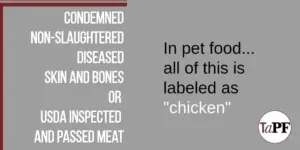
Underneath this framework lies a controversial regulatory stance: the FDA explicitly permits the inclusion of diseased livestock and animals that have died by means other than slaughter within pet food formulations. Despite statutory prohibitions against adulterated food under federal law, the FDA intentionally exercises "enforcement discretion" to allow these ingredients to enter the feed supply chain without mandatory label disclosures.
This investigative report examines the structural realities of pet food regulation, ingredient thresholds, visual marketing exemptions, and the ongoing legal battles led by consumer advocacy organizations to establish systemic transparency.
The Regulatory Matrix: Decoupling Authority, Standards, and Oversight
Understanding pet food safety requires disentangling the distinct roles played by federal agencies, state authorities, and advisory bodies.
+-------------------------------------------------------------------+
|                  AGENCY ROLES & JURISDICTIONS                     |
+-------------------------+-----------------------------------------+
| ENTITY                  | STATUTORY / OPERATIONAL ROLE            |
+-------------------------+-----------------------------------------+
| FDA (CVM)               | Federal statutory enforcement under     |
|                         | Federal Food, Drug, and Cosmetic Act.   |
+-------------------------+-----------------------------------------+
| State Depts. of Ag      | Commercial feed registration, facility  |
|                         | inspections, and state law enforcement. |
+-------------------------+-----------------------------------------+
| AAFCO                   | Private non-profit; establishes model   |
|                         | regulations and nutrient profiles.      |
+-------------------------+-----------------------------------------+
| USDA                    | No regulatory oversight over pet food;  |
|                         | formerly ran voluntary certification.   |
+-------------------------+-----------------------------------------+
The Federal vs. State Divide
At the federal level, the FDA’s Center for Veterinary Medicine (CVM) holds statutory jurisdiction over pet food under the Federal Food, Drug, and Cosmetic Act (FFDCA). The FDA is tasked with ensuring that animal feed is safe, produced under sanitary conditions, and accurately labeled.
However, day-to-day enforcement of feed distribution often occurs at the state level. State Departments of Agriculture are tasked with registering individual pet food products, inspecting manufacturing plants, and analyzing product samples to ensure compliance with guaranteed analysis statements. This bifurcated approach creates regional inconsistencies in enforcement, leaving national uniformity largely reliant on model regulations drafted by non-governmental groups.
The Role of AAFCO: Standard-Setter Without Enforcement Power
A widespread misconception among consumers is that the Association of American Feed Control Officials (AAFCO) regulates, tests, or approves pet food. In reality, AAFCO is a private, non-profit voluntary membership association comprising state and federal feed control officials, industry representatives, and researchers.
AAFCO’s primary functions are to:
- Define official feed ingredients.
- Formulate model pet food regulations.
- Establish nutritional adequacy standards (AAFCO Nutrient Profiles).
AAFCO possesses zero regulatory authority. It does not inspect manufacturing facilities, analyze commercial recipes, test finished products, or certify label claims. AAFCO model laws only acquire legal force when individual state legislatures or departments of agriculture explicitly adopt them into state law.
Historical Context: The USDA’s Former Role
The United States Department of Agriculture (USDA) currently exercises no regulatory jurisdiction over pet food manufacturing or marketing. Historically, however, the USDA operated a voluntary "Certified Pet Food" program. Under this legacy program, participating pet food manufacturers could receive official certification if 100% of the ingredients utilized in their formulas met human-edible quality standards and were processed under continuous USDA inspection.

As the commercial pet food market rapidly expanded, this voluntary program was phased out, transferring baseline feed safety oversight entirely to the FDA and state agencies.
Ingredient Thresholds and Labeling Naming Conventions
The nomenclature used on pet food labels is tightly dictated by legal percentage minimums established under AAFCO Model Pet Food Regulations. These naming conventions govern how specific ingredients can be featured in product titles, directly dictating actual ingredient content.
       AAFCO INGREDIENT PERCENTAGE THRESHOLDS

  100% +---------------------------------------------+
       | Single Ingredient / "100% Beef"             |
   95% +---------------------------------------------+
       | Primary Name Component (e.g., "Beef Dog Food")|
   10% +---------------------------------------------+
       | Descriptors: "Dinner", "Recipe", "Formula"  |
    3% +---------------------------------------------+
       | Modifier: "With [Ingredient]"               |
    0% +---------------------------------------------+
Naming Percentage Rules: "With" vs. "Dinner," "Recipe," and "Formula"
Manufacturers select product names strategically based on ingredient weight relative to total product formulation (exclusive of added water for processing):
- The 95% Rule: If a product is labeled simply as "Beef Dog Food" or "Chicken Cat Food," the named ingredient must constitute at least 95% of the total weight of the product (or 70% if accounting for added water).
- The "Dinner," "Recipe," or "Formula" Rule (10% Threshold): When qualifying descriptors such as Dinner, Formula, Recipe, Platter, or Entrée are used in the product name (e.g., "Salmon Recipe Cat Food" or "Beef Dinner for Dogs"), AAFCO regulations mandate a minimum of 10% of the named ingredient by weight, exclusive of added water used for processing.
- The "With" Rule (3% Threshold): The inclusion of the word "with" radically lowers the mandatory requirement. A label claiming "Dog Food With Beef" is legally required to contain a minimum of just 3% beef by product weight, exclusive of processing water.
Visual Representation and the Enforcement Vacuum
AAFCO model regulations contain explicit language regarding packaging imagery:
"A vignette, graphic, or pictorial representation on a pet food label shall not misrepresent the contents of the package."
Despite this explicit rule, consumer advocates point to a widespread failure of regulatory enforcement. Packaging routinely features photographs of human-grade whole chicken breasts, prime cut steaks, and fresh salmon fillets—even when the underlying formulation consists primarily of low-grade animal rendered by-products, meal, or plant proteins. Neither the FDA nor State Departments of Agriculture actively enforce this provision against visual misrepresentation, allowing manufacturers to market feed-grade products using imagery suggestive of human-grade ingredients.
Dominant Ingredients: Corn’s Market Hegemony
Beyond meat claims, market data reveals that agricultural grain commodities form the structural backbone of the commercial pet food industry.
               PET FOOD INGREDIENT USAGE (TONNAGE)

Corn & Derivatives   [====================================] Top Ingredient
Other Ingredients    [========================] (~1M Tons Less)
According to an extensive industry research report published by the Institute for Feed Education and Research (iFEEDER), corn is utilized in pet food manufacturing in quantities nearly 1 million tons greater than any other single ingredient. Used across dry kibble formulations as a primary source of carbohydrates, energy, and binding starch, corn’s dominance underscores the industrial agronomic reliance underlying commercial animal feed production.
Nutritional Benchmarks and Feeding Trial Vulnerabilities
To be legally marketed as a complete and balanced meal, a pet food must demonstrate nutritional adequacy through one of two primary pathways outlined in AAFCO Model Regulations: compliance with laboratory-analyzed Nutrient Profiles or completion of an AAFCO-protocol Feeding Trial.
       AAFCO MINIMUM PROTEIN REQUIREMENTS (DRY MATTER BASIS)

  35% +-------------------------------------------------------+
      |                                                       |
  30% +-----------------------------------+                   |
      |                                   |                   |
  25% +-----------------+                 |                   |
      |                 |                 |                   |
  20% +-----------------+                 +-------------------+
      |                 |                 |                   |
  15% +-----------------+-----------------+-------------------+
      |   Adult Dog     |  Growth/Puppy   |    Adult Cat      |  Growth/Kitten
      |    (18.0%)      |    (22.5%)      |     (26.0%)       |    (30.0%)
AAFCO Nutrient Profiles for Canines and Felines
AAFCO maintains two distinct baseline Nutrient Profiles based on life stage: Adult Maintenance and All Life Stages (which includes Growth and Reproduction).
Feline Minimum Protein Requirements
Cats are obligate carnivores requiring significantly higher baseline amino acid profiles:

- Adult Maintenance: Requires a minimum crude protein content of 26.0%.
- All Life Stages / Growth (Kittens): Requires a minimum crude protein content of 30.0%.
Canine Minimum Protein Requirements
Dogs are omnivorous carnivores with lower baseline protein requirements:
- Adult Maintenance: Requires a minimum crude protein content of 18.0%.
- All Life Stages / Growth (Puppies): Requires a minimum crude protein content of 22.5%.
Life Stage Classifications and Large-Breed Nuances
Products categorized for "Growth" (puppy and kitten formulas) are legally required to meet the comprehensive "All Life Stages" Nutrient Profile. However, AAFCO mandates a critical formulation difference for diets targeted toward large breed puppies (dogs projected to weigh 70 lbs or more as adults). These formulas are restricted to slightly lower maximum calcium levels to prevent rapid bone growth and developmental orthopedic disorders such as hip dysplasia.
The Illusion of Certified Feeding Trials
Manufacturers can establish nutritional adequacy by conducting standard AAFCO Feeding Trials, wherein a cohort of test animals is fed the target diet under specific protocols for a defined duration.
However, a major structural vulnerability exists in how these trials are validated:
- AAFCO outlines the procedural protocols for feeding trials but does not verify, certify, or audit the results.
- No regulatory authority (neither the FDA nor state bodies) nor any independent third party is legally required to review, validate, or authenticate feeding trial laboratory data before a manufacturer places an "AAFCO Feeding Trial Tested" claim on retail shelves.
The process operates entirely on an honor system, leaving data validation in the hands of the manufacturing companies.
Official Statements and the Legal Paradox of Adulterated Ingredients
The most significant battleground between consumer advocates and federal regulators centers on the quality and legal status of meat ingredients used in commercial animal feed.
             THE ADULTERATION ENFORCEMENT GAP

    STATUTORY LAW                       FDA POLICY
  (21 U.S.C. § 342)            (Compliance Policy Guides)
+--------------------+           +--------------------+
|  Prohibits 4-D     |   VS.     |  Permits 4-D       |
|  Livestock & Non-  |  =======> |  Ingredients via   |
|  Slaughter Meats   |           |  "Enforcement      |
|  in ALL Food       |           |   Discretion"      |
+--------------------+           +--------------------+
4-D Livestock and FDA Enforcement Discretion
Under Section 402(a)(5) of the Federal Food, Drug, and Cosmetic Act (21 U.S.C. § 342), a food is deemed legally adulterated if it is, in whole or in part, the product of a diseased animal or an animal that has died otherwise than by slaughter (commonly referred to in industry parlance as 4-D livestock: Dead, Dying, Diseased, or Disabled).
Despite this statutory prohibition applying to all animal food, the FDA officially permits the rendering and inclusion of these materials in pet food through formal policy directives, operating under what the agency terms "enforcement discretion."
The official position of the FDA’s Center for Veterinary Medicine states:
"We do not believe that the use of diseased animals or animals that died otherwise than by slaughter to make animal food poses a safety concern and we intend to continue to exercise enforcement discretion."
Through this mechanism, high-heat rendering processes are deemed by federal regulators to neutralize biological pathogens sufficiently to render diseased or fallen animal tissue acceptable for animal consumption, despite direct conflicts with federal statutory text.
+-------------------------------------------------------------------+
|               STATUTORY LAW VS. REGULATORY POLICY                 |
+-------------------------------------------------------------------+
| STATUTORY LAW (21 U.S.C. § 342)                                   |
| Expressly defines food containing diseased or non-slaughtered    |
| animal tissue as adulterated and illegal.                         |
+-------------------------------------------------------------------+
                                VS.
+-------------------------------------------------------------------+
| REGULATORY POLICY (FDA Enforcement Discretion)                    |
| Waives statutory enforcement, allowing rendered 4-D meats into    |
| pet food formulations without public disclosure.                  |
+-------------------------------------------------------------------+
Advocacy Petitions and Regulatory Rejections
This policy has met persistent opposition from consumer protection organizations. Susan Thixton, a prominent pet food consumer advocate and founder of TruthaboutPetFood.com and the Association for Truth in Pet Food, has repeatedly challenged the agency’s position.
+-------------------------------------------------------------------+
|                  ADVOCACY PETITIONS & FDA RESPONSES               |
+-------------------------------------------------------------------+
| ADVOCACY DEMANDS (Association for Truth in Pet Food)              |
| 1. Enforce federal statutory law prohibiting 4-D animal meats.    |
| 2. Mandate clear label disclosures identifying feed-grade vs.     |
|    human-grade raw materials.                                     |
+-------------------------------------------------------------------+
                                VS.
+-------------------------------------------------------------------+
| FDA RESPONSES                                                     |
| Formal rejection of petitions; continued reliance on enforcement  |
| discretion for rendered non-slaughtered animal tissues.           |
+-------------------------------------------------------------------+
The Association for Truth in Pet Food—which represents consumer interests directly at AAFCO proceedings and FDA stakeholder meetings—has filed multiple formal administrative petitions with the FDA. These petitions have urged the agency to:
- Enforce existing federal law by prohibiting diseased animals and non-slaughtered carcasses in pet food.
- Mandate explicit warning statements or label disclosures on retail packaging when feed-grade or non-slaughtered animal ingredients are utilized.
To date, the FDA has rejected these petitions, sustaining its administrative policy of enforcement discretion and permitting the unannounced inclusion of non-slaughtered and diseased animal materials across commercial feed supply lines.
The Human-Grade Standard and Future Industry Outlook
In response to regulatory loopholes and opaque sourcing standards, a growing segment of the market has shifted toward manufacturing legally verifiable Human Grade pet food.
Defining "Human Grade": 21 CFR Part 117 Compliance
Unlike subjective marketing terms like "premium," "ultra-premium," or "natural," the term Human Grade carries strict legal definitions established under AAFCO Model Guidelines and federal regulations.
To legally market a pet food product as "Human Grade," a manufacturer must ensure that:
- 100% of Ingredients are Edible: Every individual ingredient—including all proteins, fats, vitamins, minerals, and processing aids—must be certified as human-edible.
- Full Chain-of-Custody Compliance: Every ingredient must be stored, handled, processed, and transported in full compliance with Current Good Manufacturing Practices (cGMPs) for human food, as specified under 21 CFR Part 117.
- Facility Certification: The processing facility itself must be licensed and inspected as a human food manufacturing plant.
If a product uses human-edible ingredients but is mixed, processed, or stored in a feed-grade facility, the final product cannot legally be labeled or marketed as Human Grade.
+-------------------------------------------------------------------+
|               FEED GRADE VS. HUMAN GRADE STANDARDS                |
+-----------------------------------+-------------------------------+
| FEATURE                           | FEED GRADE                    |
+-----------------------------------+-------------------------------+
| Legal Definition                  | Governed by AAFCO model feed  |
|                                   | rules and FDA discretion.     |
| Permissible Meat Sources          | Rendered 4-D livestock,       |
|                                   | non-slaughtered animals allowed.|
| Processing Facility               | Commercial animal feed mill.  |
| Handling Rules                    | Basic feed-grade cGMPs.       |
+-----------------------------------+-------------------------------+
| FEATURE                           | HUMAN GRADE                   |
+-----------------------------------+-------------------------------+
| Legal Definition                  | Governed by 21 CFR Part 117   |
|                                   | human edible regulations.     |
| Permissible Meat Sources          | 100% USDA/Inspected human-    |
|                                   | edible meat cuts only.        |
| Processing Facility               | Licensed human food facility. |
| Handling Rules                    | Human-grade cGMPs throughout  |
|                                   | entire supply chain.          |
+-----------------------------------+-------------------------------+
Strategic Trajectory for Consumer Transparency
The operational divergence between feed-grade production standards and human-grade mandates points toward a changing pet food industry landscape:
- Escalating Regulatory Friction: Independent consumer advocacy organizations, including the Association for Truth in Pet Food, continue to lobby federal lawmakers and push for regulatory reform at AAFCO meetings. Their primary goals remain establishing mandatory label disclosures regarding meat origin, curbing misleading packaging graphics, and eliminating the FDA’s reliance on enforcement discretion for adulterated ingredients.
- Independent Verification Infrastructure: Due to the lack of third-party verification in standard feeding trials and label claims, consumers and veterinary professionals are increasingly turning to independent consumer advocacy groups for transparent ingredient evaluations, such as the yearly published trusted product evaluations.
- Supply Chain Bifurcation: The commercial pet food sector is undergoing a clear structural split. Traditional feed-grade manufacturing relies on grain-heavy formulas and high-heat rendered by-products. Meanwhile, human-grade manufacturers operate within human-edible supply chains to guarantee verifiable ingredient integrity.
As pet owners become increasingly aware of the legal and regulatory realities governing animal feed, market demands for transparency, strict visual label accuracy, and full statutory compliance are forcing both regulators and legacy manufacturers to confront long-standing industry practices.