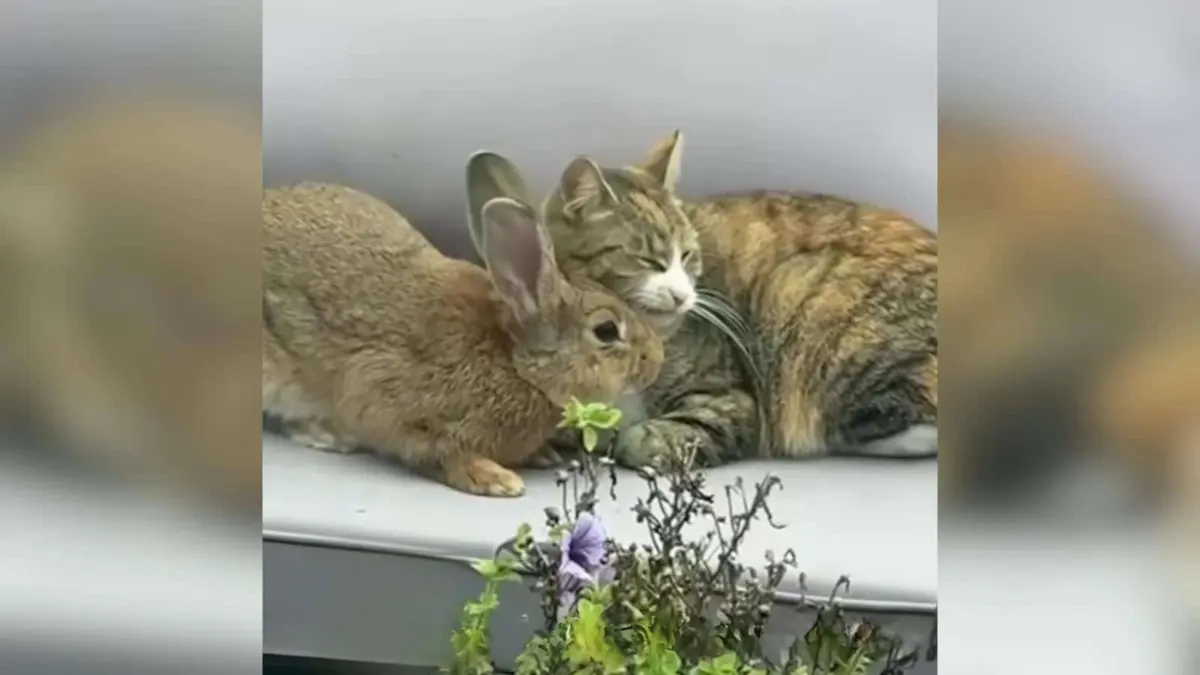
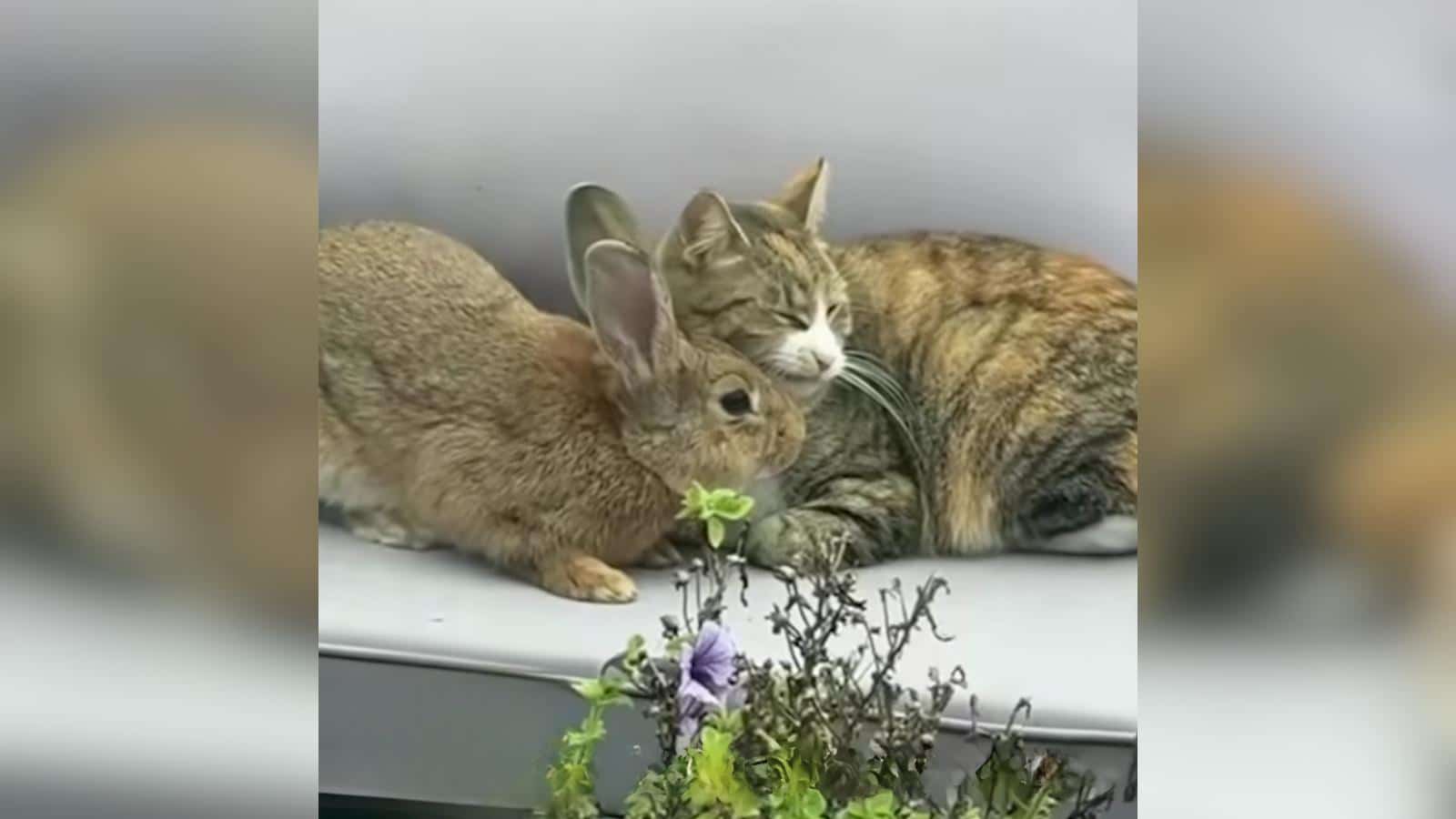
In an era where digital connectivity often isolates communities, heartwarming cross-species relationships continue to capture the public imagination, serving as a poignant reminder of the universal need for companionship. This report examines the extraordinary relationship between Luna, a formerly feral cat, and Henry, a wild brown rabbit. Unfolding in a suburban backyard owned by animal advocate Bobby, this interspecies dynamic challenges traditional understandings of predatory instincts and social bonding in animals.
Luna’s journey from a terrified stray hiding in the dense borderlands of a nearby forest to a secure, affectionate companion is a masterclass in animal rehabilitation. Having previously learned to trust the domestic environment through the mentorship of an older feline named Willie, Luna faced profound grief following Willie’s passing. Just two months later, a wild rabbit materialized in the yard. Defying conventional ecological behaviors, the cat and the rabbit forged a deep, tender alliance defined by mutual grooming, shared naps, and synchronized yard-pacing.
This comprehensive case study analyzes the chronological progression of Luna’s socialization, the emotional architecture of her grief, the ecological anomaly of her bond with Henry, and the broader implications of cross-species companionship as observed by animal behavioral science.
Detailed Chronology
Phase I: The Shadows of the Woods and the First Spark of Trust
Long before the yard became a sanctuary of interspecies harmony, Luna’s existence was defined by survival, wariness, and isolation. Skulking along the tree lines of the woods adjacent to Bobby’s property, the young feline was the quintessential feral stray. Her survival instincts dictated absolute avoidance of human presence; any attempt by Bobby to bridge the distance resulted in Luna retreating deeper into the dense underbrush.
Recognizing the cat’s plight, Bobby implemented a systematic feeding regimen, placing nutritional resources at a predictable distance from the tree line. The strategy relied on classical conditioning—associating human presence and habitation with positive reinforcement. However, progress was agonizingly slow. Weeks bled into months, and while Luna grew comfortable enough to claim the food, she remained fiercely autonomous and deeply suspicious of human touch.
The turning point in Luna’s behavioral evolution arrived not through human intervention, but through feline socialization. Bobby was already caretaker to an established, confident resident cat named Willie. Willie possessed an innate tranquility that acted as a social bridge for the frightened stray.
Observing Willie’s relaxed demeanor around Bobby and the homestead, Luna began to mirror his confidence. She inched closer to the back porch, eventually abandoning the forest entirely to take up permanent residence in the yard. Willie had provided more than just a model for domestic assimilation; he had offered emotional anchoring. Through their close association, Luna transformed from a panicked phantom of the woods into a grounded, secure household cat.
[Feral Stray in Woods]
       │
       ▼ (Systematic Feeding & Patience by Bobby)
[Approaching the Property Edge]
       │
       ▼ (Social Mentorship via Resident Cat, Willie)
[Full Integration into Backyard Sanctuary]
Phase II: Grief, Loss, and an Unforeseen Arrival
The hard-won peace of Luna’s new life was severely tested by the inevitability of mortality. Willie, who had served as Luna’s guide, protector, and surrogate family, fell ill and passed away. For Luna, the loss was catastrophic. Animal behavioral studies consistently demonstrate that domestic and feral felines experience grief, manifesting as lethargy, altered vocalizations, behavioral withdrawal, and visible stress.
Having lost the primary anchor that tethered her to a trusting domestic reality, Luna retreated inward once more, mourning the absence of her feline companion. The yard, once a theater of joyful rehabilitation, became a space marked by an aching void.
Just two months after Willie’s passing, nature intervened in a manner that defied all statistical and biological expectations. A small, wild brown rabbit—subsequently christened Henry—trotted into Bobby’s yard. Originating from the surrounding wilderness, the wild lagomorph exhibited an unusual lack of territorial panic or fear-flight responses when encountering human infrastructure and domestic animals.
Bobby’s initial reaction was one of acute anxiety. Evolutionary biology dictates that felines are apex ambush predators, while rabbits occupy the lower rungs of the trophic pyramid as prey species. The standard domestic cat possesses an ingrained predatory drive to chase, pounce, and dispatch small mammals. Bobby feared for the rabbit’s safety, anticipating a violent or territorial confrontation that would end in tragedy.
Phase III: Deconstructing Predatory Instincts
To the astonishment of observers and animal behaviorists alike, Luna’s reaction inverted every preconceived notion of predator-prey dynamics. Upon spotting the newcomer, Luna did not drop into a predatory stalk or manifest the dilated pupils and twitching tail of the hunter. Instead, she approached the wild rabbit with deliberate, calming body language.
Henry, rather than bolting into the underbrush as wild lagomorphs are genetically hardwired to do, held his ground and leaned into the feline’s presence. What began as a cautious, tentative sniff rapidly blossomed into a complex social routine.
As documented over subsequent weeks, the interaction between Luna and Henry transcended mere peaceful coexistence; it became intensely affectionate. Luna initiated grooming behaviors, licking the rabbit’s head and ears—a maternal and social bonding gesture typically reserved for bonded feline conspecifics. Henry reciprocated by seeking out Luna’s physical warmth, pressing his soft body against her fur during sunbathing sessions.
The daily choreography of their relationship stabilized into predictable patterns:
The Approach: Upon entering the yard, Henry bypassed all other environmental stimuli to seek out Luna directly.
The Grooming Loop: Mutual facial grooming sessions lasting several minutes.
Synchronized Resting: Side-by-side naps in the open yard, displaying complete vulnerability—an evolutionary impossibility for a wild rabbit unless absolute trust has been established.
Parallel Foraging: Wandering the perimeter of the yard together, maintaining close physical proximity.
Supporting Context & Metrics
To fully appreciate the anomaly of the Luna-and-Henry dynamic, one must examine the broader ecological and behavioral context of interspecies socialization among mammals.
Cross-Species Socialization Metrics in Domestic Environments
Parameter
Typical Feline-Lagomorph Interaction
The Luna & Henry Dynamic
Initial Reaction
High predatory arousal (Cat) / Panic flight response (Rabbit)
Calming body language (Cat) / Stationary curiosity (Rabbit)
Spatial Proximity
Maintained flight distance (>15 meters)
Direct physical contact, shared resting spaces (<0 meters)
Grooming Behavior
Non-existent; potential for redirected aggression
Active mutual allogrooming (head, ears, neck)
Temporal Stability
Fleeting or ending in predation/escape
Sustained, recurring over multiple months with regular returns
Behavioral Science Frameworks
Animal behaviorists point to several psychological and environmental factors that facilitate such extraordinary bonds:
Early Life Socialization Windows: While Luna was a feral stray, her intense bonding with Willie proved that her capacity for social attachment remained intact and adaptable.
Grief-Driven Social Substitution: Following the death of Willie, Luna experienced a state of social deficit. This emotional vulnerability may have lowered her baseline territorial aggression, making her receptive to alternative forms of companionship.
Habituation to Human Habitats: Henry’s frequent incursions into a human-managed environment suggest he may have been raised near human settlement, dulling his baseline wild startle reflexes and increasing his tolerance for strange, large species like cats.
Neurological Oxytocin Pathways: Mammalian bonding relies heavily on oxytocin release through tactile stimulation (grooming, warmth sharing). The physical contact between Luna and Henry triggered mutual neurochemical rewards, reinforcing the friendship over the hunting instinct.
Official Statements & Expert Perspectives
While formal institutional studies on cat-rabbit friendships remain sparse due to their rarity, veterinary professionals and animal behaviorists have offered critical insights into the mechanics of such phenomena.
"We frequently underestimate the emotional complexity and cognitive flexibility of animals," notes Dr. Alistair Vance, a noted comparative psychologist specializing in mammalian behavioral adaptations. "While predator-prey lines are heavily emphasized in evolutionary biology, individual animals possess unique personality matrices. When stress, grief, and mutual curiosity intersect in a secure environment, biological imperatives can be temporarily suspended or rewritten through learned experience."
Bobby, the custodian of the property and primary witness to the unfolding events, reflects on the emotional trajectory of her backyard ecosystem:
"When Willie passed, I was heartbroken for Luna. I thought she would spend her golden years alone, reverting to that frightened creature hiding in the woods. When the little brown rabbit walked into the yard, my heart stopped—I thought it was a disaster waiting to happen. But watching Luna choose love, patience, and companionship over instinct has been the most humbling experience of my life. They don’t care that they are different species; they just know they make each other’s world a little less lonely."
Veterinary epidemiologists emphasize that while such relationships are heartwarming, pet owners must remain vigilant. Wild rabbits can carry parasites, ticks, and zoonotic pathogens such as Pasteurella multocida, which can be transmitted to domestic felines via close contact and grooming. Routine veterinary oversight remains paramount when wild and domestic animals establish close physical contact.
Future Outlook
The durability of Luna and Henry’s friendship remains subject to the unpredictable rhythms of the natural world. Henry is, fundamentally, a wild animal. He operates on biological imperatives dictated by changing seasons, resource availability, and the natural life cycle of lagomorphs.
During observation periods, Henry occasionally vanishes into the surrounding woods for days at a time, leaving Bobby and Luna in a state of suspended anticipation. Yet, the persistent pattern of his return underscores the profound gravitational pull of their bond. Each time he emerges from the tree line, he navigates directly to Luna, demonstrating that their connection transcends a fleeting juvenile curiosity.
Key Indicators for Future Observation:
Seasonal Shifts: As winter approaches, resource scarcity in the woods may increase the frequency and duration of Henry’s visits to the protected, food-rich backyard.
Age-Related Changes: Luna, transitioning into her senior years following her traumatic early life, may require altered activity levels, which could gently shift the dynamic of their play and resting routines.
Ecological Pressures: Predatory pressures in the surrounding forest (such as foxes, raptors, or coyotes) serve as external variables that could abruptly terminate Henry’s ability to return to the homestead.
Regardless of how long their unique companionship endures, the legacy of Luna and Henry has already cemented itself as a testament to the resilience of the animal spirit. Luna’s arc—from a terrified, traumatized feral cat hiding in the shadows, to a grieving companion, to the gentle matriarch of an interspecies friendship—illustrates that empathy and connection are not bound by the rigid laws of species classification. In the quiet corners of a suburban backyard, a cat and a rabbit continue to redefine what it means to find family in unexpected places.