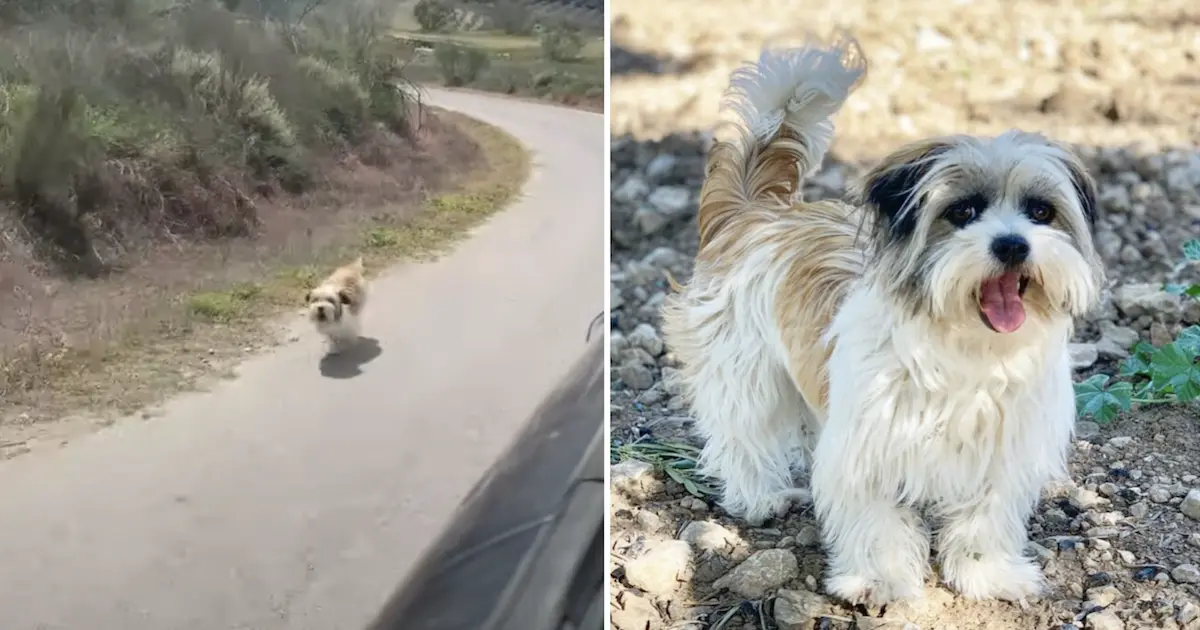
In an extraordinary event along a secluded stretch of the Spanish countryside, a chance encounter between two digital nomads and a persistent stray canine has highlighted both the ongoing challenges of animal abandonment and the transformative power of emergency field rescue. Traveling couple Martina Russo and her partner Fil, who routinely navigate the continent in a specially fitted camper van, found themselves at the center of an unexpected rescue operation when a small, distressed dog pursued their moving vehicle across an isolated rural road.
What initially appeared to be a play behavior quickly revealed itself as a desperate bid for survival by an abandoned companion animal. Upon halting their vehicle, Russo and Fil secured the exhausted dog, initiated an extensive regional search for potential owners, and subsequently facilitated comprehensive veterinary intervention. Diagnostic examinations revealed that the female Shih Tzu and Yorkshire Terrier mix—subsequently named Moxie—was approximately one year old, unchipped, unspayed, and suffering from physical neglect.
With no registered owner coming forward and local inquiries yielding no leads, Russo and Fil formally adopted Moxie into their family. Today, the canine has transitioned from an imperiled stray on a remote thoroughfare to a key participant in a multi-species, cross-continental expedition. This report provides a detailed chronology of the event, examines the broader behavioral and statistical context of pet abandonment in Southern Europe, and highlights the broader implications for pet rescue within the growing global community of nomadic travelers.
Detailed Chronology: From Roadside Emergency to Final Adoption
+-----------------------------------------------------------------------------------+
|                            RESCUE TIMELINE: MOXIE                                 |
+-----------------------------------------------------------------------------------+
| 1. VISUAL IDENTIFICATION                                                          |
|    - Spot small animal pursuing vehicle on isolated Spanish countryside road.     |
|    - Initial impression of playful behavior shifts to concern over acute distress.|
+-----------------------------------------------------------------------------------+
                                         |
                                         v
+-----------------------------------------------------------------------------------+
| 2. INTERVENTION & FIELD CONTAINERIZATION                                          |
|    - Vehicle brought to controlled stop. Hydration administered immediately.      |
|    - Dog voluntarily enters camper van; displays strong human attachment.         |
+-----------------------------------------------------------------------------------+
                                         |
                                         v
+-----------------------------------------------------------------------------------+
| 3. INVESTIGATIVE SEARCH & TRACING                                                 |
|    - Door-to-door canvas of local residential structures in the perimeter.        |
|    - Digital notices posted across regional community networks.                   |
|    - Trial return to discovery location yields zero home-seeking orientation.     |
+-----------------------------------------------------------------------------------+
                                         |
                                         v
+-----------------------------------------------------------------------------------+
| 4. VETERINARY DIAGNOSTIC EVALUATION                                               |
|    - Microchip scanning yields negative result (unidentified identification status)|
|    - Confirmation of non-spayed female, age estimated at 12 months.               |
|    - Medical findings: Extensive coat matting, bilateral ocular discharge.       |
+-----------------------------------------------------------------------------------+
                                         |
                                         v
+-----------------------------------------------------------------------------------+
| 5. FORMAL ADOPTION & INTEGRATION                                                  |
|    - Legal ownership assumed; named "Moxie" (Shih Tzu/Yorkshire Terrier mix).     |
|    - Successful cross-species integration into van-life with three resident cats. |
+-----------------------------------------------------------------------------------+
Phase 1: Visual Contact and Initial Assessment
During a routine leg of their European transit through rural Spain, Martina Russo and her partner Fil encountered an unexpected hazard on an unpaved country lane. Although the couple frequently travels through rural regions where wildlife sightings are common, domestic stray animals rarely intersected directly with their driving routes.
As their vehicle maintained a low speed along the rural corridor, Fil noted a small, dark silhouette sprinting behind the rear bumper. Initially, the couple assumed the animal was an off-leash pet engaging in a brief, predatory or playful pursuit—a behavioral response occasionally triggered in domestic dogs by moving vehicles. However, as the distance lengthened and the vehicle maintained its speed, the dog refused to break stride.
Visual monitoring through the rear-view mirrors revealed clear signs of physical exhaustion and physiological panic. The small dog was running at maximum physical capacity over rough terrain, exhibiting open-mouth breathing and an erratic gait that signaled acute distress rather than playfulness. Recognizing that the animal was either lost, stranded, or pursuing the only human presence within miles, Russo and Fil immediately pulled the camper van to a complete stop on the shoulder.
Phase 2: Immediate Mitigation and On-Scene Rescue
Upon bringing the vehicle to a halt, the couple opened the van door to evaluate the situation. The small dog did not display fearful or defensive behaviors; instead, she immediately approached the vehicle, exhibiting extreme submissive and social signaling.
The couple immediately provided clean drinking water to combat dehydration caused by sustained physical exertion in heat. Without hesitation or prodding, the canine climbed directly into the living compartment of the vehicle. This immediate comfort around vehicles and humans strongly indicated prior domestic habituation, reinforcing the hypothesis that the dog had recently been abandoned or separated from a household.
Phase 3: The Search for Legal Owners
Operating under the ethical and legal obligation to return lost property to its rightful owner, Russo and Fil initiated a local canvassing effort before leaving the area:
Neighborhood Canvas: The couple conducted a door-to-door survey of all accessible residential properties, agricultural compounds, and farmsteads within a multi-kilometer radius of the initial encounter. None of the local residents recognized the dog or reported missing livestock or companion animals.
Digital and Social Outreach: Visuals and location markers were uploaded to regional social media groups, lost-and-found pet networks, and local community boards in neighboring municipalities.
Site Re-visit Protocol: To eliminate the possibility that the dog had temporarily wandered from an unseen nearby property, the couple returned Moxie to the exact geographical coordinates where the chase occurred. When placed on the ground, the dog showed no inclination to navigate toward any surrounding terrain or structures. Instead, she fixated entirely on the couple and their vehicle, attempting to re-enter the van immediately.
Phase 4: Clinical Diagnostic Results
Having exhausted local avenues to locate a owner, Russo and Fil transported the dog to a veterinary clinic for comprehensive diagnostic triage and microchip scanning.
The absence of an internal RFID microchip meant there was no direct registration link to a legal owner. Furthermore, the presence of untreated coat matting and periocular accumulation suggested that the animal had experienced a period of neglect prior to her discovery on the road.
Supporting Context & Metrics: Broader Dynamics of Rescue and Welfare
Moxie’s story occurs against a broader backdrop of companion animal displacement, international pet transport, and dedicated welfare funding mechanisms across Europe and North America.
Rural Animal Displacement and Microchipping Gaps
In many rural sectors of Southern Europe, domestic dog populations face systemic challenges related to uncontrolled breeding, lack of universal microchipping compliance, and seasonal abandonment.
While European Union directives increasingly mandate electronic identification (microchipping) for domestic dogs, implementation and enforcement vary significantly between urban and rural municipalities. Unchipped animals that become lost in agricultural zones face significantly lower return-to-owner (RTO) rates compared to their urban counterparts.
Without a microchip, lost or abandoned animals rely almost entirely on immediate human intervention, municipal shelter capacity, or independent rescue networks to avoid euthanasia or prolonged stray survival.
Behavioral Mechanics of Vehicle Pursuit
Animal behaviorists note that stray or recently abandoned dogs chasing moving vehicles is a distinct phenomenon driven by specific psychological triggers:
Separation Distress: Animals recently dumped from a car frequently associate moving vehicles with their former handlers, leading to high-intensity pursuit behavior out of acute panic.
Movement-Induced Tracking: High-arousal states can trigger a chase response, which in desperate strays transitions into a plea for social connection and resource acquisition (food, water, shelter).
Familiarity with Automotive Enclosures: Moxie’s immediate willingness to enter the van indicates positive prior reinforcement associated with vehicle interiors, making the moving camper van a focal point for safety.
Quantitative Impacts of Modern Rescue Organizations
The resolution of Moxie’s case reflects a growing global movement toward direct-action pet rescue and community-supported welfare initiatives. Across the international landscape, humanitarian and animal welfare metrics demonstrate the vast scale of intervention required to sustain vulnerable animal populations:
These programs highlight the extensive financial and logistical framework necessary to support shelters, fly at-risk animals out of overcrowded regions, and maintain safety nets for both human and animal survivors of crisis.
Official Statements & Direct Perspectives
Reflecting on the emergency rescue and subsequent diagnostic findings, Martina Russo detailed the sequence of events and the emotional impact of Moxie’s arrival:
"We took her to the vet the next day, and turns out she was not chipped, not spayed, female, about one-year-old, fur very overgrown and full of gunk around the eyes. We looked everywhere for her owners, but nobody came forward."
— Martina Russo, Co-rescuer and Owner
Russo noted that once the veterinary evaluation was complete and the legal hold period concluded, the decision to integrate Moxie into their nomadic lifestyle was immediate, driven by the intense bond formed during the rescue.
"She’s very sweet and funny, very playful, loves our cats—to be fair, she loves everything and everyone! Especially cats and kids. We love taking her on adventures, and she makes us laugh every day."
— Martina Russo
Cross-Species Integration in Nomadic Environments
Integrating a newly rescued stray dog into a confined space—such as a mobile camper van already housing three resident cats—presents significant behavioral challenges. The success of Moxie’s integration relies heavily on her specific temperament:
Despite her small frame and historic neglect, Moxie demonstrated low prey drive toward the resident felines and high adaptability to changing environments, allowing her to transition into a multi-species mobile household without territorial conflict.
Future Outlook: Nomadic Pet Integration and Welfare Advocacy
The Expanding Sphere of "Van-Life" Rescues
Moxie’s transformation from an endangered stray on a Spanish road to an international traveler reflects a growing trend within the mobile-living and digital nomad communities. As more individuals adopt full-time mobile lifestyles, their geographic reach enables them to serve as informal first responders in remote or underserved regions where municipal animal control is minimal.
Today, Moxie regularly accompanies Russo and Fil on high-altitude mountain hikes, coastal excursions, and cross-border journeys throughout Europe. Her physical stamina allows her to navigate rugged trails despite her small stature, disproving initial assumptions about the physical limits of small terrier/toy breeds in outdoor environments.
Key Takeaways for Global Animal Welfare
Importance of Universal Identification: Moxie’s case underscores the critical need for mandatory microchipping. Had she been chipped, her original background—whether lost or intentionally abandoned—could have been conclusively verified.
Promoting Spay/Neuter Programs: As an unspayed female roaming free in rural Spain, Moxie was at high risk of contributing to the regional stray population. Field rescues combined with prompt veterinary sterilization remain essential to breaking the cycle of unwanted litters.
The Role of Mobile Rescue Advocates: The intersection of travel culture and pet rescue continues to provide lifesaving alternatives for animals that fall outside the reach of traditional shelter systems.
Moxie’s story stands as a compelling case study in emergency animal rescue. Her relentless pursuit of a passing vehicle was a desperate act of survival that ultimately secured her a permanent home, transforming a near-tragedy into a lifelong journey across Europe.