
Flying commercial with a larger-than-average dog has long presented a logistical nightmare for pet owners. Strict airline regulations regarding under-seat dimensions, combined with the rigid frames of traditional soft-sided pet carriers, often mean that dogs standing slightly taller than the average lap breed are automatically relegated to cargo holds—a terrifying prospect for many owners. However, one resourceful dog owner has broken the mold, proving that with strategic planning, rigorous behavioral conditioning, and a radical, hands-on modification, in-cabin air travel is entirely possible for a long-legged miniature poodle.
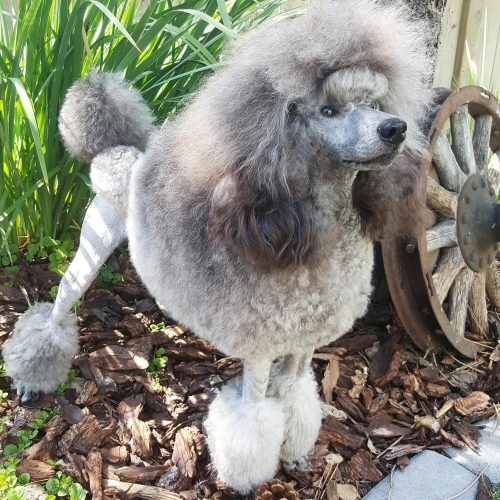
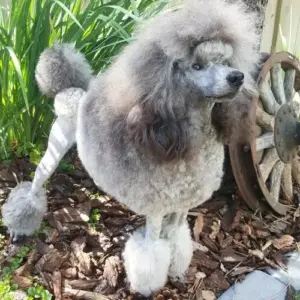
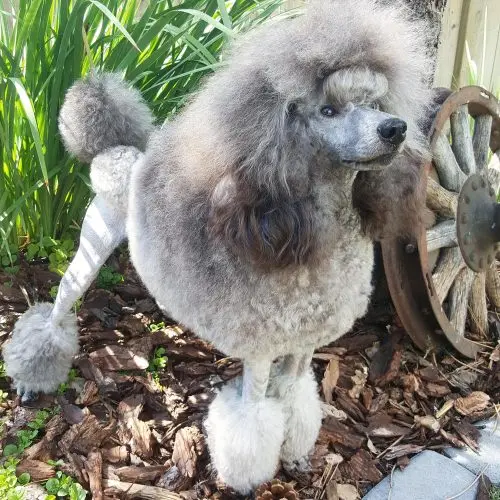
Keri, a professional dog groomer, faced this exact dilemma when preparing for a multi-leg journey on Air Canada with her tall miniature poodle, Flint. Known for his big hair and long legs, Flint presented a clear structural challenge for standard in-cabin pet containers. Rather than accepting defeat or risking cargo transit, Keri embarked on an exhaustive evaluation of available pet carriers. Rejecting the highly praised—yet ultimately restrictive—Teafco Argo Petagon, she selected the budget-friendly large Pettom Expandable Foldable Travel Carrier.
What followed was a masterclass in DIY pet gear engineering. Armed with bolt cutters and an uncompromising commitment to her dog’s comfort and safety, Keri surgically modified the carrier’s internal wire frame to achieve the necessary flexibility for tight aircraft under-seat clearances. Over a series of rigorous flights spanning Embraer regional jets, Airbus narrowbodies, and Bombardier turboprops, Keri and Flint successfully navigated the skies. This report provides an in-depth chronicle of Keri’s preparation, her innovative modification techniques, an exhaustive breakdown of her performance metrics across various aircraft configurations, and the broader implications for pet travel in commercial aviation.
Detailed Chronology: From Concept to Cabin
The Carrier Selection Phase: Teafco Argo vs. Pettom Expandable
The journey began months before departure as Keri weighed her options against widespread skepticism. Numerous peer reports suggested that Flint’s height would disqualify him from cabin travel. Undeterred, Keri reviewed market offerings, initially rejecting the large Sherpa and Bergan carriers as structurally inadequate for Flint’s frame.
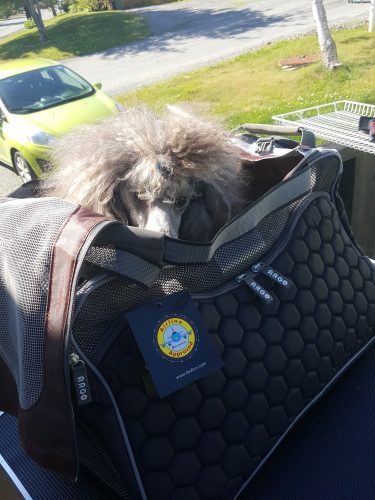
She ultimately ordered two premium contenders: the Teafco Argo Petagon Carrier ($$$) and the Pettom Expandable Foldable Travel Carrier ($). Upon arrival, the evaluation process shifted from human preference to canine ergonomics. Despite its stellar reputation, rugged build quality, multiple storage pockets, and reflective safety tape, the Teafco Argo failed Flint’s personal inspection. The carrier’s cooling tray insert sacrificed critical interior height, and its rigid zipper design caught on Flint’s thick, full poodle coat. Furthermore, Flint actively resisted entering the Argo.
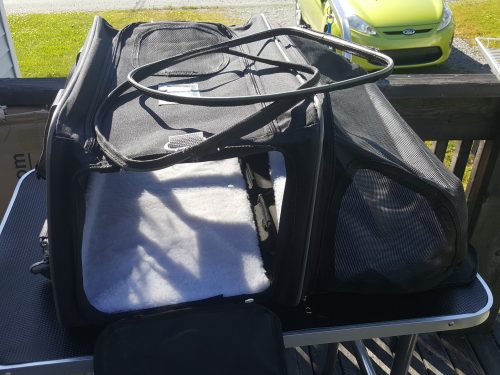
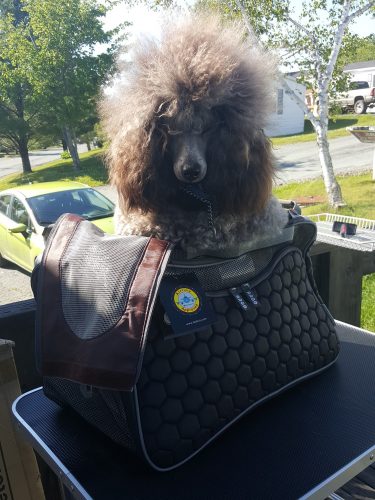
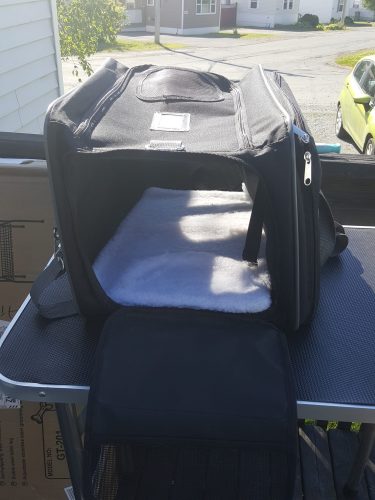
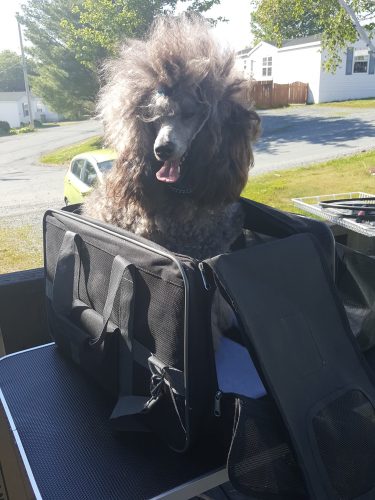
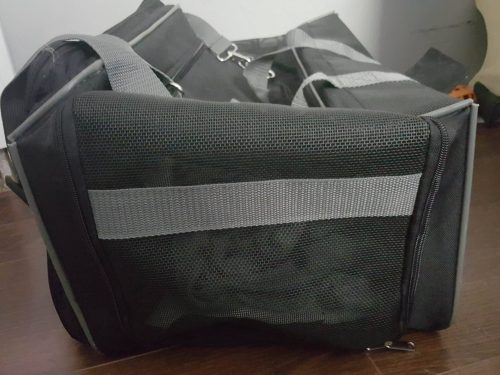
Conversely, the large Pettom carrier emerged as the clear victor. Featuring dual zippered ends, the Pettom allowed Flint to walk inside entirely unassisted from day one. Its defining feature—an integrated, zip-out mesh "pup tent" extension—nearly doubled the carrier’s interior width from a standard footprint to an expansive 22.5 inches, giving Flint’s long poodle legs ample room to stretch. While the Pettom’s budget-friendly construction was visibly inferior to the Argo in terms of fabric weight and pocket volume, its functional design suited Flint’s physical dimensions far better.
The Engineering Feat: Modifying the Pettom Carrier
Standard in-cabin carriers are rigid rectangular prisms designed to maintain shape under load. However, commercial aircraft under-seat spaces are notoriously irregular, often featuring structural bars, life-vest pouches, and sloping floors that prevent rigid bags from sliding fully into place.
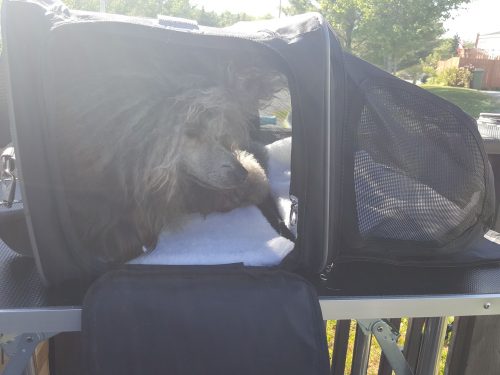
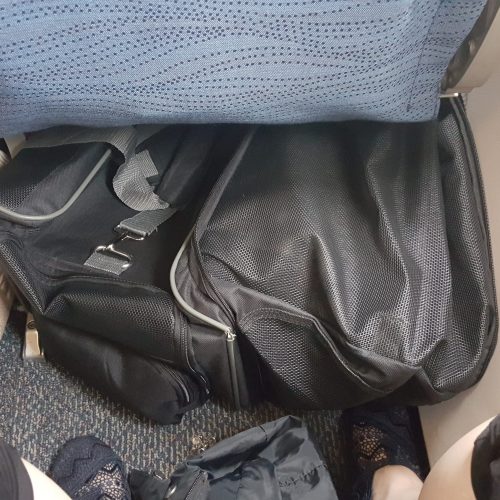
Recognizing that the Pettom’s rigidity posed a safety hazard regarding compliance with airline dimensions, Keri executed a daring structural modification. First, she removed the zippered-in supports for the expandable section, correctly anticipating that an active dog could catch a foot in them. Next, she tackled the primary obstacle: the four rigid wire frame supports dictating the kennel’s height.
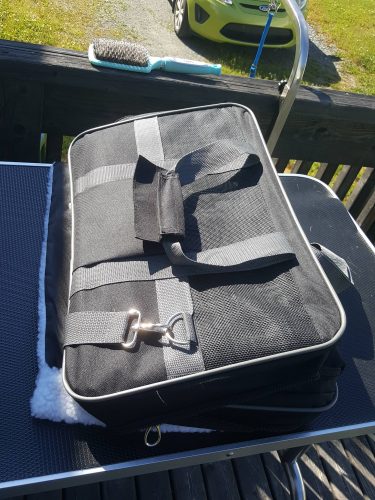
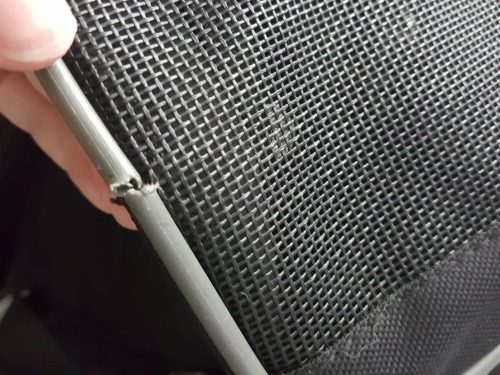
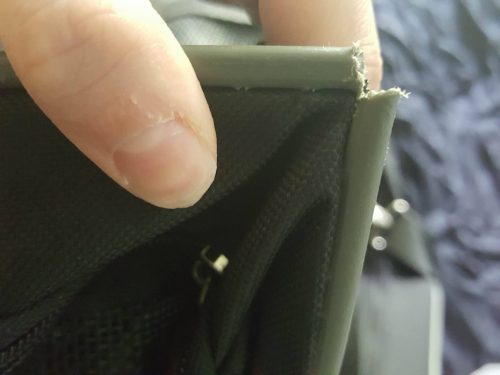
Using bolt cutters, Keri meticulously severed the four steel wire supports at a height of 9 inches, exercising extreme caution to leave the surrounding synthetic mesh and nylon fabric completely intact. This modification transformed the container: when empty, the upper sides tilted inward, creating a flexible, sloping profile. Under light pressure or when Flint moved inside, the sides naturally adapted to whatever vertical clearance the surrounding aircraft seat frame imposed. (Safety advisory: Keri subsequently noted the importance of taping or filing the freshly cut wire ends, as exposed metal points can pose a scratching hazard during handling.)
Behavioral Conditioning and Veterinary Sign-Off
A modified carrier and a plane ticket are worthless if a dog panics at 30,000 feet. Keri instituted a rigorous, multi-week desensitization protocol to ensure Flint viewed his mobile den as a safe haven.
- Initial Access (Week 1): The carrier remained fully open in the living room with treats tossed inside, encouraging Flint to enter and exit voluntarily.
- Enclosure Trials (Week 2): Short, closed-zipper sessions were introduced incrementally while Flint remained close to Keri’s feet, punctuated by positive reinforcement.
- Nap Integration (Week 3): Flint was placed inside the carrier during his regular afternoon nap intervals (lasting approximately one hour), conditioning him to remain calm for extended periods.
- Professional Validation: Because Flint frequently accompanied Keri to her job as a dog groomer and was accustomed to kennel environments, his baseline crate anxiety was low. However, as an extra precaution, Keri brought the modified carrier to her veterinarian, securing an official written endorsement verifying that the enclosure was appropriate for Flint’s physical dimensions and health status.
Supporting Context & Metrics: Fleet-by-Fleet Performance
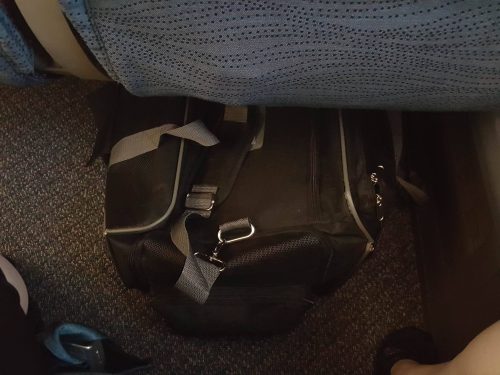
Keri’s itinerary involved four distinct Air Canada aircraft types. Her tactical adjustments—deploying the expandable mesh section only after takeoff and stowing it prior to descent—yielded varying degrees of success depending on seat pitch, width, and under-seat obstructions.
| Flight Leg | Aircraft Type | Seat Configuration | Seat Pitch & Width | Expansion Success | Key Operational Notes |
|---|---|---|---|---|---|
| Leg 1 | Embraer 175 | Economy Window (No seatmate) | Pitch: 32–34" Width: 18" |
Fully Expanded | Flint cried during boarding, settled post-takeoff. Carrier pulled into footwell; mesh tent fully deployed into empty adjacent leg space. |
| Leg 2 | Airbus A320-200 | Preferred Seating Window | Pitch: 35" Width: 17.8" |
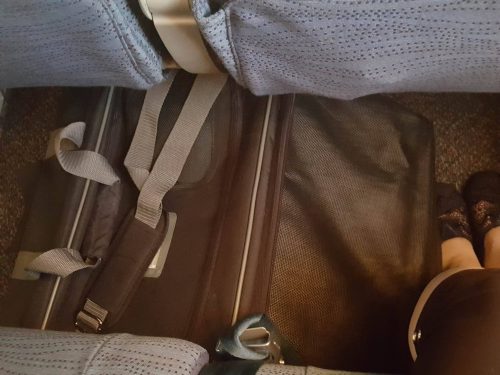
Partially Expanded | Nearly 5-hour duration. Upgraded for legroom. Carrier pushed fully back and tilted to accommodate narrow under-seat width; pup-tent half-deployed. |
| Leg 3 | Embraer 190 | Economy (Occupied seatmate) | Pitch: 31–33" Width: 18" |
Fully Expanded (Into foot space) | Loaded horizontally. Neighbor permitted slight incursion into under-seat space. Mesh tent deployed over Keri’s feet post-takeoff. |
| Leg 4 | Bombardier Q400 | Economy Window (Occupied seatmate) | Pitch: 31" Width: 17" |
None (Zero expansion) | Tightest spatial configuration. Carrier remained fully zipped in its baseline footprint to fit regional turboprop clearances. |
Canine Relief Logistics
A critical finding from Keri’s journey highlights the systemic lack of pet-friendly infrastructure within major airports. Across multiple multi-hour transits and layovers, dedicated indoor pet relief stations were entirely absent within the sterile boarding areas. Keri had to utilize standard human restroom facilities to provide Flint with necessary stretch breaks, underscoring the logistical hurdles pet owners face during regional connections.
Official Guidelines & Regulatory Considerations
Navigating airline pet policies requires strict adherence to carrier-specific parameters. While Keri flew exclusively on Air Canada, her experience underscores universal truths regarding cabin animal transport:
- Dimension Compliance vs. Flexibility: Most airlines publish strict maximum dimensions for soft-sided carriers (typically around 17" x 11" x 8" to 19" x 12" x 10"). However, gate agents rarely measure carriers with calipers unless the bag appears grossly oversized or the animal cannot comfortably lie down. The inherent flexibility introduced by Keri’s wire-cutting modification bridges the gap between official carrier size and actual under-seat clearance.
- The "Stand and Turn" Rule: Regulatory bodies and airline policies generally state that an in-cabin pet must be able to stand up, turn around, and lie down naturally inside its container. For a tall miniature poodle like Flint, strict adherence to this rule in an unmodified carrier is physically impossible. Keri’s pragmatic workaround—conditioning the dog to curl comfortably while utilizing expandable mesh zones for temporary postural adjustments—highlights a vital grey area in regulatory enforcement.
- Documentation & Veterinary Support: Securing a written veterinary sign-off proved invaluable. Though gate agents did not request it, having professional medical documentation confirming the carrier’s suitability neutralizes potential challenges during check-in or security screening.
Future Outlook & Industry Implications
Keri’s successful aviation experiment offers a blueprint for owners of larger small-breeds and medium-sized dogs navigating commercial airline restrictions. Her bold willingness to alter commercial pet products challenges manufacturers to rethink carrier design.
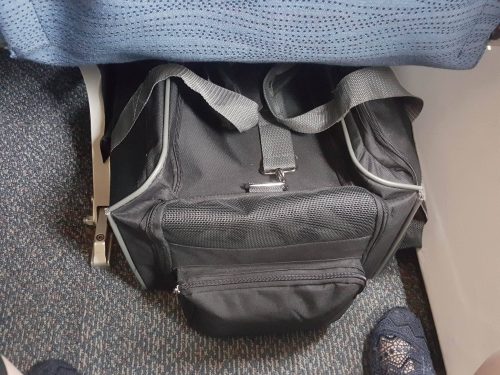
Traditional pet product engineering prioritizes static rigidity to project durability. However, as Keri’s field test proves, the future of in-cabin pet travel lies in dynamic adaptability—carriers engineered with semi-flexible composite stays or variable-tension frames that can compress vertically under aircraft seat clearances while expanding horizontally into passenger footwells.
For travelers willing to exercise ingenuity, precision conditioning, and a pair of bolt cutters, the skies are no longer strictly closed to tall poodles and long-legged companions. As pet ownership continues to surge alongside an increase in pet-inclusive travel demand, consumer modifications like Keri’s may well serve as the catalyst for the next generation of intelligent, aircraft-optimized pet travel gear.