The commercial pet food industry has reached a pivotal juncture in its handling of microbiological safety. Premium pet food manufacturer Vital Essentials recently disclosed that it has begun processing its product lines using electron-beam ("E-Beam") irradiation. According to official disclosures published on the company’s technical FAQ platform, Vital Essentials has “implemented E-Beam Technology to eliminate harmful pathogens using electricity.”
This operational shift brings renewed public scrutiny to food irradiation—a process that alters the microbiological landscape of raw and minimally processed animal foods. Under federal labeling regulations, any packaged food—whether intended for human or animal consumption—that undergoes ionizing radiation must carry the internationally recognized Radura symbol on its packaging, accompanied by explicit declaration statements such as “Treated with radiation” or “Treated by irradiation.”
          /
        (  *  )   [ Radura Symbol Mandatory Declaration ]
         ___/    "Treated with radiation" / "Treated by irradiation"
While regulatory authorities, including the U.S. Food and Drug Administration (FDA), alongside chemical industry white papers, maintain that food irradiation is safe and effective, the technology carries a complex history within veterinary medicine. Historical precedents—most notably a catastrophic incident in Australia involving gamma-irradiated imported cat food, as well as unresolved questions regarding toxic jerky treats imported from Asia—continue to raise critical questions among veterinary epidemiologists and consumer advocates.
Beyond the immediate mechanics of radiation, the industry’s adoption of alternative pasteurization methods highlights systemic challenges in raw agriculture. As manufacturers scramble to comply with the FDA’s stringent zero-tolerance mandates for foodborne pathogens, critics argue that end-stage intervention methods fail to address the core problem: high initial bacterial loads in raw animal ingredients. Furthermore, neutralizers like irradiation do not eliminate bacterial endotoxins—heat-stable cellular debris that poses latent hepatic risks to companion animals.
This report provides an in-depth investigation into the mechanics of E-Beam technology, historical regulatory missteps, the mathematics of pathogen control, and the unaddressed physiological risks of bacterial endotoxins in the pet food supply chain.
Detailed Chronology: A History of Irradiation, Safety Failures, and Regulatory Pivots
To evaluate the introduction of E-Beam technology into modern pet food production, one must examine the timeline of food irradiation, regulatory enforcement shifts, and historical veterinary health crises linked to ionizing radiation.
+-----------------------------------------------------------------------------------+
| CHRONOLOGY OF PET FOOD IRRADIATION & REGULATORY MILESTONES                         |
+-----------------------------------------------------------------------------------+
| 2008: Australia Gamma-Irradiation Cat Disaster                                    |
|       - Imported Orijen cat food irradiated via Cobalt-60 sources.                |
|       - Causes widespread feline neurological collapse, paralysis, and fatalities.  |
|       - Investigation links process to Vitamin A depletion and free radical surge.|
+-----------------------------------------------------------------------------------+
| 2007–2014: Asian Jerky Treat Contamination Crisis                                  |
|       - Thousands of canines suffer illness/death from imported treats.          |
|       - Treats subjected to undisclosed irradiation protocols.                    |
|       - FDA admits lack of validated methods to measure actual radiation dosage. |
+-----------------------------------------------------------------------------------+
| 2013: FDA Imposes FSMA "Zero-Tolerance" Mandate                                    |
|       - FDA enforces total ban on Salmonella, Listeria, and E. coli in pet food.   |
|       - Triggers industry-wide shift toward HPP, thermal processing, and E-Beam. |
+-----------------------------------------------------------------------------------+
| Present: Commercial Adoption of High-Energy E-Beam Processing                    |
|       - Vital Essentials implements linear accelerator-driven E-Beam technology.  |
|       - Advocates call for transparency regarding post-treatment nutrient testing.|
+-----------------------------------------------------------------------------------+
The 2008 Australian Feline Paralysis Crisis
The most prominent historic precedent regarding irradiated pet food occurred in Australia in 2008. When Canadian manufacturer Champion Petfoods began importing its Orijen brand raw-inspired cat food into Australia, national biosecurity and quarantine regulations mandated that all imported dry or semi-moist meat products undergo heavy gamma irradiation to neutralize potential foreign animal diseases.
Shortly after the irradiated food hit Australian retail shelves, veterinarians nationwide reported an epidemic of severe neurological dysfunction in cats. Affected animals exhibited severe ataxia, hind-limb paralysis, loss of motor control, and in numerous documented cases, death or euthanasia.
A formal inquiry conducted by the Australian Parliament examined the causes of the outbreak. The parliamentary committee concluded:
"An irradiation treatment applied to pet food for quarantine purposes may have been a factor in causing depletion of vitamin A, and the formation and release of free radicals in the imported Orijen brand pet food."
The gamma irradiation process—which utilized high-energy Cobalt-60 isotopic gamma rays—had degraded essential lipid-soluble nutrients, specifically Vitamin A, while catalyzing severe lipid peroxidation. The resulting formation of toxic free radicals damaged the central and peripheral nervous systems of felines, which are biologically sensitive to oxidative stress and nutritional deficiencies. Following the investigation, Australia altered its quarantine requirements, effectively ending mandatory gamma irradiation for imported pet foods.
The Asian Jerky Treat Illnesses and Dose Validation Deficits
Between 2007 and 2014, the FDA received thousands of reports concerning canine illnesses and deaths associated with jerky treats imported from China. Affected dogs suffered from Fanconi-like syndrome (a severe kidney tubule failure), gastrointestinal hemorrhaging, and acute liver disease.
During its multi-year investigation, the FDA evaluated whether irradiation—frequently applied to poultry jerky exports to satisfy international sanitary standards—played a direct or indirect role in the toxicities. Investigators analyzed jerky samples for chemical markers of food irradiation, including volatile radiolytic compounds such as 2-alkylcyclobutanones.
The investigation revealed a critical vulnerability in global food safety oversight. In an official consumer advisory update published during the height of the crisis, the FDA admitted a fundamental limitation in its forensic capabilities:
"Currently there are no validated methods to determine the dose of radiation that was used to ensure the product was properly irradiated."
Without a validated testing methodology to quantify the precise absorbed radiation dose (measured in kiloGrays, or kGy), regulatory bodies could neither confirm nor deny whether raw treats had been exposed to excessive levels of radiation, potentially creating harmful radiolytic chemical byproducts or degrading vital micronutrients.
The 2013 FDA Zero-Tolerance Mandate
In response to passage of the Food Safety Modernization Act (FSMA), the FDA’s Center for Veterinary Medicine (CVM) instituted a zero-tolerance policy for pathogenic bacteria in pet food in 2013. Under this regulatory framework, the presence of any detectable colony-forming units (CFUs) of Salmonella spp., Listeria monocytogenes, or Escherichia coli in commercial pet food rendered the entire production lot adulterated under federal law, subjecting the manufacturer to mandatory recalls and enforcement actions.
This zero-tolerance stance forced pet food manufacturers—particularly those producing raw, freeze-dried, or dehydrated fresh meat diets—to adopt post-packaging pasteurization technologies to protect their supply chains from economic loss and administrative regulatory enforcement.
Supporting Context & Metrics: Evaluating Irradiation Technologies and Pathogen Recalls
Distinguishing Irradiation Modalities: Gamma Rays vs. E-Beam
To evaluate Vital Essentials’ operational transition, it is necessary to distinguish the physics of traditional isotopic gamma irradiation from modern high-energy electron beam (E-Beam) processing.
Technical Parameter
Isotopic Gamma Irradiation
Electron-Beam (E-Beam) Irradiation
Energy Source
Radioactive Isotopes (Cobalt-60 or Cesium-137)
High-Voltage Commercial Linear Accelerators (Electricity)
Penetration Depth
Deep penetration; highly effective for thick, high-density pallets.
Moderate penetration; optimized for thin-profile packaging and single layers.
Processing Duration
Prolonged exposure time (hours inside a heavily shielded cell).
Rapid exposure time (seconds to minutes under a focused electron beam).
Radiolytic Byproduct Risk
Higher risk of lipid peroxidation if exposure levels are miscalculated.
Lower exposure duration reduces temperature rise and oxidative stress.
Nutritional Impact
Documented risk of significant Vitamin A and Thiamine degradation.
Claims of superior nutrient retention under calibrated dosage regimes.
Vital Essentials emphasizes this technical distinction in its technical literature, arguing that its application of electricity-generated E-Beam technology avoids the nutritional degradation associated with isotopic gamma irradiation. The manufacturer asserts: “Our validation work shows the food maintains nutritional integrity after treatment.”
Despite these claims, independent veterinary nutritionists emphasize that any process capable of splitting microbial DNA via ionization has the potential to alter delicate micronutrients, essential fatty acids, and natural enzyme profiles depending on the total absorbed dose ($kGy$).
E-Beam Mechanism:
Focused Electron Beam  --->  Breaks Microbial DNA  --->  Pathogen Inactivation
                             (Risk: Concurrent oxidation of sensitive micronutrients)
Statistical Analysis: The Ten-Year Failure of End-Stage Kill-Steps
A key argument advanced by consumer advocates against total reliance on post-processing kill-steps is that these interventions treat the symptoms of contamination rather than its root cause.
A metric comparison of human meat safety oversight by the United States Department of Agriculture (USDA) versus pet food oversight by the FDA reveals an informative regulatory divergence:
USDA Human Meat Framework: Enforces zero tolerance for pathogenic E. coli strains (such as $O157:H7$) in raw ground beef products, but permits manageable baseline thresholds for Salmonella and Listeria in raw meat and poultry, operating on the premise that human consumers will apply proper domestic thermal cooking.
FDA Pet Food Framework: Enforces absolute zero tolerance for Salmonella, Listeria, and E. coli across all commercial pet food formats (raw, kibble, canned, and dehydrated).
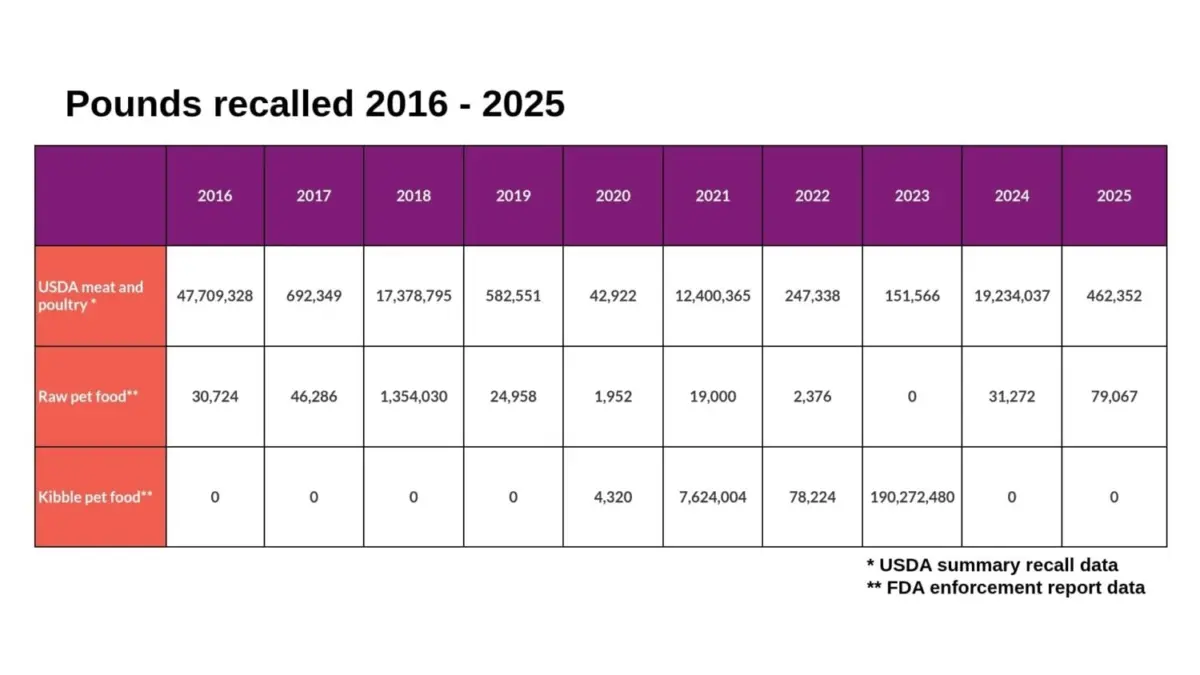
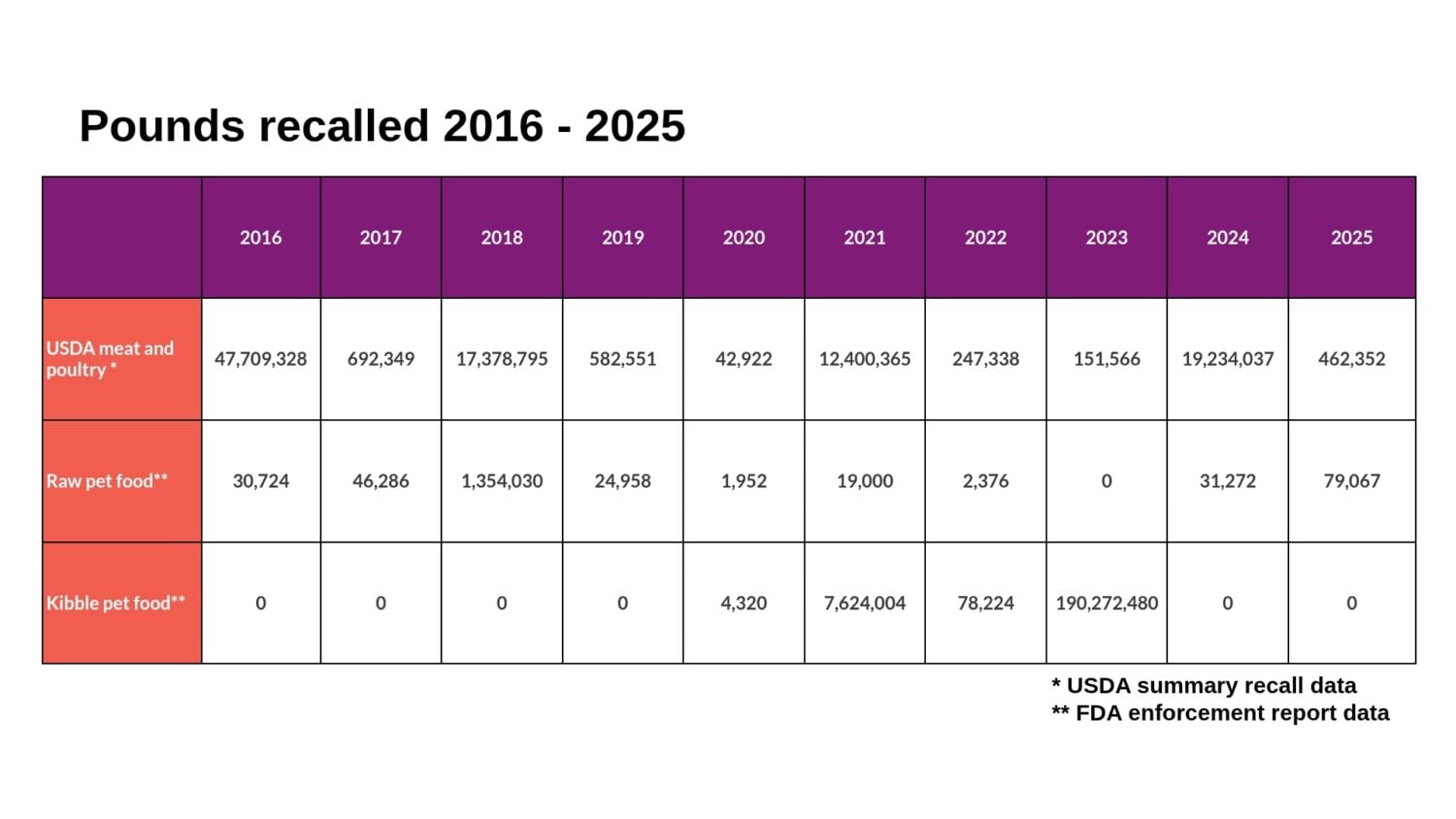
Despite the FDA’s strict enforcement policy, longitudinal recall data over the past decade demonstrates that aggressive post-processing mitigation has failed to achieve a sustained downward trend in pathogen-related product recalls.
10-Year Pathogen Recall Volumes (Conceptual Distribution across Categories)
+--------------------------------------------------------------------+
| Kibble (Extruded/Thermally Processed):   [#######################] | -> Millions of lbs
| Raw / Fresh Pet Food Formats:            [#########]              | -> High frequency
| USDA Human Meat/Poultry (Zero E.coli):   [#####################]   | -> Persistent volume
+--------------------------------------------------------------------+
* Note: Despite thermal "kill steps" in kibble, post-cook contamination persists.
Extruded kibble undergoes extreme heat and pressure processing—the FDA’s preferred "kill step." Yet, millions of pounds of dry kibble continue to be recalled annually due to post-extrusion cross-contamination during fat-spraying, cooling, and packaging operations.
This persistent failure pattern suggests that enforcing end-stage pasteurization—whether through cooking, High-Pressure Processing (HPP), or E-Beam irradiation—does not resolve structural sanitation deficits within upstream slaughterhouses and ingredient rendering facilities.
The Hidden Pathological Risk: Bacterial Endotoxins and Hepatic Stress
While irradiation effectively neutralizes living bacteria by severing double-stranded genomic DNA, it leaves behind an unaddressed microbiological hazard: bacterial endotoxins.
The Biochemistry of Endotoxins
Gram-negative bacteria, including Salmonella spp. and Escherichia coli, possess a complex outer cell membrane composed largely of lipopolysaccharides (LPS). When a Gram-negative bacterium is killed—whether through thermal extrusion, chemical sanitization, HPP, or E-Beam irradiation—its outer cell membrane disintegrates, releasing these lipopolysaccharide fragments into the surrounding substrate. These fragments are known as endotoxins.
+-----------------------------------------------------------------------+
| CELL LYSIS & ENDOTOXIN RELEASE MECHANISM                              |
+-----------------------------------------------------------------------+
| Living Gram-Negative Bacteria (Salmonella / E. coli)                  |
|                        |                                              |
|                        v  [ Irradiated via E-Beam / Thermal Processing ]
| Cellular Disruption & Bacterial Death                                  |
|                        |                                              |
|                        v                                              |
| Structurally Fragmented Cell Wall Releases Heat-Stable Endotoxins (LPS)|
|                        |                                              |
|                        v                                              |
| Intact Endotoxins Persist in Finished Pet Food Diet                   |
+-----------------------------------------------------------------------+
Endotoxins are structurally robust, heat-stable, and resistant to ionizing radiation. While irradiation successfully renders the pet food sterile of live bacteria (preventing active infection), it leaves the biological burden of heat-stable endotoxins fully intact within the finished food product.
Hepatic Pathology and Synergistic Toxicity
When a companion animal ingests pet food containing elevated concentrations of bacterial endotoxins, these lipopolysaccharides cross the intestinal mucosal barrier and enter the hepatic portal circulation. The liver serves as the primary metabolic filtration system responsible for neutralizing and clearing circulating endotoxins.
Dr. Donald R. Strombeck, Professor Emeritus of Veterinary Medicine at the University of California, Davis, and a leading authority on companion animal gastroenterology and nutrition, detailed the cumulative physiological impact of chronic endotoxin ingestion:
"Endotoxin entering the body is carried to the liver where it is inactivated. Increased endotoxin levels can damage the liver. Moreover, when the amount of endotoxin reaching the liver is normal, the presence of another potential toxin can interact with endotoxin to damage the liver. The other substances are not necessarily toxins. They include vitamin A, copper and iron, and many drugs. Thus, any level of endotoxin can damage the liver. Exposure to endotoxin should be minimized as much as possible."
                     +---------------------------+
                     | Ingested Endotoxins (LPS) |
                     +---------------------------+
                                   |
                                   v
                     +---------------------------+
                     | Hepatic Portal Circulation|
                     +---------------------------+
                                   |
                                   v
             +-----------------------------------------------+
             |       Liver (Kupffer Cell Activation)        |
             +-----------------------------------------------+
               /                     |
              v                      v                      v
    Direct Hepatocyte      Synergistic Damage      Micro-Vascular
         Toxicity        (with Cu, Fe, Vit A)     Inflammation
This biochemical reality introduces a critical issue for raw ingredient selection:
If a manufacturer sources low-grade animal meats with high initial bacterial contamination ($10^7 text CFU/g$), high-dose E-Beam irradiation will successfully kill the live bacteria.
However, the high initial bacterial load is converted into a high concentration of residual endotoxins.
The pet owner feeds a legally "pathogen-free" food that nevertheless delivers a chronic metabolic burden to the animal’s liver.
Despite repeated inquiries from veterinary professionals and consumer advocacy groups, the FDA’s Center for Veterinary Medicine (CVM) has not established maximum regulatory thresholds for endotoxin concentrations in finished pet foods, nor does it require pre-kill-step bacterial load testing on raw ingredients.
Official Statements & Stakeholder Perspectives
Industry and Regulatory Stance
Supporters of E-Beam processing—including food technology corporations, radiation equipment manufacturers, and regulatory scientists—maintain that electricity-based irradiation is one of the safest and most precise pasteurization tools available to modern food processing.
In white paper literature published by food safety technology providers such as NextBeam, advocates argue that E-Beam processing operates with exceptional thermal efficiency, elevating product temperature by only a few degrees during processing. This minimal thermal impact prevents the structural denaturing of proteins and preserves fragile heat-sensitive nutrients.
Furthermore, because linear accelerators operate entirely on electrical power, the technology eliminates the need for radioactive isotopic sources (such as Cobalt-60), addressing environmental and supply-chain biosecurity concerns associated with traditional gamma processing plants.
Vital Essentials reassures consumers on its platform that its implementation of E-Beam technology maintains raw diet integrity while fulfilling regulatory demands for pathogen elimination.
Consumer Advocacy and Independent Oversight
Conversely, pet consumer advocates argue that relying on terminal irradiation obscures underlying supply-chain issues. Susan Thixton, founder of TruthaboutPetFood.com and director of the Association for Truth in Pet Food (ATPF)—a consumer stakeholder organization representing pet owners at AAFCO and FDA proceedings—urges caution regarding the wholesale adoption of irradiation technologies.
+--------------------------------------------------------------------------+
| STAKEHOLDER PERSPECTIVES COMPARISON                                       |
+--------------------------------------------------------------------------+
| INDUSTRY / FDA                                                            |
| - E-Beam eliminates pathogenic liability (Salmonella/Listeria).           |
| - High thermal efficiency prevents heat-induced protein denaturing.      |
| - Meets mandatory federal zero-tolerance pathogen regulations under FSMA. |
+--------------------------------------------------------------------------+
| CONSUMER ADVOCATES (TruthaboutPetFood.com / ATPF)                         |
| - Masks sub-standard, high-bacterial-load raw meat ingredients.           |
| - Fails to eliminate hepatic-damaging bacterial endotoxins (LPS).        |
| - Lacks long-term feeding studies verifying micronutrient stability.     |
+--------------------------------------------------------------------------+
Thixton notes that applying terminal pasteurization allows manufacturers to utilize lower-quality raw meat inputs that would otherwise fail basic hygienic standards.
"Just because a pathogenic bacteria is killed by some type of kill step does NOT mean the food is safe to consume," states Thixton. "The higher the level of Salmonella in an ingredient before a kill step results in higher endotoxin levels in the finished pet food… Shouldn’t regulatory authorities go back to the drawing board and look at the source of pathogenic bacteria in food—and control it at the source?"
Advocates stress that without mandatory disclosure of pre-treatment bacterial counts and routine post-treatment nutritional assays, pet owners cannot verify whether irradiated diets maintain essential vitamin levels (such as Thiamine and Vitamin A) over their shelf life.
Future Outlook & Consumer Recommendations
As the pet food industry continues to integrate post-packaging pasteurization technologies—ranging from High-Pressure Processing (HPP) to high-voltage linear E-Beam systems—consumers must navigate an increasingly complex marketplace.
Industry Projections
Market dynamics suggest that more raw and fresh-preserved pet food manufacturers will adopt E-Beam irradiation in the coming years. Driven by strict FDA regulatory enforcement and the risk of costly product recalls, manufacturers view terminal pasteurization as a necessary risk-management tool.
However, long-term consumer acceptance will depend on transparency, regulatory updates, and independent nutritional verification.
                           [ Raw Meat Sourcing ]
                                     |
                                     v
                        [ On-Farm Hygiene Standards ]
                                     |
                                     v
                  +-------------------------------------+
                  | Pre-Treatment Microbiological Testing|
                  +-------------------------------------+
                                     |
                                     v
               +-------------------------------------------+
               | Terminal Intervention (E-Beam / HPP / Heat)|
               +-------------------------------------------+
                                     |
                                     v
                  +-------------------------------------+
                  | Post-Treatment Assay & LPS Monitoring|
                  +-------------------------------------+
Actionable Guidance for Pet Owners
For consumers evaluating pet foods treated with E-Beam or other forms of irradiation, veterinary consumer advocates recommend the following steps:
Verify Labeling and Symbols: Check product packaging for the mandatory green Radura symbol and explicit statements indicating the product was “Treated with radiation” or “Treated by irradiation.”
Request Processing Details from Manufacturers: Contact pet food brands directly to inquire about the exact irradiation method utilized (e.g., electricity-generated E-Beam versus isotopic Gamma radiation) and the precise absorbed radiation dosage ($kGy$) applied to the product.
Demand Post-Treatment Nutritional Profiling: Request certified third-party laboratory analysis verifying the finished product’s nutrient levels—specifically fragile micronutrients like Vitamin A, Thiamine (Vitamin B1), and essential fatty acid profiles—taken after the irradiation treatment has been completed.
Inquire About Pre-Treatment Sourcing and Standards: Ask manufacturers whether they enforce pre-pasteurization baseline limits on total plate counts (TPC) and bacterial endotoxin levels in their raw meat inputs, ensuring the product was not formulated using high-bacterial-load ingredients.
As the regulatory framework evolves, consumer groups like the Association for Truth in Pet Food continue to advocate for systemic reform at FDA and AAFCO meetings, urging regulators to prioritize upstream livestock sanitation over end-stage processing techniques.