
Executive Overview
Asia’s agricultural landscape stands at a critical, defining crossroads. As the continent presses forward with ambitious agendas centered on Regenerative and Resilient Agriculture (RRA)—while simultaneously bearing the monumental responsibility of feeding a population nearing five billion people—it faces an unprecedented convergence of systemic stressors. Climate change-induced weather extremes, accelerating soil degradation, acute water scarcity, biodiversity loss, climbing production overheads, and volatile geopolitical events have exposed the profound vulnerabilities embedded within traditional supply chains and farming paradigms.
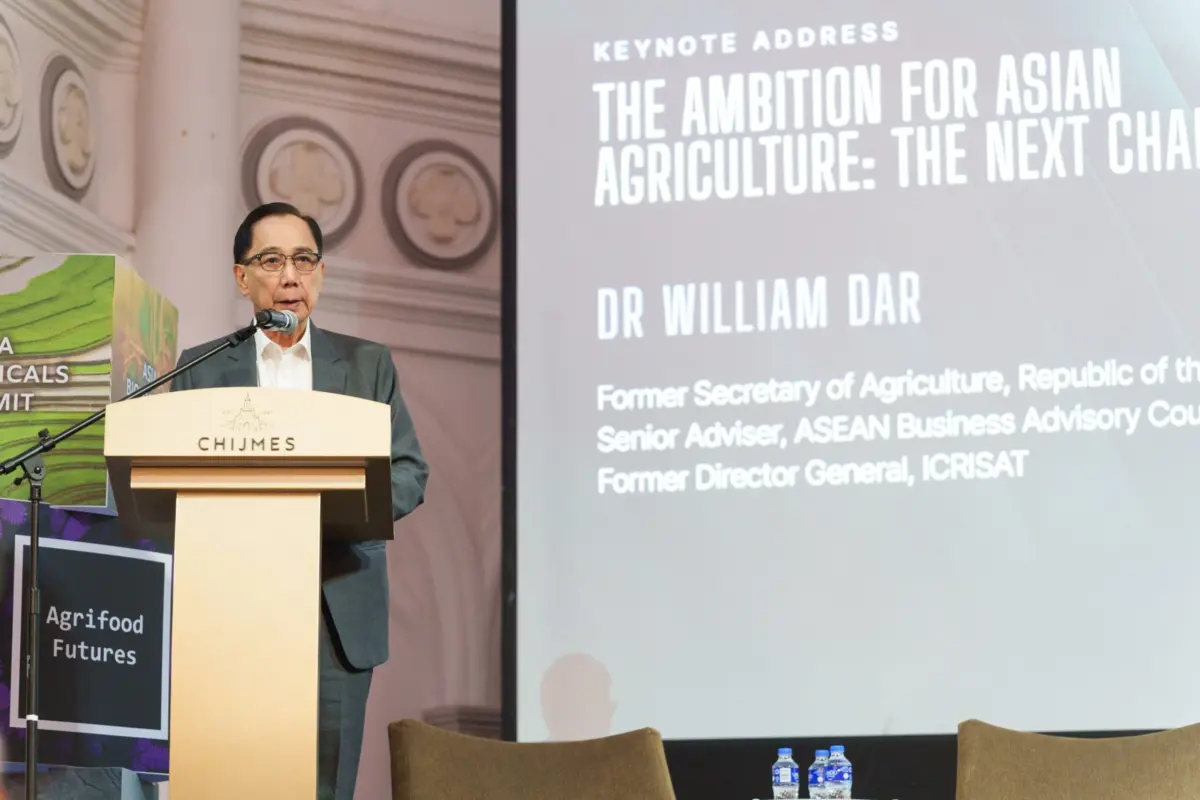
Amid these intensifying pressures, agricultural biologicals have emerged not merely as an alternative input category, but as a core strategic pillar for future-proofing the region’s food systems. Speaking at the high-profile Asia Biologicals Summit 2026 in Singapore, Dr. William Dar—former Director General of the International Crops Research Institute for the Semi-Arid Tropics (ICRISAT) and current Senior Adviser to the ASEAN Business Advisory Council Philippines—issued a clarion call for a comprehensive "resilience revolution." This envisioned transformation goes far beyond superficial adaptations; it demands an industrial, scientific, and socio-economic pivot that renders Asian farming systems fundamentally more productive, regenerative, climate-resilient, economically viable, and socially inclusive.
However, scaling biologicals across diverse agro-ecological zones requires more than enthusiasm. It calls for rigorous scientific backing, streamlined regulatory pathways, robust public-private partnerships, and—most importantly—the absolute trust and active participation of the region’s smallholder farmers. This comprehensive report explores the multifaceted challenges facing Asian agriculture, examines the strategic roadmap required to scale biological innovations, analyzes the socioeconomic imperatives of placing farmers at the center of innovation, and maps out Asia’s ambition to transition from a mere consumer market into a global powerhouse for agricultural technology.
Detailed Chronology: The Road to the Asia Biologicals Summit 2026
The discourse surrounding agricultural biologicals in Asia has evolved rapidly over the past decade, shifting from niche environmental discussions to mainstream economic and geopolitical strategy. Tracing the trajectory of this movement reveals how regional institutions, private sector actors, and scientific communities converged in Singapore for the milestone summit.
The Shift from Conventional to Regenerative Paradigms (2018–2022)
For decades, the dominant agricultural narrative across Asia was defined by the legacy of the Green Revolution—maximizing yield through synthetic fertilizers, chemical pesticides, and intensive irrigation. While these practices successfully averted widespread famine and fueled unprecedented economic growth, they left a heavy environmental footprint. By the late 2010s, governments and academic institutions began documenting severe soil fatigue, declining factor productivity, and alarming rates of groundwater depletion across South, Southeast, and East Asia.
The COVID-19 pandemic and subsequent geopolitical conflicts exposed the acute fragility of global supply chains, triggering historic spikes in the cost of synthetic inputs, particularly nitrogen-based fertilizers. This economic shock forced a profound reassessment among policymakers. Regional bodies, including the Association of Southeast Asian Nations (ASEAN), began drafting frameworks aimed at decoupling agricultural productivity from heavy chemical reliance, laying the groundwork for the modern Regenerative and Resilient Agriculture (RRA) agenda.
The Rise of Biologicals and the Regulatory Bottleneck (2023–2025)
As interest in bio-pesticides, bio-fertilizers, and bio-stimulants accelerated, the agricultural sector encountered structural roadblocks. Unlike synthetic chemicals, which benefited from decades of established regulatory frameworks, biological products faced antiquated approval processes. Many national regulatory agencies across Asia treated living organisms and natural extracts under the exact same legal criteria as synthetic molecules, creating massive bureaucratic backlogs.
Innovators, venture capitalists, and multinational agribusinesses struggled with unpredictable registration timelines, which often stretched for years. Furthermore, a lack of standardized testing protocols allowed sub-standard or fraudulent products to infiltrate local markets, severely damaging farmer trust. Recognizing that policy reform was a mandatory prerequisite for market maturation, industry stakeholders began mobilizing regional coalitions to harmonize regulatory standards and advocate for science-based pathways.
The Singapore Milestone: The Asia Biologicals Summit 2026
The culmination of these mounting pressures and collaborative efforts materialized at the Asia Biologicals Summit 2026 in Singapore. Bringing together a diverse coalition of policymakers, researchers, investors, and agricultural leaders, the summit served as the definitive platform for establishing actionable strategies. It was within this high-stakes environment that Dr. William Dar delivered his landmark keynote address, crystallizing the vision for a continent-wide resilience revolution and outlining the exact mechanics required to transition biologicals from an alternative input to a mainstream agricultural standard.
Supporting Context & Metrics: The Imperatives of Asian Agriculture
To fully grasp the urgency behind Dr. Dar’s proposals, one must examine the macro-level metrics and environmental realities dictating the future of Asian food systems.
Feeding Five Billion Under Climate Duress
Asia is currently home to nearly five billion people, a demographic weight that demands continuous, high-volume agricultural output. Yet, this production must occur against a backdrop of severe environmental degradation. According to data from international agricultural research bodies, over 30% of Asia’s agricultural land is suffering from moderate to severe degradation, driven by intensive tillage, wind and water erosion, and chemical over-application.
Furthermore, water scarcity is reaching crisis levels. Agriculture accounts for roughly 70% to 80% of freshwater withdrawals across the continent. With glacial melt in the Himalayas threatening major river basins—such as the Mekong, Ganges, Indus, and Yangtze—and increasingly erratic monsoon patterns disrupting traditional planting calendars, the margin for agricultural error has shrunk dramatically.
The Smallholder Vulnerability Matrix
Despite the rapid industrialization of certain Asian economies, smallholder farmers remain the backbone of the region’s food production. Across Southeast Asia and South Asia, the vast majority of farms are under two hectares in size. These smallholders operate within razor-thin profit margins and face asymmetrical market risks.
| Metric / Indicator | Regional Context & Impact |
|---|---|
| Average Farm Size | < 2 hectares across most of South and Southeast Asia, limiting economies of scale. |
| Input Cost Inflation | Synthetic fertilizer and pesticide costs have risen by 40% to 80% since 2020, squeezing net farm incomes. |
| Climate Exposure | Over 60% of Asian smallholders rely on rain-fed agriculture, making them acutely vulnerable to droughts and erratic monsoons. |
| Risk Tolerance | A single failed harvest can push a smallholder household into multi-generational debt, stifling technology adoption. |
This structural vulnerability explains why smallholders cannot afford to experiment with unproven agricultural technologies. For an industrial farm in a developed nation, testing a new biological input is a calculated R&D expense; for an Asian smallholder, it represents a high-stakes gamble with their family’s annual livelihood.
Official Statements and Strategic Insights
Dr. Dar’s address at the Asia Biologicals Summit 2026 provided a masterclass in pragmatic agricultural transformation. By balancing visionary ambition with granular, operational realities, he outlined a comprehensive framework for industry stakeholders. Below is a thematic synthesis of the core principles articulated during his keynote:
1. The Call for a Resilience Revolution
"It’s a defining moment for Asian agriculture systems today. Our agriculture systems face interconnected challenges with climate change, soil degradation, water scarcity, biodiversity loss, rising production costs, of course, geopolitical events, and increasingly uncertain markets… These challenges demand a fundamental shift in ambition. We need a resilience revolution in Asia’s agriculture systems, one that makes our farming systems more productive, regenerative, climate resilient, profitable, and inclusive."
Dr. Dar emphasized that incremental adjustments are no longer sufficient. The compounding crises facing the region require a holistic re-engineering of how crops are grown, managed, and commercialized. Resilience must be economically viable; if sustainable practices do not yield profitability for the farmer, the transformation will inevitably stall.
2. Science as the Foundation of Modern Agriculture
"This transformation is not about abandoning modern agriculture. It is about building on scientific progress, improved crop varieties, digital technologies, sound agronomic practices, and biological innovations to create an ecosystem that can drive under changing conditions."
Crucially, Dr. Dar pushed back against false dichotomies that pit traditional wisdom against high-tech solutions, or organic farming against modern science. He argued that the future lies in an integrated approach where biological innovations synergize with precision agriculture, digital tools, and advanced breeding techniques.
3. The Pillars of Biological Adoption
"Biologicals have an important role to play in this transformation, but their success will depend on scientific evidence, reliable product quality, enabling policies, investments and, above all, the trust and participation of the farming community."
To move biologicals from the periphery to the mainstream, Dr. Dar outlined a structured set of priorities for policymakers, researchers, and industry leaders:
- Science-Based Regulations: Development of transparent, predictable registration procedures that maintain high safety standards without imposing prohibitive bureaucratic delays.
- Research & Field Validation: Strengthening multi-location, independent trials through cross-sector collaboration among governments, universities, and private enterprises to build undeniable proof of product efficacy.
- Quality Standards: Enforcing rigorous benchmarks covering product identity, purity, viability, potency, stability, labeling, and storage, backed by proactive post-market surveillance.
- Financial Inclusion & Integration: Expanding access to green financing, seamlessly integrating biologicals into existing agronomic systems, and scaling up farmer education and extension networks.
- Regional Collaboration: Fostering cross-border cooperation in research, regulatory dialogue, testing capacity, technology transfer, and local manufacturing hubs.
4. Keeping Farmers at the Center
"No agricultural transformation will succeed unless farmers benefit. Farmers do not adopt technology simply because it is new. They adopt solutions that are affordable, practical, reliable, and capable of improving their livelihoods… For a small older farmer, testing a new biological product may mean risking scarce income during an entire production season."
This human-centric philosophy is arguably the most vital takeaway from the summit. Technology developers are frequently detached from the grassroots realities of rural farming communities. By highlighting the acute financial risk borne by smallholders, Dr. Dar underscored the necessity of robust institutional support, including subsidized input trials, crop insurance, and participatory research models where farmers co-design solutions.
Future Outlook: Asia’s Ambition to Lead Globally
Looking beyond immediate market dynamics, Dr. Dar articulated a bold, aspirational vision for the continent: Asia must not remain a passive consumer market for Western or multinational biological technologies. Instead, the region possesses all the necessary ingredients to become a global epicentered powerhouse for research, development, validation, manufacturing, and responsible deployment.
Capitalizing on Regional Assets
Asia’s unmatched agro-ecological diversity—ranging from tropical Southeast Asian archipelagos to the high-altitude plateaus of Central Asia and the intensive delta systems of East and South Asia—provides a natural laboratory for bio-discovery. Microorganisms and botanical extracts native to these diverse environments hold immense untapped potential for developing localized, highly effective biological solutions.
Combined with Asia’s rapidly expanding technical talent pool, robust entrepreneurial ecosystems, and massive domestic markets, the region is uniquely positioned to scale manufacturing and drive down unit costs. Localizing production not only enhances supply chain security but also ensures that the economic benefits of the bio-economy remain anchored within rural economies.
The Collaborative Imperative
In his concluding remarks, Dr. Dar synthesized the ultimate requirement for achieving this grand vision. The transition cannot be achieved by any single stakeholder group operating in isolation.
"The future of Asian agriculture will not be defined by the technologies we possess, the policies we announce, or the investments we mobilise alone. It will be defined by what we achieve together… If we unite the power of finance, the commitment of governments, the discipline of enterprise, the vision of investors, and the agency of farmers, Asia can do more than adapt to the future of agricultural systems. Asia can lead a resilience revolution that regenerates its resources, strengthens its agriculture systems, advances agricultural biologicals, rewards its farmers, and secures food and prosperity for generations to come."
Conclusion
The Asia Biologicals Summit 2026 marked a watershed moment for the region’s agricultural sector. By confronting systemic vulnerabilities head-on and championing a science-backed, farmer-centric approach to agricultural biologicals, leaders like Dr. William Dar have charted a clear, actionable course forward. As governments begin translating these high-level priorities into regulatory reforms and financial commitments, Asia edges closer to realizing its destiny: transforming from a region grappling with ecological vulnerability into the undisputed global leader of agricultural resilience and sustainable food security.