
Executive Overview
A cross-country relocation exerts a profound psychological and physical toll on any household. Every room becomes a grid of tactical decisions regarding prioritization, spatial constraints, and logistical sequencing: Which boxes go first? What stays readily accessible? Where will everyone sleep on arrival night?
For a human family, these logistical headaches are mitigated by cognitive foresight—an understanding of shipping manifests, real estate timelines, and transit schedules. For a dog, however, the existential calculus is starkly immediate and devoid of context: Where are my people? When do we eat? Why has the living room couch vanished into thin air?
Transitioning a canine companion across state lines or through multiple time zones cannot be treated as a mere afterthought penciled in at the bottom of a household packing checklist. As relocation experts and veterinary behavioral specialists consistently advise, a successful move requires treating the pet’s itinerary as an independent, highly specialized workstream.
From updating interstate health documentation and microchip registry data to constructing a secure travel-day quarantine zone and pacing post-arrival integration, moving cross-country with a dog demands methodical planning. By divorcing your pet’s physical and emotional needs from the chaotic logistics of household boxing, you safeguard their well-being, mitigate acute travel anxiety, and ensure that your entire household settles into its new geography with minimal friction.
Detailed Chronology: A Week-by-Week Relocation Roadmap
To prevent moving anxiety from overwhelming your dog, the process must be broken down into structured, anticipatory phases. Here is how to manage the timeline effectively from two months out to arrival night.
Six to Eight Weeks Out: Veterinary Clearance and Legal Compliance
The journey begins not with cardboard boxes, but in the examination room. Schedule a comprehensive veterinary appointment well in advance to refill ongoing prescriptions, request exhaustive medical and vaccination records, and proactively address any potential motion-sickness or anxiety concerns. According to the American Veterinary Medical Association (AVMA), carrying physical proof of current vaccinations and medical histories is a baseline requirement for safe interstate travel.
If your relocation crosses state borders, you cannot assume uniform regulatory standards. The United States Department of Agriculture Animal and Plant Health Inspection Service (USDA APHIS) notes that individual destination states retain the authority to establish their own distinct animal-health requirements. Certain jurisdictions mandate specific health certificates issued within a strict window prior to entry, or require targeted inoculations beyond core vaccines.
Simultaneously, audit your dog’s identification infrastructure:
- Microchip Data: Update the telephone numbers and physical addresses linked to your dog’s microchip registry.
- Collar Tags: Order a durable physical collar tag displaying an active, roaming-capable mobile number.
- Visual Documentation: Save a clear, high-resolution, full-body photograph of your dog on your smartphone to streamline emergency recovery efforts if an escape occurs.
- Hardware Inspection: Invest in a secure, professionally fitted harness or martingale collar. Moving week is an inopportune time to discover that a nervous animal can slip out of worn, ill-fitting gear.
Four Weeks Out: Establishing the Moving-Day Containment Plan
Before you begin sorting kitchenware, determine precisely where your dog will be housed while professional movers traverse your home with heavy furniture through open doorways. The safest approach is often outsourcing care entirely: a trusted friend, a familiar boarding facility, or a reputable daytime care center can completely eliminate the hazard of an open-door escape.
If your dog must remain on-site during moving day, designate a quiet, secure room that the moving crew is explicitly instructed never to enter. Fasten a highly visible warning sign to the handle, and assign one specific adult the sole responsibility of monitoring the animal from the initial box load-out to the final truck departure.
The ASPCA echoes this containment strategy, emphasizing that maintaining normal routines alongside strict physical isolation prevents startled pets from bolting past workers carrying mattresses or hand trucks.
Two Weeks Out: Assembling the Canine Essentials Bag
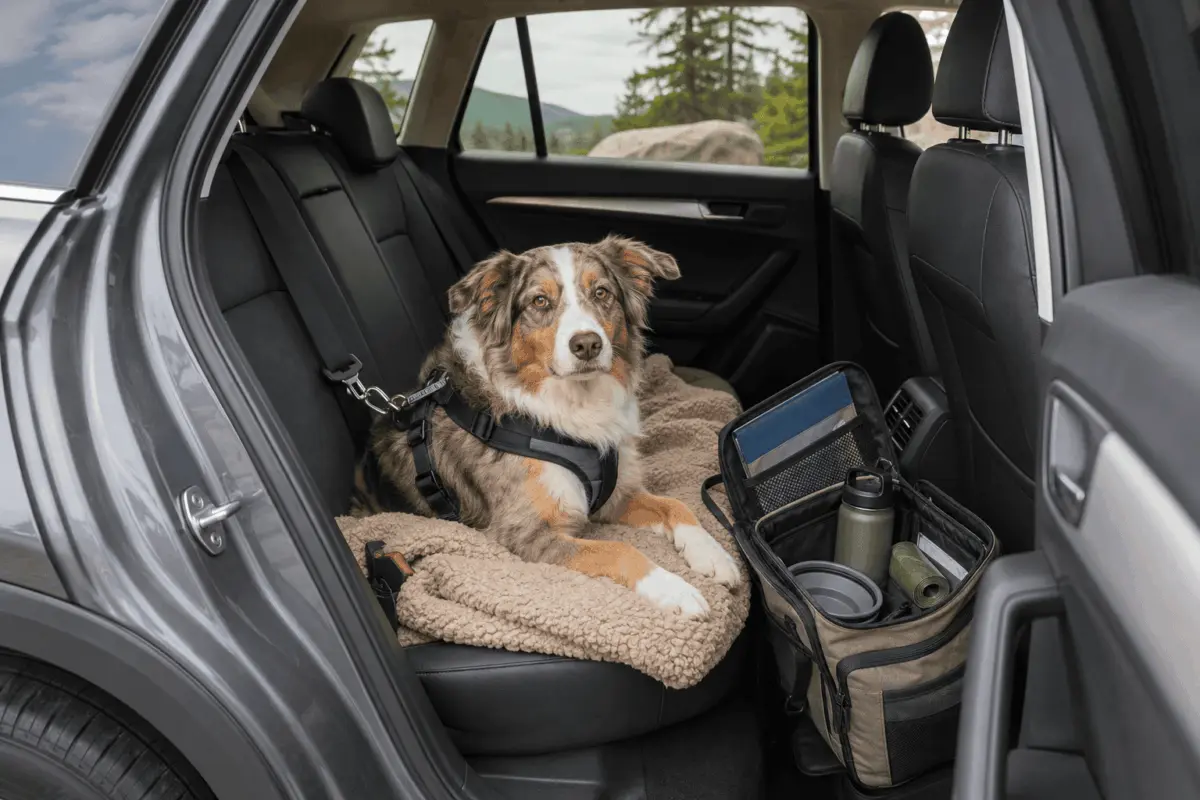
Never pack your dog’s daily necessities inside the household shipping containers. Instead, curate a dedicated, easily accessible duffel bag or plastic bin that travels with you in the climate-controlled passenger cabin.
This kit must contain:
- Several days’ worth of your dog’s standard, unvaried food.
- Bottled water or large jugs of water sourced from home to prevent digestive upset caused by shifting municipal water chemistry.
- Collapsible or standard feeding bowls.
- All necessary medications and a comprehensive pet first-aid kit.
- A robust supply of waste bags, disinfectant surface cleaner, and fresh towels.
- A primary leash, a secure backup leash, and a waste disposal system.
- One or two familiar, comforting toys.
- A bed or blanket saturated with home scents—deliberately avoiding laundering these items before departure.
The Golden Rule of Transit
Never place a live animal inside a moving truck cargo bay or a non-climate-controlled trailer. Your dog must travel exclusively within the passenger space of a vehicle, secured safely via a crash-tested travel crate, a properly rated seatbelt harness, or a partitioned cargo area behind a secure barrier.

Moving Week: Preserving Routine Amidst the Chaos
As packing paper rusts and cardboard towers rise, your dog will inevitably sense the disruption. Mitigate their stress by rigidly preserving feeding and walking schedules. Keep their primary sleeping bed, water bowls, and favorite toys fully accessible until the very final hours of packing.
If your dog displays distress in response to tape guns, clattering hand trucks, or unfamiliar laborers, manufacture physical distance rather than expecting stoic compliance. Brief your moving coordinator explicitly: ensure the lead foreman knows which bedroom door must remain bolted shut, where the pet sanitation supplies are located, and whom to contact if a logistical question arises.
Supporting Context & Metrics: The Behavioral and Logistical Reality
Moving cross-country is not merely a change of scenery; it is a profound neurological event for a domesticated canine. Dogs rely heavily on olfactory mapping and spatial predictability. When an entire home is dismantled, their cognitive map disintegrates.
- Physiological Stress Indicators: Veterinary studies indicate that significant environmental shifts can elevate baseline cortisol levels in dogs for upwards of 14 days post-relocation. Manifestations include transient anorexia, hyper-vigilance, gastrointestinal disturbances, and sudden regressions in house-training.
- The Escape Risk Spike: Animal sheltering data consistently demonstrates a heightened rate of pet loss during the first 72 hours of a relocation. Open doors, unsecured perimeter gates in new neighborhoods, and the disorientation of unfamiliar sights and sounds create an elevated escape vector.
- Financial and Time Allocation: Industry data suggests that accommodating a pet properly during a long-distance move increases total travel expenditures by roughly 15% to 25%, factoring in health certificates, specialized travel gear, pet-friendly lodging, and potential boarding fees. Neglecting these budgetary allocations frequently results in compromised safety margins and acute stress for both owner and animal.
Official Statements and Industry Insights
Maintaining structural integrity in pet logistics requires listening to seasoned professionals who manage the intersection of human transit and animal welfare on a daily basis.
"The easiest moves with dogs are the ones where the pet plan is separated entirely from the household packing. Keep the dog’s food, medication, records, leash, and familiar bedding with the family—not on the truck—and decide where the dog will stay before the first box leaves the house."
— Leon Schwab, Owner, FairPrice Movers
Industry consensus highlights that friction during cross-country transits almost invariably stems from poor demarcation between human and animal logistics. When pet care is bolted onto a moving plan as an afterthought, crisis management replaces execution.
Future Outlook: Arrival, Contingencies, and the Two-Week Adjustment
Travel Day Execution
When you finally hit the open road, pace your journey around your dog’s biological clock and physiological limits, rather than forcing marathon driving shifts to optimize fuel stops. Administer water frequently in small increments, ensure the leash is securely fastened to your wrist or hand before opening any vehicle door, and bypass bustling, high-stress interstate rest areas if your animal is easily overwhelmed.
Never leave a dog unattended in a parked vehicle, even for a few minutes; internal cabin temperatures can spike to lethal levels within moments, regardless of ambient outdoor readings.
Navigating Unexpected Delays
Even meticulously planned itineraries encounter friction. Real estate closings can stall, keys can be withheld, or building management may abruptly alter approved move-in windows.
If your new home is inaccessible when the moving truck arrives:
- Contact your long-distance moving carrier immediately to understand storage-in-transit protocols.
- Ensure your canine emergency kit remains in your personal possession, entirely independent of the main shipment.
- Identify temporary pet-friendly accommodations (such as extended-stay hotels or local boarding kennels) well in advance so that you are not searching for emergency lodging with an exhausted animal at dusk.
Arrival Night and the Two-Week Integration Window
Upon reaching your destination, inspect the new property before bringing your dog inside. Check perimeter fencing for gaps, secure low-hanging window screens, and sweep the interior for residual contractor debris, exposed wiring, or toxic cleaning agents left behind by prior occupants.
Establish a singular "home base" room containing your dog’s familiar bed, bowls, and toys. Confine them to this micro-environment initially, expanding their access to the rest of the residence gradually over the subsequent days. Keep initial neighborhood walks brief, calm, and purposeful.
Over the first fourteen days, monitor your dog closely for signs of emerging separation anxiety. Because the familiar architectural boundaries of your previous home have been erased, dogs frequently experience a temporary regression in confidence when left alone. Rebuild alone-time increments patiently from the ground up. By respecting your dog’s psychological timeline, you ensure that the cross-country voyage concludes not with trauma, but with a confident, secure transition into your household’s next chapter.