
Executive Overview
Along the sun-drenched shores of the Florida panhandle, a delicate and high-stakes battle for survival plays out every spring and summer. As tourists and locals flock to Navarre Beach to enjoy the pristine white sands and emerald-green waters of the Gulf of Mexico, vulnerable colonies of imperiled seabirds—most notably the Least Tern (Sternula antillarum) and the Black Skimmer (Rynchops niger)—attempt to raise their young in the open sand.
For Kiara Roman Gonzalez, a dedicated Navarre Beach seabird monitor with Audubon Florida, the summer season was more than a routine assignment; it was a profound lesson in the symbiotic relationship between local wildlife and human communities. Facing grueling summer heat, unpredictable weather, and constant urban pressures, Gonzalez and her team learned that modern conservation cannot succeed through regulatory enforcement alone. Instead, protecting these ground-nesting species requires a mobilized, empathetic community where volunteers, law enforcement agencies, state wildlife officials, and everyday beachgoers act as a unified defensive shield.
This report examines the intricate dynamics of coastal seabird conservation on Navarre Beach. It explores the biological significance of the local ecosystem, details the collaborative chronology of the nesting season, analyzes the multifaceted threats facing these birds, highlights official perspectives from conservation stakeholders, and outlines a forward-looking blueprint for sustainable coastal management. Through education, community outreach, and boots-on-the-ground monitoring, Navarre Beach has emerged as a compelling case study in how human communities can coexist with—and actively champion—fragile coastal wildlife.
Detailed Chronology of the Nesting Season: A Season on the Sand
The annual cycle of seabird nesting along the Emerald Coast is a race against time, human activity, and natural elements. Understanding the chronology of this seasonal migration and reproductive period reveals the immense logistical effort required to safeguard these colonies.
Phase One: Arrival and Site Selection (Early Spring)
As spring temperatures rise, Least Terns and Black Skimmers migrate back to the Florida coast from their wintering grounds in Central and South America. These seabirds do not build traditional, elevated nests in trees. Instead, they practice "scrape nesting," creating shallow depressions directly in the open sand.
Choosing these sites often puts the birds in direct conflict with human recreation zones. For example, a primary nesting site established on a small, vulnerable stretch of open sand along the Navarre Causeway presented a high-stakes paradox. The site’s proximity to a heavily trafficked roadway exposed the birds to the constant hazard of passing vehicles. Yet, paradoxically, the heavy human and vehicular presence acted as an inadvertent deterrent to mammalian predators, such as raccoons, coyotes, and ghost crabs, which typically ravage ground nests.
Phase Two: Monitoring and Public Engagement (Late Spring & Early Summer)
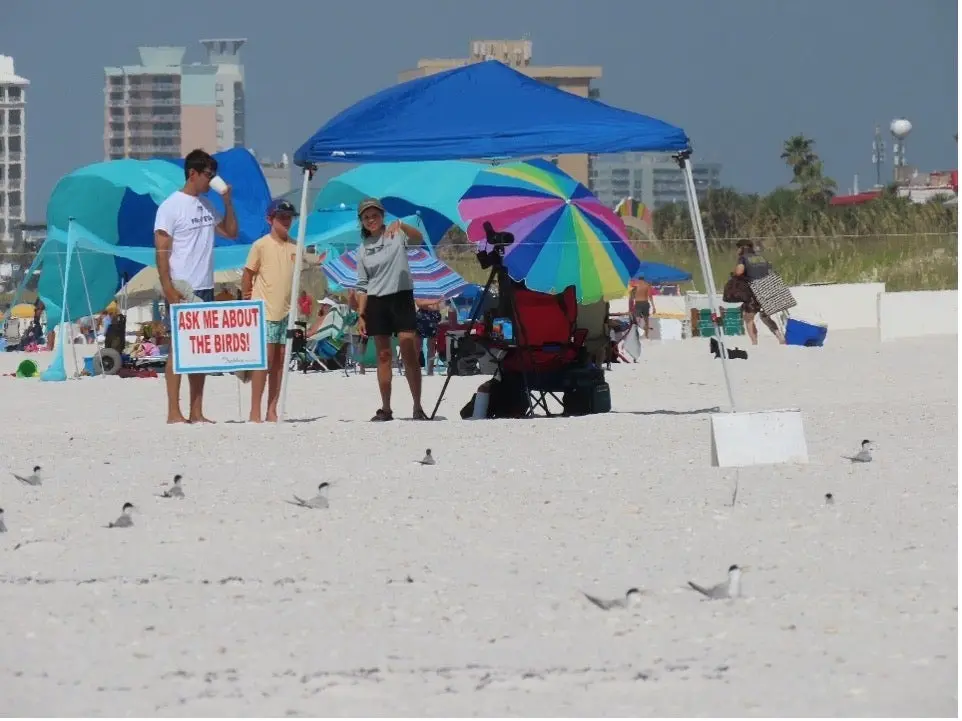
Once the colonies were established, monitors like Gonzalez deployed to the beaches to map nesting boundaries, erect protective symbolic fencing, and engage directly with the public. Dressed in specialized shirts bearing the conversation-starting prompt, "Ask Me About the Birds," Gonzalez transformed passive beachgoers into active participants in conservation.
To bridge the gap between human curiosity and wildlife protection, Audubon Florida deployed high-powered spotting scopes near the nesting perimeters. This simple intervention revolutionized the public’s perception of the colonies. Rather than viewing the fenced-off areas as inconveniences, beachgoers peered through the eyepieces to witness intimate, charismatic wildlife behaviors: an adult Least Tern returning with a fresh catch to feed its chirping chicks, or a Black Skimmer shifting its weight to regulate egg temperature. These micro-interactions dissolved apathy and fostered a profound emotional connection between the public and the local ecosystem.
Phase Three: Mid-Summer Crises and Interventions (Mid-Summer)
As the heat intensified during the peak of summer, the vulnerability of the colonies spiked. Inclement weather events, particularly sudden Florida summer downpours and tropical storm surges, threatened to wash away shallow nests and flood chick-rearing areas. Stormwater runoff carved chasms into protective chick fencing, occasionally allowing flightless chicks to wander dangerously outside the sanctuary boundaries.
During this critical window, the community apparatus swung into full operation. Volunteers patrolled the perimeters daily, patching fence lines, tracking wandering chicks, and reporting casualties. Law enforcement agencies monitored vehicular speeds along the Navarre Causeway, ensuring drivers adhered to reduced limits that minimized both road mortality and startle responses in the adjacent colonies. Meanwhile, beachgoers demonstrated unprecedented restraint, keeping dogs on leashes, packing out trash, and respecting established buffer zones.
Phase Four: Fledging and Departure (Late Summer)
By late summer, surviving chicks matured into juveniles capable of flight, and the colonies gradually dispersed. The conclusion of the nesting season marked a moment of reflection for conservationists. Despite facing the trifecta of natural predators, human disturbance, and severe weather, the collaborative framework established on Navarre Beach resulted in successful fledging events, proving that community-powered conservation yields tangible biological results.
Supporting Context & Metrics: The Ecology and Threats of Navarre Beach
To fully appreciate the gravity of the conservation efforts on Navarre Beach, one must examine the ecological profiles of the species involved and the systemic threats they face in a rapidly developing coastal landscape.
Profile of the Species: Least Terns and Black Skimmers
- Least Tern (Sternula antillarum): As the smallest member of the American tern family, the Least Tern is easily recognized by its striking black cap, white forehead, and yellow bill. Listed as a state-threatened species in Florida, Least Terns rely heavily on open, sandy habitats for nesting. Their camouflage-colored eggs and chicks blend seamlessly into the sand, making them exceptionally vulnerable to being crushed by unsuspecting pedestrians, off-road vehicles, or beach equipment.
- Black Skimmer (Rynchops niger): Distinguished by its unique bill—where the lower mandible is significantly longer than the upper—the Black Skimmer feeds by skimming the surface of the water for small fish. Skimmers are highly social colonial nesters, often sharing habitat space with Least Terns. Like terns, their ground-nesting habits place them directly in the path of coastal development and human recreation.
Quantifying the Threat Matrix
Conservation data collected across Florida’s coastal ecosystems highlights the compounding pressures placed on beach-nesting birds:
| Threat Category | Specific Stressor | Biological & Environmental Impact |
|---|---|---|
| Anthropogenic (Human-Induced) | Beach Recreation & Foot Traffic | Crushing of eggs and camouflage-colored chicks; displacement of incubating adults. |
| Anthropogenic | Unleashed Domestic Pets | Dogs flush adult birds from nests, exposing eggs to lethal thermal stress and preying directly on chicks. |
| Anthropogenic | Vehicular Traffic (Causeway sites) | Risk of direct road mortality when mobile chicks wander onto asphalt surfaces. |
| Natural | Predation (Avian & Mammalian) | Crows, gulls, raccoons, and coyotes consume eggs and nestlings. |
| Environmental | Inclement Weather & Storms | Tidal surges and heavy rainfall wash away shallow scrape nests and flood low-lying colonies. |
Despite these overwhelming odds, localized data from Audubon Florida demonstrates that community-driven stewardship drastically reduces human-caused mortality rates. When beachgoers are educated via interpersonal communication and visual aids like spotting scopes, voluntary compliance with nesting boundaries increases by a measurable margin.
Official Statements and Stakeholder Perspectives
The success of the Navarre Beach seabird monitoring program underscores a decentralized model of environmental management. Key stakeholders emphasize that modern conservation is fundamentally a collaborative enterprise.
Reflecting on her summer in the field, Kiara Roman Gonzalez, Navarre Beach seabird monitor for Audubon Florida, emphasized the transformative power of everyday dialogue:
"Throughout the season, I had the pleasure of interacting with people from all walks of life, most showing compassion and curiosity for these birds. Conservation does not always require large-scale efforts. Sometimes, it can start with just a conversation that raises one’s awareness and respect for the wildlife that share public spaces with them."
Gonzalez further highlighted the collective nature of the work, noting that safeguarding these species required an integrated coalition:
*"We build community
when we come together for a common cause. I noticed countless examples of community members and partners who stepped up to protect these birds and their habitats, including volunteers, law enforcement, the Florida Fish and Wildlife Conservation Commission (FWC), and the public. Everyone played a role in their own way."*
Conservation biologists and local authorities echo these sentiments, pointing out that municipal law enforcement and state conservation officers serve an indispensable function. By strictly enforcing speed reductions along vulnerable corridors like the Navarre Causeway and penalizing habitat encroachment, institutional partners provide the legal framework necessary for grassroots volunteers and monitors to perform their daily fieldwork safely and effectively.
Future Outlook: A Blueprint for Sustainable Coastal Coexistence
As coastal populations along the Florida panhandle continue to surge and tourism reaches record highs, the pressures on beach-nesting bird habitats will only intensify. Ensuring the long-term survival of species like the Least Tern and Black Skimmer requires scaling up the successes observed on Navarre Beach into a permanent, institutionalized framework for coastal management.
1. Expanding Educational Infrastructure
The integration of spotting scopes and interactive outreach proved to be a game-changer for public compliance. Future conservation strategies should institutionalize these mobile education stations across high-density tourist beaches during peak nesting months. Equipping more volunteers with communication tools ensures that public curiosity is consistently channeled into environmental literacy.
2. Enhancing Habitat-Infrastructure Engineering
The precarious nature of sites like the Navarre Causeway—where vehicular safety and wildlife conservation collide—demands innovative civil engineering solutions. Future urban planning along coastal thoroughfares should incorporate permanent wildlife warning signage, flashing radar speed displays during nesting seasons, and reinforced physical barriers that prevent mobile chicks from accessing active roadways without disrupting natural stormwater drainage.
3. Fostering Grassroots Digital Advocacy
One of the most encouraging trends noted during the recent nesting season was the organic spread of conservation awareness via social media and word-of-mouth networks. When beachgoers share their experiences of peering through spotting scopes or learning about local ecology online, they amplify the reach of on-the-ground monitors exponentially. Cultivating these digital ambassadors will be critical for shaping public norms around beach etiquette.
Conclusion
The narrative of Navarre Beach is ultimately a story of hope. It demonstrates that wildlife and human recreation are not mutually exclusive entities destined for perpetual conflict. By fostering a culture of curiosity, mutual respect, and shared responsibility, communities can protect their natural heritage. As Gonzalez aptly noted, the journey of conservation is a team effort: “I hope people continue to explore the outdoors, stay curious, and ask questions about what they see, whether that be birds or all the other fascinating nature around them.” Through sustained community engagement, the shores of the Emerald Coast will remain a safe haven for generations of seabirds to come.