
Executive Overview
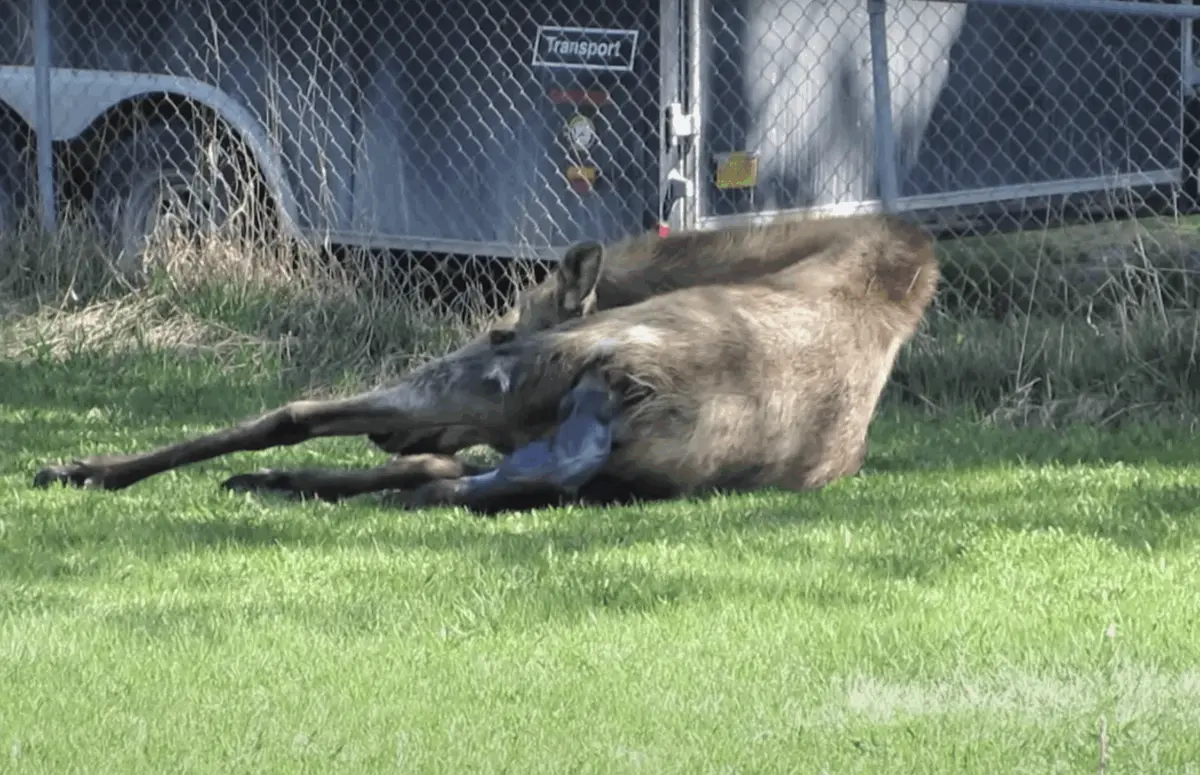
In an extraordinary demonstration of multi-year site fidelity and interspecies habituation, an adult female Alaskan moose (Alces alces gigas) recently returned to a residential backyard in Southcentral Alaska to give birth to twin calves. This marks the sixth consecutive year the wild ungulate has chosen the exact same private property as her calving refuge—a phenomenon that highlights the growing complexities of the wildlife-urban interface across northern latitudes.
The event, documented on video by local resident Levi Perry and witnessed from a safe distance by bystanders, offers a rare, granular look into the initial moments of neonatal ungulate life. Beyond its emotional resonance, the documentation provides valuable observational data regarding urban wildlife refuges, the "predator shield" hypothesis, and the physiological milestones of newborn calves within their first hours of life.
While wildlife management officials continuously urge caution regarding human interaction with large mammals, this long-standing case of non-threatening coexistence serves as an intriguing case study. It illustrates how consistent, respectful human behavior can alter wild animal space-use patterns during highly vulnerable life stages.
Detailed Chronology
+-----------------------------------------------------------------------------------+
|                        TIMELINE OF THE PARTURITION EVENT                          |
+-----------------------------------------------------------------------------------+
| Initial Arrival    | Gravid cow enters residential backyard; selects secluded,    |
|                    | low-wind corner near human structure.                        |
+--------------------+--------------------------------------------------------------+
| Phase 1: Delivery  | Labor commences; first calf is delivered. Onlookers begin    |
|                    | filming from elevated, safe vantage point.                   |
+--------------------+--------------------------------------------------------------+
| Phase 2: Grooming  | Cow actively cleans firstborn's airways and coat, stimulating |
|                    | circulation and maternal bonding.                            |
+--------------------+--------------------------------------------------------------+
| Phase 3: Twinning  | Off-camera delivery of a second calf occurs within minutes   |
|                    | while cow continues maternal care of the firstborn.          |
+--------------------+--------------------------------------------------------------+
| Phase 4: Standing  | Both neonates attempt initial locomotion, experiencing       |
|                    | multiple falls before achieving stable posture.              |
+-----------------------------------------------------------------------------------+
Phase I: The Multi-Year Foundation
The relationship between the female moose and the property owner began six years prior. According to local accounts, the homeowner established a baseline of predictable, low-impact human presence when the moose first entered the yard during her birthing cycle. By maintaining a safe distance, minimizing loud noises, and occasionally displaying non-hostile behaviors—such as offering a piece of fruit—the resident created an environment free of perceived threats.
Over six consecutive spring seasons, the cow has demonstrated strong philopatry (the tendency of an animal to return to a specific site). This behavioral trait suggests that the animal calculates the suburban property to be significantly safer than surrounding wilderness zones.
Phase II: The Birthing Event
On the day of the recorded event, the visibly gravid cow arrived at the property, selecting a sheltered area of the backyard lawn. Local resident Levi Perry and two observers observed the animal settling into position to begin labor. Recognizing the delicate nature of the event, the witnesses positioned themselves at an elevated, non-intrusive distance to capture the process on video.

The primary delivery proceeded rapidly. The initial calf emerged enclosed in amniotic fluids. Within seconds of complete expulsion, the newborn exhibited automatic reflexive head shakes and leg extensions, attempting to clear its nasal passages and adjust to atmospheric exposure.
Phase III: Maternal Grooming and the Unseen Twin
Immediately following the birth of the first calf, the mother began vigorous grooming—a critical physiological step. Maternal licking serves three vital functions:
- Clears fluid from the neonate’s respiratory tract.
- Stimulates blood circulation and body temperature regulation.
- Establishes the chemical olfactory bond between mother and offspring.
While observers focused on the mother tending to her firstborn, a second birth occurred just out of the primary camera angle. Twinning in Alaskan moose, while not uncommon under favorable nutritional conditions, increases the biological demand on the mother significantly. Within minutes, both neonates were lying side by side on the grass, fully accounted for and undergoing simultaneous maternal cleaning.
Phase IV: Biomechanical Milestones and Locomotion
Within an hour of birth, both calves initiated attempts to achieve an upright posture. The video records the classic trial-and-error motor development typical of wild ungulates:
- Initial Extension: The first calf extended its elongated metacarpals and metatarsals, attempting to anchor its hooves into the turf.
- Loss of Equilibrium: Due to underdeveloped core muscle strength and high centers of gravity, the neonate experienced several collapses, falling sideways onto the soft ground.
- Secondary Attempts: The second twin replicated these movements shortly thereafter, briefly standing upright for several seconds before tumbling over.
- Maternal Stabilization: Throughout these attempts, the mother remained within arm’s reach, offering physical contact and vocal reassurances to stabilize the calves.
Supporting Context & Metrics
Comparative Metrics: Alaskan Moose Parturition & Development
To understand the biological significance of this event, it is helpful to examine standard baseline metrics for Alces alces gigas:
| Biological Parameter | Standard Baseline (Alaskan Moose) | Observed Yard Event Data |
|---|---|---|
| Average Birth Weight (Single) | 28–35 lbs (13–16 kg) | Estimated within normal parameters |
| Average Birth Weight (Twins) | 22–28 lbs (10–13 kg) per calf | Slightly smaller, typical for twins |
| Time to First Standing Attempt | 30 to 90 minutes post-delivery | ~45 minutes post-delivery |
| Twinning Rate in Southcentral AK | 20%–50% (Habitat/Nutrition dependent) | Confirmed Twin Birth |
| Maternal Site Fidelity Rate | High (50%–70% return to home range) | Extreme (6 consecutive years to exact yard) |
The "Predator Shield" Hypothesis
Biologists frequently cite the "predator shield" hypothesis to explain why female ungulates select urban and suburban environments for parturition. In natural settings across Alaska, newborn calves face severe predation pressures from apex predators:

- Brown Bears (Ursus arctos): Responsible for up to 40%–60% of calf mortality in early summer.
- Black Bears (Ursus americanus): Significant opportunistic predators of neonates.
- Wolves (Canis lupus): Pack hunting dynamics pose a continuous threat to young calves.
Because large carnivores generally avoid high-density human developments, suburban yards act as unintended ecological sanctuaries. By giving birth near human dwellings, the female moose effectively leverages human presence as a deterrent against natural predators, significantly increasing the early survival odds of her twins.
       [ WILDERNESS ZONE ]                     [ SUBURBAN SANCTUARY ]
 High Bear/Wolf Density                     Low Carnivore Presence
         │                                            │
         ▼                                            ▼
   High Predation Risk                         "Predator Shield"
   for Newborn Calves                         Enhanced Calf Survival
         │                                            │
         └─────────────► COW MOOSE CHOOSES ───────────┘
                         RESIDENTIAL YARD
Official Statements & Expert Perspectives
Wildlife Management Advisories
While the video footage highlights a peaceful interaction, wildlife management agencies, including the Alaska Department of Fish and Game (ADF&G), maintain strict protocols regarding urban moose encounters.
An agency spokesperson provided context regarding the risks associated with calving moose in suburban settings:
"Female moose with newborn calves are among the most dangerous large mammals in North America. Their maternal protective instincts are exceptionally strong. While site-faithful cows may become habituated to a specific property owner, members of the public must remember that these remain wild, unpredictable animals. Approaching a cow with neonates can trigger explosive defensive aggression."
Ethical Considerations on Feeding Wildlife
State wildlife officials also reiterated policies regarding the feeding of wild ungulates. Though well-intentioned acts—such as offering apples—can foster familiar bonds, feeding wild game is generally illegal under Alaska Administrative Code (5 AAC 92.230), which prohibits feeding big game animals.
Experts emphasize that habituation can sometimes lead to negative outcomes if an animal loses its natural fear of humans and wanders onto properties where residents are less accommodating or equipped to handle high-risk wildlife encounters.

Future Outlook
Long-Term Urban-Wildlife Coexistence
As suburban sprawl continues to encroach upon historic wildlife corridors in Southcentral Alaska, encounters of this nature are projected to increase. Urban planning initiatives are increasingly factoring in wildlife corridors and greenbelts to accommodate the movement of large ungulates, reducing the need for moose to bed down in manicured residential lots.
Research and Public Awareness
The viral footage captured by Levi Perry serves a dual purpose: it offers entertaining digital content while acting as an educational tool for wildlife research. Modern, high-definition consumer video allows field researchers to study fine-motor skill acquisition, maternal grooming duration, and twin interaction dynamics without the logistical expense of deploying field research teams into remote wilderness locations.
As for the mother moose and her newborn twins, their immediate future involves a critical few weeks of rapid development. Within two to three weeks, the calves will be capable of accompanying their mother across far greater distances, browsing on willow buds, and navigating the broader Alaskan landscape. If historical patterns hold, wildlife observers expect this resilient cow to return to the same suburban haven next spring to repeat one of nature’s most compelling cycles.