
Executive Overview
For thousands of years, humans have kept aquatic life in artificial enclosures. What began in ancient China around 4,500 years ago as rudimentary ornamental setups has evolved into a sophisticated, highly accessible hobby. Today, entering the world of freshwater aquariums offers a deeply rewarding intersection of biology, interior design, and mindful pet care.
However, transitioning from a casual admirer to a successful fish keeper requires moving past the romanticized notion of a bowl and a plastic castle. Because an aquarium is a closed artificial ecosystem rather than a limitless natural body of water, minute biological shifts can spell disaster if managed incorrectly.
To determine the absolute best equipment, methods, and practices for beginning and intermediate freshwater-aquarium enthusiasts, we consulted industry veterans, analyzed extensive consumer feedback, evaluated market-leading products, and spoke with aquatic pathology experts. Whether you are looking to build a serene planted scape or a vibrant community tank, investing in the right foundational components ensures a thriving ecosystem with minimal long-term upkeep.
Detailed Chronology & Expert Research Methodology
Our reporting involved rigorous, hands-on testing and comprehensive qualitative research. To establish a baseline of authority, we sought guidance from multiple industry experts:
- Chi Cho, co-owner of Pacific Aquarium in New York City, provided extensive walk-throughs of operating retail setups, detailing which commercial systems perform under continuous retail stress and explaining the nuances of filtration media.
- Keith Seyffarth, creator of The First Tank Guide and a veteran aquarist with over 35 years of experience managing tanks ranging from 2.5 gallons to 180 gallons, offered practical insights learned from managing commercial pet store fish departments.
- Dr. Jesse Trushenski, fish pathologist supervisor at the Idaho Department of Fish and Game, provided rigorous scientific context on fish nutrition, pathogen vectors, and biological health requirements.
The Testing Process
We called in samples of top-tier tank kits, stand-alone enclosures, LED lighting strips, submersible heaters, and gravel vacuums to test in physical environments. Additional essentials—such as water conditioners, test kits, substrates, and fish foods—were evaluated through deep-dive technical research and verified via hands-on lab and home use.
Experts overwhelmingly advise beginners to bypass micro-tanks and start with a 20-gallon tank or larger. Counterintuitively, smaller bodies of water are significantly harder to manage. A minor chemical spike or a single decaying flake of fish food can cause a lethal ammonia spike in a 10-gallon tank, whereas a 20- to 30-gallon volume provides a vital biological buffer.
Supporting Context & Metrics: Essential Equipment Breakdown
Starting a home aquarium requires specific hardware designed to mimic natural cycles. Below is a comprehensive breakdown of the necessary equipment, evaluated by our testing panels.
1. The Tank Kit vs. Stand-Alone Setup
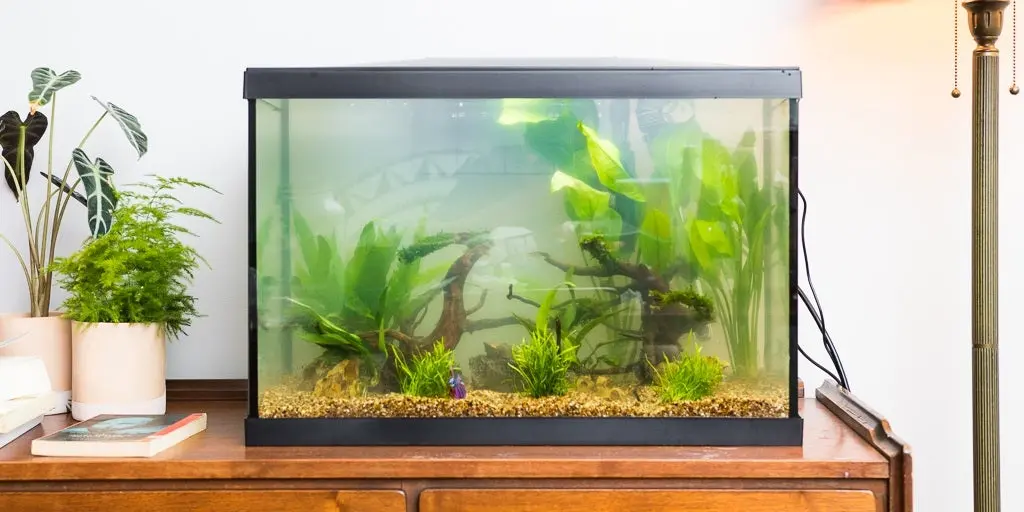
For most beginners, a reliable kit provides a convenient entry point. After evaluating 10 glass 20-gallon kits and physically testing five, our top recommendation is the Marina 20G LED Aquarium Kit.
- Why it wins: It features the most powerful, modular power filter and the brightest built-in LED lighting of any tested kit. Its slim black hood maintains an elegant profile.
- The Catch: It does not include a heater. However, because the preset heaters bundled into competing kits are generally low-quality and non-adjustable, we prefer purchasing the Marina kit and pairing it with a professional, adjustable heater.
- Runner-Up Kit: For those insistent on an all-in-one bundle including a heater, the Aqueon LED 20 Aquarium Kit is widely available and features a lifetime-warranty filter, though its lighting and filtration components are inferior to the Marina setup.
When choosing between glass and acrylic for tanks under 75 gallons, glass is unequivocally superior. Glass costs a fraction of acrylic, resists scratching, and will not yellow or fog over time.
2. Filtration: The Heart of the Ecosystem
No aquarium cleans itself. Filters must handle three types of filtration: mechanical (trapping physical debris), chemical (adsorbing toxins via activated carbon), and biological (cultivating beneficial bacteria colonies to process toxic nitrogen waste).
- Top Pick: AquaClear Power Filter. Acclaimed across the industry (and endorsed by Chi Cho of Pacific Aquarium), the AquaClear utilizes a three-stage system featuring porous foam, activated carbon, and porous ceramic rings (BioMax). The ceramic rings offer maximum surface area for nitrifying bacteria. Furthermore, its modular insert design lets you clean or replace components independently without wiping out your entire bacterial colony.
- Rule of Thumb for Sizing: Buy a filter rated slightly above your tank size (e.g., an AquaClear 30 for a 20-gallon tank) to ensure adequate water turnover without creating an overwhelming current.
3. Heaters and Temperature Control
For tropical fish, a reliable submersible heater is non-negotiable. Temperature fluctuations weaken immune systems and trigger outbreaks of ich (a lethal parasitic disease marked by white spots).
- Top Pick: Eheim Jäger Thermostatic Aquarium Heater (100-watt). This is a community staple offering a calibration precision of half a degree and a wide temperature range (65°F to 93°F). Its stiff adjustment ring prevents accidental changes during tank maintenance.
- Alternative Pick: Aqueon Pro Heater. Shatterproof with an aluminum core and backed by a lifetime warranty, though its temperature markings are less granular than the Eheim.
4. Lighting Systems
While fish are indifferent to atmospheric lighting nuances, live plants and human aesthetics require quality LEDs.
- Top Pick: Current USA Satellite Freshwater LED. Slim, energy-efficient, and equipped with a wireless remote featuring dimmable weather and moonlight presets.
- Budget Pick: Nicrew White and Blue LED Aquarium Light. Super-bright and affordable, though it lacks dimming controls.
- Upgrade Pick: Finnex Planted+ 24/7 Automated LED. The ultimate choice for high-tech planted tanks, offering unmatched PAR output and customizable RGB color spectrums.
5. Water Conditioning and Maintenance Tools
- Water Conditioner: Seachem Prime. The industry gold standard. It is highly concentrated—treating 50 gallons per teaspoon—and neutralizes chlorine, chloramine, and toxic ammonia compounds safely.
- Testing: API Freshwater Master Test Kit. Liquid drop tests are vastly superior to unreliable test strips. This kit provides up to 800 tests for pH, ammonia, nitrite, and nitrate.
- Substrate: CaribSea Instant Aquarium (Peace River) or CaribSea Eco-Complete (for planted tanks). These provide smooth, pH-neutral, nutrient-rich beds embedded with starter bacteria.
- Siphon/Vacuum: Terapump Aquarium Gravel Cleaner. Features an integrated hand-squeeze pump that initiates suction cleanly and efficiently without requiring manual siphoning by mouth.
- Algae Control: API Algae Scraper for Glass Aquariums. Features an 18-inch handle to keep your hands dry while scrubbing away green film.
Official Statements & Expert Guidance
Proper maintenance relies heavily on understanding the nitrogen cycle. In a closed system, decaying food and fish waste produce toxic ammonia. Beneficial bacteria must colonize the filter to convert ammonia into nitrites, and subsequently into harmless nitrates.
"There is very little that happens to a fish that can’t be directly or indirectly influenced by their diet, including pigmentation and health."
— Dr. Jesse Trushenski, Fish Pathologist Supervisor, Idaho Department of Fish and Game.
Experts emphasize sourcing livestock responsibly. Independent local fish stores (LFS) generally maintain healthier, better-quarantined fish stocks than large commercial pet superchains, where overcrowded tanks can harbor disease. Furthermore, never dump store-bag water directly into your display tank; always use a clean net to introduce your new fish.
Future Outlook: The Evolution of the Hobby
As manufacturing standards improve, home freshwater aquaculture continues to grow more streamlined. The widespread adoption of high-efficiency LEDs, precision digital thermostatic controls, and concentrated biological supplements has drastically lowered the barrier to entry for prospective hobbyists.
While the initial setup demands patience—particularly during the four-week tank-cycling phase—the ongoing commitment transforms into a low-cost, highly meditative routine. Once established, a quality freshwater aquarium operates as a self-sustaining biological work of art, providing years of quiet fascination and connection to the natural world right inside your living room.