
Casual Client Remarks
By Kyla Savick, DVM
Executive Overview
In veterinary medicine, the physical examination is often considered complete once all clinical findings are addressed, diagnostic test results are reviewed, and the patient is deemed stable. Yet, a subtle, highly critical dynamic frequently occurs just as the veterinarian reaches for the exam room door. A client offers an offhand, casual remark: "Fluffy had a hairball, but that’s normal," or "Mittens has lost weight, but he’s just getting older."
To the exhausted clinician rushing to a backlog of appointments, these understated comments are easily dismissed as benign background noise. However, failing to investigate these latent remarks can mean missing the initial warning signs of severe, progressive, and potentially life-limiting pathologies.
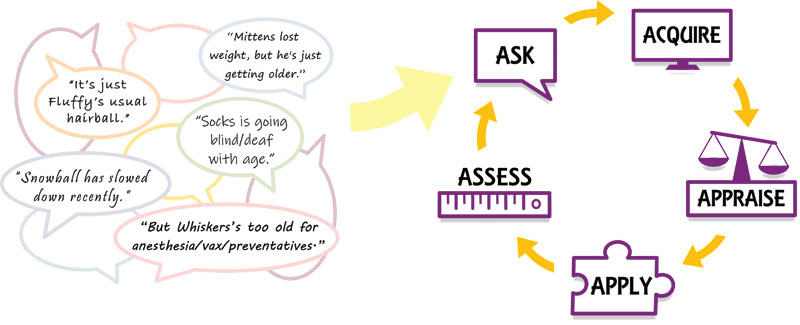
Veterinarians have long utilized the principles of Evidence-Based Veterinary Medicine (EBVM)—specifically the cycle of the Five ‘A’s (Ask, Acquire, Appraise, Apply, and Assess)—to navigate complex therapeutic and diagnostic decisions. This article explores how clinicians can pivot this exact framework outward, transforming casual client commentary into a structured investigative tool. By applying critical thinking and rigorous communication strategies to seemingly innocuous statements, veterinary professionals can bridge the gap between perceived benign aging and critical underlying health concerns, ultimately honoring their commitment to being the voice for patients who cannot speak for themselves.
Detailed Chronology: The Anatomy of a Missed Diagnosis
The modern veterinary practice environment is characterized by relentless time pressure, high caseloads, and emotional fatigue. To understand how critical health details slip through the cracks, it is essential to trace the typical timeline of a routine wellness or sick visit, and where the conversational breakdown occurs.
Phase 1: The Formal Examination and the Illusion of Completion
During the primary structured phase of the exam, the veterinarian methodically evaluates organ systems, reviews vaccination histories, and prompts the client for specific concerns. Clients typically arrive with a mental checklist of acute issues—lameness, prominent vomiting, or anorexia. If the patient does not present with overt red flags, the client often declares, "No concerns." The clinician, reassured by normal vital signs and a cooperative patient, concludes the active diagnostic phase.
Phase 2: The Threshold Phenomenon
The clinical risk materializes precisely as the appointment concludes. As the veterinarian pivots toward the exit, the psychological pressure of the formal exam lifts. In this relaxed transitional space, the client’s guard drops. They offer an unscripted, casual observation—a defense mechanism or a normalization of chronic symptoms.
Phase 3: The Fork in the Professional Road
At this juncture, the veterinarian faces a professional and ethical crossroads. The clinician can register the comment as conversational filler and proceed to the next appointment, or they can pull the door closed, step back into the room, and initiate an investigative sequence. Choosing the latter requires translating the client’s colloquialisms into actionable clinical inquiries using a systematic framework.
The Five ‘A’s in Action: Translating EBVM to Client Communications
Originally designed to resolve clinical questions using peer-reviewed literature, the EBVM cycle of the Five ‘A’s maps seamlessly onto the unscripted clinical narratives provided by pet owners.
[ASK] ──> [ACQUIRE] ──> [APPRAISE] ──> [APPLY] ──> [ASSESS]
  │           │              │             │            │
  ▼           ▼              ▼             ▼            ▼
Define    Gather internal  Evaluate data  Contextualize  Verify long-
questions  records & logs  trustworthiness  care plans   term results
1. Ask: Transforming Vague Statements into Answerable Inquiries
When a client says, "It’s just Fluffy’s usual hairball," the statement must be treated as a clinical hypothesis requiring interrogation. In literature searches, clinicians rely on tools like PICO (Patient, Intervention, Comparison, Outcome) to build structured queries. In client communication, clinicians must build a parallel investigative sequence starting with open-ended questions and narrowing down through targeted differential diagnoses.
- Differentiating Phenomenology: Clients frequently mislabel physiological events. Expelled stomach contents described as "hairballs" may actually be regurgitation, expectoration, lower gastrointestinal elimination, or metabolic fluid discharge. Clinicians must press for precise descriptions: Was there hair present? Was it digested or cylindrical? Was the action preceded by abdominal contractions (vomiting) or passive ejection (regurgitation)?
- Quantifying Parameters: Vague timelines ("recently," "sometimes") must be replaced with precise metrics. Establishing frequency, duration, and environmental correlations (e.g., introduction of new household plants, changes in dietary formulations) prevents premature closure and diagnostic missteps.
2. Acquire: Gathering Data Beyond the Immediate Memory
When a client remarks, "Mittens lost weight, but he’s just getting older," the clinician cannot rely solely on the immediate physical exam or subjective recall. Acquiring information requires mining historical data across multiple channels:
- Internal Auditing: Consult with veterinary technicians and support staff to verify that precise scales and standardized weighing protocols were utilized during intake.
- Longitudinal Chart Review: Navigate electronic medical record (EMR) graphs to map weight trajectories against seasonal fluctuations, concurrent pharmacotherapy, and previous diagnostic entries.
- Differential Phenotyping: Differentiate true cachexia (generalized muscle and fat loss secondary to systemic disease) from primary sarcopenia (age-related muscle wasting) or localized disuse atrophy by reviewing historical Body Condition Scores (BCS) and Muscle Condition Scores (MCS).
- External Acquisition: Request historical records from previous primary care facilities or reference laboratories to resolve ambiguous or borderline diagnostic flags.
3. Appraise: Assessing the Validity of Subjective Information
When a client observes, "Snowball has slowed down recently," the clinician must critically appraise the validity and inherent bias of the data. Just as a published research paper must be evaluated for methodological flaws or funding bias, client-provided history is heavily susceptible to subjective distortion.
- The "Telephone" Effect: Often, the person presenting the animal is a secondary caretaker, relative, or pet-sitter, introducing second-hand paraphrasing errors.
- Semantic Ambiguity: Words like "recently" or "slowing down" carry vastly different meanings depending on the client’s baseline perspective. "Slowing down" may mask occult lameness, progressive osteoarthritis, chronic pain, early-stage cognitive dysfunction, or cardiorespiratory compromise.
- Cognitive and Placebo Biases: Clinicians must evaluate timelines for plausibility, ruling out owner-driven placebo effects, misattributed post-vaccination fatigue, or confirmation bias.
4. Apply: Contextualizing Care and Overcoming Ageism in Medicine
A frequent barrier encountered during the application phase is the fatalistic assumption: "Whiskers is too old for anesthesia, vaccines, or preventatives."
Applying evidence-based insights requires contextualized care—balancing the objective physiological data of the patient against the personal values, financial realities, and emotional thresholds of the owner. Age is not a disease entity in itself. Clinicians must dismantle the misconception that advanced age contraindicates diagnostics or intervention. By communicating risk accurately and structuring tiered diagnostic plans, practitioners empower clients to make educated, compassionate decisions that maximize quality of life rather than prematurely writing off geriatric patients.
5. Assess: Closing the Loop on Client-Driven Concerns
Interventions prompted by casual client remarks cannot be left unmonitored. When a client notes, "Socks is going blind and deaf with age," and subsequent investigation reveals feline cognitive dysfunction syndrome (CDS) rather than sensory organ failure, the implementation of dietary, environmental, and pharmacological interventions must be systematically evaluated.
- Formal Assessment Tools: Implement objective scoring matrices, such as the VISHDAAL mnemonic (Vocalization, Interaction changes, Sleep-wake cycle disturbances, House-soiling, Disorientation, Activity changes, Anxiety, Learning/memory deficits) or validated questionnaires like SeniCat.
- Informal Follow-Up: Execute structured follow-up check-ins via text message or telephone at predetermined intervals to gauge therapeutic efficacy and pivot treatment strategies if the patient’s condition evolves.
Supporting Context & Metrics: The Geriatric Feline Patient
The necessity of investigating casual remarks is underscored by shifting demographics within small animal veterinary practice. Pets are living significantly longer due to advances in nutrition, preventative medicine, and therapeutic modalities.
- Senior Population Growth: According to demographic data from companion animal veterinary associations, geriatric cats (defined as individuals aged 11 to 14 years) and super-senior cats (15 years and older) constitute a rapidly expanding segment of active clinic patients.
- Under-Reporting of Chronic Pain: Feline species, as evolutionary prey animals, instinctively mask signs of chronic pain, systemic illness, and discomfort. Consequently, low-grade weight loss, subtle behavioral alterations, and decreased jumping capacity are frequently normalized by owners as mere "signs of aging."
- Multimorbidity in Geriatric Patients: Case studies frequently reveal complex multimorbidity in geriatric patients. For instance, advanced feline patients may simultaneously manage chronic kidney disease, early-stage restrictive cardiomyopathy, osteoarthritis, and occult neoplasia. Detecting these concurrent disease processes relies heavily on decoding understated client observations rather than waiting for dramatic, acute crises to manifest.
Expert Perspectives
Veterinary epidemiologists and internal medicine specialists emphasize that communication breakdown remains one of the primary drivers of diagnostic delay in companion animal practice.
"The casual remarks made by clients as they walk out the exam room door are rarely random. They represent psychological safety valves where the client feels comfortable enough to voice a nagging worry without the formal pressure of the exam. Treating these comments with the same methodological rigor as a textbook clinical sign fundamentally alters the diagnostic trajectory of geriatric patients."
— Evidence-Based Veterinary Medicine Association (EBVMA) clinical advisory consensus.
Practitioners who cultivate active listening skills and deploy structured inquiry frameworks report higher client retention, greater diagnostic accuracy, and improved patient welfare outcomes, particularly in chronic disease management and palliative care planning.
Future Outlook: Integrating EBVM Communication into Curriculum and Practice
As veterinary medicine continues to evolve toward structured, transparent, and collaborative care models, the integration of EBVM principles into routine client communication must move from an intuitive art form to an explicit clinical standard.
- Educational Integration: Veterinary training programs are increasingly incorporating communication modules that train students to treat subjective client narratives with structured epidemiological inquiry, moving beyond simple history-taking into active hypothesis testing.
- Standardized Intake Tools: Future electronic medical record (EMR) systems will likely feature integrated screening prompts designed to capture and categorize qualitative client observations, flagging high-risk statements for longitudinal tracking.
- The Spectrum of Care Evolution: By refusing to dismiss minor complaints as normal aging, the profession validates the human-animal bond and ensures that every patient—regardless of age—receives a customized, high-standard diagnostic workup tailored to their specific life stage.
Ultimately, the mastery of veterinary medicine lies not only in interpreting complex laboratory panels and high-resolution imaging, but in possessing the patience to pause at the threshold, turn back into the room, and listen closely to what the client didn’t quite know how to say.