
EXECUTIVE OVERVIEW
Deep within the hyper-arid coastal desert of northern Peru, a team of international archaeologists has unearthed unprecedented physical evidence of hairless dogs dating back more than 1,200 years. Recovered from Castillo de Huarmey—the sole confirmed administrative and burial complex of the pre-Inca Wari Empire—these extraordinary finds include naturally preserved mummies, skeletal anomalies, and chemical signatures that reveal complex, multifaceted relationships between ancient humans and their canines.
Long before the rise of the Inca Empire, the Wari civilization shared its urban spaces, diets, and ritual landscapes with the iconic Peruvian hairless dog, a distinct Indigenous breed celebrated today as a national cultural heritage symbol. Published in the Journal of Anthropological Archaeology, this breakthrough study not only confirms the deep historical roots of the breed through unique genetic markers—such as missing premolars tied directly to hairlessness—but also challenges long-held assumptions regarding how ancient societies viewed and treated domestic animals.
By combining traditional zooarchaeological methods with cutting-edge isotopic analysis, the research team has opened a fascinating window into daily life, elite burial customs, and early animal husbandry practices in the pre-Hispanic Andes, illustrating that human-animal relationships over a millennium ago were just as nuanced and contradictory as they are in the modern era.
DETAILED CHRONOLOGY: UNLOCKING THE SECRETS OF CASTILLO DE HUARMEY
The journey to uncovering these ancient canines spans decades of meticulous excavation, natural disasters, and scientific detective work at one of Peru’s most vital archaeological monuments.
The Wari Empire and Castillo de Huarmey
Located approximately 190 miles north of Lima, Castillo de Huarmey sprawls across 110 acres of punishing desert terrain. Between 600 and 1050 CE, the site functioned as a major provincial administrative and ceremonial center for the Wari Empire, an expansive civilization that dominated the central Andean highlands and coast roughly four centuries before the Incas established their hegemony.
Despite the region’s extreme aridity—which naturally preserves organic materials like hair, textiles, and leather—Castillo de Huarmey has suffered significant historical disruption. In 1970, a massive earthquake rattled the region, causing sections of the ancient complex to collapse and exposing subterranean burial chambers. This catastrophic structural failure triggered extensive looting, leaving upper archaeological layers heavily disturbed and mixed. However, deeper, undisturbed strata remained pristine, preserving critical historical contexts that continue to astonish modern researchers.
Key Milestones in the Excavation Timeline
- 2012: Archaeologists announced the monumental discovery of the first undisturbed elite Wari tomb at the site. The chamber held the remains of 58 high-status noblewomen, six human sacrificial victims, and approximately 1,300 exquisite artifacts crafted from gold, silver, bronze, wood, and textiles.
- 2022: Excavations revealed adjacent elite workshops and burials belonging to master craftspeople. These graves were accompanied by specialized tools made of precious metals, shedding light on the Wari imperial economy and elite-sponsored manufacturing.
- 2010–2025: Ongoing systematic excavations in the northern section of the main ceremonial area yielded a massive cache of faunal remains, including South American camelids (llamas and alpacas) and an unexpected abundance of canid specimens. Among these, researchers identified 341 individual dog bone fragments representing at least 19 animals, culminating in the recovery of remarkably preserved mummies.
SUPPORTING CONTEXT & METRICS: GENETICS, DIET, AND BURIAL CONTEXTS
The identification of these remains as Peruvian hairless dogs hinged on a fascinating biological coincidence linking skin morphology to dental development.
The Genetic Signature: Missing Teeth and Hairlessness
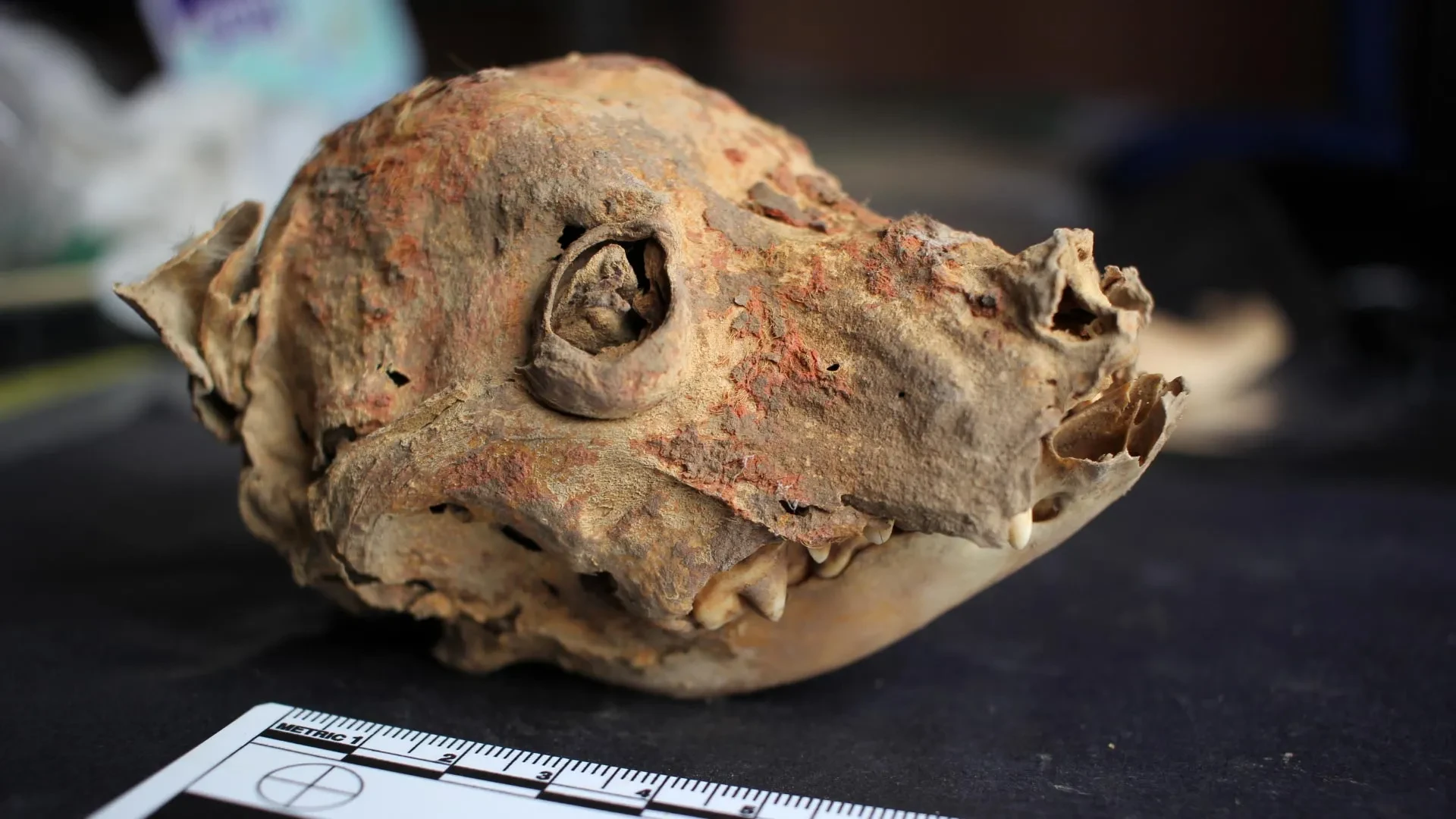
During laboratory processing, lead researchers noted a puzzling anomaly: several of the dog skulls were missing specific teeth—not due to trauma, periodontal disease, or old age, but because the teeth had never erupted. Crucially, the missing elements were consistently the first premolars and occasionally the final molars.
Literature reviews confirmed a direct genetic link: the precise gene responsible for congenital hairlessness in dogs also suppresses dental development, leading to oligodontia (a reduced number of teeth). This biological fingerprint provided definitive proof that the remains belonged to the ancestral lineage of the Peruvian hairless dog.
Isotopic Analysis: Reconstructing Ancient Diets and Mobility
To determine how these animals lived, the research team subjected the bone and tooth specimens to rigorous isotopic analysis. By examining carbon, nitrogen, oxygen, and strontium isotopes preserved in the tissues, scientists reconstructed distinct chapters of the dogs’ lives:
- Teeth Isotopes: Because canine teeth erupt rapidly during early life, isotopic signatures captured in the enamel provided a snapshot of the animals’ puppyhood diets and geographic origins.
- Bone Isotopes: Bone collagen reflected the nutritional intake of the animals’ final year of life.
- Comparative Metrics: Isotopic baselines were cross-referenced against human and camelid remains from Castillo de Huarmey.
The chemical data revealed that the dogs consumed a diet heavily rich in maize (corn), mirroring the primary staple of the human population. Interestingly, hairless puppies displayed dietary signatures closely mirroring those of human children, suggesting that young hairless dogs may have received targeted nutrition or lived in closer proximity to human living quarters than standard working dogs.
Stratified Treatment in Death
The archaeological context of the canine burials varied dramatically, reflecting diverse social roles within Wari society:
- Elite Associations: A puppy aged just 6 to 8 weeks was interred directly alongside an elite craftsperson known as the "Master Basketmaker." Another puppy skeleton was discovered buried with an adult male sacrificial victim (designated XY) who likely served as a tomb guardian.
- Palatial Settings: An adult dog was recovered directly within the confines of the site’s elite residential palace.
- Ritual Mummification: A naturally mummified male dog, preserved with skin and furless patches, was radiocarbon-dated to at least 1,200 years old, making it the oldest radiocarbon-dated specimen recovered from the complex to date.
- General Disposal: While selective burials indicated high status or ritual significance, other canine remains were discovered commingled with general domestic refuse. Notably, very few bones displayed butchery marks, proving that unlike other regions where dogs were consumed as livestock, canines at Castillo de Huarmey were rarely, if ever, used for food.
OFFICIAL STATEMENTS: INSIGHTS FROM THE RESEARCH TEAM
The complexity of interpreting ancient human-animal dynamics is a central theme emphasized by the study’s authors, who caution against applying modern sentimentalities directly to the archaeological record while acknowledging deep emotional parallels.
"Our findings indicate that humans and dogs coexisted at this Wari site, but reconstructing their bond is challenging, as past emotions are difficult to capture through archaeological methods," explains Weronika Tomczyk, lead author of the study, research associate in Dartmouth’s Department of Anthropology, and a postdoctoral fellow in its Ecology, Evolution, Environment and Society Program.
Tomczyk highlights the dichotomous nature of human attitudes toward domestic animals across time:
"The goal of our study was to not only present data on Castillo de Huarmey’s dog burials, but also emphasize that people in the past had often contradictory relationships with the animals, just as they do today: a pet for one group of people could at the same time be considered a pest by their closest neighbors."
Commenting on the dental indicators that unlocked the identity of the mummies, Tomczyk notes:
"What I noticed is that some of the dog skeletons were missing teeth, and not that they lost them during their lifespan; some teeth, especially first premolars and sometimes last molars, had just never erupted. And then I found in the literature that the same gene which is responsible for hairlessness in dogs is responsible for a reduced number of teeth, indicating that these were Peruvian hairless dogs."
Regarding the dietary habits of the mummified puppies, Tomczyk adds:
"We do not know if the dogs were intentionally fed maize or if perhaps they were just eating leftovers or trash. Yet, the distinct dietary patterns of hairless puppies provide insights into what may have been organized breeding."
Summarizing the social standing of these ancient canines, Tomczyk concludes:
"While we will never know if any of the three dogs were pets or how people treated them, it is evident they received different treatment than other dogs."
The collaborative research initiative features an interdisciplinary team of co-authors, including Miłosz Giersz, Wiesław Więckowski, and Roberto Pimentel Nita from the University of Warsaw, alongside Claire Ebert of the University of Pittsburgh.
FUTURE OUTLOOK: THE NEXT FRONTIER IN ANDEAN ARAEOLOGY
The groundbreaking identification of Peruvian hairless dogs at Castillo de Huarmey marks a major milestone in Andean zooarchaeology, but it also opens up exciting new avenues for future scientific inquiry.
As analytical techniques in ancient DNA (aDNA) and proteomics continue to evolve, researchers anticipate extracting genetic material directly from the mummified tissues. Successful DNA extraction could trace the precise lineage of the Wari hairless dog population, mapping their evolutionary divergence and migration patterns across pre-Hispanic South America.
Furthermore, expanded isotopic testing across broader regional sites of the Wari Empire will help determine whether these prized hairless dogs were bred locally at Castillo de Huarmey or traded across long distances from highland administrative centers to coastal enclaves. By continuing to examine the intersection of human burials, elite manufacturing, and domestic animal management, archaeologists will gain a clearer, more holistic picture of how complex societies governed, ritualized, and coexisted with the natural world more than a millennium ago.