
Executive Overview
In the realm of canine companionship, few names evoke as much immediate fascination, widespread misunderstanding, and passionate debate as the American Bulldog and the American Pit Bull Terrier. Frequently conflated by the general public due to their imposing physical stature, muscular contours, and shared historical ties to blood sports, these two distinct breeds are vastly different entities. They possess unique genetic lineages, behavioral profiles, care requirements, and structural characteristics that demand a thorough, nuanced understanding.
This comprehensive comparative analysis seeks to cut through the noise of cultural stigma and superficial resemblance. By evaluating historical provenance, biometric metrics, behavioral tendencies, and expert-backed husbandry requirements, we provide an authoritative resource for prospective owners, canine behaviorists, and animal welfare advocates. Ultimately, while both breeds were engineered for physical prowess and labor, their modern realities as family companions depend entirely on responsible ownership, rigorous early socialization, and an appreciation of their respective evolutionary paths.
Detailed Chronology: The Evolutionary History of Two Distinct Icons
To truly understand the modern American Bulldog and the American Pit Bull Terrier, one must trace their lineage back centuries to the blood sports and working farms of Great Britain, and subsequently, to the pioneering efforts of preservationists in North America.
The Old English Root and the Era of Blood Sports
Both breeds share a foundational ancestor in the Old English Bulldog—a stocky, fiercely tenacious animal historically utilized in the brutal blood sports of bull-baiting and bear-baiting. During an era when public entertainment frequently intersected with animal cruelty, these dogs were specifically bred for jaw strength, absolute fearlessness, and a high pain tolerance. When the British Parliament passed the Cruelty to Animals Act of 1835, outlawing these blood sports, the utility of the original Bulldog plummeted, pushing the archetype toward the brink of extinction.
The Divergent Paths: Bulldog Preservation vs. Terrier Crossbreeding
As the traditional Bulldog declined, dogmen and breeders diverged down two distinct paths to preserve and adapt the canine stock:
- The American Bulldog’s Migration and Salvage: Immigrants traveling to the American South brought working Bulldogs with them. These dogs served a vital agricultural purpose, operating as all-around farm guardians, stock dogs, and catch dogs used to hunt feral pigs and cattle. By the mid-20th century, however, industrialization and agricultural shifts nearly wiped out these working farm bulldogs. The breed’s modern existence is largely credited to the tireless revitalization efforts of Dr. John D. Johnson and Alan Scott, who traveled the rural South seeking out surviving specimens to rebuild the gene pool, giving rise to the distinct "Johnson" (bully) and "Scott" (standard) types.
- The Genesis of the American Pit Bull Terrier: In an effort to create a faster, more agile competitor for the underground fighting pits of England, Ireland, and America, breeders crossed the remaining Old English Bulldogs with various nimble terrier breeds (such as the Old English Terrier). This deliberate fusion injected speed, high prey drive, and tenacity into a smaller frame. When these dogs were brought to the United States, they were further refined into the American Pit Bull Terrier—a breed celebrated by farmers and sportsmen for its versatility, unyielding loyalty, and unmatched athletic capability.
Supporting Context & Metrics: Anatomy, Biometrics, and Breed Standards
Visual confusion between the American Bulldog and the Pit Bull is understandable at a glance, yet a rigorous biometric examination reveals stark differences in scale, structural geometry, and physical capacities.

| Metric / Trait | American Bulldog | American Pit Bull Terrier |
|---|---|---|
| Height Range | 20–27 inches (51–69 cm) | 17–21 inches (43–53 cm) |
| Weight Range | 75–125 lbs (34–57 kg) | 35–65 lbs (14–29 kg) |
| Skeletal Build | Heavy-boned, stocky, and powerfully rectangular | Streamlined, muscular, and athletic |
| Coat Characteristics | Short, single or double coat; smooth texture | Short, stiff, glossy, and single-layered |
| Color Variations | Solid white, or patterned with brindle, red, or brown patches | Highly variable: blue, fawn, red, black, brindle, and white |
| Average Life Span | 10–12 years | 12–15 years |
Structural and Physiological Contrasts
The American Bulldog: Power Incarnate
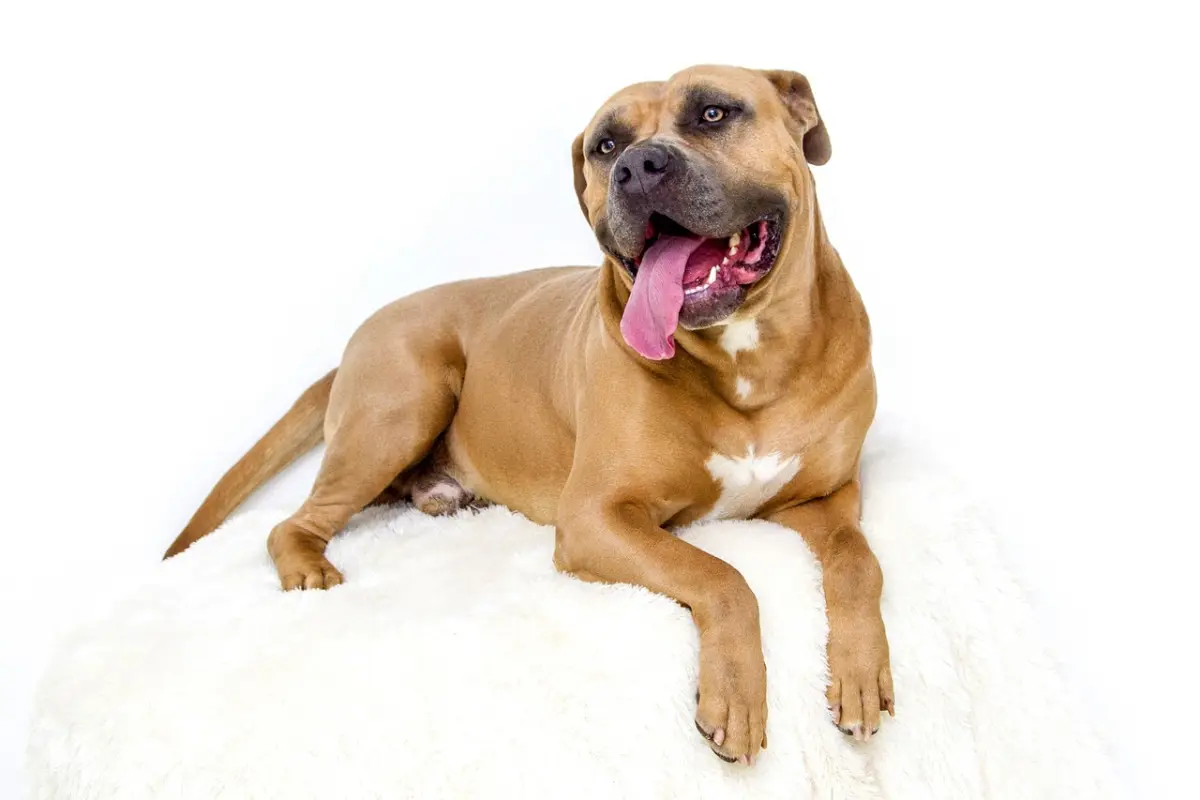
The American Bulldog is a heavy-duty working dog designed for sheer physical dominance. Exhibiting a robust, broad skull and exceptionally powerful jaws, males typically stand between 22 and 27 inches, while females range from 20 to 24 inches. Their deep, expansive chests symbolize an immense lung capacity meant for endurance work on farms. Because of their shorter muzzles (brachycephalic tendencies in some lines), American Bulldogs are notably susceptible to heat exhaustion, requiring careful temperature management during exercise.
The American Pit Bull Terrier: Built for Agility
In contrast, the Pit Bull is a monument to functional athleticism. While possessing a broad skull and formidable jaw strength relative to its size, the Pit Bull is noticeably lighter, standing 17 to 21 inches tall and generally weighing between 35 and 65 pounds. This lower center of gravity and streamlined bone structure grant the Pit Bull superior acceleration, agility, and vertical leaping ability compared to its heavier Bulldog cousin. Their tight, glossy coats require minimal maintenance, but their high-octane motor demands constant physical engagement.
Official Statements: Temperament, Behavior, and Husbandry Realities
Public perception of both breeds is frequently skewed by media sensationalism, breed-specific legislation (BSL), and cultural stereotypes. To establish an authoritative baseline, canine behaviorists and breed registries emphasize the interplay between genetics, environmental conditioning, and responsible stewardship.
The American Bulldog: Protective Sentinels
American Bulldogs are defined by an unshakeable loyalty and an instinctive desire to guard their human pack. They are confident, deeply affectionate with family members, and possess an inherent protective streak.
- The Socialization Imperative: Because they were historically bred to handle large livestock and protect property, American Bulldogs can harbor a dominant or aloof demeanor toward strangers and unfamiliar animals if not properly socialized.
- Training Dynamics: They are intelligent but can exhibit a stubborn streak. First-time owners may find their sheer physical strength challenging to manage without consistent, positive reinforcement training established during early puppyhood.
The American Pit Bull Terrier: Affectionate Athletes
Often subjected to unfair stigmas regarding human aggression, the American Pit Bull Terrier is paradoxically recognized by major kennel organizations as an intensely people-oriented, eager-to-please companion.
- The Animal Aggression Factor: Experts note a critical genetic distinction: while well-socialized Pit Bulls are notoriously gentle and affectionate with people (often earning the historical moniker "nanny dogs" due to their tolerance of children), their historical breeding for fighting means they can harbor a higher propensity for animal-directed aggression. Unmanaged, this can manifest as reactivity toward other dogs or small pets.
- The Energy Equation: Pit Bulls do not merely enjoy exercise; they require it to maintain psychological equilibrium. Left without an outlet for their boundless energy, they are prone to destructive behaviors, barrier frustration, and intense anxiety.
Debunking Canine Myths
Two persistent myths continue to plague these breeds:

- The "Locking Jaw" Fallacy: Scientific studies and veterinary anatomical examinations have repeatedly proven that neither Pit Bulls nor Bulldogs possess a specialized jaw-locking mechanism. The perception arises from their tenacity, gameness, and high drive to maintain a grip once an objective is secured.
- Inherent Human Aggression: Neither breed is born inherently vicious toward humans. Aggression is overwhelmingly a byproduct of poor breeding practices, isolation, abuse, or the intentional cultivation of aggressive traits by negligent owners.
Future Outlook: Responsible Ownership in a Changing Landscape
As municipal legislation, landlord policies, and insurance regulations continue to evolve regarding bully breeds, the future of both the American Bulldog and the American Pit Bull Terrier hinges upon a collective commitment to education and responsible ownership.
The Burden of Care
Owning a dog scaling upwards of 100 pounds, such as an American Bulldog, or managing an ultra-athletic dynamo like a Pit Bull, is not a passive endeavor. Prospective owners must weigh several practical factors:
- Financial and Spatial Investment: Larger dogs incur significantly higher costs for nutrition, veterinary care, parasite prevention, and specialized equipment. Furthermore, secure, high-fenced yards are practically mandatory for keeping these high-drive athletes safely contained.
- Lifelong Commitment to Training: Obedience training is not an optional accessory for these breeds; it is a fundamental safety requirement. Early socialization, leash-handling mastery, and impulse-control exercises ensure these powerful animals can navigate public spaces safely and harmoniously.
Conclusion: Choosing the Right Companion
While the American Bulldog and the American Pit Bull Terrier share an ancient lineage rooted in the Old English Bulldog, they have diverged into two unique animals. The American Bulldog stands as a heavy, formidable guardian ideal for rural or spacious suburban environments with experienced handlers. The American Pit Bull Terrier represents an agile, fiercely loyal, and high-energy companion that thrives in active, outdoor-oriented households.
Ultimately, neither breed is an inherently "dangerous" monster nor an effortless lapdog. They are powerful, sensitive, and profoundly loyal animals whose place in our homes and communities reflects our own dedication to understanding, training, and respecting their extraordinary capabilities.