
Executive Overview
The global community stands at an ecological and atmospheric crossroads. According to the United Nations Environment Programme’s (UNEP) stark and definitive Limiting Overshoot report, the Earth is hurtling toward a critical climate threshold: average global temperatures are projected to exceed the pre-industrial baseline by 1.5°C within the next few years. Despite existing national climate commitments and emerging net-zero frameworks, global greenhouse gas emission reductions have failed to match the velocity required to prevent this temporary breach.
For decades, scientists have flagged the 1.5°C mark as a vital guardrail. Crossing it—even temporarily—will unleash cascading crises, including accelerated sea-level rise, intensified and prolonged droughts, catastrophic wildfires, and the crossing of irreversible climate tipping points such as the large-scale destabilization of polar ice sheets. Yet, the UNEP report clarifies that throwing up our hands is not an option. The world’s best remaining pathway is an "overshoot, peak, and decline" trajectory. This strategy demands that global society limits the peak temperature rise to the lowest possible ceiling, minimizes the duration of the overshoot, and aggressively pulls temperatures back down below the 1.5°C threshold through sweeping technological and nature-based interventions.
The implications of this trajectory extend far beyond abstract atmospheric metrics. Birds—widely recognized by ecologists as the sensitive sentinels of environmental change—are already signaling the profound dangers of unmitigated warming. Landmark research from the National Audubon Society, including the Survival by Degrees report, demonstrates a direct, quantifiable correlation between rising temperatures and avian vulnerability. At 1.5°C of warming, nearly half of North American bird species face severe habitat degradation and range loss. At 3°C, that figure skyrockets, threatening the very fabric of our ecosystems.
Fortunately, the crisis offers a roadmap to its own solution. Safeguarding birds and their habitats inherently shields human communities from parallel climate-driven catastrophes, from coastal erosion to devastating floods. Achieving a safer climate requires a dual-pronged approach: transitioning to clean energy through responsibly sited infrastructure, and aggressively deploying natural climate solutions—such as forest and grassland restoration—that simultaneously sequester carbon and preserve biodiversity. Every fraction of a degree avoided, and every acre of habitat conserved, directly translates into preserved lives, resilient landscapes, and a viable planetary future.
Detailed Chronology: The Pathway to and Beyond 1.5°C
To understand how global climate policy arrived at the concept of "overshoot," it is necessary to examine the timeline of scientific consensus and political commitments that have shaped the past three decades of international climate action.
The Scientific Awakening and the Paris Agreement (1990s–2015)
For years, international climate negotiations focused broadly on preventing "dangerous anthropogenic interference with the climate system," as outlined in the 1992 United Nations Framework Convention on Climate Change (UNFCCC). However, specific numerical targets remained elusive until the landmark 2015 Paris Agreement. During these negotiations, island nations and vulnerable developing countries successfully pushed for a more stringent aspirational target of limiting warming to 1.5°C above pre-industrial levels, pointing out that a 2°C world would spell existential doom for their populations.
In 2018, the Intergovernmental Panel on Climate Change (IPCC) published its Special Report on Global Warming of 1.5°C. This watershed document provided the scientific community’s starkest warning yet: the impacts of 2°C of warming—ranging from the near-total loss of tropical coral reefs to extreme weather frequency—were exponentially more severe than those at 1.5°C. The report outlined that keeping warming within the 1.5°C limit required global net carbon dioxide emissions to decline by about 45 percent from 2010 levels by 2030, reaching net zero around 2050.
The Implementation Gap and the Rise of "Overshoot" (2016–2023)
In the years following the Paris Agreement, national emissions trajectories consistently outpaced reduction rates. Despite the formal adoption of net-zero targets by dozens of industrialized nations, fossil fuel consumption, industrial expansion, and deforestation maintained high atmospheric greenhouse gas concentrations.
By the early 2020s, climate modelers and policy analysts arrived at an unavoidable mathematical reality: even if every current national climate plan (Nationally Determined Contributions) were implemented in full, alongside all pledged long-term net-zero targets, global emissions would not drop fast enough to prevent a temporary breach of the 1.5°C threshold. The world was officially locked into a climate trajectory characterized by "overshoot"—a period where emissions surpass the capacity of natural and technological carbon sinks, pushing global temperatures past the critical guardrail before corrective actions can pull them back down.
The UNEP Limiting Overshoot Paradigm (Present and Beyond)
Released amid escalating climate volatility, the UNEP’s Limiting Overshoot report confronts this new reality head-on. Rather than treating overshoot as an inevitable climate apocalypse or an excuse for inaction, the report establishes it as the defining framework for the next half-century of climate policy.
The core message of the chronology moving forward is clear: every single year spent in overshoot compounds the risk of irreversible Earth-system tipping points. The timeline for humanity is no longer just about preventing the threshold from being crossed—since a temporary breach is now practically guaranteed—but about minimizing the depth and duration of that overshoot. Success will be measured by how quickly society can pivot from achieving net-zero emissions to realizing net-negative emissions, actively scrubbing historic carbon pollution from the atmosphere to force global temperatures back down to safe levels.
Supporting Context & Metrics: Avian Sentinels and Ecosystem Vulnerability
Why should humanity care about fractions of a degree? The answer lies in the physiological and ecological stress experienced by the natural world, perfectly encapsulated by the plight of North America’s bird populations. Birds serve as dynamic, highly visible barometers of ecological health. Their high mobility, rapid metabolic rates, and expansive geographic ranges make them exceptionally sensitive to minute shifts in climate, temperature, and habitat availability.
The Quantifiable Risk of Degrees: Survival by Degrees Metrics
Audubon’s comprehensive Survival by Degrees report models the future distributions of 604 North American bird species under various warming scenarios. The data reveals a terrifyingly steep curve of vulnerability:
- At 1.5°C of Global Warming: 47 percent of North American bird species face high vulnerability to range loss and potential extinction. While significant, this scenario allows ecosystems to retain a baseline of resilience.
- At 3.0°C of Global Warming: Vulnerability surges to 63 percent of all evaluated species. Entire ecosystems face systemic collapse as climate zones shift faster than species can adapt or migrate.
- The Delta of Prevention: Holding peak warming closer to 1.5°C instead of allowing it to run unchecked toward 3.0°C lowers the risk for an astonishing 76 percent of vulnerable species. Specifically, 146 bird species are pulled back from the brink of high vulnerability, securing their long-term survival.
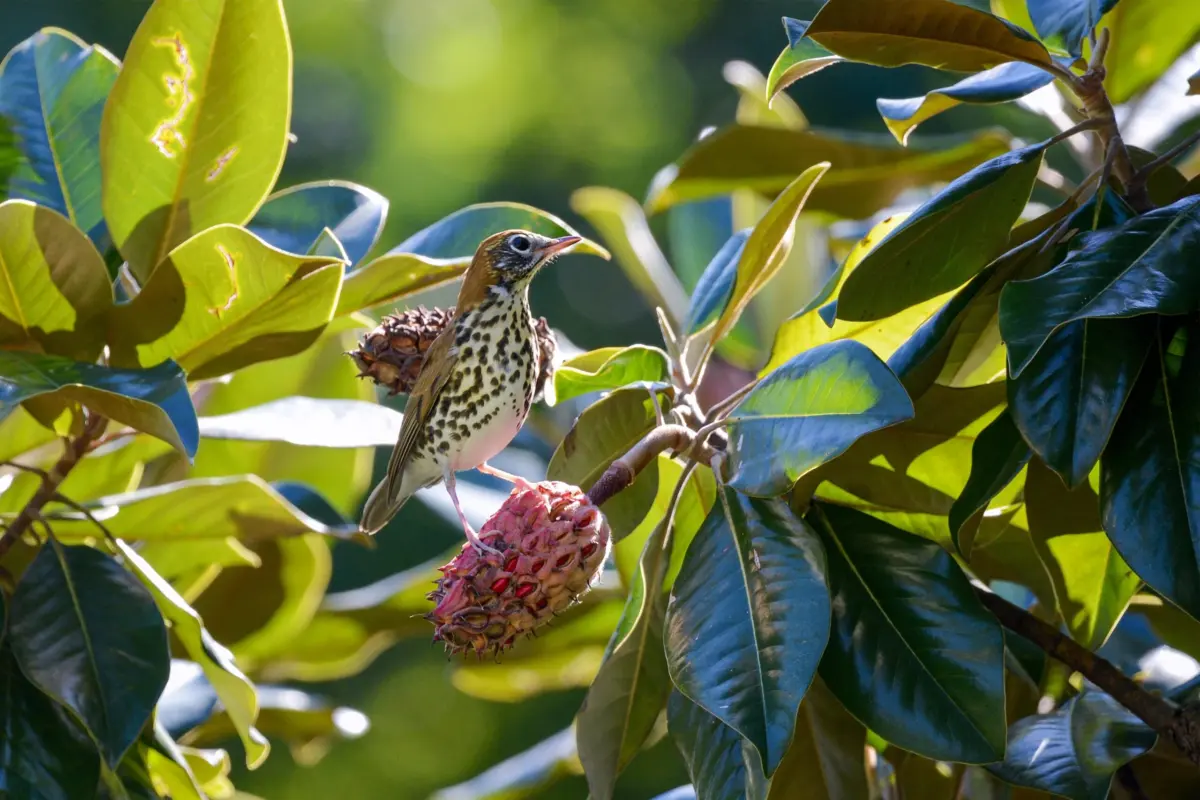
Case Study: The Wood Thrush (Hylocichla mustelina)
Consider the Wood Thrush, a beloved migratory songbird renowned for its flute-like, ethereal song echoing through the eastern deciduous forests of North America.
- Under a 3°C Scenario: The Wood Thrush is classified as highly vulnerable, projected to lose a staggering 57 percent of its traditional breeding range as forests dry out, insect populations crash due to heat stress, and extreme weather destroys nests.
- Under a 1.5°C Scenario: The species’ vulnerability drops dramatically to low levels. Its breeding range remains largely intact, ensuring that future generations will continue to hear its iconic song in our spring forests.
Compound Threats Across Landscapes
Rising temperatures do not operate in a vacuum; they act as force multipliers for ecological destruction. At a 3°C warming scenario across the lower 48 United States:
- Breeding Season Crises: Nearly every bird species would experience extreme spring heatwaves during their critical breeding seasons.
- Cumulative Hazards: More than 95 percent of bird species would face two or more compounding climate-related threats simultaneously—such as concurrent heat stress, extreme fire weather, catastrophic floods, prolonged droughts, and sea-level rise.
- The 1.5°C Buffer: In stark contrast, if warming is capped and returned to the 1.5°C threshold, most species and human communities across the United States would face only one primary climate-related threat at a time, providing a manageable window for ecological adaptation and human intervention.
Crucially, what protects birds inherently protects human societies. The preservation of coastal wetlands, resilient forests, and expansive grasslands directly mitigates the very hazards that threaten human infrastructure: coastal erosion, extreme wildfire ignition, agricultural drought, urban flooding, and deadly urban heatwaves.
Official Statements and Strategic Insights
The release of the UNEP Limiting Overshoot report has galvanized environmental scientists, policy experts, and conservation leaders worldwide. The consensus emerging from leading international bodies and conservation organizations underscores that addressing overshoot requires a synchronized, multi-sectoral mobilization.
The Mechanics of Net-Zero vs. Net-Negative
Environmental economists and climate scientists contributing to the UNEP framework emphasize a fundamental physical distinction that policymakers must internalize:
- Net-Zero Emissions: Halts the accumulation of additional greenhouse gases, stabilizing global temperatures at whatever peak they have reached. It stops the bleeding, but it does not heal the wound.
- Net-Negative Emissions: A technologically and ecologically demanding phase where global society actively removes more carbon dioxide from the atmosphere than it emits. This is the absolute prerequisite for bringing global average temperatures back down below the 1.5°C ceiling after an overshoot period.
Achieving this requires an unprecedented scale-up of renewable energy infrastructure, which in turn depends on a modernized, expanded electrical grid. However, this green transition presents its own nuanced conservation challenges. According to Audubon’s Birds and Transmission report, approximately one-third of existing and planned electrical transmission lines overlap directly with ecologically sensitive areas critical to bird migration and nesting.
Conservation leaders stress that the green energy transition must not come at the expense of biodiversity. Forward-thinking energy developers are actively collaborating with conservation scientists on careful routing, underground cabling, and bird-friendly infrastructure design (such as visibility markers on power lines to prevent deadly collisions) to ensure that clean energy deployment heals the climate without harming local wildlife.
Nature-Based Solutions: A Dual Dividend
Alongside technological innovation, the UNEP report highlights the indispensable role of nature-based solutions—specifically reforestation, afforestation, wetland restoration, and sustainable agricultural management.
Research from Audubon’s Natural Climate Solutions report reveals a remarkable ecological overlap: the very habitats that birds will depend upon most urgently as the climate changes are also regions possessing extraordinarily high carbon storage value. Conserving and restoring priority forests, native grasslands, and vital wetlands could deliver up to 23 percent of the United States’ original 2016 Paris Agreement emissions reduction commitments. This represents a profound economic and ecological win-win: natural habitats actively draw down carbon while building structural resilience for vulnerable wildlife populations.
Future Outlook: Every Acre Counts, Every Fraction of a Degree Matters
As the world confronts the reality of climate overshoot, the path forward demands both macro-level systemic transformation and micro-level individual engagement. The narrative of climate despair is superseded by a rigorous, actionable blueprint for survival.
Private Lands and the Frontline of Conservation
A critical reality of land stewardship in North America is that two-thirds of priority bird conservation habitat is privately owned. This dynamic places farmers, ranchers, forest landowners, and agricultural producers at the absolute center of the global conservation movement.
- Audubon Conservation Ranching: This voluntary certification program actively partners with ranchers who manage their lands to benefit birds and grassland health. Currently, more than 100 ranches participate, encompassing nearly 3 million acres of vital grassland ecosystems. Consumers can directly support these practices by purchasing beef and bison bearing the Audubon Certified Bird-Friendly seal. Grasslands store approximately one-third of the global land-based soil carbon, making their preservation doubly vital for climate mitigation and for supporting grassland birds—the most rapidly declining group of avian species in North America.
- Bird-Friendly Maple Program: Forests store more terrestrial carbon than any other ecosystem and provide irreplaceable sanctuaries for climate-vulnerable species like the Wood Thrush. Programs like Audubon’s Bird-Friendly Maple recognize and certify maple syrup producers who actively manage their sugarbush forests to protect nesting and migratory birds.
Empowering Individuals: Action in Our Own Backyards
Combatting climate overshoot is not solely the responsibility of international climate summits or multinational corporations; it is a collective mission in which every individual can play a tangible role. Homeowners and urban dwellers can transform their immediate surroundings into havens of resilience by:
- Growing Native Plants: Replacing traditional lawns with native flora restores local insect populations—the foundational food source for breeding birds—and enhances local soil carbon retention.
- Mitigating Direct Threats: Implementing window-collision reduction retrofits, keeping cats indoors, and eliminating pesticide use creates safe urban and suburban stepping stones for migratory species navigating increasingly fragmented landscapes.
Conclusion
The UNEP Limiting Overshoot report delivers a sobering diagnosis of our planetary condition: the threshold of 1.5°C will be crossed, and the era of overshoot has arrived. Yet, within this stark assessment lies an empowering truth. Birds, as our ecological sentinels, have mapped out both the urgency of the crisis and the pathways to our salvation.
By aggressively deploying nature-based solutions, responsibly building out clean energy infrastructure, supporting sustainable private-land stewardship, and shaving every possible fraction of a degree off peak global warming, humanity can navigate the overshoot era. Every acre conserved, every watt of clean energy intelligently routed, and every degree of warming avoided buys time for ecosystems to adapt and for human societies to secure a resilient, thriving future.