
Executive Overview
In the stark, sun-bleached expanse of the Southern Arizona desert, survival is rarely a solitary endeavor. Amidst the formidable thickets of ironwood, the sprawling canopies of mesquite, and the towering sentinels of saguaro cacti, the harsh realities of the Sonoran environment demand extraordinary adaptations. While the vast majority of diurnal raptors—falcons, eagles, and traditional hawks—lead notoriously solitary lives, fiercely guarding isolated territories and hunting alone, one remarkable species has rewritten the evolutionary playbook of avian behavior. The Harris’s Hawk (Parabuteo unicinctus) stands alone as an anomaly in the raptor world: a highly social, pack-hunting bird of prey whose complex cooperative structures challenge our fundamental understanding of avian intelligence and social organization.
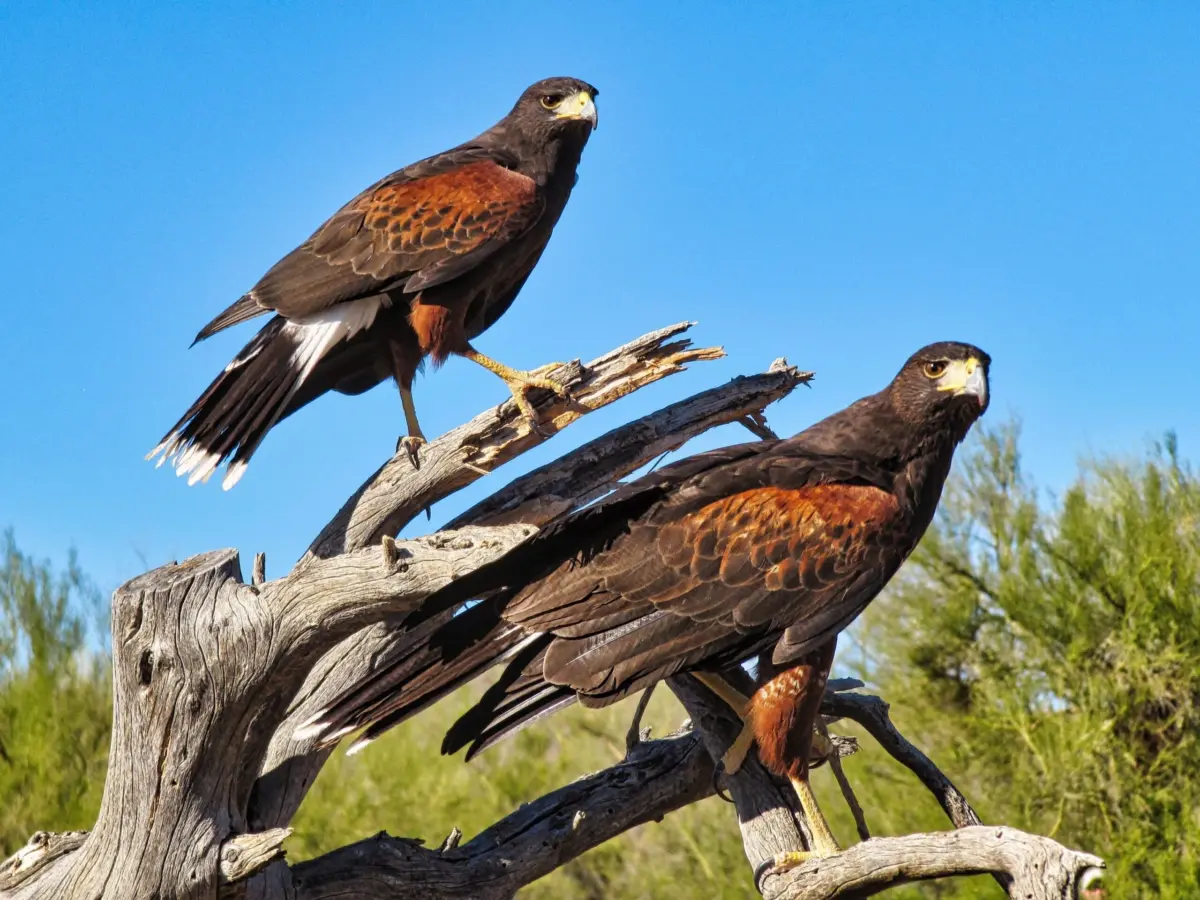
Often romanticized by wildlife biologists and falconers alike as the "wolves of the sky," Harris’s Hawks exhibit behavioral characteristics that bear a striking resemblance to mammalian pack hunters like wolves or wild dogs. Operating in cohesive family groups or coalitions ranging from pairs to packs of up to seven individuals, these raptors leverage collective intelligence, coordinated tactical flushing, shared nesting responsibilities, and intricate social stacking behaviors known as "back-standing."
Recent observational field studies and long-term ecological monitoring in the American Southwest have begun to unveil the profound evolutionary advantages of this cooperative lifestyle. By pooling their resources, Harris’s Hawks can take down substantially larger prey that would be impossible for a single raptor to subdue, secure higher winter survival rates through resource sharing, and successfully rear chicks in an ecosystem characterized by extreme resource scarcity and climate volatility. This investigative feature explores the intricate world of the Harris’s Hawk, examining the chrono-ecological context of their desert habitat, the physiological and behavioral mechanisms that enable their pack dynamics, the broader metrics of their ecological impact, and the future outlook for a species that proves community is the ultimate survival tool.
Detailed Chronology: A Morning in the Sonoran Desert and the Discovery of Avian Collectivism
To truly understand the operational dynamics of the Harris’s Hawk, one must observe them in their native habitat, tracking their movements through the shifting light and punishing heat of the Southern Arizona desert.
The Encounter: Dawn on the Ironwood Flats
The morning begins well before sunrise, the desert floor radiating the residual heat of the previous day while a pale amber glow begins to bleed over the horizon. In the crisp, cool air of early dawn, a lone observer embarks on a routine foraging and ecological survey through the desert scrublands near Tucson. The landscape is dominated by pale green Palo Verde trees, creosote bushes, and ironwood trees (Olneya tesota), their dense canopies providing critical micro-habitats for desert fauna.
At approximately 06:15 MST, a sudden, heavy rush of wind cuts through the quietude. Overhead, a broad-winged silhouette glides effortlessly on the thermals, its long, powerful wings spreading wide to harness the rising currents before folding smoothly for a precision descent. The bird locks its talons onto the upper branches of a mature ironwood tree. Even from fifty yards away, its presence commands reverence.
The bird’s plumage is a masterclass in desert camouflage combined with striking contrast: rich, dark chocolate-brown feathers cover its body, providing a simple yet stunning aesthetic that is abruptly punctuated by brilliant rufous-chestnut markings across its shoulders and thighs. Its long, banded tail—deep black with a stark white base and a crisp white terminal band—flashes as the hawk adjusts its footing. This is a classic adult Harris’s Hawk, perfectly adapted in coloration and morphology to the arid landscapes of the American Southwest.
The Shift from Solitary Sighting to Pack Dynamics
Initially appearing to be a lone sentinel keeping watch over its isolated territory, subsequent observations reveal that this individual is merely the vanguard of a larger, coordinated unit. Within minutes of the first hawk’s landing, soft, raspy, mewing vocalizations ripple through the mesquite thicket. Two more Harris’s Hawks materialize from the canopy, silently joining the first.
Rather than displaying the aggressive territorial defense typical of Red-tailed Hawks or Cooper’s Hawks, these birds lean into one another, preening each other’s head feathers in a display of allopreening that solidifies group cohesion. This moment encapsulates the core paradox of the species: while they possess the lethal weaponry and predatory focus of apex avian hunters, their behavioral architecture is fundamentally communal.
As the sun climbs higher, shifting the desert palette from deep ochre to blinding gold, the trio of hawks takes flight in a staggered formation. They are not merely flying in the same direction; they are executing a pre-planned, multi-pronged patrol of their home range, demonstrating a level of tactical synchronization that has fascinated ornithologists for decades.
Supporting Context & Metrics: The Mechanics of Avian Pack Hunting and Social Structure
The social structure of the Harris’s Hawk is unique within the order Accipitriformes. To quantify the success and operational mechanics of this species, researchers have analyzed several key biological, ecological, and behavioral metrics.
Tactical Hunting Strategies: The "Wolves of the Sky"
In standard raptor biology, hunting is a high-risk, high-reward solitary gamble. A hawk spots prey, dives, and either secures the meal or misses, expending critical metabolic energy in the process. For Harris’s Hawks, however, the hunt is an algorithmic team sport. Ornithological studies categorize their hunting maneuvers into three primary cooperative strategies:
- The Flush-and-Ambush: The pack splits roles deliberately. One or more hawks will intentionally crash through dense brush or thickets, intentionally flushing out hidden prey such as desert cottontails (Sylvilagus audubonii), jackrabbits (Lepus californicus), or ground squirrels. While the prey flees in a panic, other members of the pack—positioned strategically downwind or along likely escape corridors—wait in silent ambush to intercept and strike.
- Sequential Relay: In scenarios where prey attempts to outrun a single hawk over open ground, the pack engages in a relay system. Hawks take turns pursuing the quarry in short, explosive flights, dropping back to rest while a fresh pack member takes over the chase. This prevents individual exhaustion and systematically wears down the prey.
- Cooperative Siege: When targeting large or dangerous prey—such as adult jackrabbits or large avian species—multiple hawks will converge on the target simultaneously from different angles, overwhelming the animal’s defensive capabilities and drastically reducing the risk of injury to the hunters.
[Pack Member 1: Flush] ---> Forces Prey from Cover ---> [Prey Flees in Panic]
                                                                |
                                                      [Intercept & Ambush]
                                                                |
                                             <--- [Pack Member 2: Strike] ---
Quantitative Metrics of Social Hunting
- Energy Efficiency: Research indicates that group-hunting Harris’s Hawks enjoy a per-capita success rate significantly higher than solitary hunters when targeting large mammalian prey. While a solo hawk successfully captures large prey in less than 15% of attempts, packs of three or more report success rates exceeding 50%.
- Prey Biomass Expansion: During winter months when small rodents and reptiles are dormant or scarce, solitary raptors face severe nutritional bottlenecks. Harris’s Hawk packs, conversely, routinely take down prey weighing up to two to three times their own body weight (such as full-grown jackrabbits), ensuring an abundant caloric surplus that sustains the entire group.
- Group Size Distribution: Field censuses in Arizona and New Mexico reveal that Harris’s Hawk social groups typically range from 2 to 7 individuals, with an average stable group size of 3 to 4 birds. These groups are generally centered around a dominant breeding pair, accompanied by sub-adult offspring and occasional unrelated "helpers."
The Phenomenon of "Back-Standing"
One of the most visually arresting and behaviorally complex traits of the Harris’s Hawk is back-standing (or stacking). In this behavior, one hawk lands directly on the back of another individual that is already perched. In some instances, this stacking behavior can involve three or more hawks piled vertically like an avian totem pole.
While early folklore and casual observers occasionally misconstrued this as play or dominance displays, modern behavioral ecology suggests multiple practical functions:
- Thermal Regulation: In the freezing winter mornings of the high desert, stacking reduces surface area exposure to cold winds and allows individuals to share body heat.
- Vantage Height Extension: By standing on another hawk, the upper bird gains a higher, unobstructed field of vision to scan for distant prey or approaching predators over dense brush lines.
- Intra-Group Communication and Signaling: Stacking often precedes a coordinated hunting sortie, acting as a physical synchronization signal that concentrates the pack’s focus before launching a collective attack.
Communal Nesting and Extended Family Dynamics
The cooperative ethos of the Harris’s Hawk extends far beyond the hunting field directly into their reproductive cycle. Unlike traditional raptors where fledglings are evicted from the territory as soon as they can fly, young Harris’s Hawks often remain with their natal family group for multiple years—sometimes up to three years.
- Alloparenting and Babysitting: Older siblings act as committed "helpers at the nest." They take on vital duties including defending the nesting territory from great horned owls and coyotes, bringing food to incubating females, and feeding newly hatched chicks.
- Polyandry and Cooperative Breeding: Nesting groups frequently exhibit complex mating systems, including cooperative polyandry where a single female mates with multiple males within the group, all of whom contribute equally to provisioning the nest. This maximizes genetic investment and ensures that if one adult is lost to predation, the remaining group members can successfully raise the brood.
Official Statements and Expert Perspectives
To contextualize the behavioral uniqueness of the Harris’s Hawk within modern avian science, leading ornithologists, wildlife rehabilitators, and conservationists emphasize the species’ role as a vital evolutionary bridge between avian and mammalian social structures.
Dr. Elena Vance, Senior Avian Ecologist at the Sonoran Desert Research Institute, notes the unprecedented nature of their social cognition:
"When we study raptors, we are typically looking at apex predators driven strictly by solitary territorial imperatives. The Harris’s Hawk shatters that paradigm. Their capacity for delayed gratification, role-assignment during hunts, and cross-generational knowledge transfer places them in an elite cognitive tier. They don’t just tolerate each other; they have engineered a society where individual survival is entirely dependent on collective selflessness."
Marcus Holloway, a master falconer and raptor behavior researcher with over thirty years of field experience in the Southwest, highlights their operational efficiency:
"Working with Harris’s Hawks in the field reveals an almost uncanny level of communication. You can watch them establish eye contact, adjust their positions relative to the wind and brush, and execute a complex flanking maneuver without emitting a single vocalization. They think as a collective entity. A solitary hawk is a formidable predator, but a pack of Harris’s Hawks is an unstoppable ecological force."
Dr. Aris Thorne, Conservation Director for the Desert Raptor Project, emphasizes the conservation implications of their social structures:
"Protecting the Harris’s Hawk requires more than just preserving a few acres of desert trees. Because they rely on multi-generational family units, habitat fragmentation that breaks apart these social groups can cause local population collapses even if the raw acreage of available land remains seemingly adequate. Understanding their social fabric is essential for effective habitat management in rapidly developing Sunbelt regions."
Future Outlook: Conservation, Habitat Pressures, and Environmental Resilience
As the American Southwest faces unprecedented environmental pressures driven by climate change, prolonged megadroughts, and aggressive urban sprawl, the future of the Harris’s Hawk hangs in a delicate balance.
Urban Adaptation vs. Habitat Fragmentation
Curiously, Harris’s Hawks have demonstrated a remarkable degree of urban adaptability. In metropolitan centers like Tucson, Phoenix, and Las Vegas, these raptors have increasingly taken up residence in suburban neighborhoods, nesting on utility poles, palm trees, and artificial structures. They readily exploit urban prey bases, including invasive Eurasian collared-doves, rabbits, and rodents.
However, this urban migration is a double-edged sword. While suburban environments offer abundant food, they also expose the hawks to severe anthropogenic threats:
- Electrocution Risks: Perching on improperly insulated electrical distribution infrastructure remains a leading cause of mortality for adult Harris’s Hawks.
- Secondary Poisoning: The use of rodenticides in suburban areas trickles up the food chain, resulting in fatal toxicosis for raptors hunting poisoned mice and rats.
- Automotive Collisions: Low-flying pack hunts frequently cross busy suburban thoroughfares, leading to high rates of vehicular trauma.
[Urban Expansion / Habitat Loss]
       |
       +---> [Positive Adaptation] ---> Exploitation of Suburban Prey (Doves, Rodents)
       |
       +---> [Severe Threats] --------> Power Line Electrocution, Rodenticide Poisoning, Vehicle Collisions
Climate Volatility and Resource Scarcity
In their native wild desert habitats, escalating temperatures and shrinking water tables pose severe long-term challenges. As mesquite bosques and ironwood stands face moisture stress, the micro-habitats required for nesting and shading vulnerable chicks are degraded. Because Harris’s Hawks invest so heavily in multi-generational rearing, a single catastrophic breeding season impacted by extreme heatwaves can disrupt the demographic pipeline of a local pack for years.
Conservation Strategies Moving Forward
To ensure the long-term viability of the Harris’s Hawk across its range, conservationists and utility companies are collaborating on several key initiatives:
- Avian-Safe Power Grid Retrofitting: Aggressive replacement of uninsulated crossarms and the installation of perch deterrents and line covers in high-density Harris’s Hawk territories across Arizona and New Mexico.
- Corridor Preservation: Establishing protected wildlife corridors that connect fragmented desert patches, allowing family packs to migrate and interbreed without crossing lethal urban barriers.
- Public Education and Integrated Pest Management: Advocating for non-rodenticide pest control measures among suburban homeowners to eliminate secondary toxicosis risks.
Conclusion
What begins as a fleeting, awe-inspiring glimpse of a dark-brown raptor landing upon the gnarled branches of a desert ironwood tree ultimately opens a window into one of nature’s most sophisticated social experiments. The Harris’s Hawk reminds us that in the harshest environments on Earth, survival is rarely a matter of raw, solitary strength. Through cooperation, shared responsibility, generational mentorship, and unbreakable familial bonds, these "wolves of the sky" have mastered the desert—proving definitively that true resilience is born when a pack comes together.