
Executive Overview
Where the rolling agricultural fields of northern Illinois meet the vibrant river corridors of the Wisconsin border, the city of South Beloit is undergoing a striking cultural and environmental transformation. Along a bustling riverfront rich in ecological history, a new wave of public art has taken flight. Spearheaded by Jennifer Kuroda, president of the Sinnissippi Audubon chapter based in nearby Rockford, and executed in partnership with the nationally renowned Audubon Mural Project, a trio of breathtaking new public art installations now anchors the region. Comprising two large-scale murals and a glittering, nine-foot mosaic sculpture, this collection highlights the diverse avian residents of the Upper Midwest while confronting head-on the severe, compounding threats they face in the twenty-first century.
Bringing together the municipal government, grassroots environmental organizations, and regional artists, this ambitious undertaking bridges the gap between urban placemaking and ecological advocacy. The installations are strategically distributed across the community: two grace the grounds of Nature at the Confluence, an 80-acre riverfront nature preserve and environmental learning center, while a third brightens the facade of a historic downtown building on Blackhawk Boulevard.
Far more than mere decoration, these works serve as visual primers for local biodiversity. By immortalizing species ranging from the majestic Bald Eagle and the endangered Whooping Crane to imperiled grassland songbirds and the charismatic Red-headed Woodpecker, the project taps into the emotional resonance of public art to spark crucial community conversations about climate change, habitat loss, and species recovery. As urban centers across the United States grapple with how to revitalize public spaces while addressing ecological crises, South Beloit’s avian art initiative offers a compelling, replicable blueprint for community-driven conservation.
Detailed Chronology of the Installations
The realization of South Beloit’s outdoor art gallery was a carefully orchestrated campaign spanning the summer and autumn of 2025. Each installation was deliberately timed and sited to maximize public engagement, leveraging distinct artistic mediums to convey urgent conservation messages.
July 2025: "The Last Watcher" by Brett Whitacre
The public-facing debut of the initiative arrived in mid-summer on the exterior wall of a squat, historic brick building housing a downtown antique shop at 511 Blackhawk Boulevard. Illinois-based artist Brett Whitacre brought his signature vibrant pop art aesthetic to the commercial corridor with a mural titled "The Last Watcher."
The piece depicts a solitary Whooping Crane standing in serene, statuesque elegance against a luminous wetland vista at sunset. Framed by bold, energetic bands of color and a lush border of native prairie flora, the mural instantly revitalized the urban streetscape. Kuroda noted that the piece successfully injects a powerful burst of life and color into downtown South Beloit, functioning simultaneously as a striking work of contemporary art and an evocative ecological reminder of the region’s position within a vital migratory flyway.
August 2025: "Where the Grasses Grow" by Justin Suarez
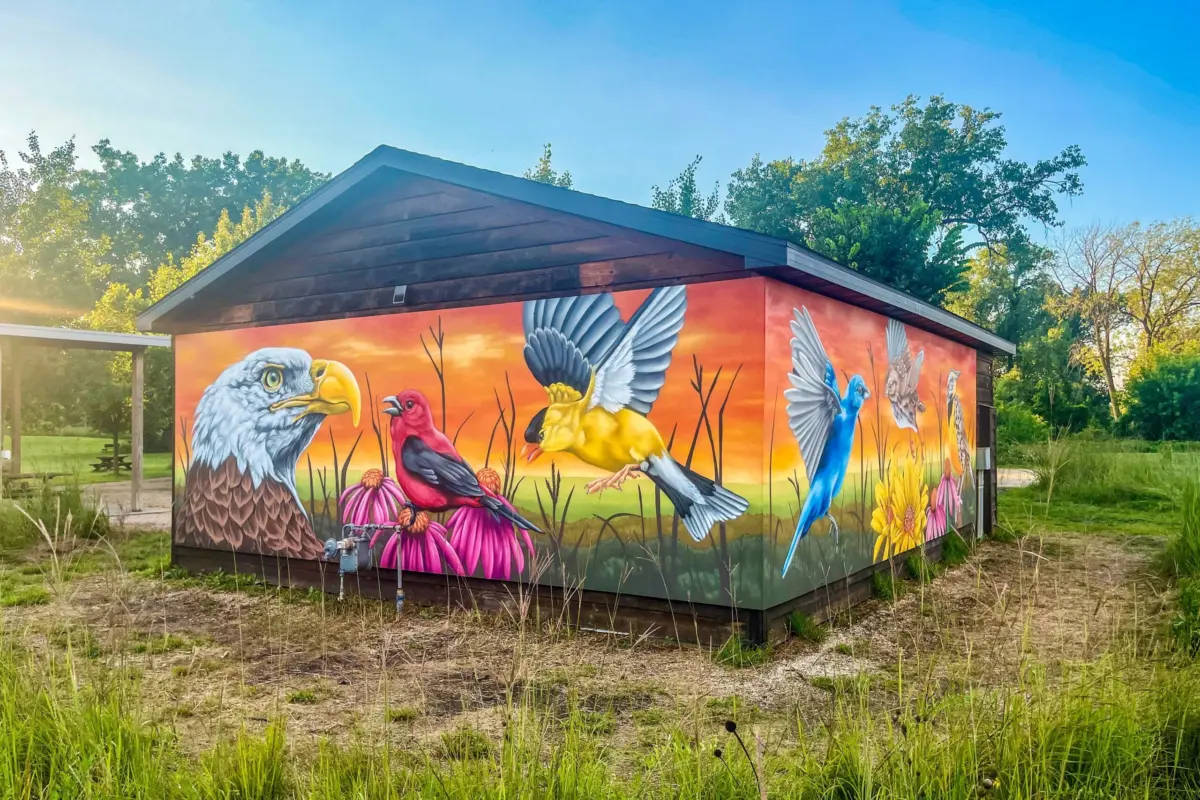
Just weeks after the downtown unveiling, the artistic focus shifted to the sprawling, riparian landscape of Nature at the Confluence. Throughout August 2025, Rochester, New York-based muralist Justin Suarez—who works under the moniker Aerosol Kingdom—transformed the exterior of a prominent wooden shed on the property.
Titled "Where the Grasses Grow," Suarez’s mural stretches dynamically across two sides of the structure. The composition is anchored by a larger-than-life Bald Eagle rendered in exquisite, dramatic profile against a searing orange sky. Flanking the apex predator is a colorful, highly detailed assembly of songbirds indigenous to northern Illinois, including the Scarlet Tanager, American Goldfinch, Indigo Bunting, Song Sparrow, and Eastern Meadowlark. Positioned amidst native prairie grasses, the mural immediately captures the attention of visitors arriving at the preserve, serving as an educational bridge between the wild inhabitants of the Rock River and the human visitors who observe them.
October 2025: "Woodrow the Woodpecker" by SPARK! Mosaic
The trilogy reached its culmination in October 2025 with the installation of a monumental, three-dimensional public sculpture dubbed "Woodrow the Woodpecker." Created in collaboration with SPARK! Mosaic—a free summer arts program for local students led by Rockford artist Susan Burton—the piece represents months of meticulous community labor.
The nine-foot-tall sculpture portrays a boldly colored Red-headed Woodpecker perched atop an intricately decorated structural pedestal. The construction process was an exercise in industrial artistry: students and mentors carved the monumental bird out of rigid Styrofoam, reinforced it with structural mesh and a durable cement coat, and painstakingly embedded hundreds of shimmering, hand-cut glass mosaic tiles across its entire surface. Strategically installed near the primary entrance of Nature at the Confluence, Woodrow’s beak points like an architectural arrow toward the center’s front door, welcoming arriving guests while delivering a profound conservation narrative.
Supporting Context & Metrics: The Scientific Imperative
While the murals and mosaic are celebrations of local biodiversity, they are also stark acknowledgments of ecological vulnerability. The species immortalized by Suarez, Whitacre, and Burton are all enduring symbols of historic conservation victories, yet they face severe, escalating pressures driven by anthropogenic climate change and rapid habitat fragmentation.
The Bald Eagle: A Cautionary Tale of Recovery
The centerpiece of Suarez’s Nature at the Confluence mural—the Bald Eagle—is one of modern conservation’s most celebrated success stories. For years, a resident pair of eagles nesting along the nearby Rock River has served as a beloved local attraction. However, this recovery is fragile and hard-won.
As recently as the mid-twentieth century, the species was pushed to the precipice of extinction across the continental United States, primarily due to the widespread agricultural application of synthetic pesticides like DDT, which caused catastrophic eggshell thinning, alongside rampant industrial habitat destruction. Following the federal ban on DDT in 1972 and subsequent legislative protections under the Endangered Species Act, eagle populations have rebounded remarkably. Conservationists frequently cite the Bald Eagle as empirical proof that concerted public policy and community-led environmental stewardship can reverse seemingly terminal population crashes.
Grassland Songbirds on the Brink
In stark contrast to the rebounding eagle, other avian species featured in the South Beloit installations are facing unprecedented demographic pressures. According to comprehensive data from the National Audubon Society, grassland birds—including the Eastern Meadowlark and Song Sparrow prominently featured in "Where the Grasses Grow"—are currently experiencing the steepest population declines of any avian group in North America.
The primary driver of this decline is the relentless conversion of native prairies into intensive agricultural land and urban sprawl, a crisis that is being exponentially accelerated by a changing climate. Furthermore, forest-dwelling migrants like the Scarlet Tanager face terrifying demographic contractions. Audubon’s landmark climate model, the Survival By Degrees report, projects that if greenhouse gas emissions and global temperature increases continue along their current trajectory, the Scarlet Tanager could be entirely forced out of an alarming 68 percent of its current breeding range.
The Precarious Plight of the Whooping Crane
Whitacre’s downtown mural of the Whooping Crane highlights North America’s tallest and arguably most vulnerable wading bird. Standing nearly five feet tall with brilliant white plumage and stark crimson crowns, Whooping Cranes were hunted to near-oblivion by the late nineteenth century.
Intensive, multi-agency captive-breeding and reintroduction initiatives—including efforts to establish a migratory flock traveling between summer breeding grounds in Wisconsin and winter refuges in the American Southeast—have yielded cautious optimism. Because South Beloit lies directly within this vital migratory flyway, local residents and visitors occasionally spot these rare giants stopping over to rest and forage.
Yet, the eastern migratory flock remains critically endangered. Recent assessments indicate that the population has suffered devastating setbacks, dropping by an estimated 64 individuals following a series of acute mortality events, including suspected outbreaks of highly pathogenic avian flu. Compounding these immediate pathological threats is the long-term shadow of climate change; Audubon’s scientific projections warn that if warming trends persist unchecked, changing thermal regimes could eliminate more than 80 percent of the Whooping Crane’s current habitat range.
The Red-headed Woodpecker and Mosaic Methodology
The majestic Red-headed Woodpecker immortalized in Burton’s mosaic shares a similarly troubled trajectory. Once exceptionally common across eastern North American woodlands and savannas, the species has suffered sustained population contractions over the past half-century due to the removal of dead snags (essential for cavity nesting) and the competitive pressures of invasive species like European starlings. Climate models predict that continued warming will push these striking black, white, and red birds entirely out of their traditional breeding territories across the state of Illinois.
The medium chosen to represent Woodrow—the mosaic—serves as a poetic metaphor for ecological activism. As Susan Burton emphasizes, mosaics demonstrate that monumental impacts are built from countless individual actions. A single glass tile possesses little transformative power on its own, but when unified through collective labor, a breathtaking image emerges. This philosophy mirrors grassroots conservation: individual lifestyle modifications or advocacy efforts may appear microscopic, but synchronized across a community, they can alter the trajectory of a species.
Official Statements & Stakeholder Perspectives
The realization of the South Beloit public art project required a rare convergence of municipal backing, grant funding, artistic vision, and ecological expertise. Key stakeholders reflect on the profound intersections of art, community, and environmental stewardship:
-
Jennifer Kuroda, President of Sinnissippi Audubon:
As the visionary catalyst behind the initiative, Kuroda has spent years working to infuse northern Illinois communities with ecological public art. Reflecting on the geographical significance of the region, Kuroda notes: "We’re in a major flyway for Whooping Cranes, and we have them stop over here quite a bit." By anchoring these migratory realities in tangible public art, Kuroda views the murals as educational touchstones that bridge local geography with hemispheric conservation challenges. Commenting on the downtown installation, she adds that Brett Whitacre’s pop-art crane "just really lights up that area," successfully transforming urban concrete into a canvas for wildlife advocacy. -
Julie Uram, Executive Director of Nature at the Confluence:
Operating from an 80-acre nature preserve positioned directly on the state line, Uram understands the critical need to lower barriers to environmental education. She champions the murals and sculptures not merely as aesthetic enhancements, but as essential public engagement tools. "It is such a great gateway to get people of all different ages interested in coming out and spending time outside together," Uram explains. Discussing the enduring conservation lesson embodied by Justin Suarez’s eagle mural, she observes: "Not that long ago, eagles were almost extinct because of, mainly, our use of chemicals and habitat destruction. But because of community efforts and public policy, things got better, and eagle populations are recovering." Furthermore, she notes the functional design of Woodrow the Woodpecker: "The beak strategically points toward our front door like an arrow," serving as both a welcoming monument and an urgent ecological reminder. -
Justin Suarez (Aerosol Kingdom), Muralist:
For Suarez, whose artistic career was profoundly shaped by more than a decade of hands-on rehabilitation work at a center for injured birds of prey, painting wildlife is an act of deep reverence and scientific study. "Working with raptors not only made me extremely passionate about these animals, but also gave me the opportunity to really study their anatomy up close," Suarez reflects. A veteran of graffiti art who began his career at age 17 in Albany, Suarez defends the precision of his chosen medium: "I personally feel that you can get just as much small detail using a can of spray paint as you can with the tiniest brush." Looking at the broader legacy of his expansive body of work, he shares a philosophical outlook on public art: "It’s really special to be able to know that this work that I’m doing has a life beyond me. As I travel and paint these murals, I’m leaving a piece of myself behind as I go." To Suarez, every mural functions as an ecological seed planted in fertile cultural soil, inspiring onlookers to investigate local wildlife or envision their own urban landscapes as canvases for positive change. -
Susan Burton, Director of SPARK! Mosaic:
Reflecting on the collaborative summer program that brought local students together to construct Woodrow the Woodpecker, Burton emphasizes the unique pedagogical power of mosaic art. "Whether it’s creating art, helping their community, or protecting wildlife, small actions add up. That’s what a mosaic teaches," Burton states. "One tiny piece by itself doesn’t seem like much, but when everyone contributes, something amazing happens."
Future Outlook & Community Legacy
As the autumn of 2025 draws to a close, the completed installations in South Beloit stand as permanent sentinels along the Illinois-Wisconsin border, marking a new chapter in the region’s cultural and environmental identity. Funded in part by dedicated municipal allocations and a competitive Audubon in Action chapter grant, the project has successfully demonstrated how regional conservation chapters can transcend traditional boundaries to engage the broader public.
Looking forward, the leaders of Nature at the Confluence and the Sinnissippi Audubon chapter anticipate that these artworks will serve as catalysts for expanded educational programming, citizen science initiatives, and local habitat restoration efforts. By embedding climate science and ecological vulnerability directly into the visual fabric of downtown South Beloit and the riverfront preserve, the project ensures that thousands of daily commuters, weekend visitors, and local youth are continually reminded of their feathered neighbors.
In an era defined by environmental anxiety and urban alienation, South Beloit’s avian murals and mosaics offer a refreshing antidote. They prove that art has the unique capacity to distill complex scientific warnings into captivating visual narratives, transforming passive observers into active stewards of the natural world. As Justin Suarez aptly noted, these murals are seeds planted in the public consciousness—seeds that promise to bloom into a deeper, more resilient commitment to protecting the fragile ecosystems of the American Midwest for generations to come.