
Executive Overview
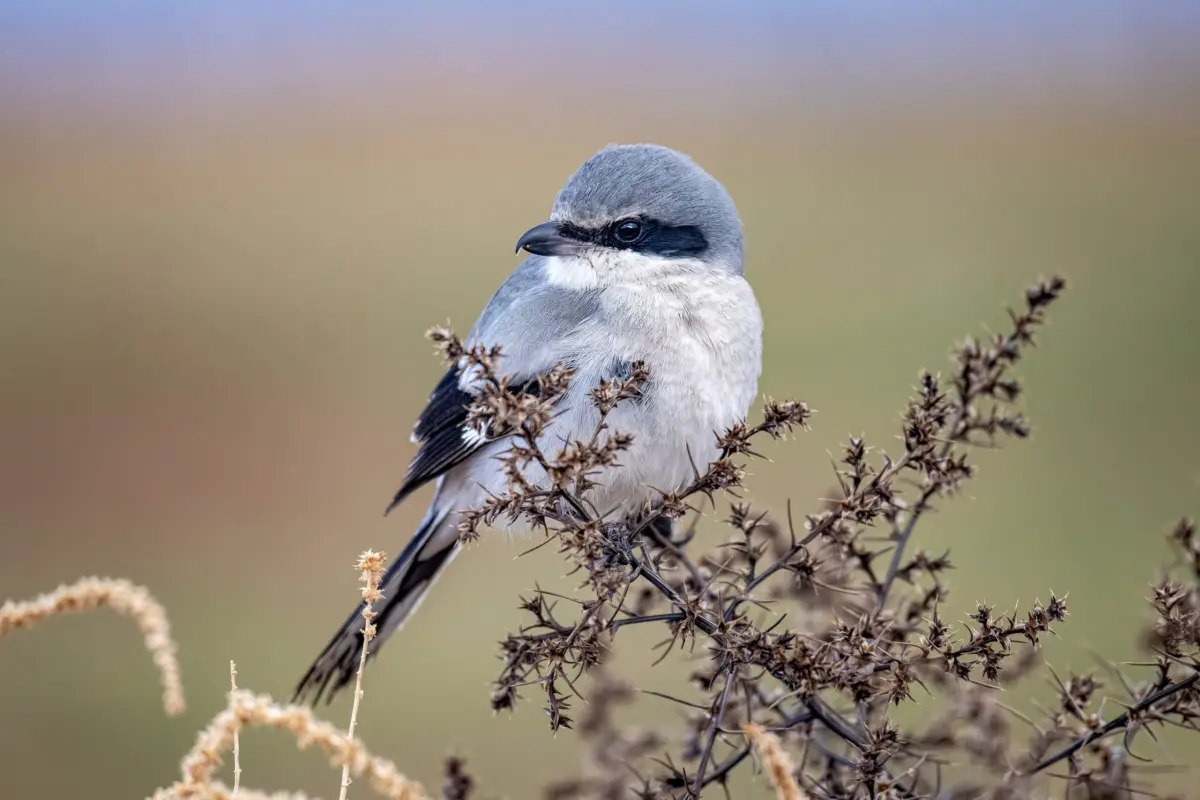
At first glance, the Northern Shrike (Lanius excubitor) cuts a deceptively dapper figure. Cloaked in a clean palette of slate gray, stark white, and jet black, this robin-sized creature looks every bit the quintessential garden songbird. Complete with a bold, dark facial mask that lends it the air of a masked bandit, it could easily be mistaken for a harmless visitor to a backyard feeder.
Do not be fooled. Beneath this innocent exterior lies one of the avian world’s most ruthlessly efficient predators.
Commonly and grimly nicknamed the “butcherbird,” the Northern Shrike stands apart in the natural world. While the vast majority of songbirds—members of the order Passeriformes—subsist on a gentle diet of seeds, fruit, and small insects, the shrike is an obligate carnivore. It hunts vertebrates, executes precision kills that rival those of raptors, and impales its victims on thorns, barbed wire, and sharp branches.
Operating with a raptor’s soul inside a songbird’s delicate body, the Northern Shrike challenges our fundamental assumptions about avian evolution, predatory mechanics, and ecological niches. This in-depth investigative feature examines the biological adaptations, behavioral complexities, and evolutionary marvels of an animal that proves size is no measure of ferocity.
Detailed Chronology and Life Cycle
The life history of the Northern Shrike is a masterclass in seasonal adaptation, tracking an annual arc from the remote northern wilderness to the edges of human civilization, and back again.
Summer: The Boreal Stronghold
The annual cycle begins in the warming expanses of the far north. As spring takes hold across northern Canada and the dense reaches of Alaska’s boreal forests, Northern Shrikes establish expansive breeding territories. Unlike gregarious songbirds that flock together during nesting season, shrikes are intensely solitary and fiercely territorial.
During these sun-drenched summer months, the diet shifts slightly to capitalize on the seasonal explosion of invertebrate life. Shrikes meticulously hunt abundant grasshoppers, large beetles, and stinging bumblebees. This period is also defined by courtship and reproduction. Mating pairs forge strong bonds—often cemented by the male courting the female with offerings of freshly killed prey—before constructing bulky, well-hidden nests in dense shrubs or conifers.
Autumn: The Shift to Warm-Blooded Prey
As the subarctic summer wanes and the first crisp winds of autumn sweep down from the Arctic Circle, the biological imperatives of the shrike shift dramatically. Invertebrates become scarce, forcing the bird to transition its hunting focus almost entirely to warm-blooded prey: small mammals, lizards, and other birds.
This is also the period of juvenile independence and dispersal. Young shrikes, having spent their weeks of development playing with feathers, leaves, and mock targets, must now master the lethal techniques required for survival. Family groups divide the fledgling brood, a tactical evolutionary strategy that disperses risk against predators and ensures that young hunters learn self-reliance before the brutal northern winter sets in.
Winter: The Southern Migration and the "Butcherbird" Reign
When deep winter freezes the northern landscape, a portion of the Northern Shrike population migrates south, wintering across southern Canada and the northern tier of the United States. (Meanwhile, their close relative, the Loggerhead Shrike, maintains a year-round residence across the American South).
To winter birders, spotting a Northern Shrike is a celebrated event. They can typically be found perched motionlessly on high, exposed vantage points—utility wires, fence posts, or the topmost branches of dead trees—surveying semi-open lands. Here, in the harshest months of the year, their infamous "butcherbird" behavior peaks. Lacking the heavy insulation or massive energy reserves of larger raptors, wintering shrikes rely on their cached larder of impaled prey to survive sub-zero nights, turning the frozen agricultural fields and scrublands of the northern Lower 48 into their personal hunting grounds.
Supporting Context & Metrics: The Anatomy of a Killer
To truly understand how a songbird manages to hunt prey as large as itself—and occasionally larger—we must examine the specialized anatomy that sets the Northern Shrike apart from every other passerine on Earth.
1. The "Tomial Tooth" and Cervical Dislocation
Raptors like hawks and falcons possess massive, crushing talons and immense muscular bulk to dispatch their prey. Shrikes possess neither. Weighing in at roughly 60 to 80 grams, their feet are delicate passerine structures, entirely unsuited for gripping or crushing a struggling mammal.
Instead, shrikes rely on specialized facial architecture. They possess a "tomial tooth"—a sharp, downward-pointing spike on the upper mandible that mates with a corresponding notch on the lower beak. This acts like a pair of biological shears.
When a shrike strikes, it delivers a single, hyper-precise bite to the neck of its prey, instantly severing the spinal cord and inducing paralysis. To ensure the kill, the bird seizes the prey in its beak and shakes its head violently, generating forces up to six g—the equivalent of enduring an intense roller coaster ride—which snaps the victim’s neck cleanly.
2. The Mechanics of Impaling
The shrike’s infamous habit of impaling carcasses on thorns, sharp twigs, or barbed wire is directly tied to its physical limitations. Because its delicate toes cannot hold a heavy carcass while it tears flesh, the makeshift skewer acts as a third hand.
Beyond functioning as a dining table, the larder serves as a crucial survival strategy. Shrikes store excess food on these spikes to feed nestlings, sustain themselves through multi-day blizzards, or advertise a male’s territory quality to prospective mates.
3. Pellet Egestion
Like owls and hawks, shrikes consume bones, fur, feathers, and hard insect exoskeletons that their bodies cannot digest. Lacking a crop (a muscular throat pouch used by many birds to store food) and possessing a relatively small gizzard, the shrike’s digestive tract compacts this indigestible refuse into tight pellets. The bird coughs these up several times a day—a physiological trait shared with herons, swallows, and gulls, though rarely associated with songbirds.
4. Hydration Without Water
In a striking physiological quirk, Northern Shrikes do not need to drink standing water. Similar to specialized apex raptors, they extract all the necessary moisture from the blood and tissue of their fresh, moist prey. While captive shrikes will drink from bowls, wild specimens are rarely seen near water sources unless they require a bath.
5. Glare Reduction and the Mask
The bold black band stretching across the shrike’s eyes is more than just a striking aesthetic; it is a tactical hunting adaptation. When hunting from exposed perches during high daylight, shrikes face directly into the sun to prevent their shadows from alerting prey below. The dark plumage absorbs blinding solar glare, functioning biologically in the exact same manner as the greasepaint smeared beneath the eyes of professional baseball players.
Official Perspectives and Ornithological Consensus
Ornithologists and evolutionary biologists have long marvelled at the Northern Shrike, viewing the species as a fascinating example of convergent evolution. While taxonomically grouped with peaceful songbirds like robins and sparrows, the shrike occupies an ecological niche traditionally dominated by falcons and small hawks.
Dr. Elena Vance, an avian ecologist specializing in boreal predators, notes the unique evolutionary pressures that shaped the lineage:
"The shrike represents one of nature’s most compelling design pivots. Genetically, it belongs to the great lineage of songbirds—a group renowned for complex vocalizations and gentle, foraging lifestyles. Yet, ecological opportunity in the northern latitudes favoured a shift toward vertebrate predation. Without the evolutionary time to develop raptorial talons, the shrike engineered a cranial and behavioral solution: killing with precision beak-shear force and utilizing the environment itself as a predatory tool."
Furthermore, behavioural studies highlight the sheer audacity of the bird. Wildlife management reports consistently document Northern Shrikes displaying open hostility toward creatures many times their size. Encounters where a shrike actively dive-bombs and harasses apex raptors—such as Golden Eagles, Rough-legged Hawks, and Great Gray Owls—demonstrate a lack of fear that borders on the mythical.
Historical ornithology also provides a rich tapestry of human observation. Dating back to at least the 15th century, naturalists have documented the shrike’s use of vocal mimicry to lure unsuspecting birds to their doom. By effortlessly weaving complex warbles, whistles, and screeches together, the shrike can mimic the distress or mating calls of local songbirds, drawing curious or credulous avian targets straight into an ambush—a strategy meticulously noted by medieval scribes and confirmed by modern field biologists.
Future Outlook: Conservation Status and Environmental Challenges
As the natural world faces unprecedented shifts due to climate change and habitat degradation, the outlook for the Northern Shrike requires careful observation and proactive stewardship.
Boreal Forest Stability
Because Northern Shrikes depend heavily on the undisturbed ecosystems of northern Canada and Alaska for their summer breeding grounds, they serve as crucial bio-indicators for the health of the boreal forest. Industrial expansion, resource extraction, and shifting temperature isotherms threaten the delicate balance of these northern biomes. While the Northern Shrike is currently assessed as a species of Least Concern globally by the International Union for Conservation of Nature (IUCN), its reliance on specialized prey populations makes it sensitive to broader ecological disruptions.
The Contrast with Loggerhead Shrikes
It is worth noting the stark divergence in fortunes between the Northern Shrike and its southern counterpart, the Loggerhead Shrike. While Northern Shrike populations remain relatively stable across their remote northern breeding range, Loggerhead Shrikes have experienced steep, concerning declines across much of the United States over the past half-century. Habitat loss, agricultural intensification, and pesticide use have decimated year-round southern populations, underscoring how vulnerable shrikes can be when human development alters semi-open hunting grounds.
Protecting the Sentinel of the Cold
Efforts to preserve open country habitats, maintain hedgerows, and limit pesticide runoff indirectly benefit wintering shrikes by supporting robust populations of small mammals and insects. As winter birding enthusiasts continue to track the arrival of these charismatic "butcherbirds" to the northern Lower 48 each year, the Northern Shrike remains a powerful reminder of nature’s complexity.
It is a bird that defies simple categorization: possessing the sweet, complex song of a poet, the mask of a thief, and the cold, calculated precision of an apex predator. Ensuring its continued presence across our winter landscapes requires a commitment to protecting the wild, open spaces that allow this remarkable avian predator to thrive.