
Executive Overview
Across the vast expanses of Alaska’s Cook Inlet, a quiet seasonal transformation is underway. Young shorebirds are vigorously exercising their developing flight feathers, transitioning from ground-bound nestlings to capable, fledged aviators. Having defied the formidable odds of their earliest weeks of life, these survivors now stand on the precipice of their ultimate endurance test: their inaugural southward migration.
Behind this fleeting moment of avian readiness lies a complex web of ecological dynamics, modern tracking technology, and decades of environmental change. Recent findings from field researchers working across the inlet—spearheaded by teams from the University of Massachusetts Amherst (UMass Amherst) and the Alaska Department of Fish & Game (ADF&G)—have revealed a surprising banner year for at least one high-profile species, the Hudsonian Godwit. Yet, this localized success unfolds against a backdrop of escalating habitat fragmentation, shifting predator-prey timelines, and a changing climate that threatens the future of the region’s vital bog ecosystems.
As researchers pivot from muddy field sites to computer laboratories, their meticulously gathered datasets offer more than academic insight; they provide an urgent roadmap for conservation. By comparing modern observations with baseline data stretching back to the 1990s, scientists are charting the resilience—and the vulnerability—of Cook Inlet’s shorebirds as they navigate a landscape increasingly reshaped by human hands.
Detailed Chronology: The Making of a Survivor
To understand the magnitude of this year’s fledging season, one must trace the arduous journey of a shorebird chick from the moment it hatches in the spongy, moss-laden bogs of Beluga to the edge of its first transcontinental flight.
Spring: The Hatching Window and the Gull Dilemma
The breeding season in Cook Inlet begins in the spring, a period of frantic activity when migratory shorebirds return to their northern nesting grounds. Among them are the Hudsonian Godwits, striking waders that rely heavily on the safety-in-numbers strategy of nesting near local colonies of Short-billed Gulls.
This symbiotic neighborhood arrangement is classically precarious. During the incubation phase, the aggressive territoriality of the gulls acts as a protective umbrella, driving off potential aerial and terrestrial predators that might otherwise pillage godwit nests. However, this defense mechanism carries an inherent biological hazard. Both species typically synchronize their reproductive cycles, meaning godwit chicks and gull chicks hatch around the same time.
Historically, this synchronization spelled disaster for newborn godwits. While adult Short-billed Gulls do not typically hunt godwit chicks as prey, they are aggressively overzealous in protecting their own young. In the frantic weeks following hatch, adult gulls will frequently kill any foreign creature that wanders too close to their territory, including fragile, newly hatched godwits.
Summer: The Phenological Mismatch That Saved a Generation
In ecology, timing is everything. During the most recent breeding season, a subtle yet profound shift occurred in the Beluga study site: the short-billed gull colonies hatched later than usual, out of sync with the early-emerging godwit chicks.
This temporal disconnect—a phenological mismatch—inadvertently favored the godwits. By the time the hostile gull parents finally hatched their broods and began aggressively patrolling their territories, the young godwit chicks had already grown large and mobile enough to evade fatal confrontations.
"That gave them a huge boost," notes Feipeng Huang, a PhD researcher from UMass Amherst who spent the season tracking shorebird movements in the bogs.
While the godwits reaped the rewards of this delayed gull hatch, neighboring shorebird species sharing the exact same bogs—such as Short-billed Dowitchers and Lesser Yellowlegs—experienced a far less forgiving season. The divergence in survival rates among species inhabiting the same ecosystem underscores the intricate, highly individualized challenges different birds face, even when exposed to seemingly identical environmental pressures.
Supporting Context & Metrics: Decoding the Bogs
To move beyond anecdotal observations, researchers rely on rigorous technological integration and historical benchmarking. The sheer volume of data collected this season provides a granular look at the mechanics of shorebird survival in Cook Inlet.
High-Tech Tracking in the Bogs
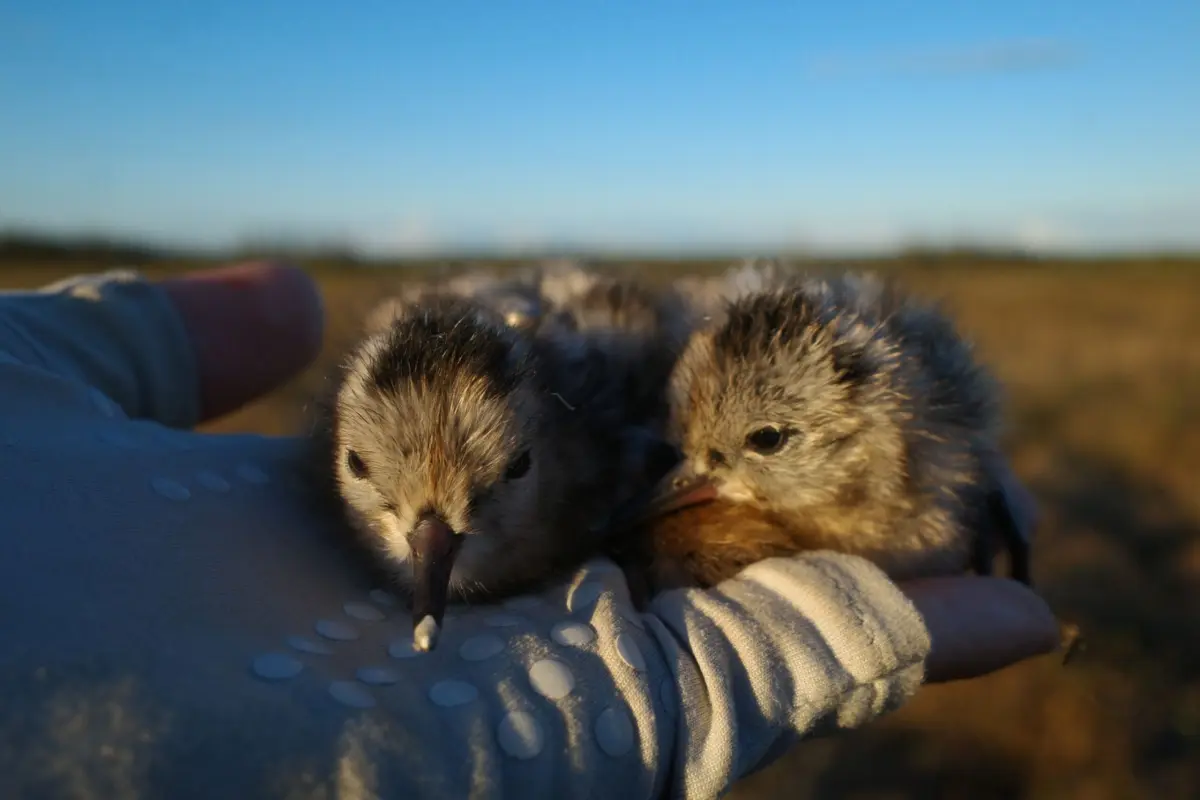
At the long-term study site in Beluga, the UMass Amherst research team deployed cutting-edge methodology to monitor the elusive survival rates of altricial shorebird chicks. Researchers fitted newly hatched Hudsonian Godwit chicks with miniature radio tags, transforming the tiny birds into active telemetry subjects.
Tracking these minuscule transmitters required an extensive infrastructure: a grid of 115 radio receivers strategically deployed across the expansive, boggy landscape. Out of thirty-four godwit chicks tagged at the outset of the season, precisely six survived their critical first three weeks to reach the fledging stage.
While an 18% survival rate might appear modest to the uninitiated, it represents a monumental victory in avian ecology. In previous years of study, chick survival rates for these populations hovered around a dismal 5%. The nearly fourfold increase highlights just how heavily predation pressure—and its fluctuation—dictates avian demographics.
Historical Benchmarking: The 1990s Resurvey
Across the inlet, a parallel effort was underway to contextualize shorebird habitats over a generational timeline. Project collaborators from the Alaska Department of Fish & Game executed a comprehensive resurvey of bird populations in Anchorage’s bogs, directly replicating a series of scientific surveys originally conducted in the 1990s.
Biologists recorded precise data on bird locations, behavioral patterns, habitat utilization, micro-topography, vegetation composition, and hydrological wetness. By comparing modern findings with data from thirty years ago, the research team can quantify precisely how bog-dwelling shorebirds have adapted—or failed to adapt—to decades of compounding human encroachment.
The metrics gathered from these surveys serve a vital predictive function. As the climate shifts and urban development expands, these historical baselines allow scientists to forecast how future alterations to Cook Inlet’s wetlands will ripple through local bird populations, identifying which species are most at risk of localized extinction.
Official Statements & Field Perspectives
The human element of shorebird conservation in Alaska is defined by a deep-seated reverence for the wilderness and a pragmatic recognition of modern development realities. Researchers on the ground offer candid assessments of the triumphs and tribulations defining their work.
The Researchers Speak
Feipeng Huang reflects on the emotional resonance of walking the bogs after a successful breeding season:
"It’s amazing to see so many godwit chicks flying in the bog."
Yet, Huang remains grounded in the sobering reality of avian mortality. Having spent rigorous months observing the breeding grounds firsthand, his perspective on the journey of migration has fundamentally shifted:
"Before I worked at the breeding grounds, I did not appreciate that it’s just so hard for these birds to make it to that point. Every single individual that’s made it is so precious."
Navigating Urbanization and Wetland Perceptions
Arin Underwood, a wildlife biologist who led this year’s ADF&G resurveys, highlights the ongoing struggle to protect wetlands in a rapidly developing municipality. Bogs, Underwood notes, frequently suffer from an undeserved public relations problem.
"Bogs get kind of a bad rap sometimes," Underwood explains, pointing to the pervasive public perception of "a nasty bog that’s filled with mosquitoes and mud and nothing else."
This negative cultural stereotype often marks wetland habitats as "no-regrets" candidates for draining, filling, and commercial or residential development. Underwood contrasts this grim stereotype with the rich, biodiverse reality of a healthy Alaskan bog—ecosystems teeming with wild roses, cinquefoil, berry bushes, wood frogs, nesting swans, loons, shorebird families, and calving moose.
The encroachment of civilization is starkly illustrated by the modern realities of historical survey points. Underwood recounts a dramatic instance from the field season:
"There was one survey point where the point itself was no longer in a bog, it was in someone’s living room."
While portions of the original wetland survived behind the property, the homeowner graciously granted permission for Underwood to conduct surveys from their backyard—a stark testament to the fragmentation of once-vast wilderness corridors.
The Urban Wilderness: Turnagain Bog
Despite decades of rapid suburban expansion, infrastructure growth, and industrial development, pockets of profound ecological resilience persist. A prime example is Turnagain Bog, situated immediately adjacent to the bustling tarmac of Ted Stevens Anchorage International Airport.
For over half a century, this isolated wetland has existed as a relictual fragment of a much larger historical marsh system. Far from serving merely as a grassy acoustic buffer between roaring jet engines and residential subdivisions, Turnagain Bog remains a functioning, highly active breeding sanctuary where Lesser Yellowlegs, Greater Yellowlegs, and Wilson’s Snipe continue to nest.
"It’s encased by a fence and surrounded on all sides by massive development," Underwood observes, painting a vivid picture of urban conservation. "But it’s just so beautiful in there. It’s like this snow globe of a little ecosystem still trucking along."
Future Outlook: Data, Migration, and Conservation Challenges
As the late-summer air grows crisp across Cook Inlet, the immediate biological theater of the breeding season draws to a close. The region’s shorebirds are congregating in increasingly massive flocks, synchronizing their internal clocks for the epic journey south toward their wintering grounds, which may stretch as far as the coastlines of South America.
Concurrently, the human custodians of these birds are also migrating—transitioning from rugged field conditions and mud-stained hip waders to indoor offices, computer monitors, and analytical software.
Unlocking the Ecological Framework
Ahead of the researchers lies a monumental computational challenge. The raw telemetry data, bird counts, and habitat metrics collected over the summer must now be synthesized. Feipeng Huang and his colleagues will spend months running complex multivariate analyses to unearth the underlying connections driving shorebird demography.
The primary objective is to untangle the web of interacting variables:
- Predation Pressures: Quantifying how temporal shifts in gull and mammalian predator populations impact chick survival.
- Trophic Dynamics: Assessing the availability and nutritional quality of macro-invertebrate prey sources across different bog micro-habitats.
- Physical Condition: Correlating chick size, hatch weight, and developmental milestones with long-term survival probability.
- Hydrological Fluctuations: Measuring how water level variations influence foraging efficiency and nest-site security.
Safeguarding Cook Inlet’s Wetlands for Tomorrow
The insights generated by the UMass Amherst and ADF&G collaborations arrive at a critical juncture. As Anchorage and the broader Cook Inlet region continue to grow, municipal planners, state wildlife managers, and conservationists face increasingly difficult decisions regarding land use, zoning, and wetland mitigation.
The historical comparisons provided by the 1990s resurveys demonstrate that urban sprawl does not merely displace wildlife; it compresses biodiversity into increasingly isolated ecological islands like Turnagain Bog. Without proactive policy measures and a broader cultural appreciation for the intrinsic ecological value of bogs, these fragile northern ecosystems risk degradation beyond the point of functional recovery.
Ultimately, the survival of Cook Inlet’s shorebirds is inextricably linked to the preservation of the landscape they call home. As the season’s fledglings take to the skies for the very first time—joining the magnificent, sweeping migratory flocks that have defined the North American flyway for millennia—they carry with them the results of a fragile ecological victory. Whether future generations of shorebirds will find a welcoming, intact wilderness waiting for them upon their return depends entirely on the stewardship decisions made in the boardrooms and laboratories of Alaska today.