
Executive Overview
At the Rheinstrom Hill Audubon Sanctuary in Hillsdale, New York, a stroll through the woods carries an entirely different meaning today. Within a specific parcel known as Stand 13, getting struck by low-hanging branches and tangling with dense thickets is no longer an annoyance—it is a definitive sign of ecological success.
Just over a decade ago, this 2.5-acre plot was characterized by a severe lack of biodiversity. It featured an anemic understory, an aggressive invasion of non-native Japanese barberry, and a monoculture of unhealthy white pine and striped maple. Today, however, Stand 13 looks, feels, and sounds drastically different from the surrounding landscape.
Through a precise combination of bird-friendly forestry actions—including strategic canopy clearing, invasive species eradication, and temporary deer exclusion—conservationists have achieved a remarkable transformation. The local Wood Thrush population has quadrupled, overall plant and shrub diversity has tripled, and an impressive 27 bird species previously absent from the area have been detected.
This initiative serves as a powerful case study in forest stewardship, proving that heavily degraded, mid-successional northeastern woodlands can be coaxed back to vibrant, multi-layered life without the need for expensive, labor-intensive replanting efforts. Instead, by unlocking the forest’s dormant seed bank and granting nature the protection it needs to regenerate, the Audubon Society has established a scalable blueprint for avian habitat restoration across the region.
Detailed Chronology of the Stand 13 Restoration Project
To understand the magnitude of the transformation at Stand 13, one must look back at the history of the land and the methodical, multi-stage restoration timeline implemented by the National Audubon Society.
Historical Context and Legacy Management
Like many forests across the northeastern United States, Stand 13 was once cleared and utilized as agricultural land. When farming operations ceased, the land naturally began to reforest, leaving behind a woodland that was roughly 50 to 90 years old.
In the 1930s, the previous owner, Mr. Rheinstrom, attempted to manage the property by replanting sections of it. However, these historic planting efforts were conducted all at once and arranged in tight, uniform rows. This lack of spacing diversity created a crowded canopy that choked out sunlight, preventing the development of a healthy understory—the complex layer of shrubs, saplings, and herbaceous plants essential for forest-dwelling wildlife.
When the Audubon Society acquired the property in the 1990s, the forest was structurally uniform and failed to provide suitable, resilient habitats for a full suite of forest-breeding birds. Recognizing this deficit, conservationists drafted a comprehensive forest stewardship plan. They designated Stand 13 as a primary demonstration site to test and showcase how targeted, bird-friendly forestry practices could repair decades of structural stagnation.
Phase One: The 2014–2015 Intervention
The physical transformation of Stand 13 kicked off in earnest during the winter of 2014 and 2015. Conservation managers executed three critical actions simultaneously:
- Full-Area Canopy Cut: Forestry crews conducted a comprehensive cut across the entire 2.5-acre parcel. By opening up the canopy, sunlight was allowed to flood the forest floor for the first time in decades.
- Invasive Species Eradication: Crews systematically treated the invasive Japanese barberry present throughout the stand. Ensuring that these aggressive invaders could not regenerate was vital to preventing them from monopolizing the newly available sunlight and soil resources.
- Deer Exclusion Fencing: Recognizing that local white-tailed deer populations pose a severe threat to young forest regeneration by browsing newly sprouted saplings and wildflowers, managers installed a sturdy, seven-foot-tall deer fence around the entire perimeter of the stand.
The Power of the Seed Bank
Remarkably, because these three steps cleared the slate, no additional plants or seeds needed to be artificially introduced. Nature supplied the rest.
Relying entirely on the natural seed bank—the rich reservoir of viable seeds hidden away in the leaf litter and underlying soil over decades—the forest exploded back to life. Shielded from hungry deer and warmed by unfiltered sunlight, dormant seeds of native oak, hickory, maple, wild basil, wild grape, and a wide array of native wildflowers germinated en masse.
Phase Two: Monitoring and the 2024 Fence Removal
Throughout the ensuing decade, Audubon staff conducted rigorous biannual bird and vegetation surveys at fixed monitoring points within Stand 13. As the stand transitioned dynamically from a bright, open clearing into a dense thicket of young forest, and eventually toward a more structurally complex mature area, researchers documented a steady influx of target avian species.
By 2024, marking the ten-year milestone of the project, the ecosystem had reached a critical threshold of maturity and resilience. Surveys revealed that saplings growing inside the protected enclosure had shot up, growing four times faster than trees outside the fence. Meanwhile, invasive species remained statistically negligible.
With the understory now dense, tangled, and structurally robust, conservationists took their final planned action: the removal of the seven-foot deer fence. Interestingly, even without the physical barrier, white-tailed deer continue to avoid the interior of Stand 13. The vegetation has become so thick and densely packed that browsing is physically difficult, and the deer naturally gravitate toward easier foraging grounds elsewhere in the sanctuary.
Supporting Context & Metrics: Measuring Ecological Success
The success of the Stand 13 restoration is not merely anecdotal; it is backed by a decade of rigorous scientific data collected through standardized avian and botanical monitoring protocols.
Avian Recovery Metrics
Forest-breeding birds are notoriously sensitive to structural degradation and habitat fragmentation. The return of 27 previously unrecorded bird species to Stand 13 underscores the direct correlation between structural forest diversity and avian abundance. Among the most notable beneficiaries are:
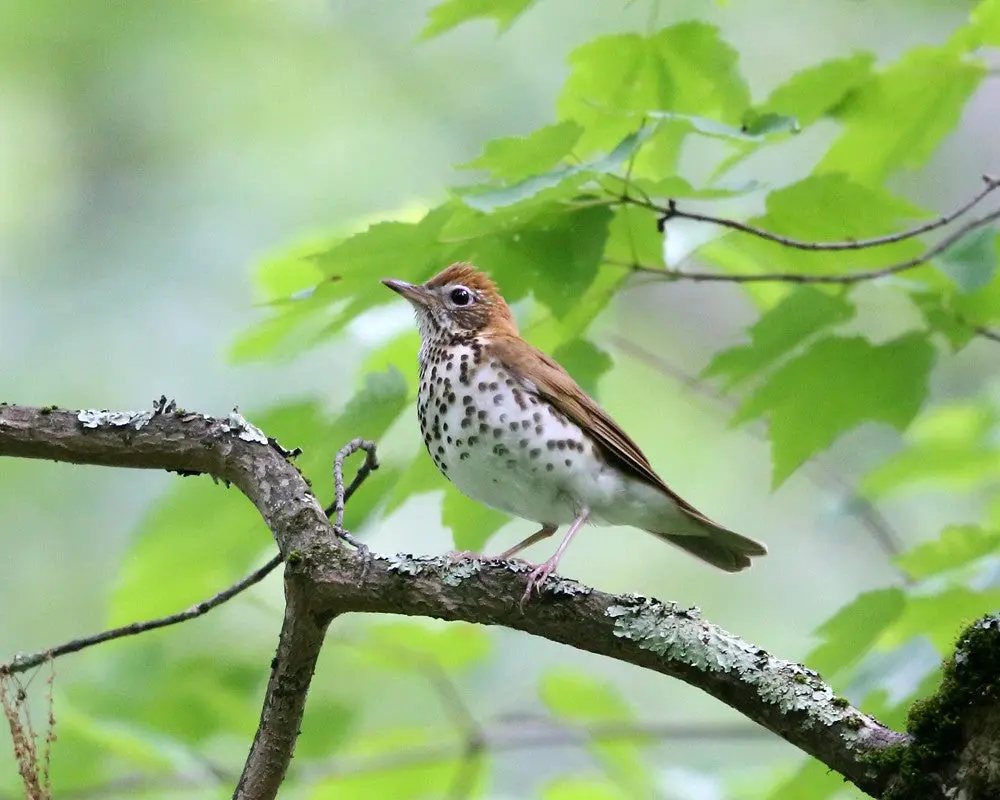
- Wood Thrush (Hylocichla mustelina): Widely considered an indicator species for the health of eastern deciduous forests, the local Wood Thrush population within Stand 13 quadrupled over the course of the project. These birds rely heavily on complex understory layers for nesting and foraging.
- Black-throated Blue Warblers (Setophaga caerulescens): These canopy and shrub-dwelling migrants returned in numbers, benefiting directly from the dense, multi-tiered vegetation structure.
- Ovenbirds (Seiurus aurocapilla): Ground-nesting warblers that require a rich leaf litter layer and protected understory cover.
- Eastern Towhees (Pipilo erythrophthalmus): Scrub-loving birds that thrived as the site transitioned into a dense, shrubby young forest.
- Rose-breasted Grosbeaks (PHEUCTICUS ludovicianus) and Chestnut-sided Warblers (Setophaga pensylvanica): Both species capitalized on the newly created edge habitats and dense sapling growth.
Botanical and Structural Metrics
From a botanical standpoint, the changes within Stand 13 shattered previous baselines:
- Species Diversity Tripled: The variety of distinct tree, shrub, herbaceous, and wildflower species increased by 300 percent.
- Accelerated Sapling Growth: Comparative measurements inside and outside the perimeter fence demonstrated that protected saplings grew at a rate four times faster than their unprotected counterparts in neighboring untreated sectors.
- Suppression of Invaders: Continuous monitoring proved that the initial targeted eradication of Japanese barberry effectively crippled the invasive plant’s reproductive capacity, keeping its presence negligible a decade later without the need for ongoing chemical treatments.
Official Statements and Conservation Perspectives
Wildlife biologists and forest ecologists point to the Rheinstrom Hill Audubon Sanctuary project as a pioneering model for how private and non-profit landowners can actively manage mid-successional forests to reverse alarming declines in migratory bird populations.
According to regional Audubon stewards, the core philosophy of bird-friendly forestry centers on mimicking natural disturbances. In historic, pre-settlement forests, disturbances such as high winds, ice storms, fires, and beaver activity routinely created localized canopy gaps. These natural events reset small patches of the forest, creating transient young forest habitats that are vital for a diverse array of wildlife.
"When we walk through Stand 13 today and get caught in the branches, we celebrate," notes the sanctuary’s land management team in project summaries. "For decades, our northeastern forests have aged uniformly, creating a monotonous landscape that leaves little room for species requiring dense understories. Stand 13 proves that when you give a forest the right combination of light, invasive control, and temporary protection from overbrowsing, the forest heals itself from the ground up."
Conservation scientists emphasize that traditional forestry management has often prioritized timber yield or passive preservation—the idea that the best way to protect a forest is to leave it entirely alone. However, passive management in already degraded, uniform woodlots often perpetuates ecological stagnation. Active stewardship, such as the protocols deployed at Rheinstrom Hill, injects much-needed structural heterogeneity back into the ecosystem, directly benefiting vulnerable neotropical migratory birds that have experienced severe population declines across North America over the past half-century.
Future Outlook and Visitor Information
The remarkable turnaround of Stand 13 marks the conclusion of its initial ten-year experimental phase, but it represents only the beginning of a broader, long-term stewardship vision at the Rheinstrom Hill Audubon Sanctuary.
Expanding the Demonstration Model
Buoyed by the undeniable success observed in Stand 13, Audubon land managers plan to use the data and visual evidence gathered over the past decade to refine and potentially expand similar bird-friendly forestry practices across other underperforming stands within the sanctuary’s broader 1,000-acre footprint. By demonstrating that active, science-based intervention yields rapid ecological dividends, the sanctuary aims to inspire private woodlot owners throughout the Hudson Valley and greater Northeast to adopt similar stewardship plans.
Public Access and Educational Outreach
Crucially, conservation and education go hand-in-hand at Rheinstrom Hill. Stand 13 is not hidden away in a restricted research zone; rather, it is situated directly along a publicly accessible trail at the sanctuary, located in Hillsdale, New York.
The Audubon Society welcomes visitors year-round to witness firsthand the striking visual and auditory contrast between the restored, thriving understory of Stand 13 and the more uniform, unmanaged woods surrounding it. For those interested in a deeper dive into the science of bird-friendly forestry, the sanctuary regularly hosts staff-led educational tours of its forest demonstration sites.
Visitors planning a trip are encouraged to consult the official Audubon event calendar to schedule a guided walk. As Stand 13 continues its natural evolution into a mature, multi-tiered forest, it stands as a living classroom—demonstrating that with thoughtful care, scientific patience, and a respect for nature’s hidden potential, our depleted woodlands can roar back to life.