
Executive Overview
To the average commuter navigating a bustling airport terminal, weaving through a crowded shopping center, or waiting for a table at a packed weekend restaurant, modern public spaces are engines of sensory overload. Roaring overhead announcements, the staccato clatter of rolling luggage, shifting crowds, and unexpected physical proximities can test the psychological endurance of any human. Yet, amidst this chaotic backdrop, service dogs glide through these environments with an unshakeable aura of serenity, supreme focus, and unwavering poise.
This seamless execution of calm is neither accidental nor innate. It is the culmination of years of meticulous breeding, early socialization, extensive obedience work, and a specialized curriculum known as Public Access Training.
While task-training equips a canine with the specific mechanical abilities required to mitigate a handler’s disability—such as retrieving dropped items, opening heavy doors, or providing stability—public access training governs behavior, social decorum, and environmental resilience. Under the rigorous frameworks of the Americans with Disabilities Act (ADA), a service animal must be individually trained to perform tasks directly related to a disability. Crucially, a dog’s mere presence or its classification as an emotional support animal does not grant public access rights. Legitimate service dogs must earn their vests through exhaustive, real-world rehearsals that demand absolute impulse control, distraction-proofing, and profound stress-tolerance.
This comprehensive report examines the anatomy of public access training, exploring how professional trainers, dedicated volunteer puppy raisers, and resilient canine candidates collaborate to forge some of the most reliable partnerships in modern society.
Detailed Chronology: The Lifelong Pipeline of a Service Dog
The journey from an uncoordinated, curious puppy to a sophisticated working service dog is an exhaustive, multi-stage developmental timeline. Every phase is strategically engineered to build confidence, fortify neural pathways, and transition the dog smoothly into its ultimate working life.
Phase 1: Early Infancy and Foundation (Birth to 8 Weeks)
The pipeline begins well before formal training commences. Elite breeding programs—often focusing on resilient, biddable breeds such as Labrador Retrievers and Golden Retrievers—emphasize genetic health, temperament stability, and low reactivity to environmental stressors. During their first eight weeks of life, puppies are introduced to early neurological stimulation protocols, gentle handling, and novel tactile surfaces.
Phase 2: The Puppy Raiser Era (8 Weeks to 12–18 Months)
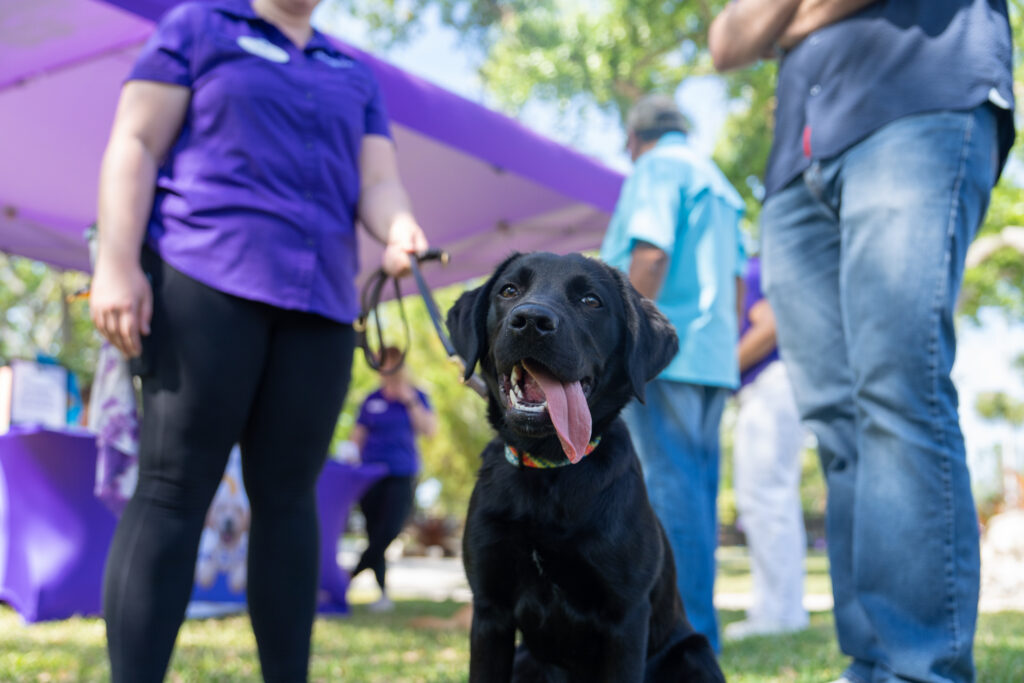
Once weaned, puppies are placed with volunteer puppy raisers who act as the primary architects of the dog’s early socialization. This stage is critical. Raisers expose the young dogs to a staggering array of sights, sounds, textures, and community spaces:
- Mobility & Transit: Riding in cars, hearing buses pass, and encountering bicycles or skateboards.
- Urban Infrastructure: Walking across metal grates, riding elevators, and navigating sliding automatic doors.
- Social Exposure: Interacting safely with diverse demographics, including children, seniors, individuals using wheelchairs, and people wearing hats, beards, or carrying umbrellas.
By integrating these experiences into everyday life, puppy raisers systematically strip away fear responses, replacing them with natural curiosity and emotional resilience.
Phase 3: Advanced Public Access and Distraction Proofing (12 to 24 Months)
As the dog reaches physical and emotional maturity, it transitions to professional training facilities (such as Dogs Inc.) for advanced schooling. Here, trainers take the foundation built by puppy raisers and pressure-test it against real-world chaos.
- Graduated Distraction Training: Trainers introduce high-value temptations—such as dropped food, running children, and unfamiliar animals—gradually increasing the difficulty level. The dog learns that ignoring distractions is the only pathway to positive reinforcement.
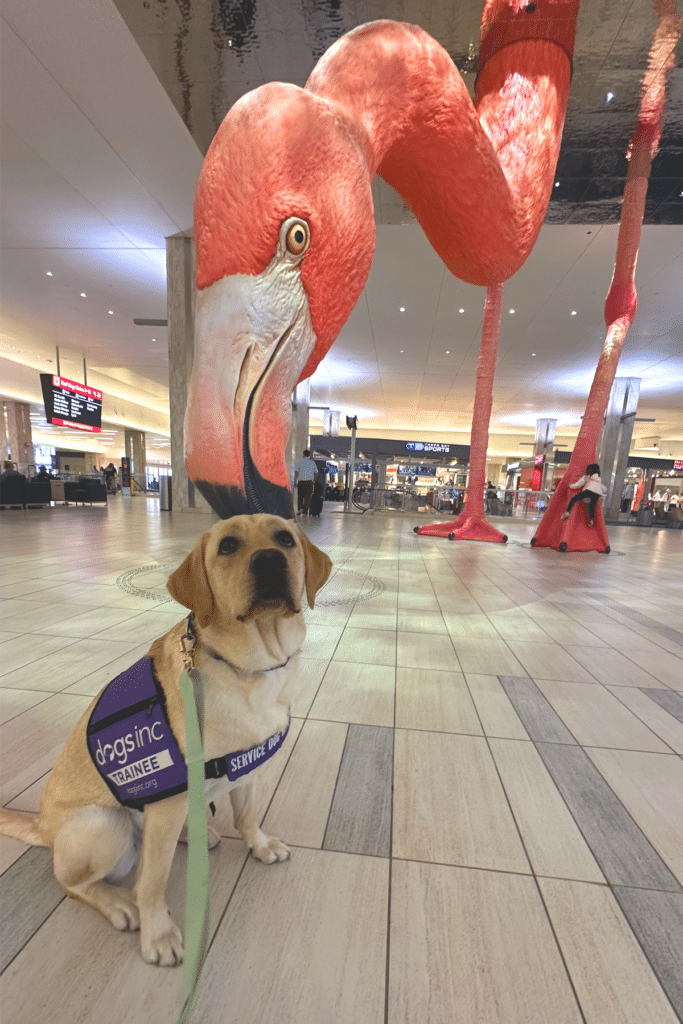
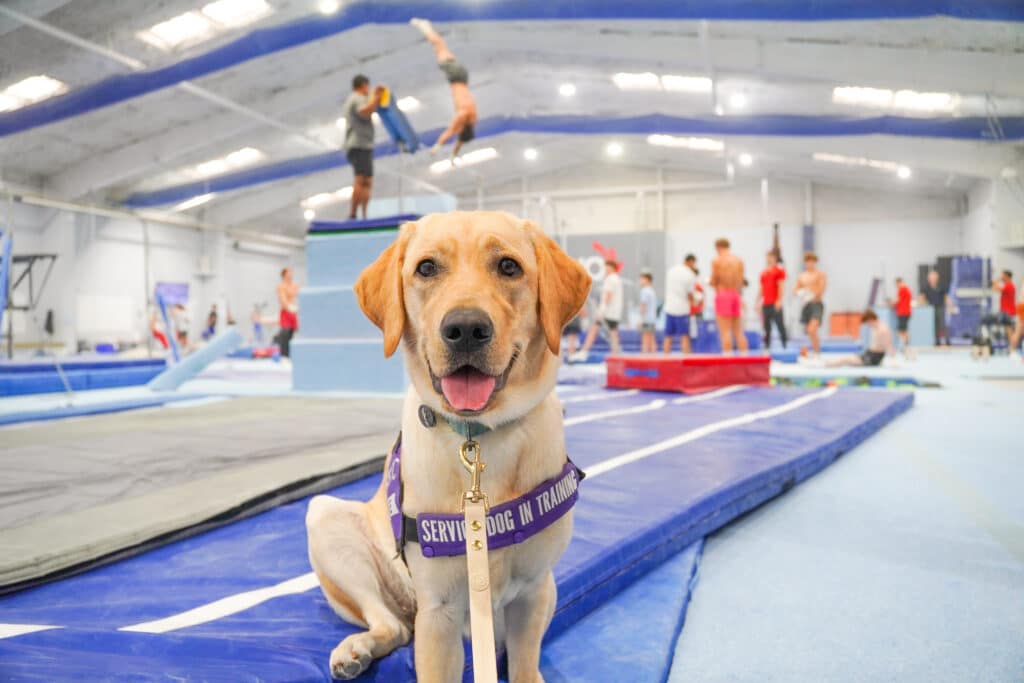
- Environmental Generalization: Training moves dynamically out of the classroom and into high-stakes environments: airports, healthcare facilities, commercial stores, and entertainment complexes.
Phase 4: Final Evaluations and Placement
Before earning the title of a fully qualified working service dog, candidates undergo rigorous multi-environment evaluations. Professional instructors evaluate the dog’s reliability, impulse control, response latency, and public composure. Only after passing these stringent testing protocols is the dog matched with a handler for team training, bridging the gap toward a lifetime of independent mobility.
Supporting Context & Metrics: The Anatomy of High-Stakes Environments
To fully appreciate the complexity of public access training, one must analyze the specific psychological and physical hurdles presented by the three most challenging training arenas: airports, restaurants, and densely crowded public spaces.
1. Aviation Terminals and Transit Hubs
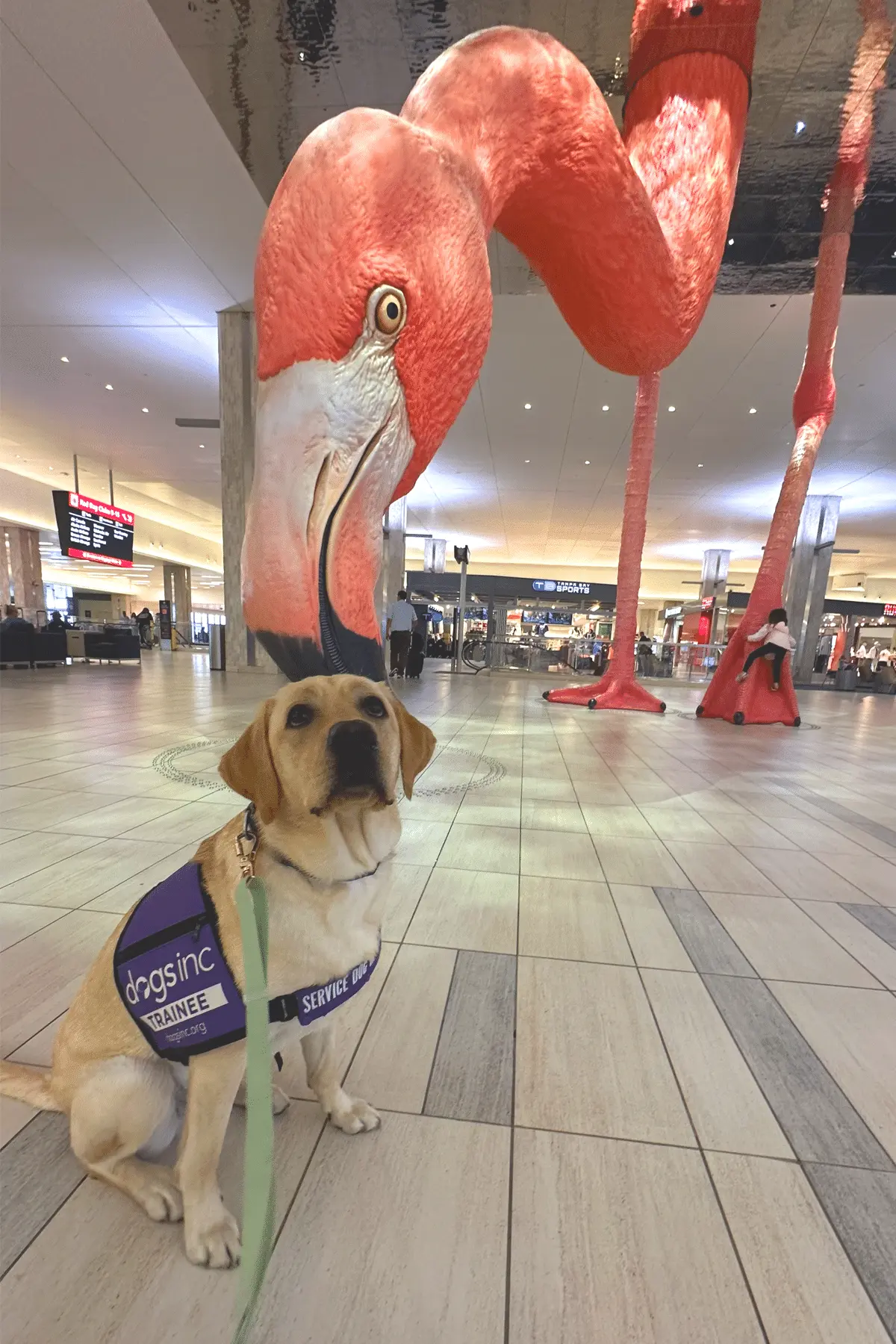
Airports represent the pinnacle of environmental complexity. Service dogs in airport training must learn to process and neutralize hyper-stimulatory triggers:
- Acoustic Stressors: Sudden security alarms, jet engine whines, and echoing PA systems.
- Spatial Compression: Navigating narrow jet bridges, tightly packed security screening lines, and crowded boarding gates.
- Moving Hazards: Rapidly moving walkways, escalators, and sprawling rivers of hurried travelers dragging heavy luggage.
Dogs are conditioned to treat these elements as white noise, anchoring themselves beside their handlers without showing signs of startle or panic.
2. Food Service Establishments and Restaurants
Restaurant training presents an entirely different psychological obstacle course. Dogs must master the art of the "down-stay" in confined spaces for extended periods:
- Olfactory Temptations: The intense, rich aromas of cooked foods, meats, and spilled sauces sitting mere inches from the dog’s nose.
- Physical Constraints: Tucking their bodies neatly underneath small, cramped restaurant tables, remaining out of the way of pacing waitstaff and patrons.
- Unpredictability: Navigating dropped silverware, clattering dishes, and unexpected physical contact from neighboring diners.
3. Dense Crowds and Urban Centers
Festivals, shopping malls, and sporting events demand absolute spatial awareness and crowd-tolerance. Service dogs learn not to crowd-surf or react defensively when bumped from behind by hurried shoppers, shopping carts, or strollers. This level of neutrality is especially vital for specialized roles, such as PTSD service dogs, which may need to perform deep pressure therapy (DPT) or interrupt panic attacks right in the middle of a swirling, chaotic crowd.
Official Statements and Expert Insights
Professional trainers and behavioral specialists emphasize that successful public access is fundamentally rooted in positive reinforcement and emotional safety rather than coercion or dominance.
"Confidence is just as important as obedience," notes lead canine development specialists. "We never force a dog through a terrifying situation. Instead, we use positive reinforcement to reshape their perception of the world. When a dog approaches a novel, high-stress environment with curiosity rather than fear, they become resilient partners capable of weathering any storm."
Furthermore, organizations championing service dog accessibility stress the legal and ethical importance of maintaining rigorous training standards.
"The calm behavior that the public witnesses in a working service dog is the product of thousands of hours of intentional, calculated practice," industry advocates explain. "A service animal is an extension of a person’s independence. Because of this, consistency is non-negotiable. Whether stepping into a quiet local boutique or navigating a chaotic international terminal on a holiday weekend, the dog must demonstrate the exact same baseline of reliability, focus, and unwavering poise."
Experts also draw a sharp regulatory line between true service animals and pets or emotional support animals (ESAs). While ESAs provide comfort through sheer presence, ADA-compliant service dogs are finely tuned operational assets. Their ability to remain invisible yet instantly responsive when a medical crisis arises is what separates a well-behaved pet from an elite working professional.
Future Outlook: The Evolution of Service Animal Integration
As public spaces continue to evolve, the methodologies surrounding service dog training must also adapt. The future of public access training points toward greater integration of simulated high-tech environments, expanded public awareness campaigns regarding the rights and responsibilities of handlers, and deeper community collaboration.
1. Advanced Simulation and Virtual Exposure
With urban architectures shifting and transportation hubs becoming increasingly automated, training facilities are exploring innovative ways to simulate unprecedented sensory stimuli. By exposing dogs to controlled virtual environments, trainers can prepare candidates for futuristic transit systems, autonomous vehicle spaces, and complex smart-city infrastructures before they ever encounter them in the wild.
2. Public Education and Access Integrity
A growing concern within the service dog community is the proliferation of improperly trained animals entering public accommodations under false pretenses. Future outlooks emphasize robust educational initiatives directed at business owners, airline personnel, and the general public. By clarifying the legal definitions under the ADA and highlighting the intense labor behind authentic public access training, communities can better protect the integrity of working teams while maintaining welcoming environments for individuals with disabilities.
3. Expanding the Pipeline of Support
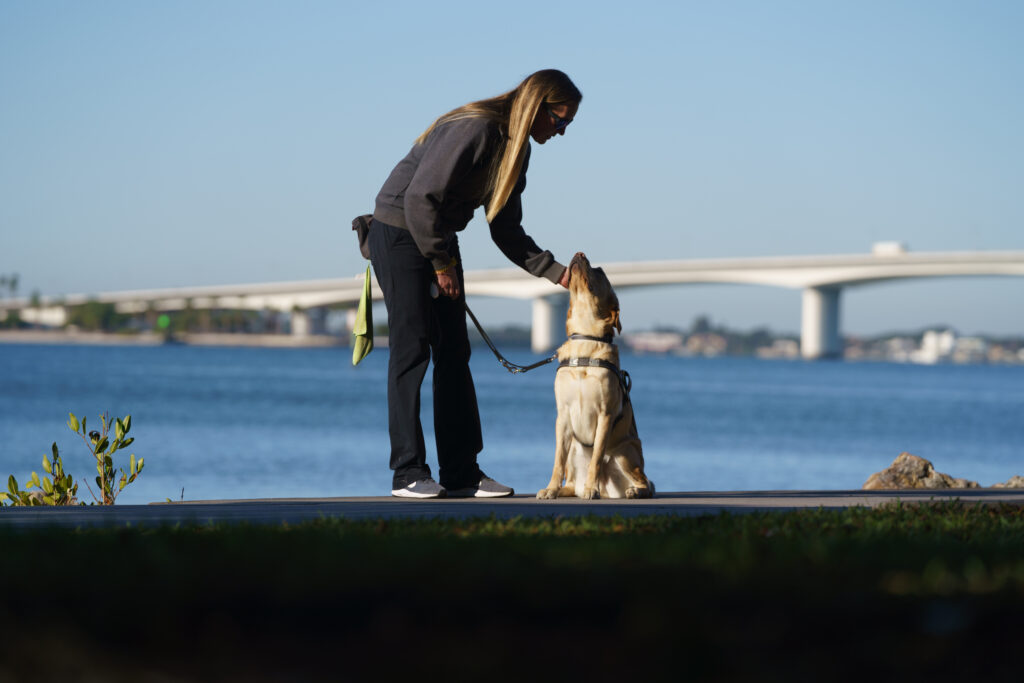
Ultimately, the future of service work relies heavily on the grassroots efforts of community members—from the puppy raisers who volunteer their homes and hearts, to the specialized instructors fine-tuning distraction-proofing techniques. As public demand for mobility, medical alert, and psychiatric service dogs rises, scaling these rigorous training pipelines without compromising quality remains the industry’s highest priority.
Conclusion
The unwavering composure visible in a working service dog is far more than simple obedience; it is the masterpiece of a deliberate, compassionate, and scientifically grounded developmental journey. Through relentless distraction-proofing, real-world environmental exposure, meticulous public access evaluations, and the foundational love of puppy raisers, these remarkable canines are transformed into confident navigators of human society.
For individuals living with disabilities, a fully trained service dog represents a passport to the world—a steadfast companion providing freedom, safety, and profound independence. To explore how organizations like Dogs Inc. continue to pioneer the future of service dog training, and to discover how you can support the next generation of life-changing canine partnerships, visit Dogsinc.org.