
Executive Overview
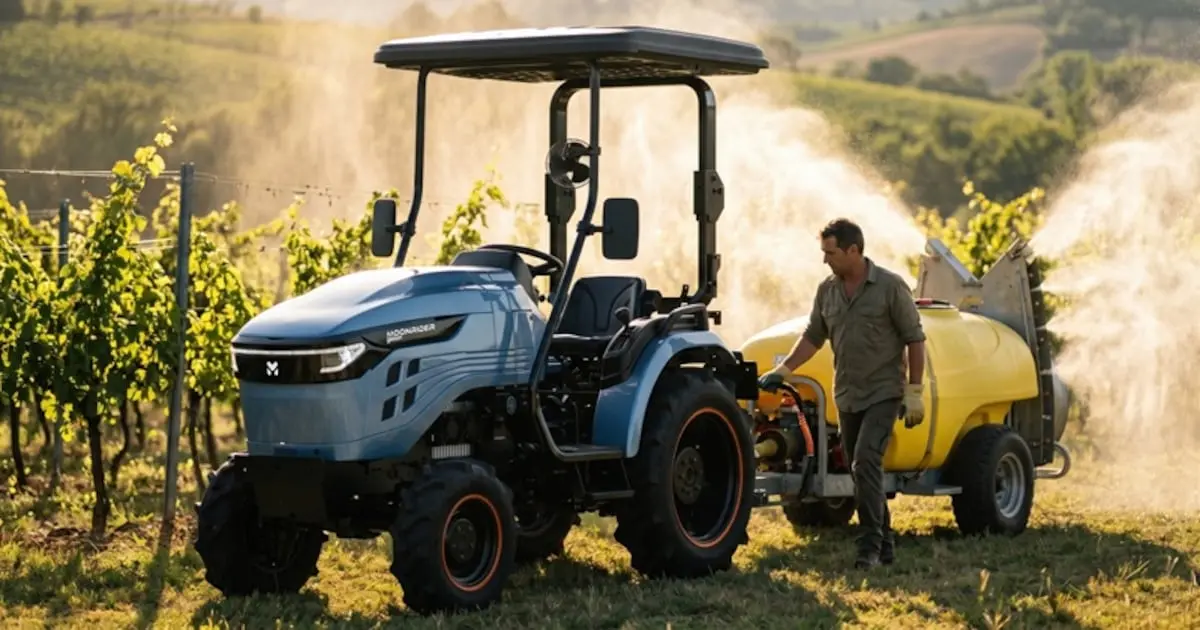
The agricultural machinery landscape is undergoing a profound, technology-driven transformation, propelled by the relentless evolution of battery chemistry, advanced software integration, and a global mandate for decarbonization. Into this shifting market steps GoSun, a Cincinnati-based clean-tech innovator historically celebrated for its consumer-oriented solar appliances and off-grid gear. In a strategic expansion, GoSun is bridging the gap into heavy-duty agriculture through a high-profile partnership with India-based machinery developer Moonrider. Together, the companies have introduced the Moonrider 27: a compact, four-wheel-drive electric tractor explicitly designed to disrupt the North American compact utility tractor segment.
Priced at $19,995—directly competitive with traditional internal combustion engine (ICE) equivalents in the 27-horsepower class—the Moonrider 27 aims to dismantle the historical financial barriers that have stalled the mass adoption of electric agricultural equipment. Beyond its upfront price parity, the vehicle promises radical operational savings over its lifecycle, driven by the elimination of costly diesel fuel and the dramatic reduction of mechanical maintenance.
GoSun’s market entry arrives at a critical juncture for North American agriculture. While larger original equipment manufacturers (OEMs) have cautiously experimented with electrification, and several early-stage electric tractor startups have faltered or been absorbed by conglomerates like Caterpillar, a glaring market vacuum remains. Small-scale farmers, homesteaders, and specialty crop growers have long craved the low-end torque, silent operation, and zero-emission profile of electric utilities, but have been priced out or underserved by available options. By leveraging rapid advancements in lithium iron phosphate (LiFePO4) battery systems, regenerative charging capabilities, and an optional 1,100-watt solar canopy, GoSun is positioning the Moonrider 27 not merely as an alternative to diesel, but as a superior, software-defined agricultural tool engineered for the 21st century.
Detailed Chronology of the GoSun-Moonrider Partnership and Product Launch
The genesis of the Moonrider 27 is rooted in an international collaboration designed to merge American market insight with proven, rugged heavy-equipment manufacturing expertise from overseas.
The Convergence of Clean-Tech and Agriculture
For years, GoSun carved out a distinct niche in the consumer clean-tech market, designing portable solar ovens, solar-powered coolers, and off-grid living solutions. However, company leadership—led by founder and CEO Patrick Sherwin—recognized a much larger, untapped frontier in the commercial and agricultural sectors. Rural operators were increasingly searching for ways to insulate themselves from the volatile pricing of fossil fuels and the burdensome upkeep of complex diesel engines.
To bring an agricultural electric vehicle (EV) to market without enduring a decades-long R&D cycle from scratch, GoSun formed a strategic alliance with Moonrider, an India-based innovator specializing in electric farm machinery. This partnership paired Moonrider’s foundational mechanical engineering with GoSun’s deep expertise in solar integration, consumer-facing distribution channels, and clean-energy branding.
Product Development and Market Positioning
The collaboration culminated in the engineering of the Moonrider 27, a utility tractor specifically tailored to meet the day-to-day demands of North American smallholdings, vineyards, orchards, and hobby farms. Recognizing that adoption hinges heavily on cost familiarity, GoSun structured the pricing model to match standard 27-horsepower diesel tractors dollar-for-dollar.
To build early market momentum, GoSun initiated a pre-order campaign requiring a modest $50 down payment, signaling confidence in the vehicle’s appeal and allowing the company to gauge demand accurately across diverse farming regions.
Public Debut and Industry Showcase
The formal rollout of the Moonrider 27 is slated for the premier agricultural stage. GoSun is officially showcasing the vehicle at the 2026 Farm Progress Show in Boone, Iowa, scheduled for September 1–3, exhibiting at booth VITW2200. This event serves as the primary proving ground where the company will demonstrate the tractor’s technical capabilities to thousands of farmers, agricultural economists, and industry stakeholders.
Supporting Context & Metrics: The Economics of Going Electric
To understand the strategic significance of the Moonrider 27, one must examine the macroeconomic realities facing modern farmers. Operating margins in agriculture are notoriously tight, leaving little room to absorb spikes in operational expenditures. While capital expenditure (CapEx) for farm equipment is always a primary consideration, operational expenditure (OpEx)—namely fuel and maintenance—dictates the long-term viability of small-to-medium agricultural enterprises.
Breaking Down the Cost of Ownership
GoSun’s entry into the market is anchored by a compelling economic argument centered on the Total Cost of Ownership (TCO). According to company analyses, the financial divergence between diesel and electric utility tractors becomes starkly apparent over a five-year operational lifecycle.
- Initial Capital Outlay: Both a standard 27-horsepower diesel compact tractor and the GoSun Moonrider 27 hover around the $19,995 mark, neutralizing the initial sticker-shock barrier that typically plagues clean-tech vehicle adoption.
- Energy and Fuel Expenses: Traditional diesel tractors consume significant amounts of refined petroleum over five years of active duty, especially under heavy loads like mowing, hauling, or tilling. The Moonrider 27 replaces costly diesel with grid electricity or off-grid solar energy.
- Maintenance and Servicing: Internal combustion engines feature thousands of moving parts—pistons, valves, fuel injectors, timing belts, exhaust systems, and transmission fluids—all of which require routine servicing, oil changes, and part replacements. An electric powertrain eliminates the vast majority of these wear-and-tear components.
GoSun estimates that the five-year cumulative cost of owning and operating a traditional compact diesel tractor runs approximately $38,000 when factoring in fuel, routine maintenance, and inevitable mechanical repairs. In contrast, the company projects that the five-year ownership cost of the Moonrider 27 drops to roughly $21,000—representing a staggering life-cycle savings of nearly 45%.
Technical Specifications and Performance Metrics
The Moonrider 27 is not merely a low-cost alternative; it is built to perform heavy-duty agricultural labor. Its engineering specifications include:
- Power and Drive: 27-horsepower equivalent electric performance paired with a robust four-wheel-drive (4WD) system, ensuring maximum traction in muddy fields, loose gravel, or steep inclines.
- Hydraulics and Lifting: Features a standard rear power take-off (PTO) and a durable three-point hitch boasting an impressive 1,653 pounds of lift capacity, allowing compatibility with standard agricultural implements such as rotary cutters, box blades, and post-hole diggers.
- Battery and Runtime: Delivers up to five hours of continuous runtime on a single charge under typical operating conditions.
- Charging Infrastructure: Equipped with flexible AC charging capabilities that replenish the battery from 0% to 80% in just 2.5 hours using a standard 220V charger.
- Solar Integration: For remote fields far from standard electrical grid hookups, the tractor can be outfitted with a specialized 1,100-watt solar canopy. This auxiliary system continuously recharges the battery array while the vehicle is parked or even during active daytime operation, pushing the boundaries of true off-grid agricultural independence.
Navigating the North American Market Landscape
GoSun’s market entry occurs within a complex and turbulent ecosystem. The adoption of electric agricultural machinery in North America has historically lagged behind the commercial automotive sector, presenting both unique hurdles and vast commercial openings.
Past Precedents and Industry Casualties
The path toward agricultural electrification is fraught with historical challenges. Over the past decade, several high-profile North American electric tractor startups have attempted to crack the code, achieving varying degrees of commercial success before encountering structural headwinds.
Fendt introduced the e100 V Vario, demonstrating that legacy European giants see a future in electric vineyard and orchard tractors, though adoption has remained niche. Meanwhile, domestic pioneers such as Solectrac pioneered community-focused electric utility tractors but faced scaling and supply chain pressures. More notably, Monarch Tractor—a prominent Silicon Valley-backed developer of autonomous electric tractors—underwent significant corporate shifts, with its core technology ultimately being acquired by heavy-machinery titan Caterpillar.
These industry shifts highlight the immense capital requirements, supply chain vulnerabilities, and dealer-network dependencies inherent in the agricultural machinery sector. GoSun is navigating this terrain by partnering with an established manufacturing base (Moonrider) to keep overhead lean while delivering a product price point that traditional startup models struggled to achieve.
Addressing the Market Gap
By targeting the compact 27-horsepower segment, GoSun is deliberately avoiding a direct clash with multi-ton, high-horsepower row-crop tractors that currently demand immense energy density far beyond the limits of near-term battery technology. Instead, the company is focusing on the high-volume, highly versatile compact utility sector. These are the workhorses of small farms, landscaping operations, municipal parks departments, and homesteads—environments where daily runtimes rarely exceed five consecutive hours without a natural break, making them ideal candidates for rapid electrical conversion.
Official Statements and Industry Insights
The philosophy guiding GoSun’s agricultural expansion is rooted in a fundamental reassessment of what machinery can achieve when untethered from internal combustion architecture. In discussions with industry analysts, GoSun founder and CEO Patrick Sherwin has articulated a vision that extends far beyond simple fuel substitution.
The Superiority of Electrical Architecture
"There are so many more things we can do, and we are doing, with electricity than with internal combustion," Sherwin emphasized in an interview with AgNavigator.
He noted that the financial advantages of ditching volatile diesel prices and reducing maintenance headaches represent only half of the equation. The true transformation lies in the realm of software and energy control:
"And so the big thing here is, of course, cost savings when you’re moving away from expensive fuel costs and lots of service maintenance issues with liquid fuels. But that’s just one side of the equation. That’s ever expanding as we have better software controls and better battery technology."
The Multipliers of Simplicity
Sherwin pointed out that the mechanical simplicity of an electric vehicle fundamentally alters the ownership experience. Because the Moonrider 27 features significantly fewer moving parts than a conventional diesel engine, the friction points of agricultural labor—downtime for oil changes, starter motor failures, fuel filter replacements, and complex hydraulic-engine interferences—are drastically minimized. Farmers spend less time servicing equipment in the barn and more time executing productive work in the field.
Future Outlook: Autonomy, Chemistry, and Heavy Machinery
GoSun’s introduction of the Moonrider 27 is not treated by its leadership as a one-off product release, but rather as a strategic beachhead in a broader, long-term technological evolution. The company’s product roadmap points toward a future characterized by machine autonomy, advanced battery chemistry, and scaling up to heavier duty classes.
Scaling Up and Embracing Autonomy
As battery technology matures, GoSun is already casting its gaze toward larger machinery capable of tackling heavier agricultural workloads. However, the hardware upgrade is only half of the anticipated transformation. Sherwin confirmed that the company’s long-term sights are firmly set on integrating advanced software, sensor suites, and autonomous navigation capabilities.
"We do also have our sights on larger machines. We have our sights on this onboarding of autonomy and software and sensors, so that the machine can run on its own," Sherwin stated. By pairing autonomous software with an electric platform—which naturally lends itself to precise digital control—future iterations of GoSun and Moonrider machinery could allow farmers to execute repetitive tasks, such as precision mowing, weeding, or orchard spraying, completely unmanned.
The Battery Chemistry Horizon
Much of this future scaling hinges on ongoing advancements in battery science. GoSun is closely tracking improvements in lithium iron phosphate (LiFePO4) chemistry and other high-density energy formulations. Unlike volatile nickel-manganese-cobalt (NMC) chemistries, LiFePO4 batteries offer superior thermal stability, significantly longer cycle lives, and enhanced safety profiles—critical attributes for heavy-duty agricultural environments exposed to dust, heat, and physical shock.
Looking further ahead, Sherwin remains bullish on the rate of innovation within the energy storage sector, predicting a narrowing gap between liquid fuels and electrical energy density:
"Additionally, battery technology, particularly lithium iron phosphate chemistry, will continue to improve over time, opening up new opportunities to develop additional utility vehicles. It’s just a matter of time. We’re moving so fast with so much capability that energy density will be something more on par with what internal combustion is."
Conclusion: A New Era for Rural Work
As GoSun prepares for its high-profile showcase at the 2026 Farm Progress Show, the agricultural sector will be watching closely. The Moonrider 27 represents a critical test case for whether affordable, solar-supplemented, electric-powered utility vehicles can successfully capture the hearts and acreage of North American farmers. By directly challenging the economic dominance of diesel in the compact tractor class—while laying the foundational groundwork for autonomy and advanced energy systems—GoSun is positioning itself as a transformative force in the modernization of agriculture. For smallholders and commercial growers alike, the era of the quiet, clean, and cost-effective electric tractor has officially arrived.