
Executive Overview
In a milestone development for agricultural biotechnology, Robigo—an innovative company pioneering the integration of engineered microbes, RNA interference (RNAi), and CRISPR technologies for crop protection—has successfully closed an undisclosed Series A funding round. The investment was spearheaded by Leaps by Bayer, the impact-driven venture capital arm of life sciences giant Bayer.
The financing round also attracted a high-profile consortium of institutional investors, including Illumina Ventures, SVG Thrive, Congruent Ventures, and Endeavor8. This formidable backing underscores a growing market conviction that next-generation synthetic biology can overcome the persistent efficacy, consistency, and scalability roadblocks that have historically limited biological crop protection products.
Robigo plans to deploy the newly acquired capital to accelerate the commercial rollout of its flagship microbial biopesticides. These initial formulations are targeted at devastating fungal diseases affecting soybeans and high-value specialty crops across the United States. Beyond its initial market entry, the company intends to rapidly scale its discovery and development pipeline. The ultimate objective is to tackle an array of entrenched, soil-borne pathogens across broadacre agriculture—a global market estimated to be worth approximately $10 billion.
Rather than resting its business model on a single blockbuster product, Robigo has constructed a proprietary, highly versatile technological engine known as the ARGO platform. By marrying synthetic biology with computational design, the company is drastically compressing product development timelines from the traditional industry norm of three to five years down to less than 20 months. For the agricultural sector, this represents a paradigm shift: the transformation of biological crop protection from an empirical, discovery-based science into a high-precision, predictable engineering discipline.
Detailed Chronology and Investment Dynamics
The journey leading to Robigo’s Series A financing reflects the rapid maturation of synthetic biology within the agtech ecosystem. While foundational research into RNAi and microbial engineering has advanced significantly over the past decade, translating these laboratory breakthroughs into field-ready products that can withstand variable environmental conditions has proven exceptionally difficult.
Robigo’s emergence onto the venture capital radar crystallized as the company advanced its ARGO platform from early-stage conceptualization to robust, data-backed field trials. The generation of compelling field performance metrics served as the critical inflection point that caught the attention of lead investor Leaps by Bayer. Known for investing in paradigm-shifting breakthroughs that address humanity’s biggest challenges, Leaps identified Robigo not merely as a portfolio asset, but as a critical infrastructure builder for the future of sustainable agriculture.
The Funding Syndicate
- Leaps by Bayer (Lead Investor): Bringing deep domain expertise in agricultural sciences and global commercialization networks, Bayer’s investment arm recognized the platform’s cross-applicability.
- Illumina Ventures: Bringing genomic instrumentation and sequencing expertise, validating the genetic precision of Robigo’s microbial design.
- SVG Thrive: Providing critical access to global agtech networks, corporate growers, and supply chain insights.
- Congruent Ventures: Focusing on sustainability-driven technologies, reinforcing Robigo’s environmental value proposition.
- Endeavor8: Contributing strategic growth capital and operational acceleration frameworks.
With the Series A capital now secured, Robigo is transitioning from an R&D-focused startup into a commercial-stage enterprise. The immediate timeline centers on regulatory navigation, pilot manufacturing scaling, and targeted commercial deployments across key agricultural corridors in the United States.
Supporting Context & Metrics: Overcoming the Limitations of Traditional Biologicals
For decades, biological crop protection products—derived from naturally occurring bacteria, fungi, or biochemicals—have been touted as environmentally friendly alternatives to conventional synthetic chemistries. However, widespread grower adoption has been stymied by three stubborn limitations: variable efficacy under unpredictable field conditions, poor shelf-life and formulation stability, and uncompetitive unit economics.
Robigo is taking direct aim at these historical vulnerabilities by reframing them as engineering and manufacturing challenges rather than passive discovery challenges.
+--------------------------------------------------------------------------+
|                      THE TRADITIONAL VS. ROBIGO PARADIGM                 |
+-----------------------------------+--------------------------------------+
|       Traditional Biologicals     |            Robigo's ARGO             |
+-----------------------------------+--------------------------------------+
| • Discovered in nature            | • Engineered via synthetic biology   |
| • 3 to 5 year development cycle   | • Under 20-month development cycle   |
| • High field efficacy variability | • High-precision, consistent output  |
| • High cost & poor stability      | • Optimized for economic scalability |
+-----------------------------------+--------------------------------------+
The Economics of Plant Pathogens
The financial stakes in controlling soil-borne pathogens are staggering. Robigo’s initial commercial targets represent multi-million-dollar annual losses for producers:
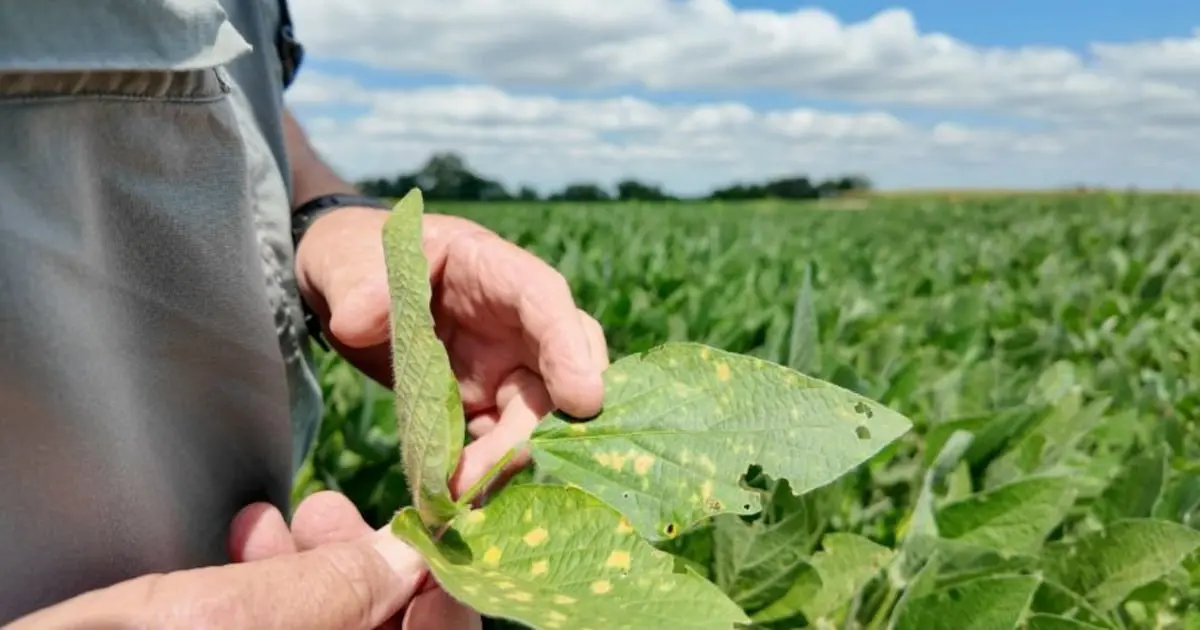
- Sudden Death Syndrome (SDS) in Soybeans: This aggressive fungal disease is estimated to cost US soybean farmers between $200 million and $500 million annually. SDS attacks the root system and lower stem, causing premature leaf scorch, defoliation, and severe yield penalties.
- Fusarium Wilt: A major affliction for high-value specialty crops such as lettuce and commercial berries. Fusarium species clog the vascular systems of plants, leading to wilting, stunted growth, and crop failure.
Robigo’s solutions are architected as a one-time application during the planting window. Once introduced, the engineered microbes colonize the plant’s rhizosphere or internal tissues, continuously producing active RNAi-based or protein-based ingredients throughout the growing season. Crucially, this delivery mechanism requires zero alterations to standard farming practices, lowering the barrier to adoption for commercial growers.
Official Statements and Industry Insights
The strategic rationale behind the investment was elaborated upon by key leaders from both investor and corporate perspectives, highlighting the convergence of biotechnology and agronomy.
Dr. Juergen Eckhardt, executive vice-president and head of Leaps by Bayer, emphasized that the true value of Robigo lies in the infinite adaptability of its core technology rather than a standalone commercial SKU.
"The scalability of the ARGO platform is what sets Robigo apart," Dr. Eckhardt remarked. "They are not just developing a single product but rather building an engine that can rapidly address diverse soil-borne pathogens across broadacre crops. The reason we describe ARGO as a platform is that the underlying technology is designed to be applicable across multiple pathogens, crops, and product concepts rather than a single use case."
Addressing the historical performance gaps of biologicals, Dr. Eckhardt noted that Robigo’s engineering-first methodology changes the equation entirely:
"While it is still early, the company has generated field and development data suggesting its platform can deliver the efficacy growers expect, while leveraging engineered microbes to address the cost and stability limitations that have challenged many biological and RNA-based approaches. What impressed us is that Robigo is tackling performance, consistency, and scalability as an engineering and manufacturing challenge, not simply a product discovery challenge."
Dr. Andee Wallace, founder and chief executive officer of Robigo, highlighted the consumer and producer philosophy driving the company’s mission:
"At Robigo, we believe in building on nature’s foundation to engineer biological products that match or exceed the performance of today’s chemistries. Growers shouldn’t have to choose between a product that works and one that’s affordable or sustainable."
Future Outlook: Commercialization, Partnerships, and Synthetic Biology Integration
As Robigo looks toward the horizon, its strategic roadmap encompasses both direct commercialization and collaborative industry partnerships. The versatility of the ARGO platform opens multiple pathways to market.
Dual Commercialization Pathways
- Proprietary Product Pipeline: Bringing internal biopesticide formulations to market for major broadacre crops (such as soybeans) and high-value specialty sectors (such as berries and leafy greens).
- Strategic Licensing and Partnerships: Leveraging the ARGO engine to co-develop custom crop protection solutions alongside major global agricultural conglomerates.
Dr. Eckhardt noted that Bayer views these commercial avenues as complementary rather than mutually exclusive, positioning Robigo to scale flexibly as market demands evolve. For larger agrochemical corporations seeking to pivot toward sustainable, biological-heavy portfolios without building massive internal synthetic biology stacks from scratch, partnering with agile innovators like Robigo represents a highly attractive alternative.
Redefining "Biologicals" Through Synthetic Biology
The rise of companies like Robigo blurs the historical lines separating traditional organic biologicals from modern genetic engineering. By utilizing genetically modified microorganisms as delivery vehicles for precision RNAi molecules, Robigo sits firmly at the intersection of synthetic biology and agronomy.
However, industry leaders maintain that the nomenclature remains appropriate. As Dr. Eckhardt pointed out, the active agents deployed in farmers’ fields remain living microbes. The genuine innovation does not lie in abandoning nature, but in supercharging natural mechanisms with the precision, predictability, and design capabilities of modern computational biology.
Conclusion
Robigo’s successful Series A financing round is a bellwether for the agtech sector. By successfully fusing CRISPR, RNA interference, and synthetic biology into a streamlined, scalable platform, the company is systematically dismantling the performance and economic barriers that have constrained biological crop protection for decades. As the ARGO platform moves from field trials to commercial reality, growers may soon have access to tools that simultaneously deliver chemical-grade efficacy, economic viability, and ecological sustainability.