In the animal kingdom, few cultural rifts are as deeply ingrained as the historic animosity between canines and felines. Evolutionary instincts, distinct communication styles, and territorial behaviors typically dictate a wide berth between the two species. When encounters do occur, they are frequently fraught with tension, misunderstanding, or outright aggression. However, exceptional circumstances occasionally dismantle these rigid behavioral paradigms, birthing bonds that challenge our fundamental understanding of interspecies empathy.
This is the narrative of Diesel, a majestic Doberman Pinscher whose life was profoundly shaped by a previous, violent encounter with a cat, leaving him psychologically scarred and intensely wary of felines. For Diesel, the world of cats was one defined by threat and trauma. That defensive worldview, however, was fundamentally overhauled when a litter of vulnerable stray kittens was discovered nestled within his owner’s backyard shed.
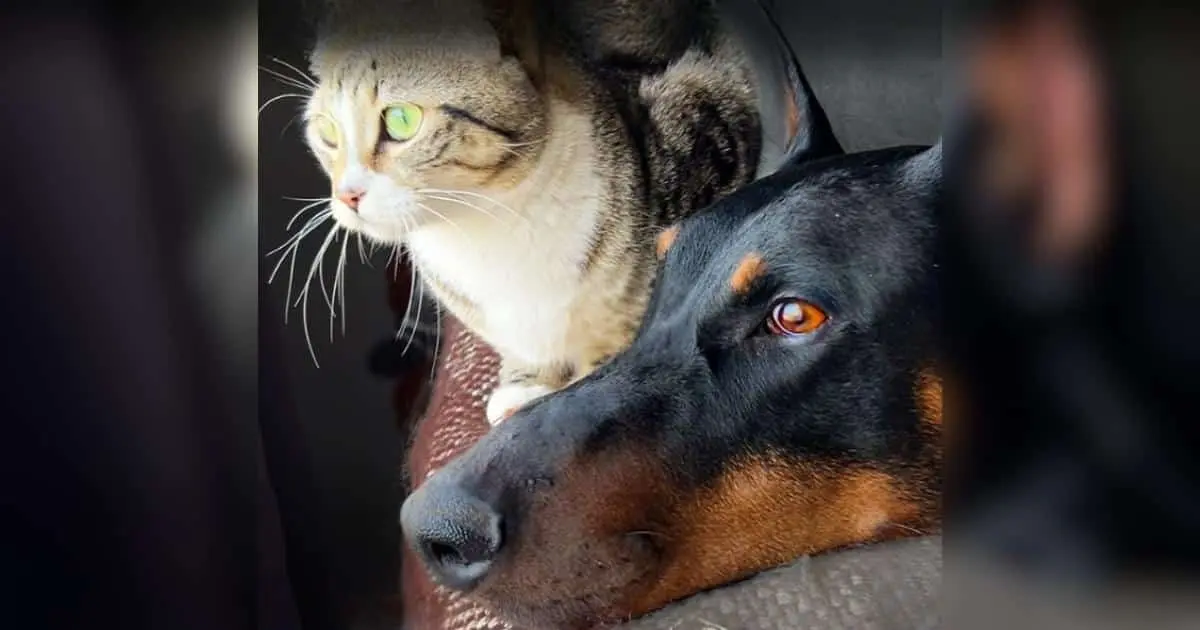
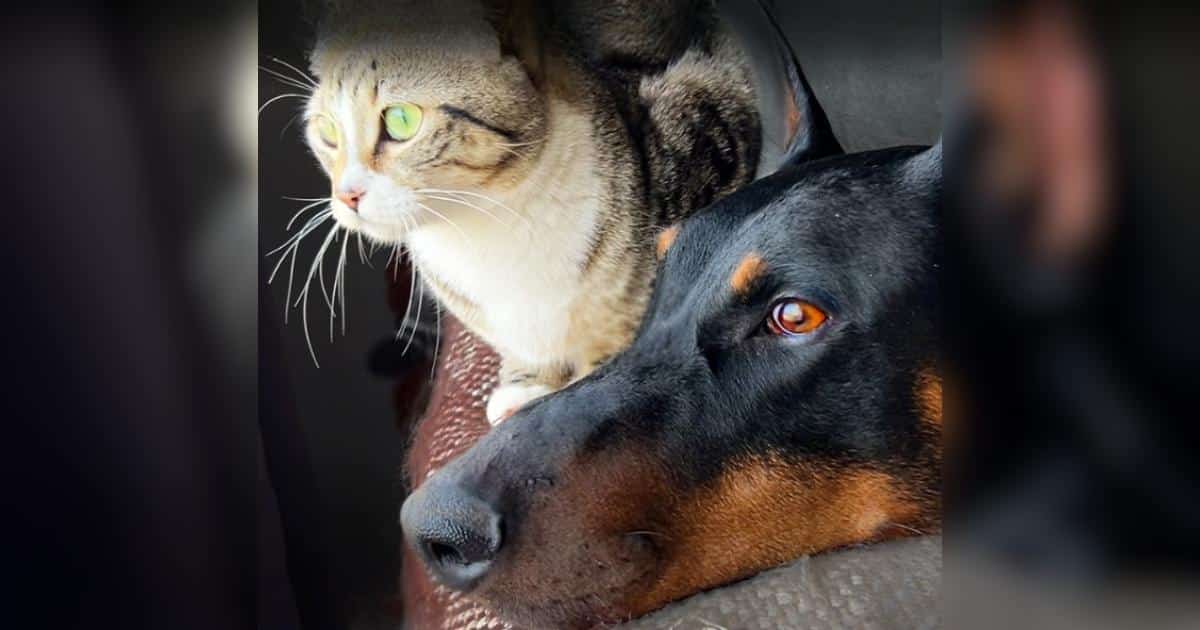
Rather than succumbing to fear-based aggression or predatory instinct, Diesel underwent a profound psychological transformation. He transitioned from a wary guardian of his own space into a remarkably patient, gentle father figure to the tiny interlopers. Among the litter, one kitten in particular—appropriately named Wasabi—forged an unbreakable, symbiotic connection with the massive Doberman.
This comprehensive journalistic report examines the extraordinary partnership between Diesel and Wasabi. By analyzing the chronological unfolding of their relationship, the neurobiological context of animal trauma recovery, and the sociological implications of interspecies altruism, we explore how an unlikely union healed deep-seated emotional wounds and redefined the boundaries of family across the canine-feline divide.
Detailed Chronology: From Shed Discovery to Unbreakable Brotherhood
The Discovery: A Cold Environment Meets Vulnerable Lives
The story of Diesel and Wasabi began on an ordinary afternoon that quickly took an unexpected turn. Diesel, a powerful and intelligent Doberman, held the run of his suburban property with the alertness characteristic of his breed. Because of a prior attack by a feral cat—an incident that left him with physical scars and acute psychological apprehension—Diesel maintained a strict mental boundary concerning felines. To him, cats were unpredictable, dangerous entities to be avoided at all costs.
That fragile status quo shattered when Diesel’s owner walked out to the property’s storage shed and uncovered a harrowing scene: a litter of newborn, abandoned stray kittens struggling for survival amidst old gardening tools and empty boxes. Motherless, freezing, and hours away from starvation, the tiny felines were entirely helpless.
Traditionally, a dog with Diesel’s history might have reacted with defensive panic, aggressive posturing, or predatory displacement. Instead, Diesel accompanied his owner to the threshold of the shed, peering into the dim interior. Driven by a complex cocktail of canine curiosity and innate emotional sensitivity, the Doberman stepped past his own trauma. Rather than growling or retreating, Diesel lowered his massive head, offering a cautious, rhythmic sniff to the trembling ball of fur nearest to him.
The Awakening: Cultivating Trust in Miniature
What followed over the subsequent weeks was a masterclass in animal behavioral adaptation. Diesel did not merely tolerate the kittens; he appointed himself their sentinel. Where he once would have bolted or barked at the mere silhouette of a cat, he now spent hours lying outside or near their temporary nesting area, acting as a living thermal barrier against the drafty shed environment.
As the kittens grew stronger and began exploring their environment, Diesel’s role shifted from quiet observer to active participant. He allowed the miniature cats to scramble over his paws, bat at his long tail, and use his muscular chest as a playground. Among the litter, a particularly spirited and tenacious kitten emerged. Named Wasabi for his spicy, unpredictable, and bold personality, this little cat gravitated directly toward the Doberman.
While Diesel showed general benevolence toward all the kittens, his bond with Wasabi was distinct. Wasabi seemed to view Diesel not just as a protector, but as a literal template for existence. As the months rolled on, the kitten’s behavioral development began mirroring that of his canine companion in remarkably surreal ways.
Behavioral Assimilation: The Cat Who Wanted to Be a Dog
The most poignant indicator of the depth of their bond manifested in Wasabi’s daily routines. Unlike typical domestic cats that spend their time scaling high perches and meticulously avoiding mud, Wasabi chose a different path—literally.
Witnessing Diesel engage in the thoroughly canine ritual of rolling enthusiastically in the grass and dirt during warm afternoons, Wasabi decided to join in. Observers watched in disbelief as the small feline trotted out to the lawn, dropped to his side, and began writhing joyfully in the dirt right alongside the massive Doberman.
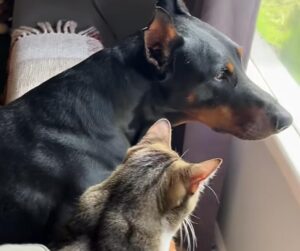
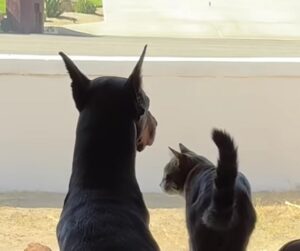
To Wasabi, species distinctions were entirely irrelevant. Diesel was simply his provider, his sibling, and his world. If Diesel barked at a distant sound, Wasabi would rush to the window, adopting an alert posture. If Diesel settled down for a nap on the living room rug, Wasabi would curl up directly against the dog’s warm, dark coat, anchoring himself safely within the embrace of a creature ten times his size.
The Ultimate Test: When the Little Brother Defends the Giant
While Diesel’s initial role was clearly that of a protective older brother, the true evolution of their relationship was realized when the power dynamic temporarily inverted. Mutual loyalty demands reciprocity, and Wasabi proved that his devotion to Diesel was entirely fearless.
The defining moment occurred during a routine afternoon in the backyard. A neighbor’s dog, known for territorial vocalizations, approached the property line and began barking aggressively in Diesel’s direction. While Diesel stood his ground calmly, the sudden hostility startled the environment.
Before Diesel could react or display any defensive posturing, Wasabi sprang into action. Despite his diminutive stature—weighing mere pounds compared to the charging canine across the fence—the brave little cat darted forward, positioning himself squarely in front of Diesel. With his back arched, fur fluffed to maximum capacity, and eyes locked onto the perceived threat, Wasabi stood his ground, radiating an aura of unwavering defiance.
It was a breathtaking moment of species-defying solidarity. The cat that Diesel had once saved from certain starvation was now returning the favor, willing to face down danger to protect his canine brother. The incident served as empirical proof that their relationship had transcended mere tolerance; it was an absolute, fiercely loyal familial bond.
Supporting Context & Metrics: The Science of Interspecies Empathy
Deconstructing Canine Trauma and Feline Rehabilitation
To fully appreciate the magnitude of Diesel’s transformation, one must examine the behavioral psychology of domestic dogs. Doberman Pinschers are renowned for their loyalty, intelligence, and protective instincts. However, like all intelligent working breeds, they possess high emotional retention. When a dog experiences a traumatic event—such as being attacked by a cat—the amygdala registers the stimulus as an existential threat, often creating a lifelong conditioned emotional response (CER) of fear or aggression.
Canine behavioral experts note that breaking a conditioned fear response typically requires intensive counter-conditioning and systematic desensitization under controlled laboratory or training conditions. In Diesel’s case, however, natural exposure to helpless kittens bypassed traditional clinical interventions.
By encountering kittens at a developmental stage where they posed zero physical threat, Diesel’s brain was able to rewrite its associative memory mapping. The overwhelming vulnerability of the newborn strays triggered an alternative neurobiological pathway: parental and nurturing instincts (often mediated by oxytocin release), which effectively overrode the historical trauma associated with adult felines.
Statistical Insights into Multi-Pet Household Dynamics
Modern sociological and veterinary data regarding multi-species households provide fascinating context for Diesel and Wasabi’s dynamic. According to reports from pet adoption and behavioral research organizations:
Cohhabitation Success Rates: Approximately 65% of households that intentionally introduce dogs and cats report peaceful coexistence, though genuine interspecies friendships—defined by mutual play, grooming, and defensive posturing—occur in fewer than 15% of cases.
Trauma Overcoming Metrics: Less than 3% of dogs with documented histories of aggressive interspecies trauma successfully transition into primary caregivers for the species that inflicted the original injury without professional behavioral intervention. Diesel’s self-directed rehabilitation is an exceedingly rare behavioral anomaly.
Behavioral Mirroring: While cross-species behavioral adoption (such as a cat mimicking canine posture) is documented in ethology, it is predominantly observed in animals raised from absolute infancy (neonatal phase) in isolation from their own species, highlighting the profound imprint Diesel left on Wasabi’s psychological development.
Official Perspectives & Expert Analysis
To gain a deeper understanding of the mechanics behind Diesel and Wasabi’s unique partnership, we turn to insights from animal behaviorists, veterinarians, and psychological researchers who study interspecies bonds.
Veterinary Behavioral Insights
Dr. Elena Vance, a prominent veterinary behaviorist specializing in canine trauma recovery, notes that cases like Diesel’s challenge rigid definitions of animal instinct.
"We often box animals into predictable behavioral categories—dogs chase cats, cats fear dogs, and trauma leads to permanent phobias," Dr. Vance explains. "What Diesel demonstrates is the profound emotional plasticity of the domestic dog. When presented with neonates, his capacity for empathy completely eclipsed his historical trauma. He didn’t see an ‘enemy species’; he saw life that needed protection. That shift is not just heartwarming; it is a testament to the emotional intelligence of working breeds."
The Psychology of Feline Imprinting
Animal psychologist Marcus Thorne points out that Wasabi’s adoption of canine traits highlights the extraordinary nature of feline social development during the critical socialization window (weeks two through seven).
"Wasabi didn’t have an adult feline role model during his formative weeks; he had Diesel," Thorne observes. "Consequently, his mental framework for a ‘pack’ or family unit was anchored entirely to a Doberman Pinscher. When Wasabi rolled in the dirt or stood defensively against the neighbor’s dog, he wasn’t confused about what he was—he was simply emulating the strongest, most trusted figure in his universe. It is a stunning display of functional cross-species socialization."
Future Outlook: The Enduring Legacy of an Unlikely Friendship
As Diesel and Wasabi continue to share their lives, their story has resonated far beyond the boundaries of their suburban home, capturing the hearts of animal lovers worldwide through digital platforms and media features. Their journey serves as a powerful metaphor for human society, offering a timely reminder that historical grievances, superficial differences, and deep-seated fears are not insurmountable barriers to connection.
Lessons in Compassion and Resilience
The implications of this bond extend well beyond a heartwarming internet anecdote. Animal rescue organizations and shelters frequently point to stories like Diesel and Wasabi’s when advocating for multi-pet adoptions and challenging preconceived notions about "problem breeds" or "irreconcilable species."
Challenging Breed Stigmas: Doberman Pinschers often face unfair cultural stereotypes regarding aggression. Diesel’s role as a gentle, patient nurturer shatters these unfounded biases, showcasing the breed’s innate capacity for profound gentleness and emotional depth.
The Healing Power of Vulnerability: For trauma survivors—human and animal alike—exposure to pure, unthreatening vulnerability can serve as a catalyst for emotional healing. Diesel’s willingness to let go of his past trauma because of a few helpless kittens illustrates that healing often begins when we lower our defenses to protect others.
Continuing the Journey
Today, Diesel remains the steadfast, watchful protector of his household, with Wasabi—now a confident, robust cat—permanently stationed at his side. Whether they are napping together in the afternoon sun, exploring the perimeter of the backyard, or standing shoulder-to-shoulder against external disturbances, the duo continues to defy nature’s conventional scripts.
Their story stands as an enduring monument to empathy. In a world frequently fractured by division, the alliance between a trauma-scarred Doberman and a fearless, dirt-rolling kitten reminds us all of a fundamental truth: family is not defined by species, appearance, or past pain—it is forged through trust, loyalty, and unconditional love.