
October 22, 2026
Featured originally in the Alley Cat Action® 2026 Fall Newsletter. Read the full newsletter edition here.
Executive Overview
Across the globe, an enduring bond connects human society with community cats—felines that live outdoors without traditional, single-household ownership. On October 16, advocates, municipal leaders, and animal welfare organizations marked Global Cat Day and National Feral Cat Day, an annual observance dedicated to transcending international borders in the name of feline advocacy. Operating under the powerful rallying call that Cats Are Community™, this year’s mobilization spotlighted the shared responsibility communities have to protect, respect, and humane-manage outdoor cat populations.
While the movement is global, its successes are deeply local. From the sun-baked neighborhoods of the American Southwest to bustling metropolitan centers across continents, humane organizations and forward-thinking local governments are proving that compassionate coexistence is not only possible, but practical. Central to this paradigm shift is the widespread adoption of Trap-Neuter-Return (TNR)—a scientifically proven, humane strategy that stabilizes outdoor cat populations while improving the health and welfare of the animals.
This report examines the state of community cat advocacy in 2026, exploring how municipal partnerships, grassroots activism, and localized initiatives like those in Tempe, Arizona, are redefining animal services. By analyzing the intersection of climate resilience, municipal policy, and cultural attitudes toward outdoor felines, we present a comprehensive look at why community-driven care remains the gold standard of modern animal welfare.
Detailed Chronology: The Evolution of Global Cat Day and Community Care
To understand the current landscape of community cat advocacy, one must examine the deliberate evolution of Global Cat Day and the structural policy changes that have accompanied it over the past two decades.
The Origins of National Feral Cat Day
Established initially as National Feral Cat Day in the early 2000s by Alley Cat Allies, the day was created to shatter myths surrounding outdoor cats—specifically the misconception that unowned felines cannot thrive outdoors or that lethal control is an effective population management tool. Over time, as advocacy efforts crossed oceans and resonated with international rescue organizations, the initiative expanded organically into Global Cat Day.
October 16: A Worldwide Day of Action
Each year, October 16 serves as a focal point for educational campaigns, spay/neuter clinics, policy forums, and community celebrations. The 2026 observance marked a watershed moment for the Cats Are Community™ initiative, emphasizing that outdoor cats are an intrinsic part of the urban and rural ecosystems they inhabit. Events spanned multiple continents, featuring virtual panels, shelter open houses, and large-scale TNR blitzes designed to reduce shelter intake burdens while safeguarding outdoor cat colonies.
Case Study: A Day in the Life of Guy the Tabby
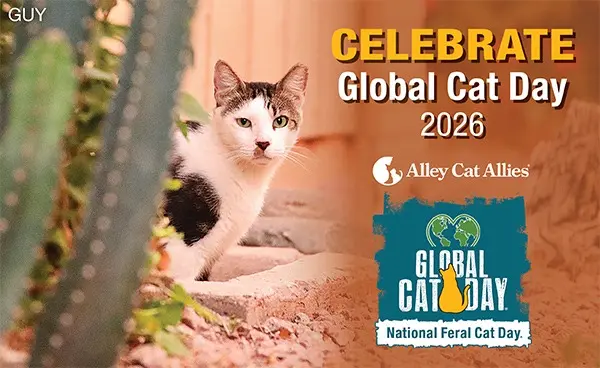
To ground these global initiatives in daily reality, advocates frequently point to localized micro-successes. Consider the case of Guy, a resilient tabby cat navigating the harsh urban landscape of Tempe, Arizona. On a scorching afternoon where temperatures routinely soar well past 100 degrees Fahrenheit, Guy exemplifies the adaptability of community cats. Ducking smoothly behind a desert cactus to escape the brutal midday glare, Guy demonstrates the instinctual survival mechanisms refined by generations of outdoor felines.
Tempe’s community cats snooze peacefully beneath protective desert bushes during peak daylight hours, only to emerge as the desert sun dips below the horizon, painting the sky in vibrant hues of amber and violet. Far from being out of place, Guy and his feline peers are woven directly into the fabric of the local ecosystem. More importantly, their survival is bolstered by a municipal framework that actively protects them rather than penalizing their existence.
Supporting Context & Metrics: The Science and Impact of TNR
The success of municipal programs like the one in Tempe, Arizona, is not accidental; it is built upon decades of data supporting Trap-Neuter-Return (TNR) as the single most effective method for managing community cat populations.
Understanding Trap-Neuter-Return (TNR)
Unlike traditional catch-and-kill approaches—which have repeatedly failed over the last century due to the "vacuum effect" (where new cats simply move in to take advantage of available resources)—TNR addresses the root cause of population growth. Under a TNR protocol:
- Trap: Community cats are humanely trapped using specialized box traps.
- Neuter/Spay: The cats are transported to licensed veterinarians, where they are spayed or neutered, vaccinated against rabies, and often ear-tipped (the universal symbol of a sterilized and vaccinated community cat) for easy visual identification.
- Return: Following a brief recovery period, the cats are returned to their original outdoor homes where they have established social bonds and access to shelter.
| Metric Area | Traditional "Catch-and-Kill" Approach | Modern Trap-Neuter-Return (TNR) |
|---|---|---|
| Population Impact | Temporary reduction followed by rapid population rebound (Vacuum Effect). | Long-term, sustainable population stabilization and gradual decline. |
| Shelter Euthanasia Rates | High intake and high euthanasia rates for unowned outdoor felines. | Dramatic decrease in shelter intake and preservation of life. |
| Public Health | Ineffective at reducing nuisance behaviors; leaves populations unvaccinated. | Vaccinated populations protect communities; neutering eliminates spraying, fighting, and yowling. |
| Community Relations | Generates public distrust and distress among animal advocates and residents. | Fosters community engagement, volunteerism, and compassionate governance. |
Climate Adaptation and Desert Felines
The ability of cats like Guy to thrive in extreme climates challenges outdated assumptions regarding animal welfare. In Tempe and surrounding desert municipalities, community cat caretakers work in tandem with local organizations to establish shaded feeding stations, monitor hydration needs during heatwaves, and ensure that natural micro-climates—such as dense desert brush and shaded alleyways—remain accessible.
Research demonstrates that outdoor cats develop sophisticated behavioral adaptations to extreme weather, including nocturnal hunting patterns and the utilization of thermal refuges during peak heat. When combined with government-backed veterinary care, these populations maintain high baseline health metrics, debunking the myth that outdoor life is inherently unlivable for feral and community felines.
Official Statements and Municipal Leadership
The transformation of Tempe, Arizona, from a city grappling with traditional animal control challenges to a national model for humane sheltering represents a triumph of political will and community collaboration.
Government-Funded Compassion in Tempe
At the heart of Tempe’s animal programming is a robust, government-funded TNR initiative. Rather than viewing outdoor cats as a municipal nuisance, city leadership recognized that true public safety and fiscal responsibility lie in partnering with grassroots advocates and dedicated caregivers.
"When a city invests in Trap-Neuter-Return, it is investing in its own community infrastructure," noted a representative from a regional animal welfare coalition during the 2026 Global Cat Day briefings. "Tempe proves that municipal government and compassionate citizens can work hand-in-hand to build a humane ecosystem where humans and animals thrive side by side."
The "Cats Are Community™" Philosophy
The overarching philosophy guiding organizations like Alley Cat Allies centers on dismantling the artificial barrier dividing "pet" cats from "community" cats. By recognizing that outdoor felines are valued members of our shared neighborhoods, municipal bodies are increasingly shifting away from archaic, punitive ordinances. Instead, cities are enacting legislation that explicitly protects caregivers, legalizes managed colonies, and prohibits the impoundment and euthanasia of healthy outdoor cats.
Future Outlook: The Road Ahead for Global Cat Advocacy
As we look toward the remainder of the decade and beyond, the trajectory of community cat advocacy points toward increased technological integration, expanded municipal funding, and deeper global solidarity.
Scaling Municipal TNR Programs
The success observed in cities like Tempe serves as a blueprint for municipal leaders worldwide. Future policy initiatives are expected to focus on:
- Mandatory Shelter-Neuter-Return (SNR) Protocols: Ensuring that all municipal shelters routinely sterilize and return healthy outdoor cats rather than admitting them into the sheltering system.
- Expanded Veterinary Access: Addressing national veterinarian shortages by mobile clinic deployment and streamlined surgical training programs for shelter staff.
- Legislative Protection: Passing state and local laws that enshrine the legality of cat caregiving and protect caregivers from neighborhood harassment or HOA-based penalties.
Empowering the Global Grassroots Network
Global Cat Day has evolved far beyond an annual awareness campaign; it is now a mobilization engine. Advocates are utilizing digital tools, international resource-sharing networks, and educational portals—such as GlobalCatDay.org—to equip local activists with the legal, medical, and strategic frameworks needed to transform their own hometowns.
Whether watching educational videos of resilient desert tabbies like Guy or participating in local colony maintenance, citizens worldwide are realizing that protecting community cats is an act of environmental stewardship. By continuing to embrace the ethos that Cats Are Community™, society moves closer to a future where every cat—regardless of whether they sleep on a velvet cushion or beneath a desert cactus—is safe, valued, and protected.
To learn more about how you can get involved, view educational resources, and celebrate the ongoing impact of community-led animal welfare, visit GlobalCatDay.org and explore the latest updates from Alley Cat Allies.