Executive Overview: The Corporate Rush to ‘Fresh’ Dog Food
The commercial pet food industry is undergoing a structural shift. For decades, traditional dry kibble and canned rations dominated pet nutrition. However, a major transition is underway as North America’s largest commercial pet food conglomerates enter the "fresh" dog food market. Driven by shifting consumer demand toward minimally processed, whole-food diets for companion animals, five major legacy kibble manufacturers have introduced fresh, refrigerated, or gently cooked product lines.
Despite this major market shift, an investigative review of these product lines reveals significant consumer transparency gaps, regulatory ambiguities, and stark pricing disparities.
Key findings include:
The Regulatory Loophole: Neither the U.S. Food and Drug Administration (FDA) nor the Association of American Feed Control Officials (AAFCO) has established a legal definition for "fresh" pet food. Consequently, products sold under this label span a wide spectrum of thermal processing, shelf stability, and storage methods without standardized quality baselines.
Feed-Grade Dominance: Out of all fresh lines launched by major traditional pet food conglomerates, only one—Mars Petcare’s Orijen Fresh Prey line—is manufactured in a licensed human food facility and carries a verified "human-grade" claim. The remaining market entries rely on standard feed-grade ingredients and processing.
Pricing Anomalies: Daily feeding costs for a standard 30-pound dog range from $6.50 to $17.28 per day, representing an unexpected price disparity across products that share nearly identical feed-grade manufacturing standards.
Exclusion of Felines: None of the legacy kibble manufacturers featured in this expansion have developed a corresponding fresh line for cats, leaving feline owners entirely dependent on conventional processed wet or dry diets.
Leading pet food consumer advocate Susan Thixton of TruthaboutPetFood.com and the Association for Truth in Pet Food has raised critical questions regarding whether these multi-billion-dollar corporations are conducting market pricing experiments on pet owners or deliberately driving up the price of fresh foods to steer consumers back to high-margin dry kibble.
Detailed Chronology: Legacy Kibble Titans Enter the Fresh Market
The strategic pivot into fresh pet food has sped up dramatically over recent years, driven largely by corporate acquisitions and brand extension initiatives targeting direct-to-consumer (DTC) and retail markets.
+-------------------------------------------------------------------------------+
|                      BIG PET FOOD FRESH EXPANSION TIMELINE                    |
+-------------------------------------------------------------------------------+
|  2022                 | Mars Petcare acquires NomNom                          |
|                       | Mars Petcare acquires Champion Petfoods (Orijen/Acana)|
+-----------------------+-------------------------------------------------------+
|  March 2026           | Mars launches Orijen "Fresh Prey" (Human-Grade Entry) |
+-----------------------+-------------------------------------------------------+
|  Mid-2026 Rollouts    | • Royal Canin launches "Fresh Health Nutrition"       |
|                       | • Blue Buffalo introduces "Love Made Fresh"           |
|                       | • Hill's Science Diet debuts "Fresh Roll"             |
|                       | • Wellness Pet Food releases "Protein Bowls"          |
|                       | • Fromm Pet Foods launches Bonnihill Farms "Chicki-   |
|                         bowls" & Fresh Rolls                                  |
+-------------------------------------------------------------------------------+
Mars Petcare: Consolidated Market Dominance
Mars Petcare, the largest pet food manufacturer globally, secured a prominent foothold in the fresh segment through strategic corporate acquisitions in 2022:
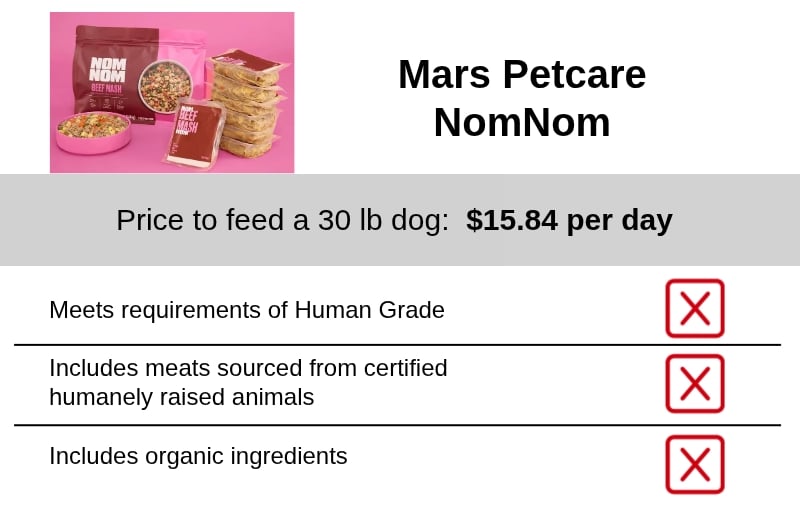
NomNom Acquisition (2022): Mars acquired the direct-to-consumer fresh pet food company NomNom. Despite its positioning, NomNom products do not carry human-grade claims, nor do they claim meats sourced from certified humanely raised livestock or organic-certified ingredients.
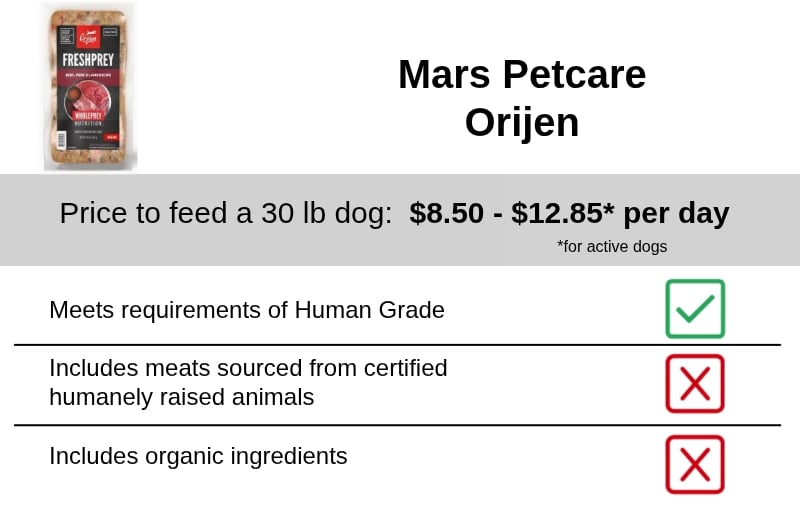
Champion Petfoods Acquisition (2022): Mars acquired Champion Petfoods, the parent company behind Orijen and Acana. Leveraging Champion’s infrastructure, Mars launched Orijen “Fresh Prey”, entering the market with a human-grade designation.
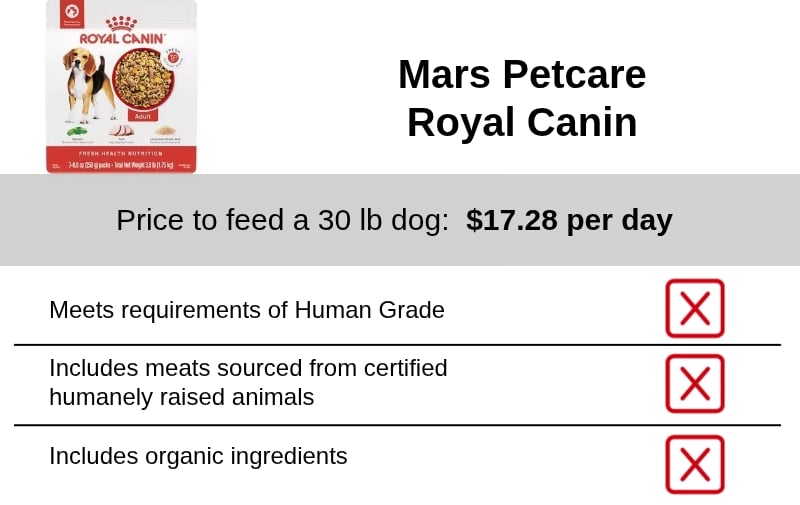
Royal Canin Extension: Under its veterinary and specialized nutrition brand, Mars introduced Royal Canin “Fresh Health Nutrition.” Like NomNom, this line relies on conventional feed-grade processing without organic or humanely raised meat claims.
The Competitors Follow Suit
Following Mars’ market moves, competing legacy manufacturers introduced their own fresh formulations tailored for retail distribution:
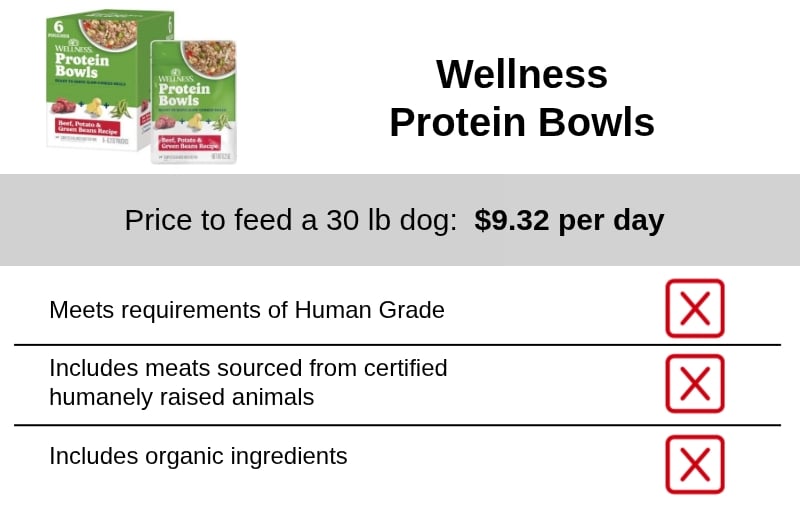
Wellness Pet Food: Introduced “Protein Bowls,” a refrigerated feed-grade line positioned as a high-protein fresh meal solution.
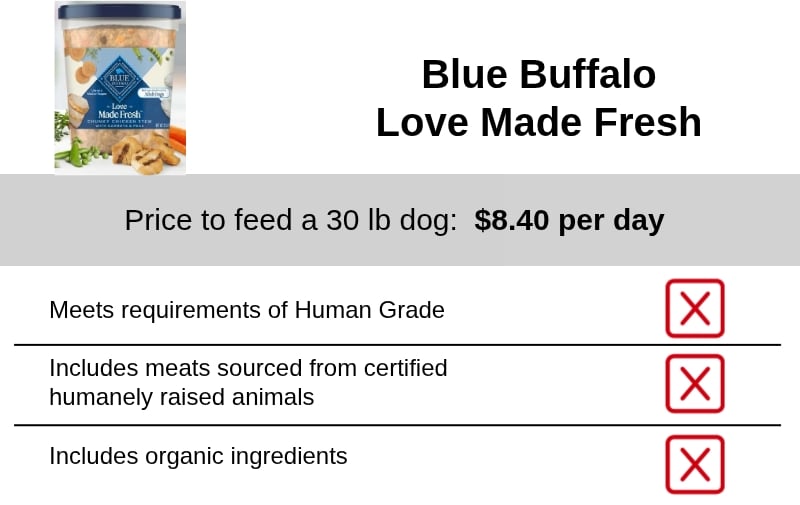
Blue Buffalo (General Mills): Entered the market with “Love Made Fresh,” offering feed-grade fresh stews and meals aimed at mainstream pet retail shoppers.
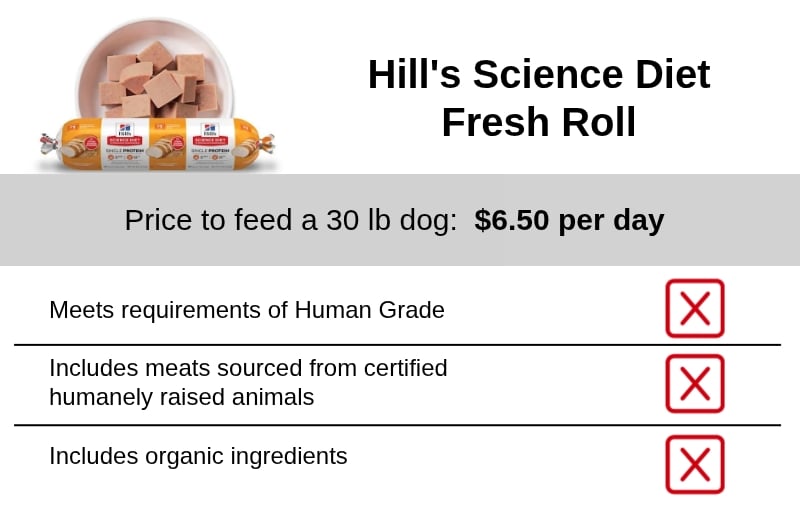
Hill’s Science Diet (Colgate-Palmolive): Rolled out its “Fresh Roll” series—a single-protein, refrigerated chub-style format distributed through major specialty retailers such as Petco.
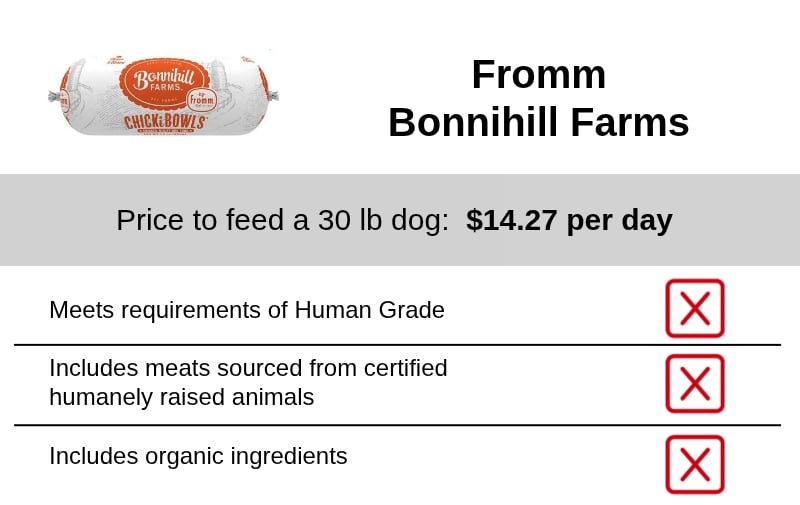
Fromm Pet Food: Through its Bonnihill Farms sub-brand, Wisconsin-based Fromm introduced “Chickibowls” alongside fresh roll formats, utilizing traditional feed-grade infrastructure.
Supporting Context & Metrics: Cost Analysis and Ingredient Standards
To evaluate the true economic impact on consumers, feeding costs were calculated using manufacturer and retailer feeding guidelines for a standard 30-pound adult dog.
Comparative Metrics Overview
Manufacturer / Brand
Product Line
Daily Cost Range (30 lb Dog)
Processing / Quality Claim
Human-Grade Certified?
Organic / Humane Claims?
Mars (Hill’s Competitor)
NomNom
$8.40 – $12.00+
Feed-Grade / Gently Cooked
No
No
Mars (Royal Canin)
Fresh Health Nutrition
$17.28
Feed-Grade / Refrigerated
No
No
Mars (Orijen)
Fresh Prey
$11.50 – $13.50*
Human-Grade Facility
Yes
No
Wellness
Protein Bowls
$9.50 – $13.00
Feed-Grade / Gently Cooked
No
No
Blue Buffalo
Love Made Fresh
$8.40
Feed-Grade / Gently Cooked
No
No
Hill’s Science Diet
Fresh Roll
$6.50
Feed-Grade / Refrigerated Roll
No
No
Fromm (Bonnihill)
Chickibowls / Rolls
$14.27
Feed-Grade / Cooked & Roll
No
No
*Note: Orijen’s pricing reflects recent retail adjustments, including a $2.00 per pouch price reduction observed at national retailers like Petco following its initial launch.
The data reveals significant cost variations that do not always align with ingredient sourcing or manufacturing standards.
1. The Pouch & Bowl Category Discrepancy ($8.40 to $17.28 per day)
Within the tray, pouch, and bowl formats—comprising NomNom, Royal Canin, Orijen, Wellness, and Blue Buffalo—daily feeding costs swing by more than 100%.
Royal Canin sits at the top of the price spectrum at $17.28 per day, despite using feed-grade ingredients manufactured under standard pet food processing conditions.
Conversely, Blue Buffalo’s Love Made Fresh offers a structurally similar feed-grade product at $8.40 per day—less than half the price of Royal Canin.
Most notably, Orijen’s Fresh Prey—the only brand produced in a licensed human-food processing facility using USDA-inspected human-grade ingredients—retails at an estimated $11.50 to $13.50 per day. This places a verified human-grade food well below the cost of Royal Canin’s feed-grade offering.
2. The Roll/Chub Category Discrepancy ($6.50 to $14.27 per day)
In the refrigerated roll format, Hill’s Science Diet Fresh Roll offers the lowest cost entry point across all major brands at $6.50 per day. However, Fromm’s Bonnihill Farms roll line demands $14.27 per day for a comparable feed-grade product.
This creates a 119% price premium for Fromm over Hill’s, despite both using similar feed-grade processing methods and packaging formats.
Regulatory Deficits and Consumer Advocacy: The ‘Fresh’ Illusion
The Legal Vacuum Surrounding "Fresh" Pet Food
The primary driver behind market confusion is the total absence of regulatory definitions. Neither the FDA Center for Veterinary Medicine (CVM) nor AAFCO provides a legal definition or regulatory standard for the term "fresh" on pet food labels.
Without explicit regulatory enforcement, manufacturers can apply the term "fresh" to a wide variety of product formats, including:
Deep-frozen cooked mashes
High-Pressure Processed (HPP) raw formulas
Refrigerated extruded rolls
Thermally processed shelf-stable pastes
Furthermore, unless a brand explicitly achieves Human-Grade certification—which requires that 100% of ingredients are fit for human consumption and manufactured in a USDA-inspected human food processing facility—the underlying ingredients remain legally classified as feed-grade. Feed-grade standards allow for ingredients that do not meet human food safety thresholds, including meats sourced via conventional rendering streams.
Advocate Insights: Susan Thixton on Pricing Strategy
Susan Thixton, a prominent pet food consumer advocate representing public interests at AAFCO and FDA proceedings, has drawn attention to these pricing anomalies.
"We have to wonder what games these traditional pet food manufacturers are playing with their prices," Thixton noted in her evaluation of the market shifts. "Are they experimenting with price to see what pet owners will pay for their fresh options?"
Thixton highlighted the recent pricing behavior of Mars Petcare’s Orijen line as an example of dynamic pricing strategies in big-box retail. Following its initial rollout in early 2026, retail partner Petco reduced the price of Orijen Fresh Prey by $2.00 per pouch. This downward adjustment on a human-grade product suggests that initial price points may have been set to test consumer price tolerance rather than strictly reflecting production costs.
THE CONSUMER ADVOCATE'S HYPOTHESIS
===================================================================================
1. PRICE TESTING: Corporations are setting arbitrary price ceilings to determine
   maximum consumer willingness to pay for fresh formulations.
2. PROTECTING DRY KIBBLE MARGINS: By artificially inflating fresh pet food pricing,
   manufacturers may create perceived affordability barriers, pushing budget-conscious
   consumers back to high-margin dry kibble lines.
===================================================================================
Official Industry & Regulatory Context
To put this market transition into perspective, traditional feed manufacturing relies on high-heat extrusion—a process that cooks kibble at temperatures often exceeding 300°F (148°C), destroying heat-sensitive nutrients that must later be sprayed back on via synthetic vitamin premixes and fats.
Fresh pet food alternatives generally use lower-temperature cooking or pasteurization methods designed to preserve natural nutrients and improve digestibility. However, because legacy kibble manufacturers are building these fresh lines using existing supply chain infrastructure, the cost of manufacturing feed-grade fresh food remains significantly lower than producing true human-grade food.
Despite this, price margins on feed-grade fresh products (such as Royal Canin’s $17.28/day option) remain elevated compared to their actual manufacturing costs.
Feline Exclusion: A Significant Gap
Another notable trend in this market expansion is the complete absence of fresh cat food options from traditional kibble manufacturers.
Despite domestic cats being obligate carnivores that benefit significantly from diets rich in moisture and unprocessed animal protein, all five major manufacturers focused their fresh expansions exclusively on canines. Industry analysts attribute this to:
Feline Palatability Challenges: Cats are historically notoriously sensitive to texture and temperature changes, posing shelf-life and formulation challenges for fresh diets.
Volumetric Market Size: The canine fresh food sector represents a significantly larger immediate market cap, leading corporate R&D divisions to prioritize dog products first.
Future Outlook: The Evolution of Fresh Pet Food and Consumer Empowerment
The entry of legacy kibble manufacturers into the fresh dog food market marks a major milestone for pet nutrition. However, as "Big Pet Food" expands its reach in this category, consumers must navigate a landscape marked by loose terminology, variable ingredient standards, and shifting retail prices.
What to Expect in the Coming Years
+----------------------------------------------------------------------------------+
|                          FUTURE MARKET & REGULATORY TRENDS                       |
+----------------------------------------------------------------------------------+
|  1. AAFCO STANDARD DEFINITIONS                                                   |
|     Increased pressure from advocacy groups will likely force regulatory bodies   |
|     to define terms like "Fresh," "Gently Cooked," and "Minimal Processing."     |
|                                                                                  |
|  2. RETAIL PRICE CORRECTIONS                                                     |
|     As fresh dog food moves from a niche offering to a mainstream staple,       |
|     early inflated price points (e.g., $17/day feed-grade options) will likely  |
|     face downward pressure from competitive options.                            |
|                                                                                  |
|  3. ENTRY INTO FELINE FRESH MARKETS                                              |
|     Once canine fresh supply chains stabilize, legacy manufacturers will turn     |
|     their attention to fresh feline formulations.                                |
+----------------------------------------------------------------------------------+
Guidance for Pet Owners
To navigate this expanding product landscape, pet owners are encouraged to look beyond surface-level marketing claims and evaluate products based on clear production metrics:
Verify Human-Grade Claims: Ensure the product carries an explicit Human-Grade label. This guarantees that all ingredients are fit for human consumption and processed in USDA-inspected human food facilities, rather than conventional feed plants.
Evaluate Price-to-Quality Ratios: Compare daily feeding costs against ingredient standards. High daily costs ($14–$17/day) for feed-grade products may reflect high corporate profit margins rather than superior nutritional quality.
Inspect Sourcing and Processing Details: Look for brands that clearly disclose their thermal processing methods, ingredient sourcing origins, and third-party facility certifications.
While major pet food manufacturers have clearly embraced the fresh pet food trend, regulatory oversight and clear labeling standards have yet to catch up. Until legal standards are established, consumer scrutiny remains the most effective tool for navigating the fresh pet food aisle.