
Executive Overview
The landscape of modern agriculture is undergoing a quiet, yet profound, technological revolution. While broadacre farming has largely embraced satellite-driven autonomy through Global Navigation Satellite Systems (GNSS) and Real-Time Kinematic (RTK) corrections, specialty crop operations—such as vineyards, orchards, and citrus groves—have historically lagged behind. The reason is deceptively simple: satellites cannot always see through dense canopies.
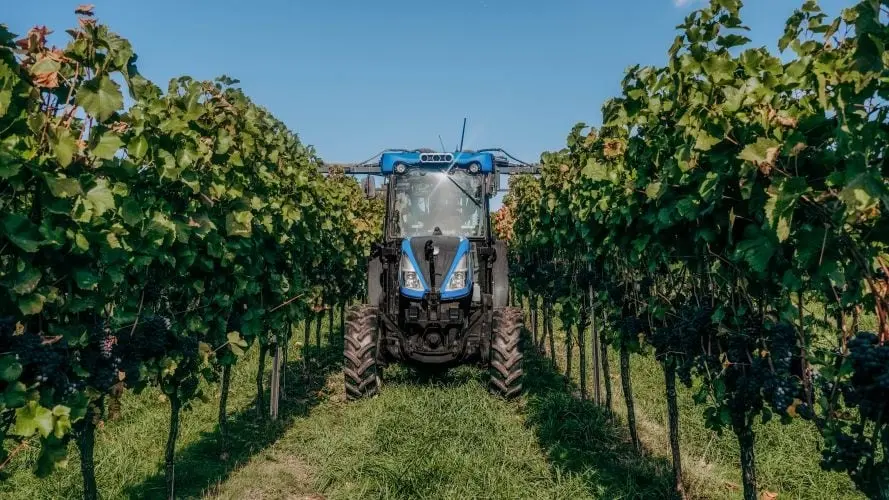
To bridge this technological gap, global technology leader Hexagon used the prestigious EIMA International exhibition in Bologna, Italy, to unveil Senvisio, an advanced, vision-based steering system engineered specifically for permanent crops. Unlike traditional setups that rely entirely on orbital positioning, Senvisio harnesses tractor-mounted cameras and cutting-edge onboard computer vision processing to detect crop rows in real time. By utilizing the physical environment—trunks, vines, trellis posts, and canopy edges—as its primary navigational map, the system frees agricultural machinery from the constraints and dropouts of satellite guidance.
Scheduled for a commercial launch in 2027, Senvisio represents a pivotal shift in agricultural robotics and automation. Designed for both factory integration on new machinery and retrofit installation on existing tractor fleets, the technology promises to ease operator fatigue, optimize chemical and fertilizer applications, and dramatically minimize costly infrastructure damage. This report provides an in-depth analysis of the technological challenges facing specialty crop automation, how vision-based navigation works, market implications, and what the future holds for autonomous agriculture.
Detailed Chronology: The Evolution of Specialty Crop Navigation
The Satellite Era and Its Blind Spots
For the past three decades, precision agriculture has been synonymous with GNSS. Tractor manufacturers spent billions of dollars perfecting auto-steer systems that rely on constellations of orbiting satellites to centimeter-level accuracy. For cereal, corn, and soybean producers operating in wide-open expanses under unobstructed skies, these systems became indispensable tools for reducing overlap, saving fuel, and lowering input costs.
However, as machinery manufacturers attempted to scale these same GNSS-based solutions down to specialty crops—where permanent installations, dense, overlapping tree canopies, anti-hail overhead netting, and narrow row spacings are the norm—they ran into a brick wall. Satellite signals degrade rapidly when blocked by thick foliage or physical structures. Multipath interference, where satellite signals bounce off tree trunks or trellis wires before reaching the receiver, creates positioning errors that can cause a multi-ton tractor to veer off course, destroying high-value crops or damaging expensive irrigation lines.
The Rise of Multi-Sensor Fusion
Recognizing the limitations of pure GNSS, the agricultural technology sector gradually shifted toward sensor fusion. Engineers began combining satellite positioning with inertial measurement units (IMUs), LiDAR (Light Detection and Ranging), and radar. While these sensors improved environmental awareness, they often came with significant trade-offs: prohibitive hardware costs, complex calibration procedures, and heavy reliance on pre-mapped field data.
The Unveiling at EIMA International
The introduction of Hexagon Senvisio at EIMA International marks a maturation point in this technological evolution. Rather than viewing cameras merely as auxiliary safety devices, Hexagon positioned computer vision as the primary navigation engine. Developed entirely in-house by Hexagon’s Agriculture Division, Senvisio dispenses with the need for pre-mapped fields, guiding lines, or continuous satellite connectivity. By shifting processing power directly to the onboard computer, the system interprets the physical reality of the orchard or vineyard layout instantly, charting a safe, repeatable course down the exact center of the row.
Supporting Context & Metrics: The Mechanics of Vision-Based Steering
Inside the Technology: How Senvisio Operates
At its core, Hexagon Senvisio is an exercise in applied edge computing and machine learning. The system configuration involves a specialized arrangement of ruggedized, tractor-mounted cameras positioned to capture the immediate front and side environments of the machinery.
As the tractor moves through the field, the onboard computer vision processor analyzes the incoming video feeds in real time. The software is trained to identify and categorize specific structural components of the agricultural landscape:
- Trunks and Vines: Acting as primary spatial anchors, these organic pillars define the boundaries of the row.
- Trellis Posts: Man-made vertical supports that provide rigid geometric markers for alignment.
- Canopy Edges: The volumetric boundary where foliage meets open air, allowing the algorithm to gauge clearance and row width dynamically.
By synthesizing these visual inputs, the system calculates the optimal trajectory for the vehicle, sending steering corrections directly to the tractor’s hydraulic or electric steering interface.
Overcoming the "Cognitive Overload" of Permanent Crops
Operating a tractor through multi-kilometer rows of trellised vines or densely planted fruit trees requires relentless concentration. Unlike a straight pass across a Kansas wheat field, specialty crop management demands constant micro-adjustments to account for undulating terrain, variable canopy growth, and obstacles.
Industry metrics highlight that operators spending eight to ten hours a day managing implements in orchards suffer from severe cognitive fatigue, which directly correlates with higher error rates, missed spots during spraying, and accidental collisions with infrastructure. By automating the tracking process, Senvisio ensures consistent machine positioning, allowing operators to focus on monitoring implement performance, managing application rates, and ensuring overall safety.
Mitigating Economic and Environmental Risk
The financial stakes in specialty crop farming are exceptionally high. A single mistake by an exhausted operator—such as clipping a concrete end-post with a rotary mower or stripping a mature branch laden with high-value apples—can cost thousands of dollars in equipment repairs and lost yield. Furthermore, accidental impacts with subsurface or hanging irrigation systems can disrupt water delivery to entire blocks of crops.
By leveraging real-time visual feedback to maintain a strict, unwavering centerline, Senvisio minimizes the risk of mechanical contact with plants and supports. This precision not only preserves long-term capital investments in orchard infrastructure but also optimizes the deployment of agrochemicals, ensuring that sprayers and fertilizer applicators maintain a uniform distance from the crop foliage for maximum efficacy.
Official Statements and Industry Perspective
The commercial rationale behind Senvisio was underscored by leadership at Hexagon, who emphasized the human and operational challenges of specialty farming.
“For a vineyard or orchard operator, keeping a machine centred through long, narrow rows takes sustained concentration,” noted Eric Wuestefeld, President of Hexagon’s Agriculture Division.
Reinforcing the core philosophy of the new platform, Wuestefeld added: “Senvisio uses the crop row itself to guide the machine.”
Agricultural economists and machinery analysts have praised the strategic timing of the release. As labor shortages continue to plague the agricultural sector globally, technologies that reduce the skill barrier required to operate complex machinery are in unprecedented demand. By making sophisticated auto-steering accessible in environments where GNSS traditionally fails, Hexagon is opening up high-value permanent crop sectors to the productivity gains long enjoyed by broadacre grain producers.
Furthermore, industry observers note that Hexagon’s dual approach—offering Senvisio for both factory integration and aftermarket retrofitting—broadens its market reach. Farmers do not necessarily have to invest in an entirely new fleet of tractors to benefit from the technology; compatible existing machinery can be upgraded in the workshop, drastically shortening the return-on-investment (ROI) timeline.
Future Outlook: The Road to 2027 and Beyond
The Commercialization Roadmap
With the official unveiling completed at EIMA International, Hexagon has set its sights on a commercial rollout by 2027. The intervening years will be critical for field testing, software refinement, and certification across various tractor models and implement types. Field trials across diverse geographical regions—ranging from the narrow, steep-slope terraced vineyards of Europe to the sprawling, mechanized citrus groves of the Americas and Australia—will ensure the computer vision algorithms can adapt to vastly different agricultural topologies and lighting conditions.
The Convergence of Autonomy and AI
Looking further into the future, systems like Senvisio represent stepping stones toward fully autonomous, unmanned orchard and vineyard operations (often referred to as "dark farming"). While current iterations are designed to assist human operators by handling the tedious task of steering, the underlying computer vision and edge processing architectures are inherently scalable.
As artificial intelligence models become more robust, the visual data gathered by systems like Senvisio could soon be integrated with real-time crop health monitoring, yield prediction algorithms, and selective micro-spraying applications. Imagine a tractor that not only navigates a dense apple orchard autonomously without satellite guidance, but simultaneously scans every individual fruit for disease or ripeness, adjusting chemical applications or harvesting mechanisms on the fly.
Conclusion
Hexagon’s unveiling of Senvisio marks a watershed moment for specialty crop mechanization. By breaking away from absolute reliance on vulnerable satellite signals and turning the crop row itself into a living navigational map, the company has addressed one of the most persistent bottlenecks in agricultural automation. As the industry marches toward the 2027 commercial release, technologies like Senvisio promise to make permanent crop farming safer, more precise, and fundamentally more resilient in the face of labor challenges and environmental complexities.