
Executive Overview
In the realm of modern companion animal care, routine medical maintenance—ranging from daily eye treatments to nail trims and ear cleanings—frequently serves as a profound source of stress for both pets and their human guardians. When Skip, affectionately known as Fabio or Mr. Wonderful, was diagnosed with pannus (a progressive, immune-mediated inflammatory disease of the cornea that can lead to irreversible blindness if left unmanaged), his daily prognosis hinged on a challenging medical regime: a daily application of Optimmune® ointment into both eyes for the remainder of his life.
While liquid eye drops present a straightforward delivery method, high-viscosity ophthalmic ointments demand precise, close-range administration that can easily trigger defensive or fearful responses in dogs. To bridge the gap between necessary medical compliance and emotional well-being, the integration of positive reinforcement methodology—specifically, Chirag Patel’s renowned "Bucket Game"—has transformed a potentially traumatic veterinary chore into a cooperative, stress-free exercise in animal autonomy.
This report explores the intersection of veterinary medicine, animal behavior science, and cooperative care. By examining Skip’s ongoing medical protocol, the foundational mechanics of the Bucket Game, and broader community experiences with animal husbandry, this article highlights a critical paradigm shift: moving away from physical restraint and coercion toward a framework centered on animal agency, patience, and mutual trust.
Detailed Chronology: From Diagnosis to Daily Protocol
The journey toward cooperative eye care for Skip began during a routine monthly chiropractic evaluation administered by Dr. Sara Greenslit of Anshen Holistic Vet Care. During the assessment, Dr. Greenslit identified early indicators of pannus.

Understanding the Medical Condition
Pannus is a chronic corneal disease characterized by cellular infiltration and blood vessel proliferation across the surface of the eye. Particularly prevalent in genetically predisposed breeds such as German Shepherds, Greyhounds, and Border Collies, the condition requires lifelong daily management to suppress immune-mediated inflammation. Without consistent intervention, the condition steadily advances, culminating in total vision loss.
The prescribed treatment, Optimmune® (a 0.2% cyclosporine ophthalmic ointment), presents a distinct mechanical challenge. Unlike liquid solutions that can be instilled rapidly from a distance, an ointment requires direct contact with the ocular surface or conjunctival sac, necessitating close proximity and physical manipulation of the animal’s eyelids.
The Implementation of the Bucket Game
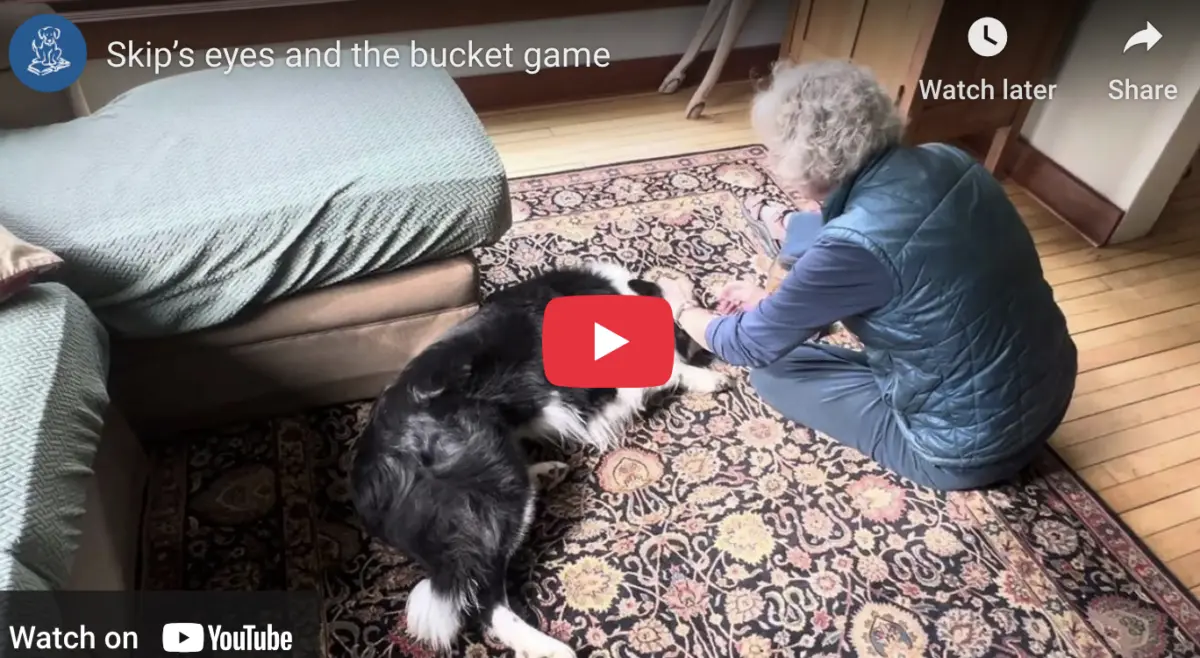
Recognizing that forced administration would erode trust and induce chronic stress, a gradual desensitization program was initiated utilizing Chirag Patel’s Bucket Game framework. Over a span exceeding one year, the behavior was systematically shaped into micro-steps:
- Orientation and Association: Initially, the dog was conditioned to lie down and direct its focus toward a stationary bucket in exchange for high-value reinforcement.
- Postural Shaping: The behavior was expanded to include lying flat on one side with the head resting flush against the floor.
- Environmental Stability: The dog was conditioned to maintain this relaxed posture while human hands gently manipulated the periorbital tissue and opened the eyelids.
- Final Administration: Only after fluid generalization across various contexts was the actual tube of ointment introduced, ensuring the animal remained entirely voluntary throughout the process.
Even when relocated to unfamiliar environments—such as a living room setup under observation—the combination of Skip’s biddable disposition and the structural predictability of the Bucket Game allowed the medical protocol to be executed seamlessly without behavioral regression or anxiety indicators.

Supporting Context & Metrics: Animal Agency and Behavioral Science
The core philosophy underlying the Bucket Game is animal agency—the fundamental capacity of a sentient being to make choices that directly influence its environment and outcomes. In behavioral science, providing an animal with an explicit "opt-out" mechanism is one of the most powerful tools available to mitigate fear-based aggression and learned helplessness.
The Mechanics of Autonomy
In traditional veterinary husbandry, restraint is often default. Animals are held down while procedures are forced upon them. While this may achieve short-term medical compliance, it exacts a severe psychological toll, frequently escalating defensive reactivity during subsequent encounters.
Conversely, the Bucket Game operates on a continuous consent model:
- The Invitation: The human presents the readiness cue or positions the treatment tool.
- The Choice: As long as the dog maintains its head position on the bucket, the procedure proceeds.
- The Withdrawal: The instant the dog lifts its head, breaks contact, or displays subtle stress signals (such as a tongue flick or averted gaze), the human immediately freezes, withdraws their hands, and removes the stimulus.
By demonstrating that movement away from the stimulus results in the immediate cessation of the pressure, the animal learns that it possesses true control over its bodily integrity. Consequently, animals frequently choose to re-engage with the task voluntarily.

Broadening Application: Nail Care and Beyond
The utility of cooperative care extends far beyond ophthalmic maintenance. Similar behavioral shaping protocols have proven vital for managing high-stress maintenance tasks like nail trimming. For instance, dogs presenting with severe tactile sensitivity regarding their paws—such as rescued dogs experiencing acute anxiety during nail maintenance—can be systematically conditioned using desensitization and counter-conditioning.
Splitting complex multi-step tasks into isolated components is paramount:
- Paw Handling: Desensitizing the dog to touch, holding, and mild pressure on individual digits independently of any trimming tool.
- Auditory Habituation: Introducing the acoustic profile of motorized rotary tools (such as a Dremel) at a distance, paired unconditionally with high-value primary reinforcers, long before the device makes physical contact with the nail.
- Patience Metrics: Proceeding at a pace dictated strictly by the animal’s threshold, prioritizing long-term emotional stability over immediate completion speed.
Official Statements and Community Perspectives
The veterinary and professional training community increasingly advocates for the formal integration of cooperative care protocols into standard clinical practice and home-management strategies.
Dr. Sara Greenslit emphasizes the importance of early detection in immune-mediated corneal conditions: "Routine wellness checks, encompassing chiropractic and comprehensive physical evaluations, remain our primary defense in catching progressive degenerative conditions before they inflict irreversible damage. However, early diagnosis is only half the battle; sustainable home management relies entirely on minimizing the psychological friction of daily treatments."

Behavioral advocates underline that successful husbandry training requires abandoning rigid timelines in favor of individualized, responsive decision-making. Because animal responses fluctuate based on environmental stimuli, physical comfort, and historical associations, rigid, generic training advice often fails. Certified behavior consultants stress that practitioners must learn to read micro-expressions—such as tension in the masseter muscles, changes in respiration rate, or subtle avoidance behaviors—and adjust their criteria dynamically.
Community Dialogue: Successes and Challenges
Opening the floor to community-sourced husbandry experiences reveals a spectrum of domestic challenges and triumphant resolutions:
- The Pacing Paradox: Many guardians struggle with knowing precisely when to advance to the next training step versus when to regress. The consensus among positive reinforcement trainers is clear: when in doubt, slow down and simplify the criteria.
- Consistency Over Intensity: Short, daily, low-pressure training sessions yield exponentially better long-term compliance than sporadic, high-stress marathons.
- Tool Separation: Separating the emotional baggage of a tool (like a nail grinder or an ointment tube) from the physical act of handling allows animals to process each variable independently.
Future Outlook: The Evolution of Stress-Free Veterinary Husbandry
As public awareness surrounding animal welfare and sentience expands, the paradigm of veterinary care is undergoing a fundamental transformation. The era of managing reluctant pets through sheer physical restraint is steadily giving way to an era of collaborative, fear-free medicine.
Future Trajectories in Companion Animal Care
- Curriculum Integration: Veterinary medicine and veterinary technician programs are placing an increased emphasis on low-stress handling, behavioral body language, and cooperative care techniques as core competencies.
- Client Education Initiatives: Clinics and holistic practices are increasingly partnering with certified professional dog trainers to offer proactive "husbandry classes," educating pet owners on how to condition their animals for medical procedures before injuries or chronic illnesses occur.
- Technological and Pharmaceutical Innovations: Continued development of longer-acting therapeutics, improved drug delivery systems (such as sustained-release ophthalmic inserts), and stress-mitigating nutraceuticals will further ease the burden of chronic disease management.
Ultimately, integrating methods like the Bucket Game into daily life proves that medical compliance and emotional well-being are not mutually exclusive. By honoring an animal’s need for autonomy, treating them with profound patience, and breaking complex challenges down into manageable, positive steps, guardians can ensure both the physical health and the psychological peace of their animal companions for years to come.