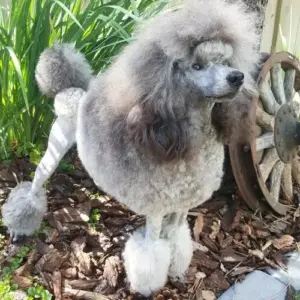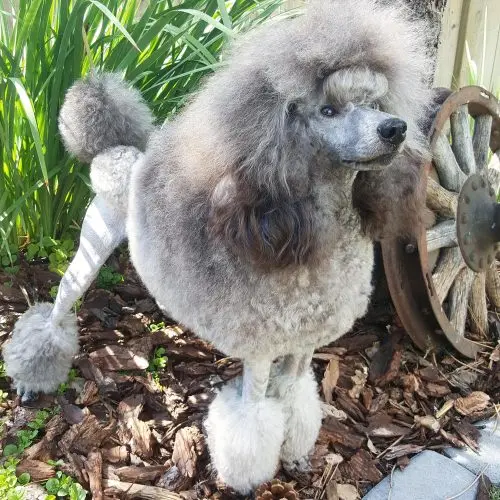

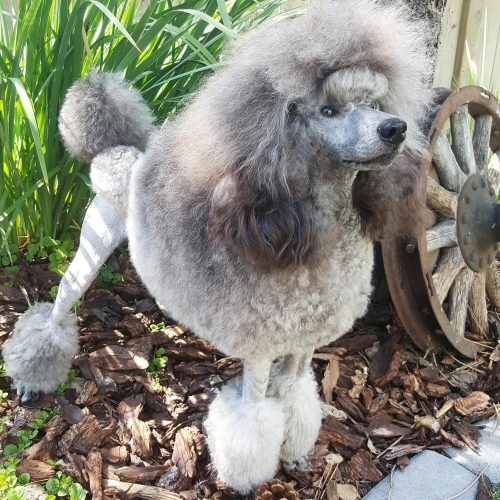
For pet owners navigating the increasingly complex labyrinth of modern commercial aviation, the challenge of traveling with a tall dog has historically presented a formidable barrier. Airline cabin regulations are famously stringent, strictly dictating the maximum dimensions of under-seat pet carriers while offering little accommodation for animals that exceed standard height thresholds. When pet enthusiast and professional dog groomer Keri faced this exact dilemma with Flint—her tall, long-legged miniature poodle endowed with a massive, high-volume coat—she encountered a chorus of skepticism. Industry insiders and fellow travelers warned that Flint’s dimensions would inevitably disqualify him from in-cabin transit, forcing him into the cargo hold.
Refusing to accept cargo-hold placement for her companion, Keri embarked on an innovative, meticulously researched travel experiment. Rather than capitulating to standard equipment limitations, she engineered a custom-tailored modification of an off-the-shelf pet carrier. Her journey spanned multiple aircraft models within Air Canada’s fleet, including the Embraer 175, Embraer 190, Airbus A320-200, and the Bombardier Q400 turboprop.
This report details Keri’s exhaustive trial-and-error selection process, her bold engineering interventions with heavy-duty bolt cutters, and the practical realities of maneuvering an expandable carrier through the tight confines of modern regional and mainline jets. By documenting every phase of her preparation and execution, this article provides an authoritative blueprint for pet owners seeking to safely transport larger-than-average canine companions inside the aircraft cabin.
Detailed Chronology: From Selection to Modification and Flight
Phase 1: Carrier Evaluation and Selection
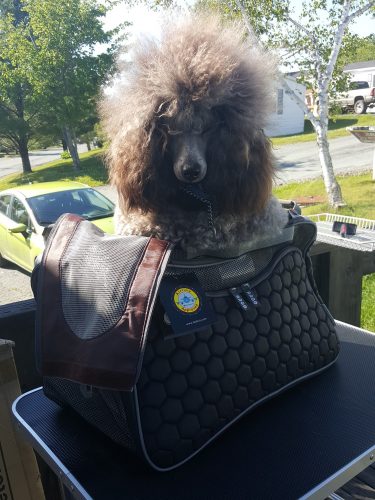
With a strict one-month countdown before her scheduled itinerary on Air Canada, Keri initiated a comprehensive market analysis of available in-cabin pet carriers. Her primary design requirements were simple yet rigorous: the carrier needed to accommodate a tall, long-legged canine without violating overhead or under-seat constraints, while permitting the dog to enter and exit unassisted.
Initial in-store evaluations of popular models proved discouraging. The Large Sherpa carrier (measuring 19 inches long by 11.75 inches wide by 11.5 inches high) and the Large Bergan carrier (19 inches long by 10 inches wide by 13 inches high) were systematically ruled out due to internal volume restrictions that would force Flint into an uncomfortably cramped posture.
Turning to online specialty retailers, Keri ordered two distinct models for side-by-side comparative testing:
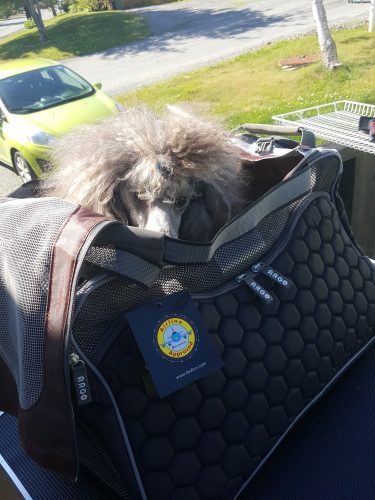
- The Argo by Teafco Petagon Carrier: Measuring 21 inches long, 12 inches wide, and 13 inches high, this carrier represented the pinnacle of premium construction. Keri noted that it was arguably the most robustly engineered carrier on the market, featuring privacy-enhancing reflective tape, ample storage pockets, and superior textiles. However, structural drawbacks quickly emerged. Flint exhibited clear resistance to entering the unit. Furthermore, the inclusion of an internal cooling-tray insert reduced vertical clearance, while the tight zipper clearance continually caught his voluminous hair.
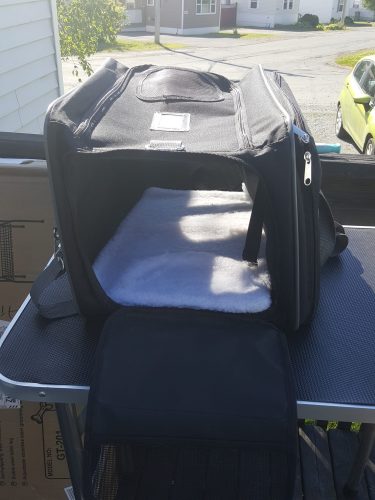
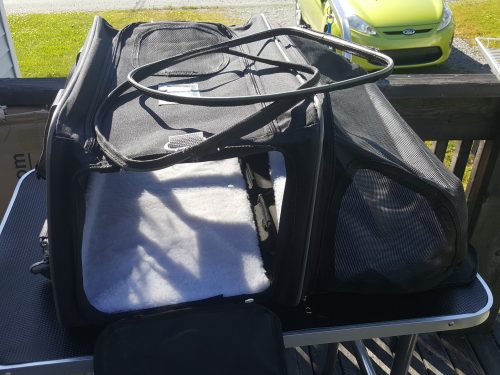
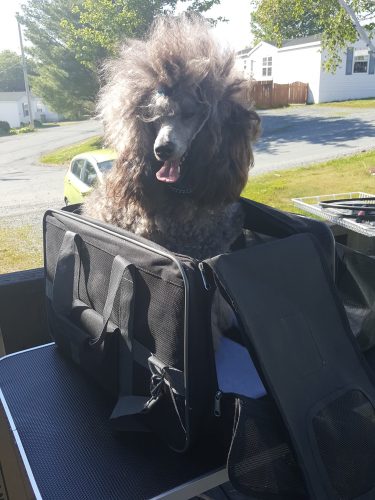
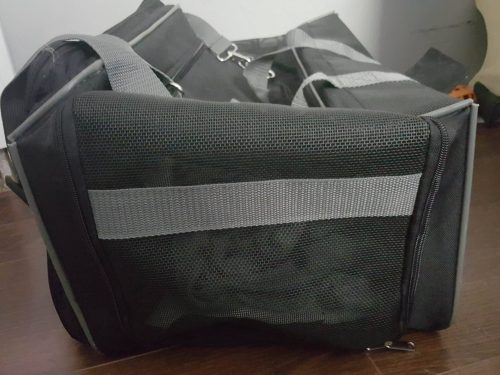
- The Large Pettom Expandable Foldable Travel Carrier: Measuring 19 inches long by 12 inches wide by 12 inches high (with an expandable "pup tent" side that stretches the width to 22.5 inches), this budget-friendly alternative immediately won Flint’s approval. Featuring dual zippered ends, the Pettom allowed the poodle to walk in under his own volition. Although constructed from noticeably cheaper materials than the Argo—prompting necessary reinforcement of the shoulder strap via heavy-duty metal carabiners—the Pettom’s expandable mesh side offered the exact spatial advantage required for long canine limbs.
Phase 2: Radical Engineering and Structural Modification
Recognizing that the Pettom carrier’s rigid frame components could cause structural jamming under the variable clearance of aircraft seats, Keri undertook a bold modification plan.
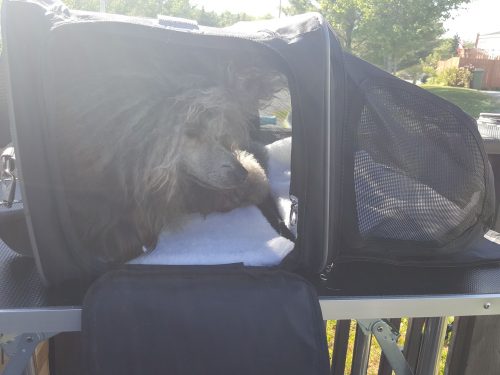
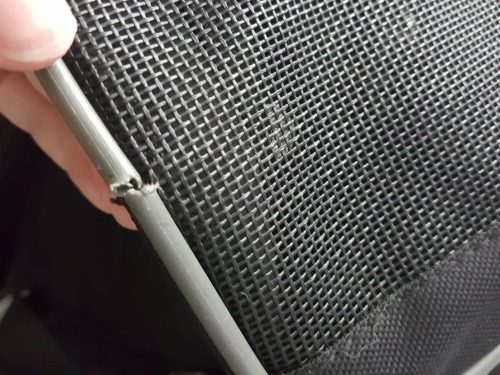
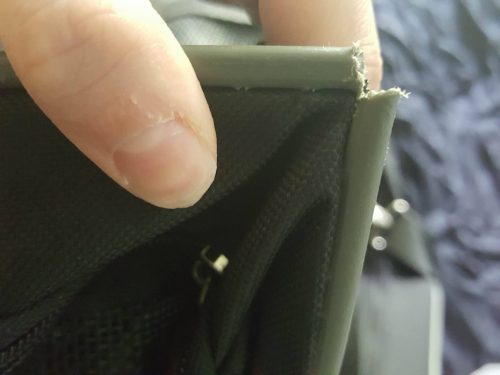
First, she removed the zippered-in supports for the expandable section, correctly identifying that a moving dog could easily catch a foot in the rigid internal bracing. More significantly, she addressed the carrier’s vertical rigidity. To ensure the carrier could compress safely beneath low-clearance seats without trapping or injuring the animal, she used bolt cutters to sever the four primary wire frame supports running around the kennel.
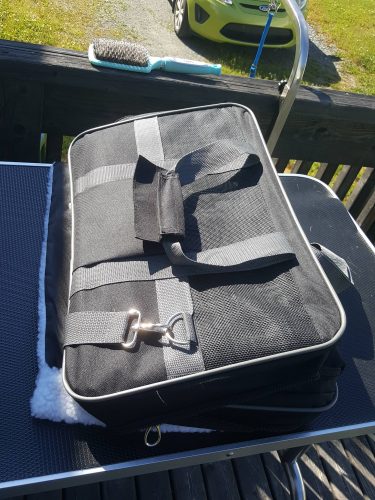
Exercising extreme precision to avoid lacerating the surrounding mesh fabric and structural textiles, she executed cuts at the 9-inch mark. This alteration introduced controlled flexibility: the sidewalls could now fold inward and slope downward when empty, yet naturally reassert their protective framework as the dog shifted weight inside. (Safety advisory: Subsequent field testing revealed that exposed metal wire ends required protective taping or filing to prevent accidental abrasions to human limbs during transit).
Phase 3: Behavioral Desensitization and Veterinary Clearance
Recognizing that physical comfort in a confined space requires psychological preparation, Keri instituted a structured three-week desensitization protocol:
- Week 1: The modified carrier was placed in a central living area with the doors permanently open. Treats were tossed inside continuously to establish positive reinforcement, encouraging Flint to enter and exit freely.
- Week 2: Short, incremental closures of the zippers were introduced while keeping the carrier stationary and close to Keri’s feet.
- Week 3: Flint was transitioned to spending his afternoon naps (averaging one hour per session) zipped inside the carrier while positioned directly against Keri’s feet, accompanied by verbal praise and high-value rewards.
Because Flint routinely accompanied Keri to her workplace as a professional dog groomer—where he was accustomed to spending hours inside standard holding kennels—his baseline stress levels were relatively low. To preempt any regulatory pushback from airline check-in agents or gate personnel, Keri took the precautionary step of presenting the modified carrier during a routine veterinary examination. The attending veterinarian formally evaluated the setup and issued a written letter confirming that the carrier was appropriately sized and safe for Flint’s physiological dimensions.
Supporting Context & Metrics: Fleet-by-Fleet Flight Performance
Keri’s travel itinerary comprised four distinct aircraft types operated by Air Canada. Each flight offered unique spatial parameters, seating configurations, and under-seat obstructions.
+-------------------+-------------------+--------------------+------------------------+
| Aircraft Model    | Seat Pitch (in.)  | Seat Width (in.)   | Carrier Deployment     |
+-------------------+-------------------+--------------------+------------------------+
| Embraer 175       | 32 - 34           | 18                 | Fully expanded (floor) |
| Airbus A320-200   | 35 (Preferred)    | 17.8               | Half-deployed (tent)   |
| Embraer 190       | 31 - 33           | 18                 | Expanded over feet     |
| Bombardier Q400   | 31                | 17                 | Unexpanded (stowed)    |
+-------------------+-------------------+--------------------+------------------------+
1. Embraer 175 (Economy Window Seat)
- Flight Duration: Approximately 2 hours.
- Cabin Metrics: Seat pitch ranged from 32 to 34 inches; seat width was 18 inches in a 2-by-2 configuration.
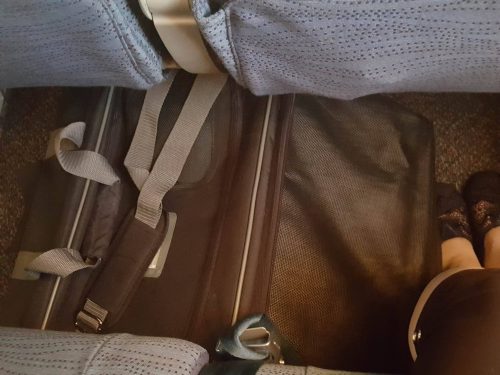
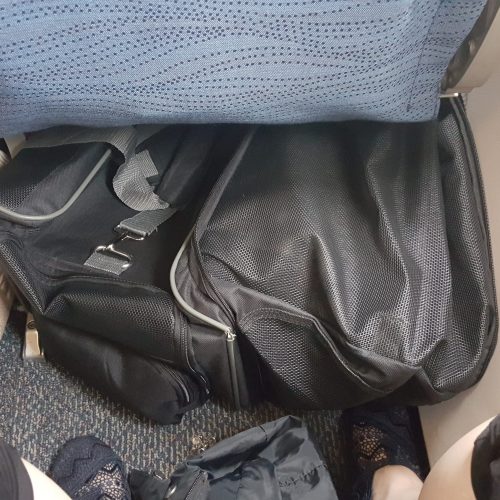
- Performance: Flint vocalized intermittently during the pre-boarding and taxi phases but fell silent immediately upon takeoff. Benefiting from an empty adjacent seat, Keri pulled the carrier out from beneath the seat post-takeoff and fully deployed the mesh expansion into the adjacent footwell, maximizing spatial relief.
2. Airbus A320-200 (Preferred Seating Window Seat)
- Flight Duration: Approximately 5 hours.
- Cabin Metrics: Preferred seating offered an enhanced seat pitch of 35 inches and a seat width of 17.8 inches.
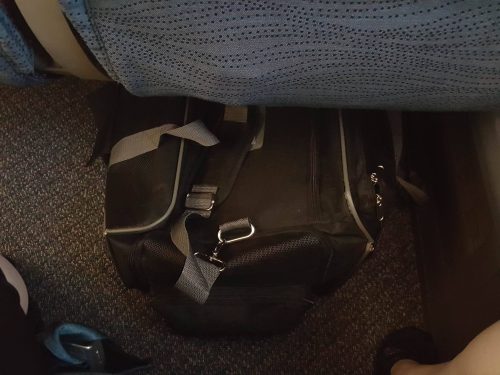
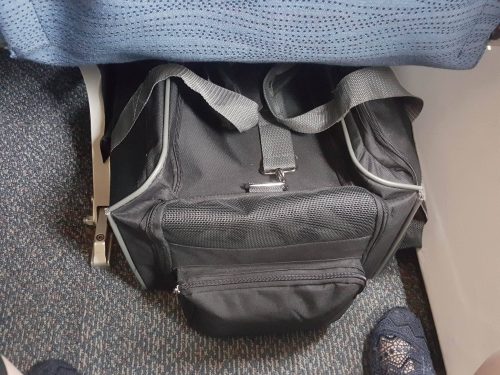
- Performance: Given the full passenger load, Keri invested in a Preferred Seating upgrade to secure additional legroom. The carrier was pushed as far back as possible and tilted slightly to accommodate the aircraft’s under-seat structural bars, with the expandable pup-tent section half-deployed during cruise flight.
3. Embraer 190 (Economy Seat)
- Flight Duration: Approximately 4 hours (Return Leg).
- Cabin Metrics: Seat pitch compressed to 31–33 inches with an 18-inch width.
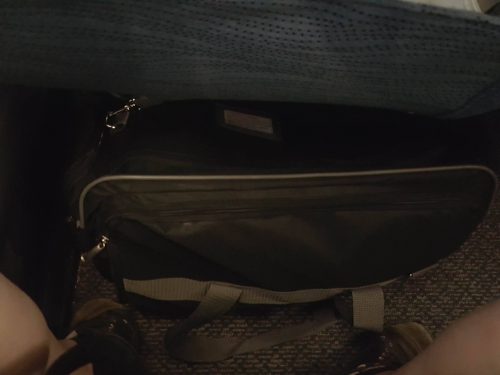
- Performance: The carrier was loaded in a horizontal orientation to accommodate a neighbor’s carry-on luggage encroachment. Post-takeoff, Keri unzipped the mesh tent to allow the expansion to rest comfortably over her feet, retracting the structure entirely prior to the final descent phase.
4. Bombardier Q400 Turboprop (Economy Window Seat)
- Flight Duration: Approximately 2 hours.
- Cabin Metrics: The most restrictive environment encountered, featuring a tight 31-inch pitch and a narrow 17-inch width.
- Performance: Due to the severe spatial limitations characteristic of regional turboprop configurations, the carrier remained fully closed and stowed beneath the seat for the duration of the flight. Flint occupied the unexpanded footprint without incident, though Keri noted that a longer daytime flight on this aircraft would have necessitated a seat upgrade.
Official Guidelines & Regulatory Considerations
Commercial airlines maintain distinct, non-negotiable safety standards regarding in-cabin animal transport. While specific dimensions vary by carrier, standard regulations dictate that soft-sided carriers must be flexible enough to compress approximately two inches without compromising the structural integrity required to protect the animal.
Key regulatory compliance checkpoints observed during Keri’s journey include:
- The "Stand and Turn" Rule: Most international carriers require that a pet be able to stand up, turn around, and lie down naturally inside the closed carrier. For tall breeds like miniature poodles, this often creates a regulatory gray area, as vertical head clearance is frequently restricted. Veterinary endorsement letters and structured desensitization training serve as critical risk-mitigation tools during gate inspections.
- Timing of Expansion: Airline policy universally dictates that expandable carriers must remain fully zipped and closed during taxi, takeoff, landing, and turbulence. Expansion features are strictly permissible only during stable, in-flight cruising phases and must never obstruct emergency egress paths for neighboring passengers.
- Terminal Infrastructure: A recurring logistical hurdle identified during the journey was the absence of designated animal relief areas within secure airside terminals. Travelers should anticipate navigating back to public arrivals areas or utilizing human restroom facilities during brief layovers to manage pet biological needs.
Future Outlook & Industry Implications
Keri’s successful deployment of a heavily modified, budget-friendly pet carrier across a diverse regional and mainline aircraft fleet challenges conventional industry assumptions regarding pet travel limitations. For decades, owners of larger toy breeds, miniature poodles, terriers, and mixed-breed rescues have been systematically priced out or logistically barred from cabin travel due to rigid manufacturer specifications and overly conservative airline enforcement.
The success of the modified Pettom carrier points toward several emerging trends in the pet travel ecosystem:
- Demand for Modular Design: Consumers are increasingly looking past static, rigid-frame pet luggage in favor of modular, adaptable systems that can dynamically reconfigure to match the erratic geometries of varying aircraft seating structures.
- Post-Market Modification: As demonstrated by Keri’s employment of bolt cutters and precise fabric preservation, enterprising pet owners are increasingly willing to take equipment modification into their own hands to bridge the gap between commercial manufacturing standards and real-world biomechanical needs.
- Aviation Policy Evolution: As pet ownership rates continue to surge globally, pressure mounts on commercial airlines to harmonize cabin carrier dimensions and provide clearer accommodations for non-traditional pet sizes, potentially inspiring manufacturers to design natively flexible, airline-compliant carriers that do not require home-shop alterations.
Ultimately, Keri’s meticulous preparation, combined with a willingness to challenge standard equipment limitations, proves that traveling with a long-legged canine companion is entirely feasible. With proper behavioral conditioning, veterinary documentation, and a willingness to adapt hardware to meet spatial realities, the skies remain open to pets of all shapes and sizes.